Extra Credit HESI Module 10
1. Questions
1. 1.ID: 9476932222
A nurse is assigned to care for four clients on the medical-surgical unit. Which
client should the nurse see first on the shift assessment?
A. A client ad
...
Extra Credit HESI Module 10
1. Questions
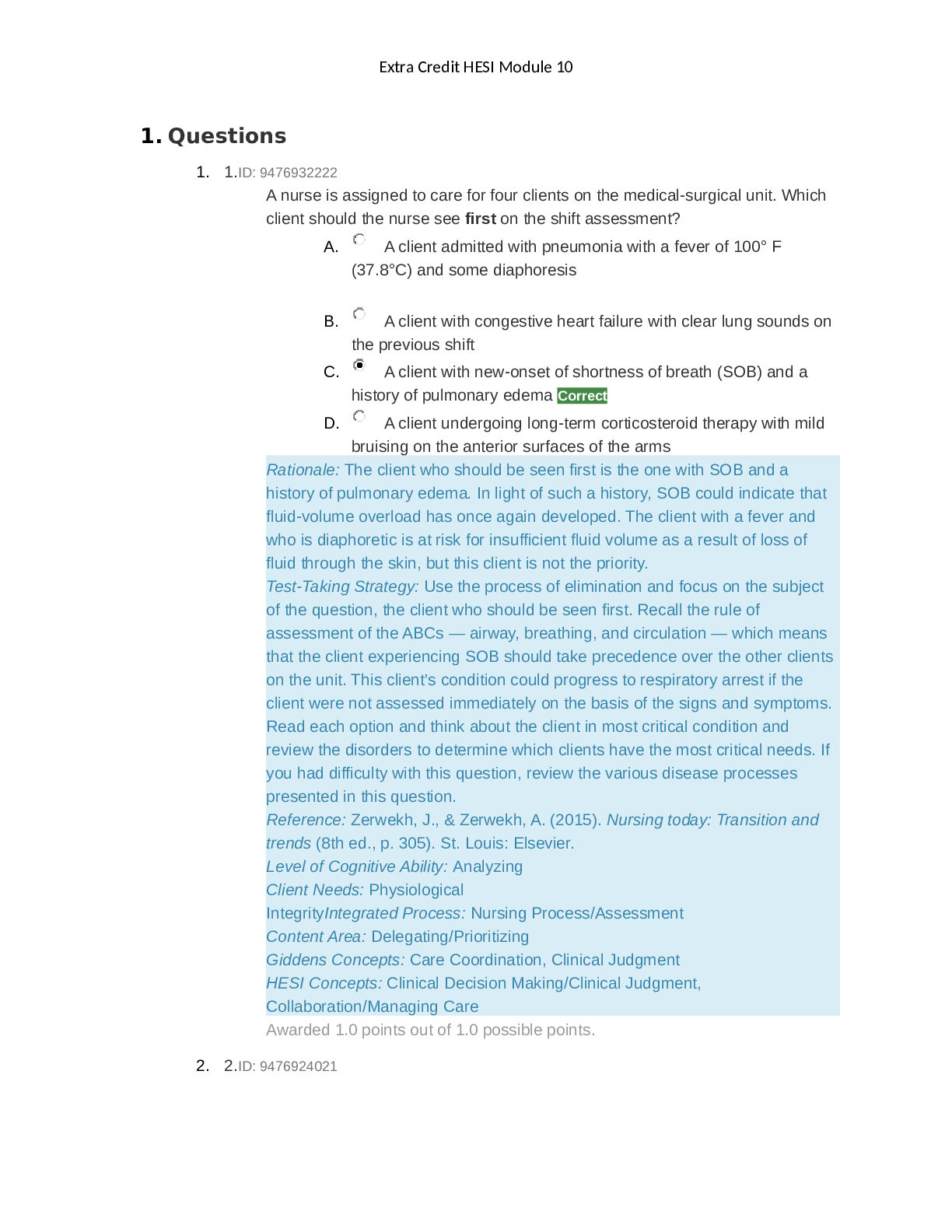
1. 1.ID: 9476932222
A nurse is assigned to care for four clients on the medical-surgical unit. Which
client should the nurse see first on the shift assessment?
A. A client admitted with pneumonia with a fever of 100° F
(37.8°C) and some diaphoresis
B. A client with congestive heart failure with clear lung sounds on
the previous shift
C. A client with new-onset of shortness of breath (SOB) and a
history of pulmonary edema Correct
D. A client undergoing long-term corticosteroid therapy with mild
bruising on the anterior surfaces of the arms
Rationale: The client who should be seen first is the one with SOB and a
history of pulmonary edema. In light of such a history, SOB could indicate that
fluid-volume overload has once again developed. The client with a fever and
who is diaphoretic is at risk for insufficient fluid volume as a result of loss of
fluid through the skin, but this client is not the priority.
Test-Taking Strategy: Use the process of elimination and focus on the subject
of the question, the client who should be seen first. Recall the rule of
assessment of the ABCs — airway, breathing, and circulation — which means
that the client experiencing SOB should take precedence over the other clients
on the unit. This client’s condition could progress to respiratory arrest if the
client were not assessed immediately on the basis of the signs and symptoms.
Read each option and think about the client in most critical condition and
review the disorders to determine which clients have the most critical needs. If
you had difficulty with this question, review the various disease processes
presented in this question.
Reference: Zerwekh, J., & Zerwekh, A. (2015). Nursing today: Transition and
trends (8th ed., p. 305). St. Louis: Elsevier.
Level of Cognitive Ability: Analyzing
Client Needs: Physiological
IntegrityIntegrated Process: Nursing Process/Assessment
Content Area: Delegating/Prioritizing
Giddens Concepts: Care Coordination, Clinical Judgment
HESI Concepts: Clinical Decision Making/Clinical Judgment,
Collaboration/Managing Care
Awarded 1.0 points out of 1.0 possible points.
2. 2.ID: 9476924021Extra Credit HESI Module 10
A client with gastroenteritis who has been vomiting and has diarrhea is
admitted to the hospital with a diagnosis of dehydration. For which clinical
manifestations that correlate with this fluid imbalance would the nurse assess
the client? Select all that apply.
A. Decreased pulse
B. Decreased urine output Correct
C. Increased blood pressure
D. Increased respiratory rate Correct
E. Decreased respiratory depth
Rationale: A client with dehydration has an increased depth and rate of
respirations. The diminished fluid volume is perceived by the body as a
decreased oxygen level (hypoxia), and increased respiration is an attempt to
maintain oxygen delivery. Other assessment findings in insufficient fluid volume
are decreased urine volume, increased pulse, weight loss, poor skin turgor, dry
mucous membranes, concentrated urine with increased specific gravity,
increased hematocrit, and altered level of consciousness. Increased blood
pressure, decreased pulse, and increased urine output occur with fluid-volume
overload.
Test-Taking Strategy: Use the process of elimination and focus on the subject,
dehydration (deficient fluid volume). Think about the pathophysiology of
deficient fluid volume. Remember that the body will increase the respiratory
rate in an attempt to maintain the oxygen level. If you had difficulty with this
question, review the signs of insufficient fluid volume.
Reference: Lewis, S., Dirksen, S., Heitkemper, M., & Bucher, L.
(2014). Medical-surgical nursing: Assessment and management of clinical
problems (9th ed., pp. 291-292). St. Louis: Mosby.
Level of Cognitive Ability: Analyzing
Client Needs: Physiological Integrity
Integrated Process: Nursing Process/Assessment
Content Area: Fluid and Electrolytes
Giddens Concepts: Clinical Judgment,Fluid and Electrolyte Balance
HESI Concepts: Clinical Decision Making/Clinical Judgment, Fluid and
Electrolytes
Awarded 2.0 points out of 2.0 possible points.
3. 3.ID: 9476934084
A nurse is reviewing the medical records of the clients to whom she is assigned
on the 7 am–7 pm shift. Which client will the nurse monitor most closely for
excessive fluid volume?
A. A 48-year-old client receiving diuretics to treat hypertension
B. A 35-year old client who is vomiting undigested food after
eatingExtra Credit HESI Module 10
C. An 85-year-old client receiving intravenous (IV) therapy at a
rate of 100 mL/hr Correct
D. A 65-year-old client with a nasogastric tube attached to low
suction following partial gastrectomy
Rationale: The older adult client receiving IV therapy at 100 mL/hr is at the
greatest risk for excessive fluid volume because of the diminished
cardiovascular and renal function that occur with aging. Other causes of
excessive fluid volume include renal failure, heart failure, liver disorders,
excessive use of hypotonic IV fluids to replace isotonic losses, excessive
irrigation of body fluids, and excessive ingestion of table salt. A client who is
receiving diuretics, vomiting, or has a nasogastric tube attached to suction is at
risk for deficient fluid volume.
Test-Taking Strategy: Read the question carefully, noting that it asks for the
client at risk for excessive fluid volume. Read each option and think about the
fluid imbalance that could occur in each situation; in the case of the incorrect
options, it is fluid-volume deficiency; the only option reflecting conditions that
could result in an excess is the correct option. If you had difficulty with this
question, review the causes of excessive fluid volume.
Reference: Lewis, S., Dirksen, S., Heitkemper, M., & Bucher, L.
(2014). Medical-surgical nursing: Assessment and management of clinical
problems (9th ed., pp. 291, 293). St. Louis: Mosby.
Level of Cognitive Ability: Analyzing
Client Needs: Physiological Integrity
Integrated Process: Nursing Process/Assessment
Content Area: Fluid and Electrolytes
Giddens Concepts: Care Coordination, Fluid and Electrolyte Balance
HESI Concepts: Collaboration/Managing Care, Fluid and Electrolytes
Awarded 1.0 points out of 1.0 possible points.
4. 4.ID: 9476926416
A nurse is caring for a client who is being treated for congestive heart failure
and has been assigned a nursing diagnosis of excessive fluid volume. Which
assessment finding causes the nurse to determine that the client’s condition
has improved?
A. Dyspnea
B. 1+ edema in the legs
C. Moist crackles in the lower lobes of the lungs
D. Weight loss of 4 lb (1.8 kg) in 24 hours
CorrectExtra Credit HESI Module 10
Rationale: One sign that excessive fluid volume is resolving is loss of body
weight. It is important to recall that 1 L of fluid weighs 1 kg, which equals 2.2 lb
(1 liter = 2.2 lb = 1 kg). The other options listed indicate that the client is
retaining fluid. Assessment findings associated with excessive fluid volume
include cough, dyspnea, rales or crackles, tachypnea, tachycardia, increased
blood pressure and bounding pulse, increased central venous pressure, weight
gain, edema, neck and hand vein distention, altered level of consciousness,
and decreased hematocrit. These symptoms must be reversed if the fluidvolume excess is to be resolved.
Test-Taking Strategy: Use the process of elimination and focus on the subject,
a sign that the client’s condition is improving. The only such finding is
decreasing body weight. If you had difficulty with this question, review the
assessment findings noted in excessive fluid volume and the signs that the
condition is resolving.
Reference: Lewis, S., Dirksen, S., Heitkemper, M., & Bucher, L.
(2014). Medical-surgical nursing: Assessment and management of clinical
problems (9th ed., pp. 292-293). St. Louis: Mosby.
Level of Cognitive Ability: Evaluating
Client Needs: Physiological Integrity
Integrated Process: Nursing Process/Evaluation
Content Area: Fluid and Electrolytes
Giddens Concepts: Clinical Judgment, Fluid and Electrolyte Balance
HESI Concepts: Clinical Decision Making/Clinical Judgment, Fluid and
Electrolytes
Awarded 1.0 points out of 1.0 possible points.
5. 5.ID: 9476930486
A nurse notes that a client has ST-segment depression on the
electrocardiogram (ECG) monitor. With which serum potassium reading does
the nurse associate this finding?
A. 3.1 mEq/L (3.1 mmol/L) Correct
B. 4.2 mEq/L (4.2 mmol/L)
C. 4.5 mEq/L (4.5 mmol/L)
D. 5.4 mEq/L (5.4 mmol/L)
Rationale: A serum potassium level below 3.5 mEq/L(3.5 mmol/L) is indicative
of hypokalemia, the most common electrolyte imbalance, which is potentially
life threatening. ECG changes in hypokalemia include peaked P waves, flat T
waves, a depressed ST segment, and prominent U waves. Readings of 4.5
mEq/L (4.5 mmol/L)and 4.2 mEq/L (4.2 mmol/L)are normal potassium levels;
5.4 mEq/L (5.4 mmol/L)indicates hyperkalemia.Extra Credit HESI Module 10
Test-Taking Strategy: Begin to answer this question by recalling the normal
range of values for serum potassium. Next it is necessary to know that STsegment depression occurs in hypokalemia. If you had difficulty with this
question, review the ECG changes that occur in hypokalemia.
Reference: Lewis, S., Dirksen, S., Heitkemper, M., & Bucher, L.
(2014). Medical-surgical nursing: Assessment and management of clinical
problems (9th ed., pp. 296, 791). St. Louis: Mosby.
Level of Cognitive Ability: Analyzing
Client Needs: Physiological Integrity
Integrated Process: Nursing Process/Analysis
Content Area: Fluid and Electrolytes
Giddens Concepts: Clinical Judgment, Fluid and Electrolyte Balance
HESI Concepts: Clinical Decision Making/Clinical Judgment, Fluid and
Electrolytes
Awarded 1.0 points out of 1.0 possible points.
6. 6.ID: 9476924035
A healthcare provider writes a prescription for the administration of intravenous
(IV) potassium chloride to a client with hypokalemia. What does the nurse plan
to do when preparing and administering this medication?
A. Insert a Foley catheter in the client
B. Prepare the client for insertion of a central IV line
C. Administer the medication with the use of a macrodrip IV
tubing set
D. Ensure that the medication is diluted in an appropriate amount
of normal saline solution Correct
Rationale: Potassium chloride administered IV must always be diluted in IV
fluid. Undiluted potassium chloride given IV can cause cardiac arrest. The
intramuscular and subcutaneous routes of administration are not
recommended because the medication cannot be adequately diluted for these
routes; toxicity could result if the medication is not adequately diluted.
Potassium chloride is never administered as a bolus (IV push) injection; an IV
push would result in sudden severe hyperkalemia, which could precipitate
cardiac arrest. Saline dilution is recommended, but dextrose is avoided
because it increases intracellular potassium shifting. Although urine output is
monitored carefully during administration, it is not necessary to insert a Foley
catheter unless this is specifically prescribed. The health care provider is
notified if the urinary output is less than 30 mL/hr. Potassium chloride should be
administered with the use of a controlled IV infusion device to avoid bolus
infusion and increased risk of cardiac arrest. A central IV line is not necessary;Extra Credit HESI Module 10
potassium chloride may be administered through a peripheral IV line.
Test-Taking Strategy: Use the process of elimination and note the strategic
words “intravenous potassium chloride.” Recalling that the medication must be
diluted will direct you to the correct option. If you had difficulty with this
question, review the guidelines for the administration of potassium chloride.
References: Gahart, B., & Nazareno, A. (2015). 2015 Intravenous
medications (31st ed., pp. 1009-1010). St. Louis: Mosby.
Level of Cognitive Ability: Analyzing
Client Needs: Physiological Integrity
Integrated Process: Nursing Process/Planning
Content Area: Pharmacology
Giddens Concepts: Clinical Judgment, Evidence
HESI Concepts: Clinical Decision Making/Clinical Judgment, Evidence Based
Practice/Evidence
Awarded 1.0 points out of 1.0 possible points.
7. 7.ID: 9476930409
A nurse notes that a client’s serum potassium level is 5.8 mEq/L(5.8 mmol/L).
The nurse interprets this as an expected finding in the client with:
A. Diarrhea
B. Wound drainage
C. Addison disease Correct
D. Heart failure being treated with loop diuretics
Rationale: A serum potassium level greater than 5.0 mEq/L (5.0
mmol/L)indicates hyperkalemia, and the nurse would report the finding to the
health care provider. Adrenal insufficiency (Addison disease) is a cause of
hyperkalemia. Other common causes of hyperkalemia include tissue damage,
such as that in burn injuries, renal failure, and the use of potassium-sparing
diuretics. The client with diarrhea or wound drainage or the client being treated
with diuretics is at risk for hypokalemia.
Test-Taking Strategy: Use the process of elimination. Eliminate the options that
are comparable or alike in that they all indicate that the client is experiencing
body fluid losses and therefore a loss of potassium. If you had difficulty with
this question, review the risk factors associated with hyperkalemia.
Reference: Reference: Lewis, S., Dirksen, S., Heitkemper, M., & Bucher, L.
(2014). Medical-surgical nursing: Assessment and management of clinical
problems (9th ed., pp. 296, 1211). St. Louis: Mosby.
Level of Cognitive Ability: Analyzing
Client Needs: Physiological IntegrityExtra Credit HESI Module 10
Integrated Process: Nursing Process/Analysis
Content Area: Fluid and Electrolytes
Giddens Concepts: Clinical Judgment, Fluid and Electrolyte Balance
HESI Concepts: Clinical Decision Making/Clinical Judgment, Fluid and
Electrolytes
Awarded 1.0 points out of 1.0 possible points.
8. 8.ID: 9476930444
A nurse is caring for a client experiencing hyponatremia who was admitted to
the medical-surgical unit with fluid-volume overload. For which clinical
manifestations of this electrolyte imbalance does the nurse monitor this
client? Select all that apply.
A. Slow pulse
B. Decreased urine output
C. Skeletal muscle weakness Correct
D. Hyperactive bowel sounds Correct
E. Hyperactive deep tendon reflexes
Rationale: Signs of hyponatremia include a rapid, thready pulse; skeletal
muscle weakness; diminished deep tendon reflexes; abdominal cramping and
hyperactive bowel sounds; increased urine output; headache; and personality
changes. The nurse must assess these changes from baseline. If muscle
weakness is detected, the nurse should immediately check respiratory
effectiveness, because ventilation depends on strength of the respiratory
muscles.
Test-Taking Strategy: Specific knowledge of the manifestations of
hyponatremia is needed to answer this question. Remember that muscle
weakness and hyperactive bowel sounds are characteristics of hyponatremia. If
you had difficulty with this question, review these clinical manifestations.
Reference: Ignatavicius, D., & Workman, M. (2013). Medical-surgical nursing:
Patient-centered collaborative care. (7th ed., pp. 181-182). St. Louis: Saunders.
Level of Cognitive Ability: Analyzing
Client Needs: Physiological Integrity
Integrated Process: Nursing Process/Assessment
Content Area: Fluid and Electrolytes
Giddens Concepts: Clinical Judgment, Fluid and Electrolyte Balance
HESI Concepts: Clinical Decision Making/Clinical Judgment, Fluid and
Electrolytes
Awarded 2.0 points out of 2.0 possible points.Extra Credit HESI Module 10
9. 9.ID: 9476938114
A nurse is monitoring a client with hyperparathyroidism for signs of
hypercalcemia. For which clinical manifestations, associated with this
electrolyte imbalance, does the nurse assess the client? Select all that apply.
A. Paresthesias
B. Muscle weakness Correct
C. Increased urine output Correct
D. Chvostek sign
E. Hyperactive deep tendon reflexes
Rationale: Signs of hypercalcemia include muscle weakness, diminished deep
tendon reflexes or an absence thereof, increased urine output, decreased
gastrointestinal motility, and increased heart rate and blood pressure.
Hyperactive deep tendon reflexes, the presence of the Chvostek sign, and
paresthesias are signs of hypocalcemia.
Test-Taking Strategy: Use the process of elimination, focusing on the subject,
signs of hypercalcemia. Note that all of the incorrect options are comparable or
alike in that they reflect hyperactivity of the neuromuscular system. Review the
assessment signs noted in hypercalcemia if you had difficulty with this
question.
Reference: Ignatavicius, D., & Workman, M. (2013). Medical-surgical nursing:
Patient-centered collaborative care. (7th ed., p. 190-191). St. Louis: Saunders..
Level of Cognitive Ability: Analyzing
Client Needs: Physiological Integrity
Integrated Process: Nursing Process/Assessment
Content Area: Fluid and Electrolytes
Giddens Concepts: Clinical Judgment, Fluid and Electrolyte Balance
HESI Concepts: Clinical Decision Making/Clinical Judgment, Fluid and
Electrolytes
Awarded 2.0 points out of 2.0 possible points.
10. 10.ID: 9476922170
A nurse is caring for a client with Crohn disease whose magnesium level is 1.0
mEq/L (0.5 mmol/L). Which assessment findings does the nurse expect to
note? Select all that apply.
A. Hypotension
B. Abdominal distention Correct
C. Trousseau sign Correct
D. Skeletal muscle weakness
E. Decreased deep tendon reflexesExtra Credit HESI Module 10
Rationale: The normal magnesium level is 1.5-2.5 mEq/L (0.75-1.25 mmol/L). A
magnesium level of 1.0 mEq/L(0.5 mmol/L) reflects hypomagnesemia.
Assessment signs include hypertension; gastrointestinal manifestations such
as anorexia, nausea, abdominal distention, and decreased bowel sounds;
shallow respirations; neuromuscular manifestations such as twitches,
paresthesias, hyperreflexia, and the Trousseau and Chvostek signs; and
irritability and confusion.
Test-Taking Strategy: Use the process of elimination, noting the options that
are comparable or alike because they reflect neurological, musculoskeletal,
and cardiovascular depression. If you had difficulty with this question, review
the assessment signs found in magnesium imbalances.
Reference: Ignatavicius, D., & Workman, M. (2013). Medical-surgical nursing:
Patient-centered collaborative care. (7th ed., p. 193). St. Louis: Saunders.
Level of Cognitive Ability: Analyzing
Client Needs: Physiological Integrity
Integrated Process: Nursing Process/Assessment
Content Area: Fluid and Electrolytes
Giddens Concepts: Clinical Judgment, Fluid and Electrolyte Balance
HESI Concepts: Assessment, Fluid and Electrolytes
Awarded 2.0 points out of 2.0 possible points.
11. 11.ID: 9476938127
A nurse enters a client's room and finds the client unconscious. The nurse
quickly performs an assessment and determines that the client is not breathing.
Which action does the nurse take first?
A. Beginning chest compressions Correct
B. Checking the client’s pulse oximetry reading
C. Placing an oxygen mask on the client
D. Counting the client’s carotid pulse for 15 seconds
Rationale: According to the American Heart Association, detecting a pulse may
be difficult. The healthcare provider should take not more than 10 seconds to
check for a pulse; if the rescuer does not definitely feel a pulse within that
period, he or she should start chest compressions. The acronym CAB
(circulation, airway, and breathing) is used to prioritize the steps of
cardiopulmonary resuscitation (CPR). Effective chest compressions are
essential for providing blood flow during CPR. To provide effective chest
compressions, the provider must push hard and fast. Current guidelines for
CPR call for the initiation of compressions before ventilations. Oxygen may be
helpful at some point, but the airway is opened before the administration of
oxygen. Checking the client’s pulse oximetry reading delays implementation ofExtra Credit HESI Module 10
lifesaving measures.
Test-Taking Strategy: Visualize the steps of CPR to answer the question.
Recall the guidelines of life support: C (circulation), A (airway), B (breathing).
This will direct you to the correct option. Review the steps of basic life support if
you had difficulty with this question.
Reference: Perry, A., Potter, P., & Ostendorf, W. (2014). Clinical nursing skills &
techniques (8th ed., p. 685). St. Louis: Mosby.
Berg, R. A, et al. (2010). American Heart Association guidelines for
cardiopulmonary resuscitation and emergency cardiovascular
care, Circulation 122: S685-S705. Available online
at http://circ.ahajournals.org/cgi/reprint/122/18_suppl_3/S685.
Level of Cognitive Ability: Applying
Client Needs: Physiological Integrity
Integrated Process: Nursing Process/Implementation
Content Area: Critical Care
Giddens Concepts: Clinical Judgment, Perfusion
HESI Concepts: Clinical Decision Making/Clinical Judgment,
Collaboration/Management of Care
Awarded 1.0 points out of 1.0 possible points.
[Show More]




 2022.png)