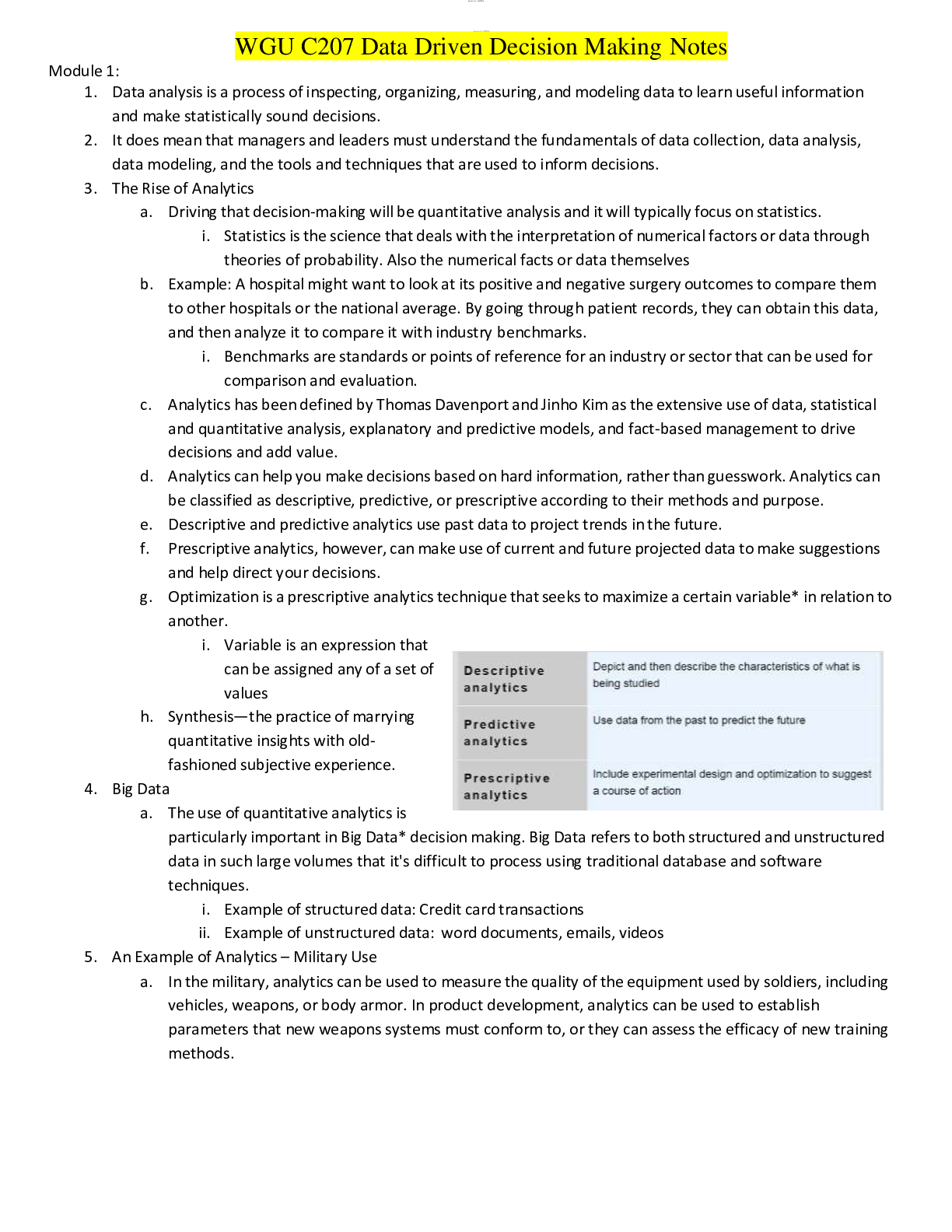
Module 1:
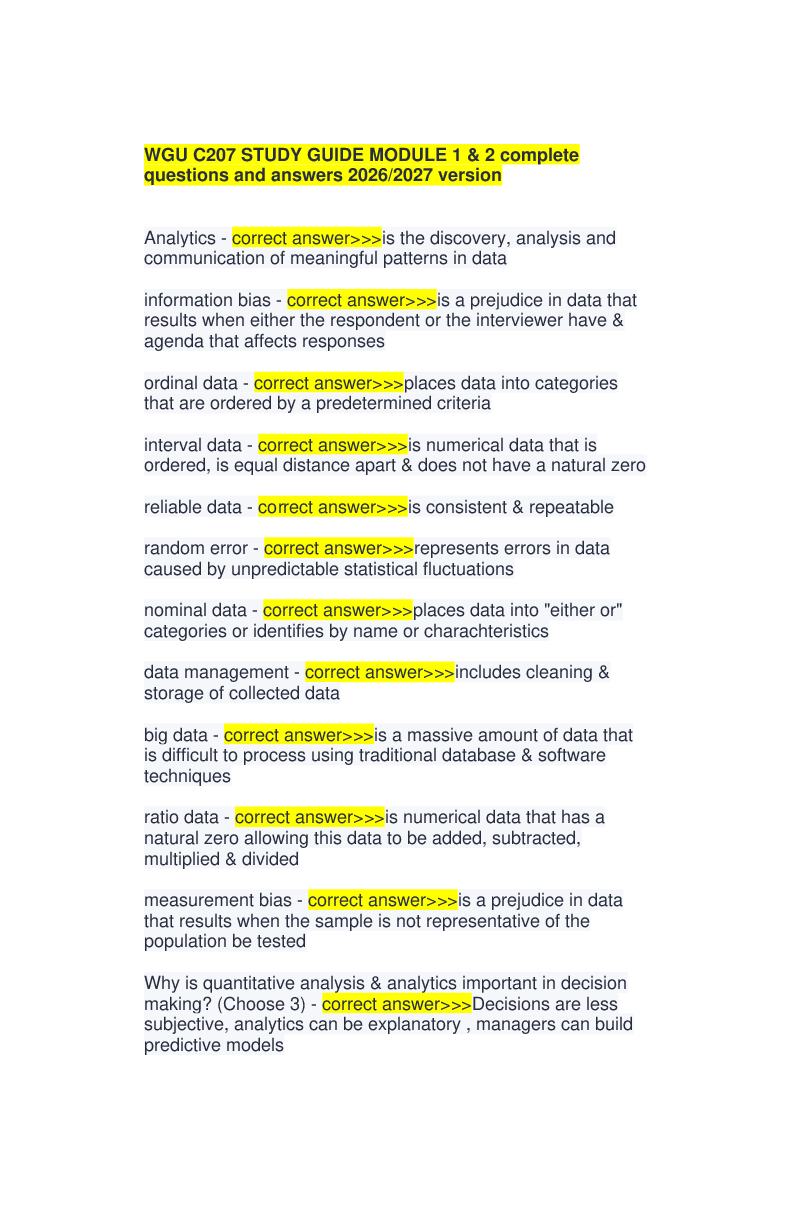
1. Data analysisis a process of inspecting, organizing, measuring, and modeling data to learn useful information
and make statistically sound decisions.
2. It does mean that managers and leaders must underst
...
Module 1:
1. Data analysisis a process of inspecting, organizing, measuring, and modeling data to learn useful information
and make statistically sound decisions.
2. It does mean that managers and leaders must understand the fundamentals of data collection, data analysis,
data modeling, and the tools and techniques that are used to inform decisions.
3. The Rise of Analytics
a. Driving that decision-making will be quantitative analysis and it will typically focus on statistics.
i. Statistics is the science that deals with the interpretation of numerical factors or data through
theories of probability. Also the numerical facts or data themselves
b. Example: A hospital might want to look at its positive and negative surgery outcomes to compare them
to other hospitals or the national average. By going through patient records, they can obtain this data,
and then analyze it to compare it with industry benchmarks.
i. Benchmarks are standards or points of reference for an industry orsector that can be used for
comparison and evaluation.
c. Analytics has been defined by Thomas Davenport and Jinho Kim as the extensive use of data, statistical
and quantitative analysis, explanatory and predictive models, and fact-based management to drive
decisions and add value.
d. Analytics can help you make decisions based on hard information, rather than guesswork. Analytics can
be classified as descriptive, predictive, or prescriptive according to their methods and purpose.
e. Descriptive and predictive analytics use past data to project trends in the future.
f. Prescriptive analytics, however, can make use of current and future projected data to make suggestions
and help direct your decisions.
g. Optimization is a prescriptive analyticstechnique thatseeks to maximize a certain variable* in relation to
another.
i. Variable is an expression that
can be assigned any of a set of
values
h. Synthesis—the practice of marrying
quantitative insights with oldfashioned subjective experience.
4. Big Data
a. The use of quantitative analytics is
particularly important in Big Data* decision making. Big Data refers to both structured and unstructured
data in such large volumes that it's difficult to process using traditional database and software
techniques.
i. Example of structured data: Credit card transactions
ii. Example of unstructured data: word documents, emails, videos
5. An Example of Analytics – Military Use
a. In the military, analyt
[Show More]