Biology OCR-AS notes
MODULE 2: Foundations of Biology:
Microscopes function is to magnify specimens to produce a clear image with fine details
of organelles/internal structure of the cell.
Size of image=magnification
...
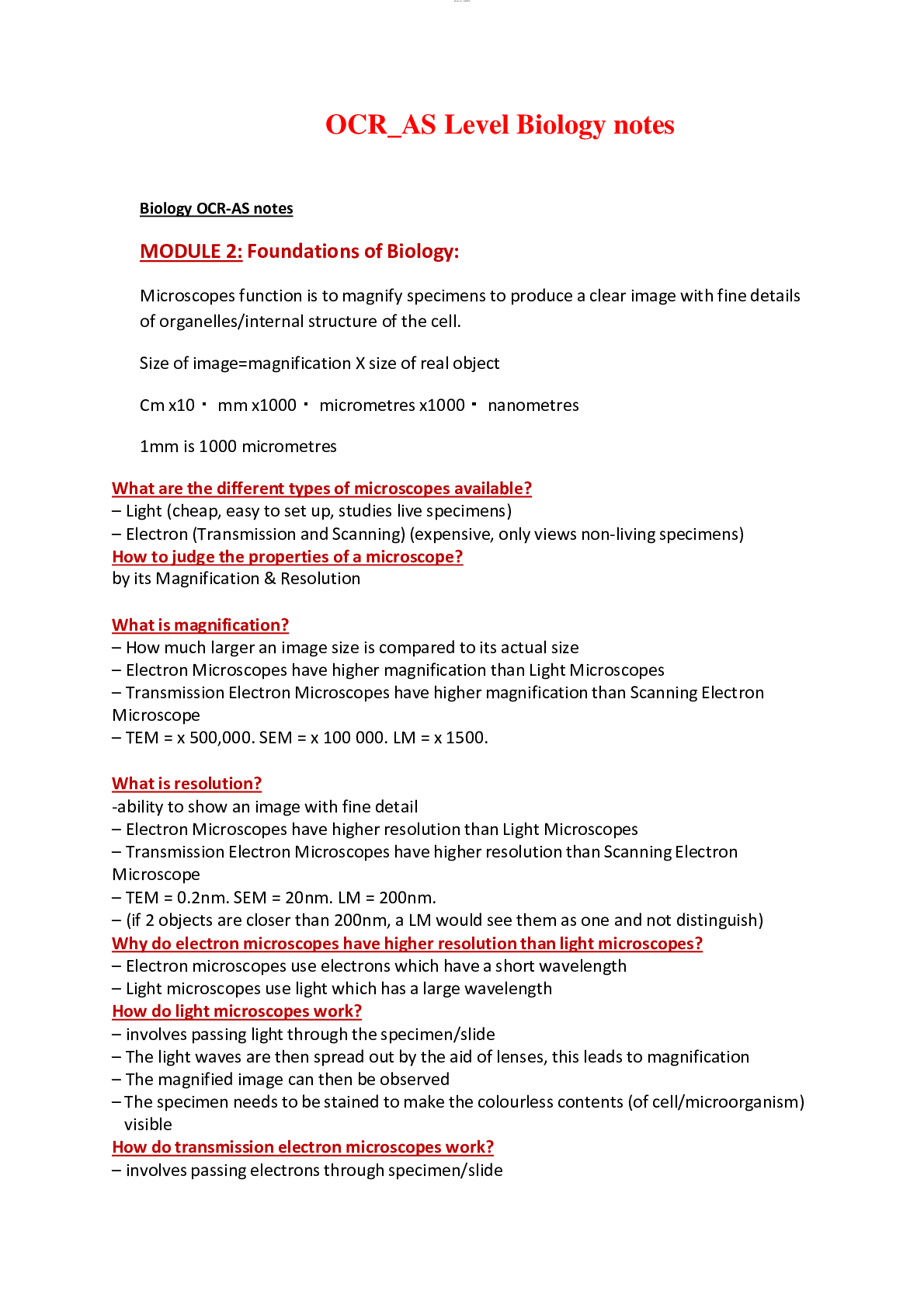
Biology OCR-AS notes
MODULE 2: Foundations of Biology:
Microscopes function is to magnify specimens to produce a clear image with fine details
of organelles/internal structure of the cell.
Size of image=magnification X size of real object
Cm x10 mm x1000 micrometres x1000 nanometres
1mm is 1000 micrometres
What are the different types of microscopes available?
– Light (cheap, easy to set up, studies live specimens)
– Electron (Transmission and Scanning) (expensive, only views non-living specimens)
How to judge the properties of a microscope?
by its Magnification & Resolution
What is magnification?
– How much larger an image size is compared to its actual size
– Electron Microscopes have higher magnification than Light Microscopes
– Transmission Electron Microscopes have higher magnification than Scanning Electron
Microscope
– TEM = x 500,000. SEM = x 100 000. LM = x 1500.
What is resolution?
-ability to show an image with fine detail
– Electron Microscopes have higher resolution than Light Microscopes
– Transmission Electron Microscopes have higher resolution than Scanning Electron
Microscope
– TEM = 0.2nm. SEM = 20nm. LM = 200nm.
– (if 2 objects are closer than 200nm, a LM would see them as one and not distinguish)
Why do electron microscopes have higher resolution than light microscopes?
– Electron microscopes use electrons which have a short wavelength
– Light microscopes use light which has a large wavelength
How do light microscopes work?
– involves passing light through the specimen/slide
– The light waves are then spread out by the aid of lenses, this leads to magnification
– The magnified image can then be observed
– The specimen needsto be stained to make the colourless contents (of cell/microorganism)
visible
How do transmission electron microscopes work?
– involves passing electronsthrough specimen/slide
lOMoAR cPSD|8976716
– Magnets are used to spread out the electrons (magnification process)
– The electrons will hit a photographic film producing an image
– Colour/stain can be added to the image after
Advantage and Disadvantage of TEM?
-Advantage = highest magnification and highest resolution
-Disadvantage = works in a vacuum so can only observe dead specimens, specimen needs
to be thin, black and white image, 2D image, artefacts
How do scanning electron microscopes work?
– involves bouncing electrons off the surface of the specimen
– produces a 3D image
Advantage and Disadvantage of SEM?
-Advantage = produces 3D image
-Disadvantage = works in a vacuum so can only observe dead specimens, black and white
image, artefacts
Viewing specimen under light microscope:
1) Pipette drop of water onto slide& use tweezers to place thin section of specimen on the drop
2) Add drop ofstain to highlight organelle sin cell, eg Eosin for cytoplasm, Iodine in potassium
iodide solution for starch grains in plant cells
3) Add cover slip to protect specimen, stand slip upright on slide and tilt and lower till specimen
covered, make sure not to get air bubbles under.
Stains:
Coloured chemicals that bind to molecules on specimen so it’s easier to see, differential
staining for different structures
• Basic stains..........................................................................................................CONTINUED
[Show More]