Gerontologic Nursing HESI Study Guide
Healthy aging is now an achievable goal for many.
Aging and disease are separate entities.
Aging is an individual process that affects each person differently.
The chrono
...
Gerontologic Nursing HESI Study Guide
Healthy aging is now an achievable goal for many.
Aging and disease are separate entities.
Aging is an individual process that affects each person differently.
The chronologic age of 65 is the standard in the United States for being considered an
older adult (elderly).
By 2050, one in five Americans will be over the age of 65.
The concept of aging is further defined as young-old (65 to 74), middle-old (75 to 84),
old-old (over 85), elite-old (over 90), centenarian (over 100), and super-centenarian (110
and over).
Eighty percent of people over the age of 70 have at least one chronic condition, and 50%
have multiple health problems.
Theories of Aging
1. Psychosocial Theories:
a. Disengagement Theory: Progressive social disengagement occurs naturally with
aging and is accepted by the older adult. Variation in disengagement across older
populations is related to cultural style and behaviors in different geographic regions.
b. Activity Theory: Successful again requires a high level of activity and involvement to
maintain life satisfaction and positive self – esteem.
2. Biologic Theories:
a. Pacemaker Theory: A programmed decline or cessation of many concepts occurs in
the nervous and endocrine systems.
b. Immunity Theory: A programmed accumulation of damage and decline of the
immune systems’ function (immunosenescence) takes place due to oxidative stress.
c. Wear-and-Tear Theory: After repeated use, damaged cells in the body structures wear
out from the harmful effects of internal and external stressors, now known as free
radicals.
HE S I Hin t
The concept of aging is shifting from viewing older adults as frail and dependent to being
able to engage in healthy living. The majority of those aged 65 and older regard their
health as good or excellent. The ability to perform activities of daily living (ADLs) is a more
accurate measure of an older person’s age than chronologic age.
3. Developmental Theories:
a. Erik Erikson’s Theory: Theory identifies 8 stages of developmental tasks throughout
the life span; 8th stage is integrity versus despair
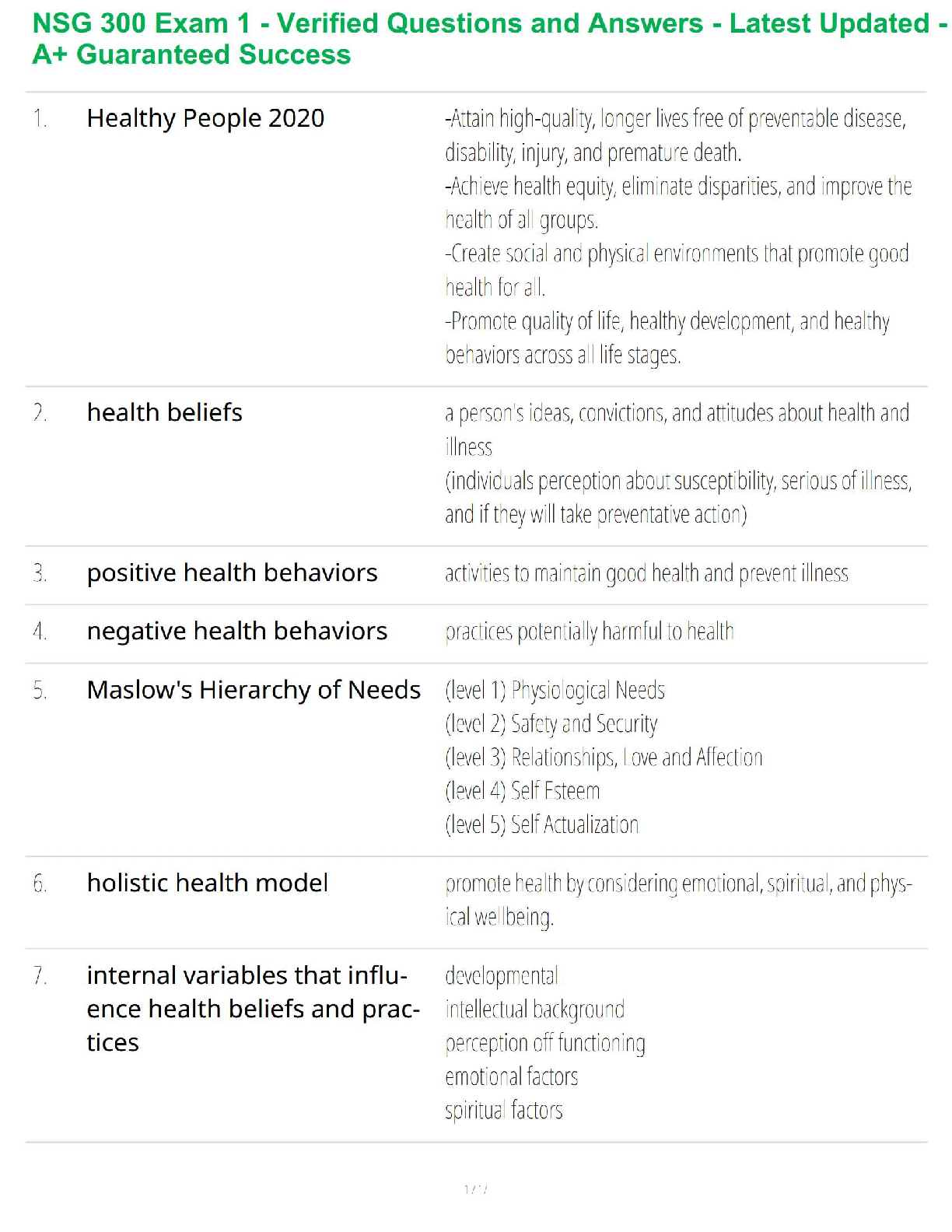
b. Maslow’s Theory: Maslow’s hierarchy of needs ranks an individual’s needs from the
most basic to the most complex. Maslow uses the terms physiologic, safety and
security, belonging, self-esteem, and self-actualization needs to describe the process
that generally motivates individuals to move through life.
Physiologic Changes
Aging effects every cell in every organ of the body, but not at the same rate
Three physiologic changes are clinically significant in making older adults vulnerable to
injury & disease:
o Loss in compensatory reserve (making up for a loss in physiological
compensation; vital signs)
o Progressive loss in efficiency of the body to repair damaged tissue
o Decreased functioning of the immune system processes
Diseases in older adults do not always present with classic signs and symptoms
Physiologic changes increase more rapidly with increasing age
Aging changes are influenced by genetic makeup & environment
HE S I Hin t
NCLEX-RN questions may ask about teaching and designing rehabilitation programs for
older adults. The answers should contain information about exercise and nutrition.
Integumentary System: Skin, hair, and nail changes occur with aging and can cause problems
concerning discomfort and self-esteem.
Thin Skin provides a less effective barrier to trauma due to a loss of subcutaneous tissue.
o Increased risk for dehydration due to decline in lean mass & loss of body water
o Decreased ability of the skin to detect and regulate temperature
o Dry skin resulting from a decrease in endocrine secretion
o Loss of elastin & increased vascular fragility
Keratinocytes become smaller and regeneration slows; wound healing is slower.
Hair loss occurs; women have increased facial hair
Vascular hyperplasia causes more varicosities (brown or blue discolorations)
Increased appearance of “age spots” and/or “liver spots” and raised lesions
(seborrheic keratosis)
Nails becomes brittle & thick.
Nursing Assessment
1. Skin dryness & tears
2. Nails for changes in shape, color, and brittleness
3. Lesions to differentiate normal from abnormal;
4. Bony prominences for signs of pressure ulcers
Nursing Plans & Interventions
A. Encourage the use of oils or lubricants on the skin at least twice a day.
B. Discourage the use of powder, which can be drying.
C. Teach to avoid overexposure to sunlight.
D. Encourage balanced nutrition and increased fluid intake.
E. Teach to maintain adequate humidity in the environment.
F. Teach to avoid temperature extremes.
G. Teach good foot care.
H. Observe bony prominences for signs of pressure.
I. Teach that poor peripheral circulation may slow the healing of foot and hand lesions.
HE S I Hin t
The NCLEX will test your ability to differentiate normal and pathologic causes of skin and
hair conditions; for example, the differences between seborrheic keratosis and melanoma.
Musculoskeletal System: Age-related changes in the musculoskeletal system are gradual but
have a significant impact on levels of mobility, which puts older adults at risk for falls and
fractures.
The Musculoskeletal system is composed on bones, joints, tendons, ligaments, and
muscles.
Age – related changes are not life threatening, but can affect function & quality of life.
Bone loss begins around age 40 and is more common in women than in men; thus;
osteoporosis occurs more often in women.
Shortening of the trunk (torso) due to thinning of the vertebral disks.
Loss of bone calcium, atrophic (decrease in size) cartilage and muscle occurs.
Bone mineral density (BMD) decreases, resulting in osteopenia and osteoporosis.
Range of motion (ROM) of joint decreases.
Progressive loss of cartilage occurs, resulting in osteoarthritis.
Muscle cells are lost and not replaced.
Lean body mass decreases with increased body fat.
[Show More]