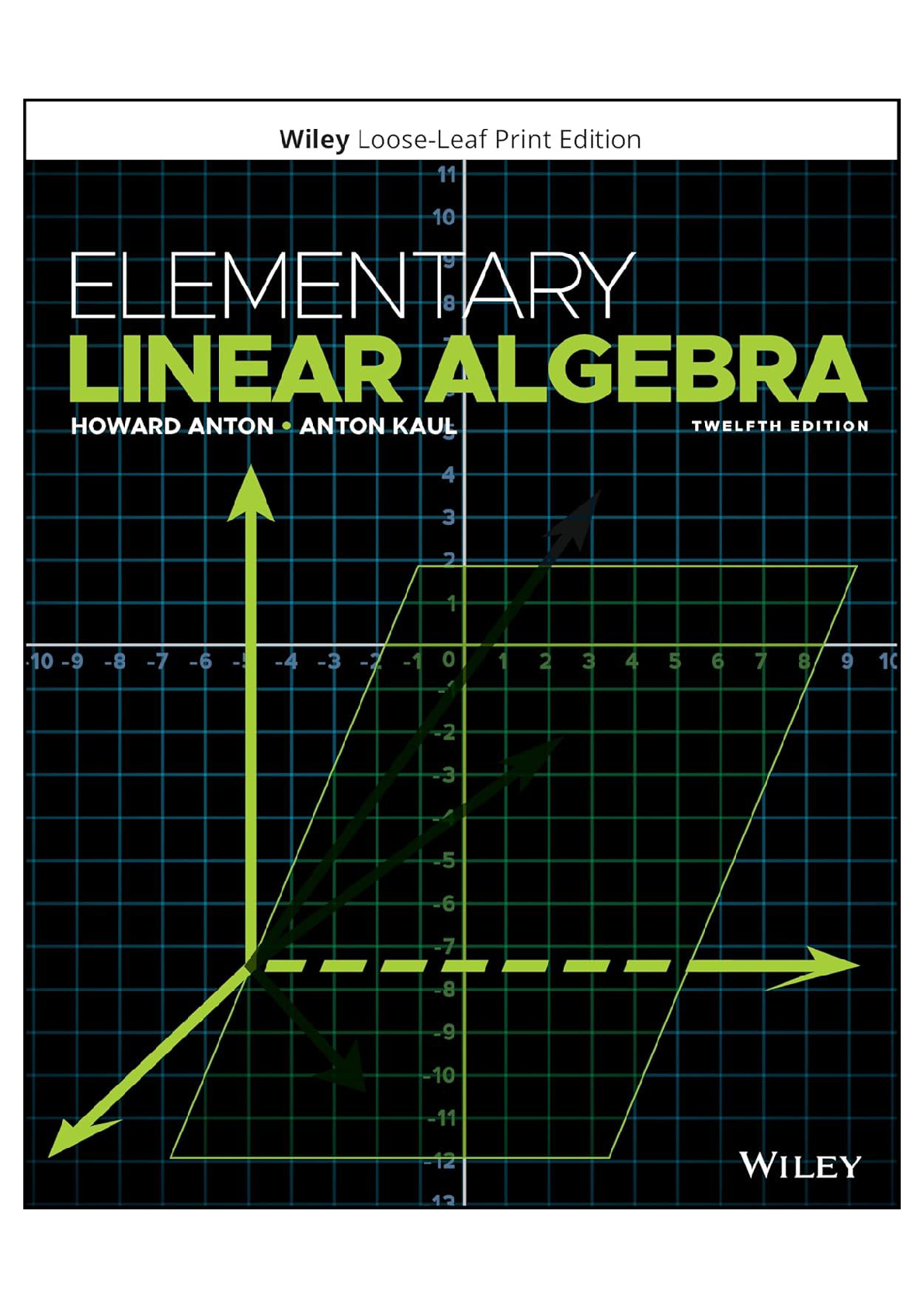
This textbook is an expanded version of Elementary Linear Algebra, eleventh edition, by
Howard Anton. The first nine chapters of this book are identical to the first nine chapters
of that text; the tenth chapter consis
...
This textbook is an expanded version of Elementary Linear Algebra, eleventh edition, by
Howard Anton. The first nine chapters of this book are identical to the first nine chapters
of that text; the tenth chapter consists of twenty applications of linear algebra drawn
from business, economics, engineering, physics, computer science, approximation theory,
ecology, demography, and genetics. The applications are largely independent of each
other, and each includes a list of mathematical prerequisites. Thus, each instructor has
the flexibility to choose those applications that are suitable for his or her students and to
incorporate each application anywhere in the course after the mathematical prerequisites
have been satisfied. Chapters 1–9 include simpler treatments of some of the applications
covered in more depth in Chapter 10.
This edition gives an introductory treatment of linear algebra that is suitable for a
first undergraduate course. Its aim is to present the fundamentals of linear algebra in the
clearest possible way—sound pedagogy is the main consideration. Although calculus
is not a prerequisite, there is some optional material that is clearly marked for students
with a calculus background. If desired, that material can be omitted without loss of
continuity.
Technology is not required to use this text, but for instructors who would like to
use MATLAB, Mathematica, Maple, or calculators with linear algebra capabilities, we
have posted some supporting material that can be accessed at either of the following
companion websites:
www.howardanton.com
www.wiley.com/college/anton
Summary of Changes in
This Edition
Many parts of the text have been revised based on an extensive set of reviews. Here are
the primary changes:
• Earlier Linear Transformations Lineartransformations are introduced earlier(starting
in Section 1.8). Many exercise sets, as well as parts of Chapters 4 and 8, have been
revised in keeping with the earlier introduction of linear transformations.
• New Exercises Hundreds of new exercises of all types have been added throughout
the text.
• Technology Exercises requiring technology such as MATLAB, Mathematica, or Maple
have been added and supporting data sets have been posted on the companion websites
for this text. The use of technology is not essential, and these exercises can be omitted
without affecting the flow of the text.
• Exercise Sets Reorganized Many multiple-part exercises have been subdividedto create
a better balance between odd and even exercise types. To simplify the instructor’s task
of creating assignments, exercise sets have been arranged in clearly defined categories.
• Reorganization In addition to the earlier introduction of linear transformations, the
old Section 4.12 on Dynamical Systems and Markov Chains has been moved to Chapter 5 in order to incorporate material on eigenvalues and eigenvectors.
• Rewriting Section 9.3 on Internet Search Engines from the previous edition has been
rewritten to reflect more accurately how the Google PageRank algorithm works in
practice. That section is now Section 10.20 of the applications version of this text.
• Appendix A Rewritten The appendix on reading and writing proofs has been expanded
and revised to better support courses that focus on proving theorems.
• Web Materials Supplementary web materials now include various applications modules, three modules on linear programming, and an alternative presentation of determinants based on permutations.
• Applications Chapter Section 10.2 of the previous edition has been moved to the
websites that accompany this text, so it is now part of a three-module set on LinearPreface vii
Programming. A new section on Internet search engines has been added that explains
the PageRank algorithm used by Google.
Hallmark Features • Relationships Among Concepts One of our main pedagogical goals is to convey to the
student that linear algebra is a cohesive subject and not simply a collection of isolated
definitions and techniques. One way in which we do this is by using a crescendo of
Equivalent Statements theorems that continually revisit relationships among systems
of equations, matrices, determinants, vectors, linear transformations, and eigenvalues.
To get a general sense of how we use this technique see Theorems 1.5.3, 1.6.4, 2.3.8,
4.8.8, and then Theorem 5.1.5, for example.
• Smooth Transition to Abstraction Because the transition from Rn to general vector
spaces is difficult for many students, considerable effort is devoted to explaining the
purpose of abstraction and helping the student to “visualize” abstract ideas by drawing
analogies to familiar geometric ideas.
• Mathematical Precision When reasonable, we try to be mathematically precise. In
keeping with the level of student audience, proofs are presented in a patient style that
is tailored for beginners.
• Suitability for a Diverse Audience This text is designed to serve the needs of students
in engineering, computer science, biology, physics, business, and economics as well as
those majoring in mathematics.
• Historical Notes To give the students a sense of mathematical history and to convey
that real people created the mathematical theorems and equations they are studying, we
have included numerous Historical Notes that put the topic being studied in historical
perspective.
About the Exercises • Graded Exercise Sets Each exercise set in the first nine chapters begins with routine
drill problems and progresses to problems with more substance. These are followed
by three categories of exercises, the first focusing on proofs, the second on true/false
exercises, and the third on problems requiring technology. This compartmentalization
is designed to simplify the instructor’s task of selecting exercises for homework.
• Proof Exercises Linear algebra courses vary widely in their emphasis on proofs, so
exercises involving proofs have been grouped and compartmentalized for easy identification. Appendix A has been rewritten to provide students more guidance on proving
theorems.
• True/False Exercises The True/False exercises are designed to check conceptual understanding and logical reasoning. To avoid pure guesswork, the students are required
to justify their responses in some way.
• Technology Exercises Exercises that require technology have also been grouped. To
avoid burdening the student with keyboarding, the relevant data files have been posted
on the websites that accompany this text.
• Supplementary Exercises Each of the first nine chapters ends with a set of supplementary exercises that draw on all topics in the chapter. These tend to be more challenging.
Supplementary Materials
for Students
• Student Solutions Manual This supplement provides detailed solutions to most oddnumbered exercises (ISBN 978-1-118-464427).
• Data Files Data files for the technology exercises are posted on the companion websites
that accompany this text.
• MATLAB Manual and Linear Algebra Labs This supplement contains a set of MATLAB
laboratory projects written by Dan Seth of West Texas A&M University. It is designed
to help students learn key linear algebra concepts by using MATLAB and is available in
PDF form without charge to students at schools adopting the 11th edition of the text.
• Videos A complete set of Daniel Solow’s How to Read and Do Proofs videos is available
to students through WileyPLUS as well as the companion websites that accompanyviii Preface
this text. Those materials include a guide to help students locate the lecture videos
appropriate for specific proofs in the text.
Supplementary Materials
for Instructors
• Instructor’s Solutions Manual This supplement provides worked-out solutions to most
exercises in the text (ISBN 978-1-118-434482).
• PowerPoint Presentations PowerPoint slides are provided that display important definitions, examples, graphics, and theorems in the book. These can also be distributed
to students as review materials or to simplify note taking.
• Test Bank Test questions and sample exams are available in PDF or LATEX form.
• WileyPLUS An online environment for effective teaching and learning. WileyPLUS
builds student confidence by taking the guesswork out of studying and by providing a
clear roadmap of what to do, how to do it, and whether it was done right. Its purpose is
to motivate and foster initiative so instructors can have a greater impact on classroom
achievement and beyond.
[Show More]










, questions and answers, Consolidated Final Examination.png)