LPA: Midterm Exam
How does the term "Latino" group people together? - ✔✔Group of people tied together by
language,cultural values and practices,similar histories in the U.S. and lastly public policies.
What is Latino
...
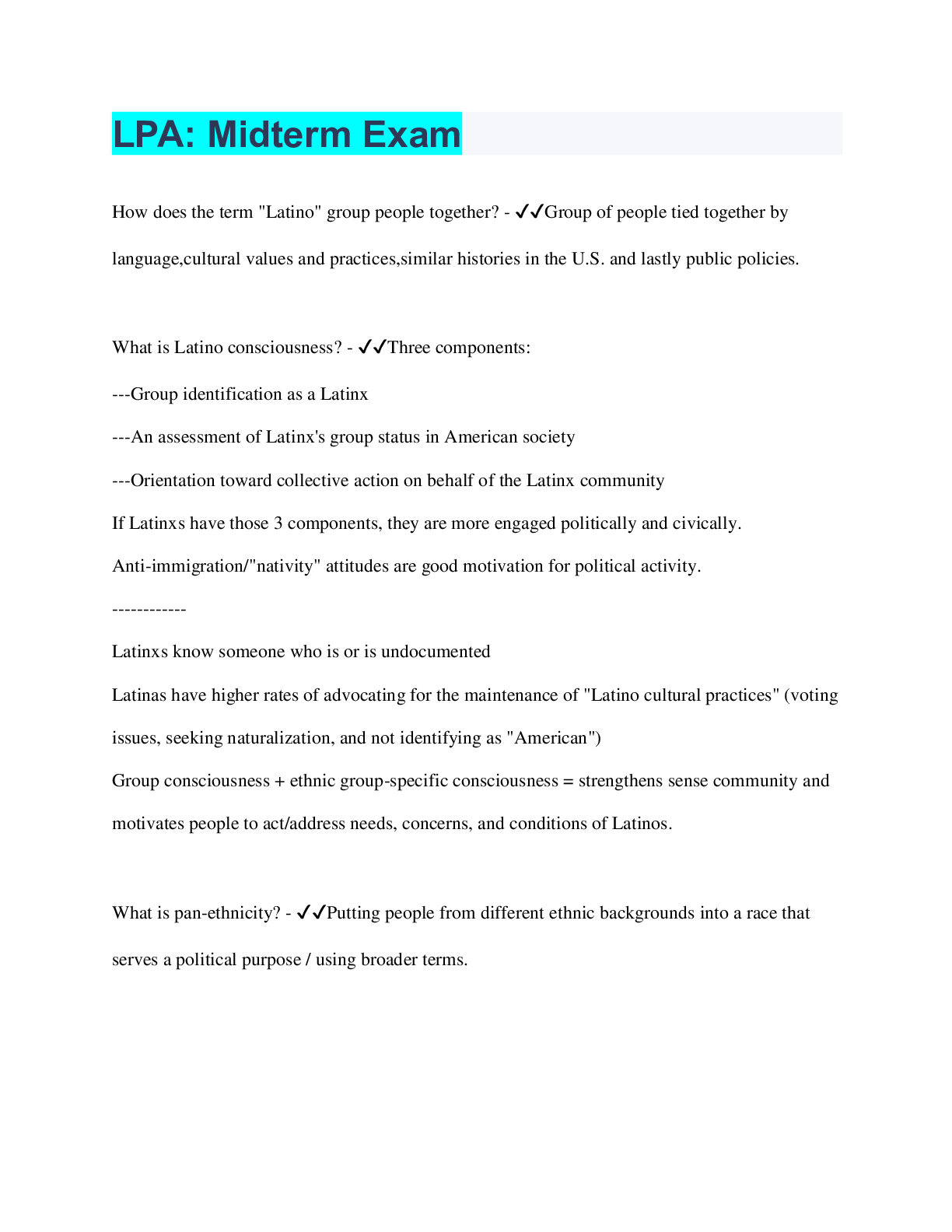
LPA: Midterm Exam
How does the term "Latino" group people together? - ✔✔Group of people tied together by
language,cultural values and practices,similar histories in the U.S. and lastly public policies.
What is Latino consciousness? - ✔✔Three components:
---Group identification as a Latinx
---An assessment of Latinx's group status in American society
---Orientation toward collective action on behalf of the Latinx community
If Latinxs have those 3 components, they are more engaged politically and civically.
Anti-immigration/"nativity" attitudes are good motivation for political activity.
------------
Latinxs know someone who is or is undocumented
Latinas have higher rates of advocating for the maintenance of "Latino cultural practices" (voting
issues, seeking naturalization, and not identifying as "American")
Group consciousness + ethnic group-specific consciousness = strengthens sense community and
motivates people to act/address needs, concerns, and conditions of Latinos.
What is pan-ethnicity? - ✔✔Putting people from different ethnic backgrounds into a race that
serves a political purpose / using broader terms.
What are the causes of migration? - ✔✔For latinos the cause of migration is because they think
they can get better opportunity in America due to the fact that they are trying to escape drug
cartels and wars in their countries.
When did Central (including Salvadorans and Guatemalans) and South Americans begin coming
to the U.S. in large part? - ✔✔Late 1800's to early 1900's
---Industries [like cigar/munitions factories, sugar cane, other agricultural product processing,
and shipyards] were venues for early labor market relations for Central/South Americans + the
U.S.
------------
mid-1970's
---Central/South Americans are more widely distributed
------------
1990's (in large part, the majority)
---Fleeing civil wars
Why was the term "Chicano" created? - ✔✔Distinguishing in-group and out-group contexts
(specific label preferences).
---Reflects: class, national origin, nativity, racial identification, cultural identification, nd
language uses
------------
---Chicano: politically charged - political orientations and ideologies
Radical political ideology (social change and justice)
Opportunity costs - ✔✔Meaning: Having to do things other than voting.
Declining social and political trust, cynicism, and decline in community
Participation is "individually driven."
Voting requires: skill, monies, knowledge and self-confidence (believing you can change the
government)
Group consciousness - ✔✔Meaning: The cognitive elements of group attachment; a person
incorporates group identity(ies) as part of his or her social identity. The idea of finding cultural
affinity (a spontaneous or natural liking or sympathy for someone or something) and attaching to
it.
Individuals with group consciousness have positive affinity for being Latino (they assess their
group as experiencing lower levels of SES & political status & opportunities; inclined to
participate; ex. - Mexican immigrant who identifies as 'Mexican' and 'Latinx')
Main components:
---Group identification as a Latinx
---An assessment of Latinx's group status in American society
---Orientation toward collective action on behalf of the Latinx community
------------
Having coexisting identities that affect our daily lives and situations.
"Pan-ethnicity"
Purpose: place more Latinos into political arena
Poverty of Latinos relative to other groups - ✔✔Occupational location:
---Influenced by nativity (U.S.-born Latinxs: fare better occupationally than foreign-born
counterparts)
---All Latinxs in labor-force market contribute: more to Social Security system, will play a
greater role in composition of the workforce, and more human resource labor force mobility.
---Important job issues for Latinxs: job mobility, job training and educational preparation, labor
market discrimination, and entrpreneurship.
------------
Larger size in families for Latinos
Native to foreign-born Latinx: 16:1
16% of Latinx fams make less than $10,000
Poverty affects socioeconomic mobility, political engagement, and participation in
organizational engagement. Common interest (linkage of family economic status)
U.S.-born Latinx: $35,000 ; foreign-birn: $27,000
Community building - ✔✔Latino Identity:
---Common language, interrelated traditions and values, similar experiences (discrimination,
minority status, SES status=unequal opportunities)
------------
Common identity but different:
---Puerto Ricans: naturalized citizens
---Cubans: refugees
---Central Americans: economic migrants
------------
Latino Consciousness:
---Ideological - interrelatedness among other Latinx subgroups
---Pragmatic - wanting to expand Latinx community
Panethnicity, positive affinity, Latino vs. Hispanic
Which Latino subgroup is more likely to consider themselves "typically American?" - ✔✔Puerto
Ricans
Which Latino subgroup is most likely to consider themselves, "different from the typical
American?" - ✔✔Central Americans
Treaty of Guadalupe Hidalgo - ✔✔The war officially ended with the February 2, 1848, signing
in Mexico of the Treaty of Guadalupe Hidalgo. The treaty added an additional 525,000 square
miles to United States territory, including the land that makes up all or parts of present-day
Arizona, California, Colorado, Nevada, New Mexico, Utah and Wyoming.
In Latino Americans, what point was made about New Mexicans? - ✔✔Conflicted identitiesPeople got conflicted whether they were texan , Mexican or America.
------------
Gold Rush-first point of discrimination "latinos" are seen as greasers,dirty,dangerous people and
300 are lynched
Political elites and activists - ✔✔Translate and interpret political and social necessities and
realities
How are Cubans different? - ✔✔Cubans are treated different because most go to Florida and get
treated well and have an easier path to citizenship.
Political capital - ✔✔---using group to strengthen their power in politics
---enhanced with the appearance of cohesion and unity
---present to legislatures
Political participation - ✔✔---Not citizens
---Not interested
---Too complicated
---Distrust gov
---Not informed
---Discouraged
Positive affinity - ✔✔Individuals with group consciousness have a positive affinity for being
latino
When do communities bind? - ✔✔---People are tied together naturally by common heritage.
---Ancestry•Language
---Religion
---Observation of holidays and festivals
---Familial networks
------------
Through the common language aka Spanish, also cultural traditions and values. The communities
bind together when they are label all together as Latinos, this happens when they fill out
paperwork(ex. Census) and given the option Latino, they can also be bonded together when they
face the same discriminatory issues.
What is the status of the various Latino subgroups (are they citizens)? - ✔✔In the 2014 US
Hispanic Population Research, there was 55 million Hispanics in the United States.
---For Mexicans , there is 35 million in the US, but only 23 million are US born.
---For Puerto Ricans, there is 5.3 million and 5.2 million who are citizens.
---For Cubans, 860k out of 2million are US Born.
---For Dominican, about 804k out of 1.7 million are US Born.
Targeted mobilization - ✔✔They target the white people. involves identifying persons who,
when contacted, are most likely to respond to calls for involvement
How do Latinos work together to achieve goals? - ✔✔Latinos work together by participating in
political events.
Social identity - ✔✔Common language
Interrelated cultural traditions and values
Similar experiences
Discrimination
Relegation to minority status
SES status = unequal opportunities
How does a community thrive? - ✔✔The latino community thrives when they participate in local
and political events, by showing representation for the Latino community they threaten the
mayority.
Leadership in the Latino community - ✔✔A leader right now is Alexandria Ocasio-Cortez, a
House Representative for the New York Bronx area
What do the terms "Hispanic" and "Latino" do in terms of they aggregate (form or group into a
class or cluster.) subgroups? - ✔✔A product of external forces trying to simplify and
homogenize a diverse aggregation of Latino subgroups.
The term "Latino" is used as a form of pan-ethnicity.
---Attempting to share cultural traditions, situations, and practices.
[Show More]
.png)


.png)