NURSING 201 (TEST BANK-UPDATED) Integrated Process - Nursing Process-Data Collection.doc
Document Content and Description Below
Nursing CollegeNURSING 201Integrated Process - Nursing Process-Data Collection.doc
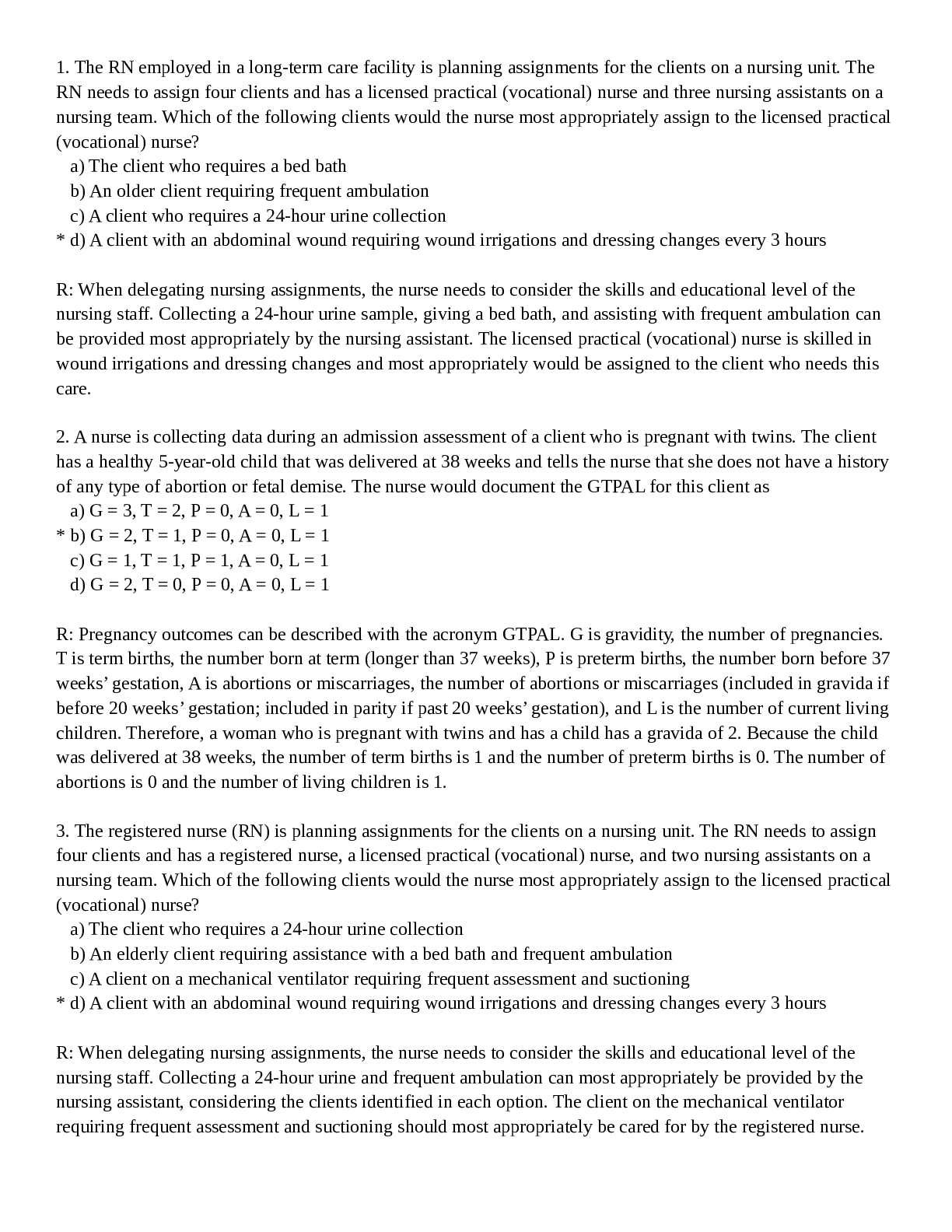
1. The RN employed in a long-term care facility is planning assignments for the clients on a nursing unit. The
R
...
N needs to assign four clients and has a licensed practical (vocational) nurse and three nursing assistants on a
nursing team. Which of the following clients would the nurse most appropriately assign to the licensed practical
(vocational) nurse?
a) The client who requires a bed bath
b) An older client requiring frequent ambulation
c) A client who requires a 24-hour urine collection
* d) A client with an abdominal wound requiring wound irrigations and dressing changes every 3 hours
R: When delegating nursing assignments, the nurse needs to consider the skills and educational level of the
nursing staff. Collecting a 24-hour urine sample, giving a bed bath, and assisting with frequent ambulation can
be provided most appropriately by the nursing assistant. The licensed practical (vocational) nurse is skilled in
wound irrigations and dressing changes and most appropriately would be assigned to the client who needs this
care.
2. A nurse is collecting data during an admission assessment of a client who is pregnant with twins. The client
has a healthy 5-year-old child that was delivered at 38 weeks and tells the nurse that she does not have a history
of any type of abortion or fetal demise. The nurse would document the GTPAL for this client as
a) G = 3, T = 2, P = 0, A = 0, L = 1
* b) G = 2, T = 1, P = 0, A = 0, L = 1
c) G = 1, T = 1, P = 1, A = 0, L = 1
d) G = 2, T = 0, P = 0, A = 0, L = 1
R: Pregnancy outcomes can be described with the acronym GTPAL. G is gravidity, the number of pregnancies.
T is term births, the number born at term (longer than 37 weeks), P is preterm births, the number born before 37
weeks’ gestation, A is abortions or miscarriages, the number of abortions or miscarriages (included in gravida if
before 20 weeks’ gestation; included in parity if past 20 weeks’ gestation), and L is the number of current living
children. Therefore, a woman who is pregnant with twins and has a child has a gravida of 2. Because the child
was delivered at 38 weeks, the number of term births is 1 and the number of preterm births is 0. The number of
abortions is 0 and the number of living children is 1.
3. The registered nurse (RN) is planning assignments for the clients on a nursing unit. The RN needs to assign
four clients and has a registered nurse, a licensed practical (vocational) nurse, and two nursing assistants on a
nursing team. Which of the following clients would the nurse most appropriately assign to the licensed practical
(vocational) nurse?
a) The client who requires a 24-hour urine collection
b) An elderly client requiring assistance with a bed bath and frequent ambulation
c) A client on a mechanical ventilator requiring frequent assessment and suctioning
* d) A client with an abdominal wound requiring wound irrigations and dressing changes every 3 hours
R: When delegating nursing assignments, the nurse needs to consider the skills and educational level of the
nursing staff. Collecting a 24-hour urine and frequent ambulation can most appropriately be provided by the
nursing assistant, considering the clients identified in each option. The client on the mechanical ventilator
requiring frequent assessment and suctioning should most appropriately be cared for by the registered nurse.
The licensed practical (vocational) nurse is skilled in wound irrigation and dressing changes, so this client
would be assigned to this staff member.
4. A client is seen in the clinic for complaints of thirst, frequent urination, and headaches. Following diagnostic
studies, diabetes insipidus in diagnosed. Lypressin is prescribed. The nurse instructs the client that the
medication is prescribed to:
a) Relieve the headaches.
* b) Increase water reabsorption.
c) Decrease the production of the antidiuretic hormone.
d) Stimulate the production of aldosterone.
R: Lypressin is an antidiuretic hormone used in the treatment of diabetes insipidus. It promotes renal
conservation of water by acting on the collecting ducts of the kidney to increase the permeability to water,
which results in increased water reabsorption. Options 1, 3, and 4 are not actions of the medication.
5. A nurse is preparing to collect a 24-hour urine specimen from the client. Which of the following is an
inaccurate action in collecting the specimen?
* a) Asking the client to void, saving the specimen, and noting the start time
b) Discarding the urine specimen at the start time
c) Placing the specimen on ice or refrigerated
d) Asking the client to void at the end of the collection and adding this to the collection
R: Because the 24-hour urine is a timed, quantitative determination, it is essential to start the test with an empty
bladder. The collected urine should be refrigerated or placed on ice to prevent changes in the urine. Fifteen
minutes before the end of the collection time, the client should be asked to void, and this specimen is added to
the collection.
6. A clinic nurse is providing instructions to a female client regarding the procedure for collecting a midstream
(“clean-catch”) urine sample. The nurse would instruct the client to:
a) Scrub the perineum with povidone-iodine solution in the evening and again in the morning before
collecting the specimen.
b) Cleanse the perineum from back to front before collecting the specimen.
* c) Begin the flow of urine and only then collect the specimen.
d) Collect the specimen in the evening before going to bed and deliver it to the laboratory immediately the
next morning.
R: As part of the correct procedure, the client should cleanse the perineum from front to back with the antiseptic
swabs that are packaged with the specimen kit, to prevent contamination of the specimen. The client should
briefly delay collecting the sample until after starting the flow of urine. The specimen should be sent to the
laboratory as soon as possible and not allowed to stand. Improper specimen handling can yield inaccurate test
results. The client is not instructed to scrub the perineum with povidone-iodine in the evening and again in the
morning before collecting the specimen. This action is unnecessary and can cause irritation.
7. A nurse who is collecting data from the client notes that the client’s left eyelid is drooping. The nurse
documents that the client is exhibiting which of the following conditions?
* a) Ptosis
b) Blockage of the lacrimal duct
c) Arcus senilis
d) Abnormal corneal reflex
R: Ptosis is a sagging of the upper lid of the eye so that it covers part of the pupil. It can be caused by edema or
be the result of third cranial nerve disorders or neuromuscular disorders. It is not caused by blockage of the
lacrimal duct. Arcus senilis is an age-related change, characterized by formation of a yellow-gray ring around
the periphery of the cornea surrounding the iris. The corneal reflex is the blink reflex.
8. A client is experiencing syndrome of inappropriate antidiuretic hormone (ADH) secretion. When explaining
this disorder to the client and family, the nurse recalls that ADH works to reabsorb water in:
a) The glomerulus and calices
b) The proximal tubule and the loop of Henle
c) The loop of Henle and the distal tubule
* d) The distal tubule and the collecting duct
R: The distal tubule and the collecting duct of the nephron require the presence of ADH for water reabsorption.
The hormone increases the permeability of the membranes to allow water to flow more easily along the
concentration gradient. The glomerulus filters but does not reabsorb. The calices are responsible for collecting
the urine. The proximal tubule and the loop of Henle reabsorb water without the assistance of ADH.
9. A nurse is collecting a sputum specimen for culture and sensitivity testing from a client who has a productive
cough. The nurse plans to implement which intervention to obtain the specimen?
a) Ask the client to expectorate a small amount of sputum into the emesis basin.
b) Ask the client to obtain the specimen after breakfast.
* c) Use a sterile plastic container for obtaining the specimen.
d) Provide tissues for expectoration and obtaining the specimen.
R: Sputum specimens for culture and sensitivity testing need to be obtained using sterile techniques because the
test is done to determine the presence of organisms. If the procedure for obtaining the specimen is not sterile,
then the specimen would be contaminated and the results of the test would be invalid. A first-morning specimen
is preferred because it represents overnight secretions of the tracheobronchial tree.
10. A nurse caring for a group of clients reviews the electrolyte laboratory results and notes a sodium level of
130 mEq/L on one client’s laboratory report. The nurse understands that which client is at highest risk for the
development of a sodium value at this level?
a) The client with renal failure
* b) The client who is taking diuretics
c) The client with hyperaldosteronism
d) The client who is taking corticosteroids
R: Hyponatremia is evidenced by a serum sodium level lower than 135 mEq/L. Hyponatremia can occur in the
client taking diuretics. The client taking corticosteroids and the client with renal failure or hyperaldosteronism
are at risk for hypernatremia.
[Show More]
Last updated: 2 years ago
Preview 1 out of 102 pages












.png)
.png)