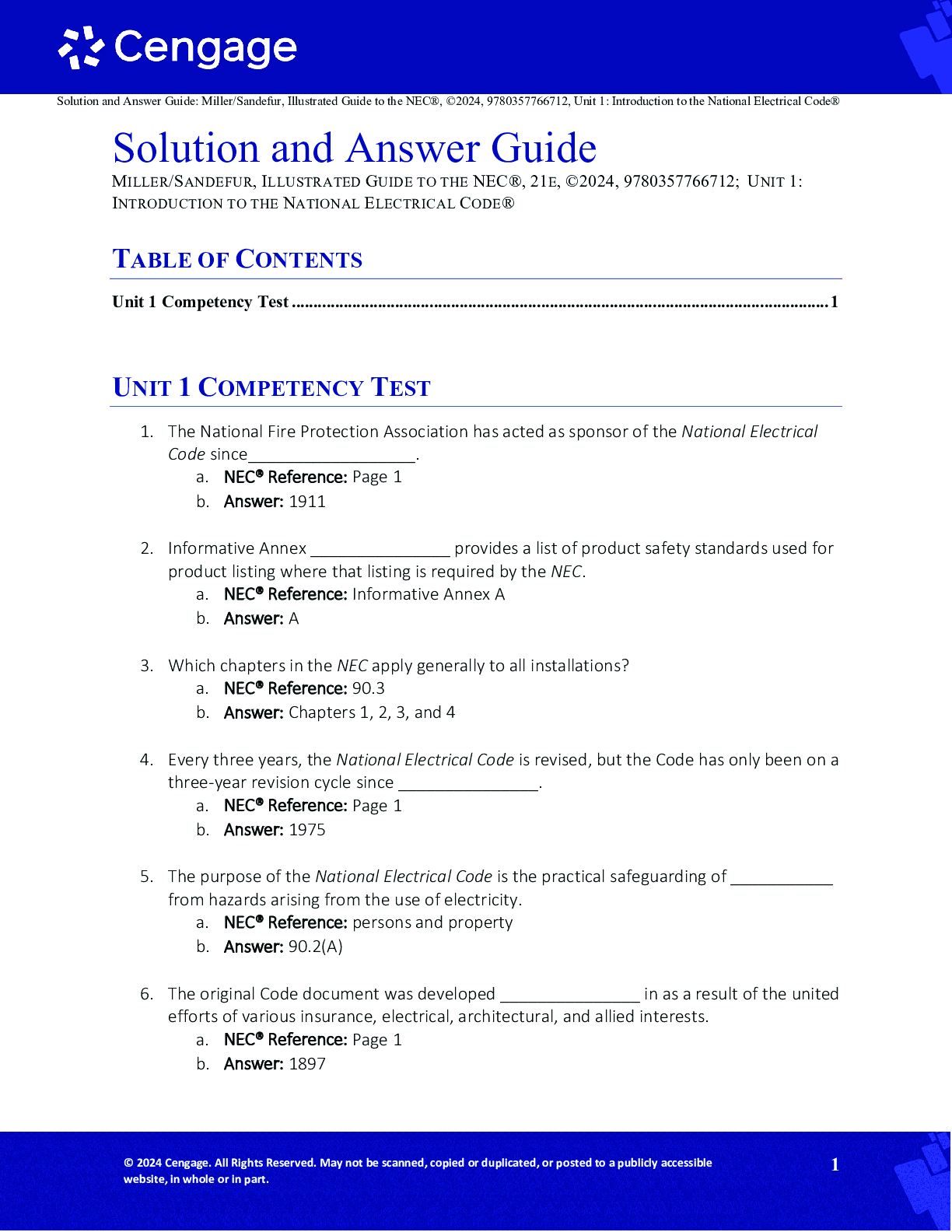
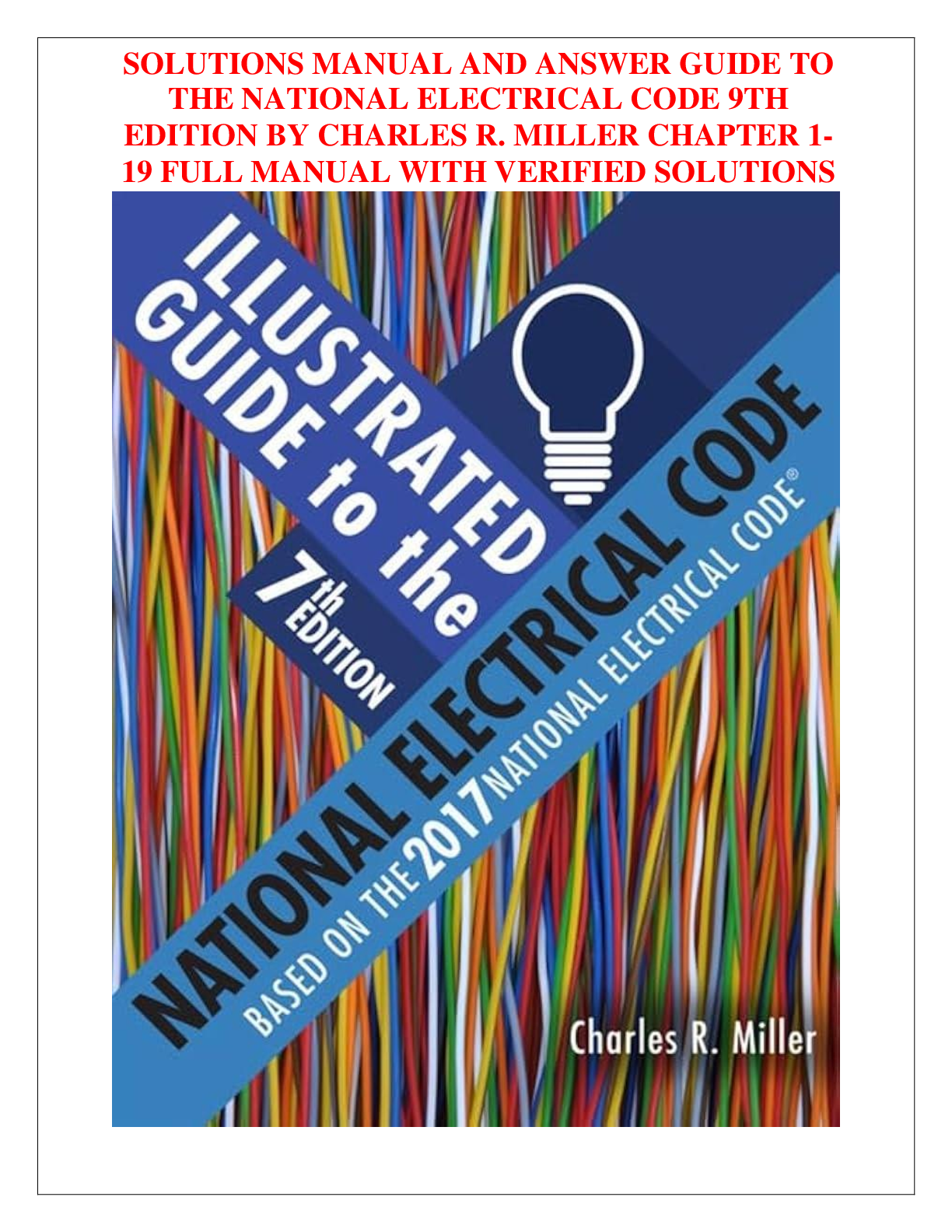
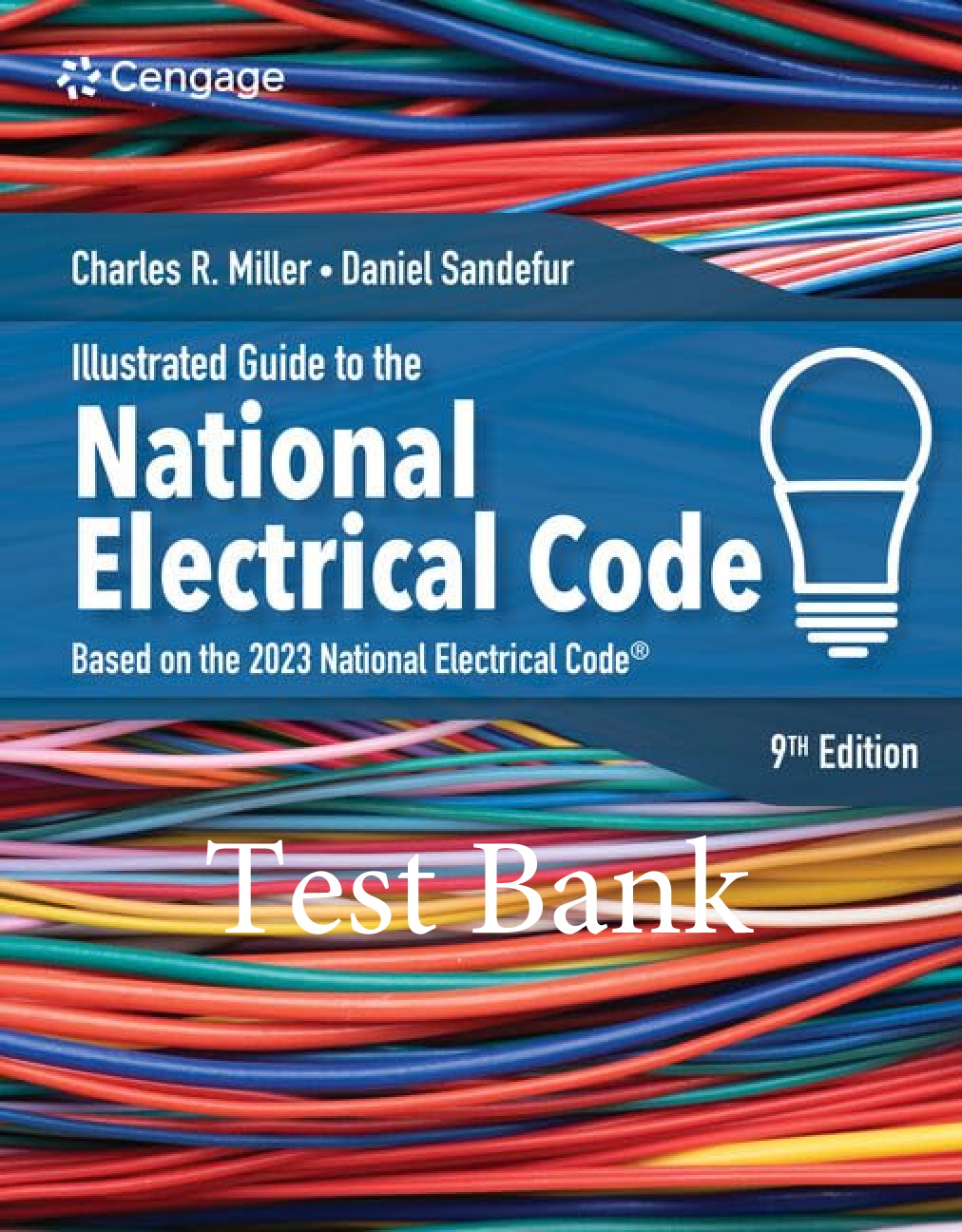
Test Bank Solution and Answer Guide Illustrated Guide to the
National Electrical Code 9th Edition by Charles R.
Miller
Chapter 1 — General
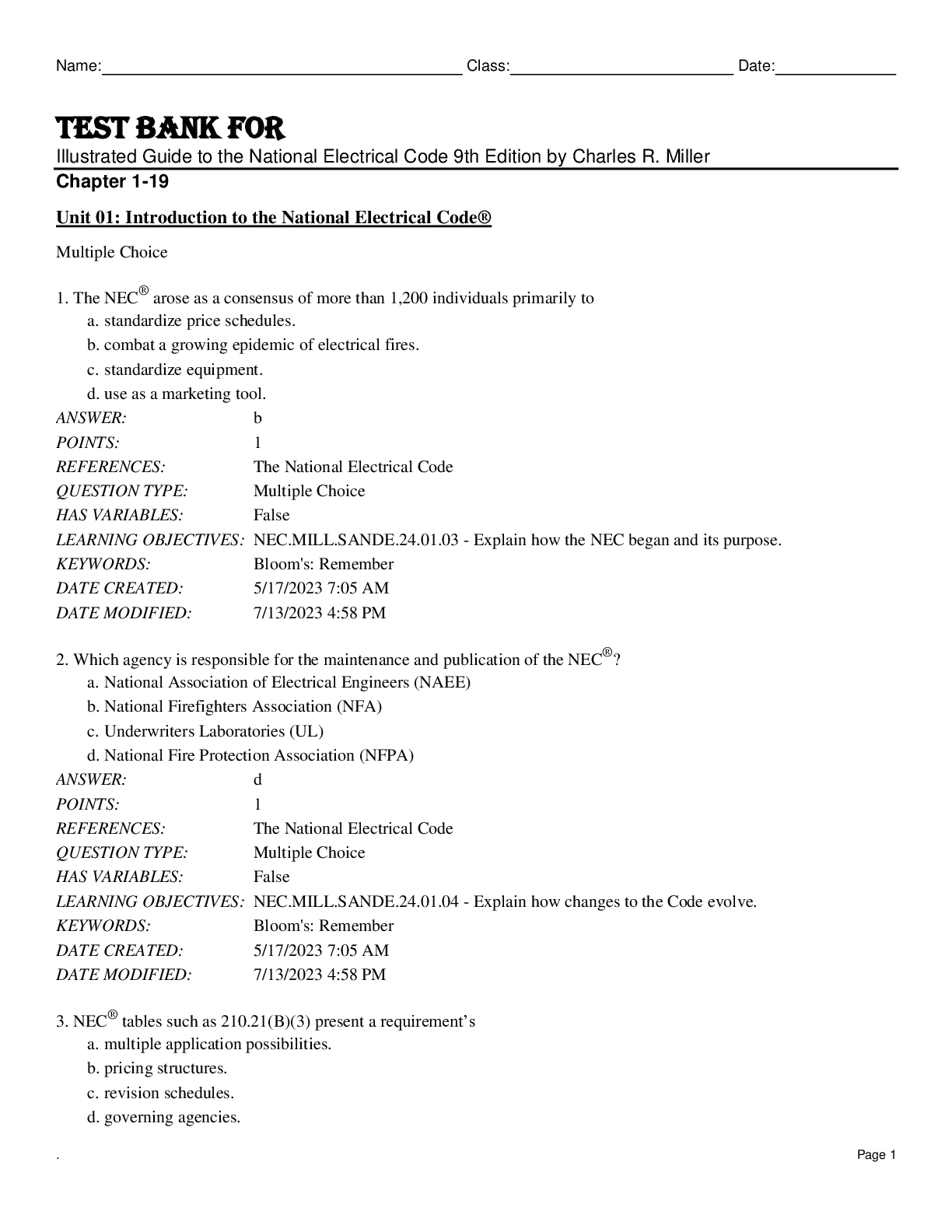
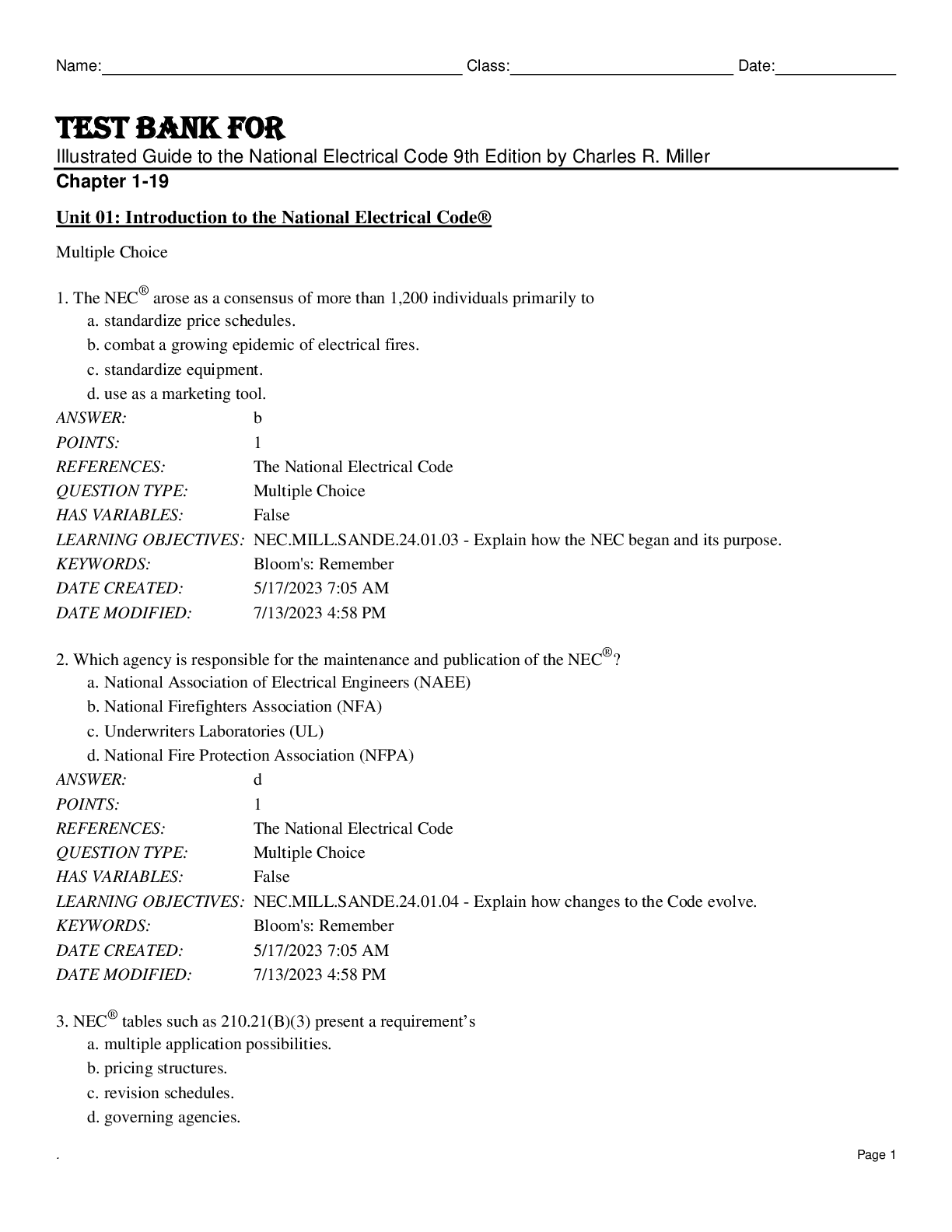
Q1. The NEC is primarily intended to:
A. Ensure efficiency of electrical system
...
Test Bank Solution and Answer Guide Illustrated Guide to the
National Electrical Code 9th Edition by Charles R.
Miller
Chapter 1 — General
Q1. The NEC is primarily intended to:
A. Ensure efficiency of electrical systems
B. Provide safety from electrical hazards
C. Establish pricing for equipment
D. Define design details for engineers
Answer: B
Rationale: NEC’s scope is safety—minimizing risks of fire and shock. It does not
address cost or design specifics.
Q2. Which authority enforces the NEC locally?
A. NFPA Board
B. Authority Having Jurisdiction (AHJ)
C. Utility company
D. OSHA exclusively
Answer: B
Rationale:The AHJ interprets and enforces the NEC, often local inspectors.
Q3. Which of the following is not covered by the NEC?
A. Marine installations regulated by other codes
B. Dwelling units
C. Commercial occupancies
D. Industrial occupancies
Answer: A
Rationale: NEC excludes ships, railways, and some communications facilities
under other regulations.
Q4. The NEC defines a “qualified person” as:
A. Anyone with electrical knowledge
B. An individual with skills and safety training to perform electrical tasks
C. A licensed engineer only
D. A certified inspector only
Answer: B
Rationale: A qualified person has demonstrated knowledge and training in
equipment and safety practices.
Q5. Which term means “an electric circuit including conductors between final
overcurrent device and outlet(s)”?
A. Feeder
B. Branch circuit
C. Service conductors
D. Equipment grounding conductor
Answer: B
Rationale:Branch circuit runs from OCPD to outlets. Feeder runs between OCPD
and other OCPD.
Q6. Which color identifies an equipment grounding conductor?
A. White
B. Green or bare
C. Red
D. Blue
Answer: B
Rationale: NEC requires green or bare copper for equipment grounding.
Q7. What does the NEC consider “listed” equipment?
A. Approved only by manufacturer
B. Approved by a qualified testing laboratory like UL
C. Chosen by installer
D. Recommended by engineer
Answer: B
Rationale: “Listed” = evaluated by recognized independent testing lab.
Q8. What is the purpose of the Nationally Recognized Testing Laboratory
(NRTL)?
A. Market products
B. Test and certify products for safety compliance
C. Issue installation permits
D. Enforce NEC in the field
Answer: B
Rationale: NRTLs verify that products meet standards for safe installation.
Q9. The NEC is revised every:
A. 2 years
B. 3 years
C. 5 years
D. 10 years
Answer: B
Rationale: NEC updates on a 3-year cycle.
Q10. The NEC applies to:
A. Design details and cost efficiency
B. Installation of conductors, equipment, and raceways for safe use
C. Manufacturing processes
D. Telecom wiring only
Answer: B
Rationale: Scope covers safe installation and use, not cost/design.
Chapter 2 — Wiring and Protection
Q1. Minimum size copper conductor for residential branch circuits:
A. 10 AWG
B. 14 AWG
C. 12 AWG
D. 16 AWG
Answer: B
Rationale: 14 AWG is minimum size permitted for 15 A circuits.
Q2. Branch circuits supplying receptacles in kitchens must:
A. Be one 15 A circuit
B. Be at least two 20 A small-appliance circuits
C. Share lighting loads
D. Use 10 AWG only
Answer: B
Rationale: NEC requires at least two 20 A small-appliance circuits for kitchens.
Q3. Overcurrent protection for continuous loads must be:
A. 100% of load
B. 125% of load
C. 80% of load
D. 150% of load
Answer: B
Rationale: NEC requires 125% for continuous loads to prevent overheating.
Q4. Conductors supplying a single motor are protected against:
A. Short circuit and overload by branch OCPD
B. Overload by motor OCPD, short circuit by branch OCPD
C. Ground fault only
D. Voltage drop only
Answer: B
Rationale:Branch OCPD protects against short circuit/ground fault; motor
overload device protects against overload.
Q5. Ground-fault circuit interrupters (GFCIs) protect against:
A. Overheating
B. Shock hazards from ground-fault current
C. Overvoltage
D. Short-circuit currents only
Answer: B
Rationale: GFCIs trip when detecting leakage to ground to prevent shock.
Q6. Minimum burial depth of direct-buried conductors under residential
driveways:
A. 12 in.
B. 18 in.
C. 24 in.
D. 30 in.
Answer: C
Rationale: NEC requires 24 in. burial depth under driveways unless using special
wiring methods.
[Show More]







![Preview of eBook [PDF] Electric Circuits 12th Edition By James Nilsson, Susan Riedel](https://browseimages.nyc3.digitaloceanspaces.com/paper-images/2026/04/05/kQESDnEk2026-04-05-08-1869d2994a4d3a9.png)
![Preview of eBook [PDF] Electricity Electromagnetism and Electric Circuits 1st Edition By Matsushita,](https://browseimages.nyc3.digitaloceanspaces.com/paper-images/2026/04/05/8apYEvyh2026-04-05-04-3369d264a2350f7.png)
![Preview of eBook [PDF] Electrical Installation Calculations Basic 10th Edition By Christopher Kitcher](https://browseimages.nyc3.digitaloceanspaces.com/paper-images/2026/04/05/OJiwhvig2026-04-05-04-3269d26461a4aef.png)