In relation to dental radiography, which one of the following terms refers to the
anatomical landmark used to identify a maxillary cuspid periapical film?
1. Maxillary sinus.
2. Mental foramen.
3. Bifurcated roots.
...
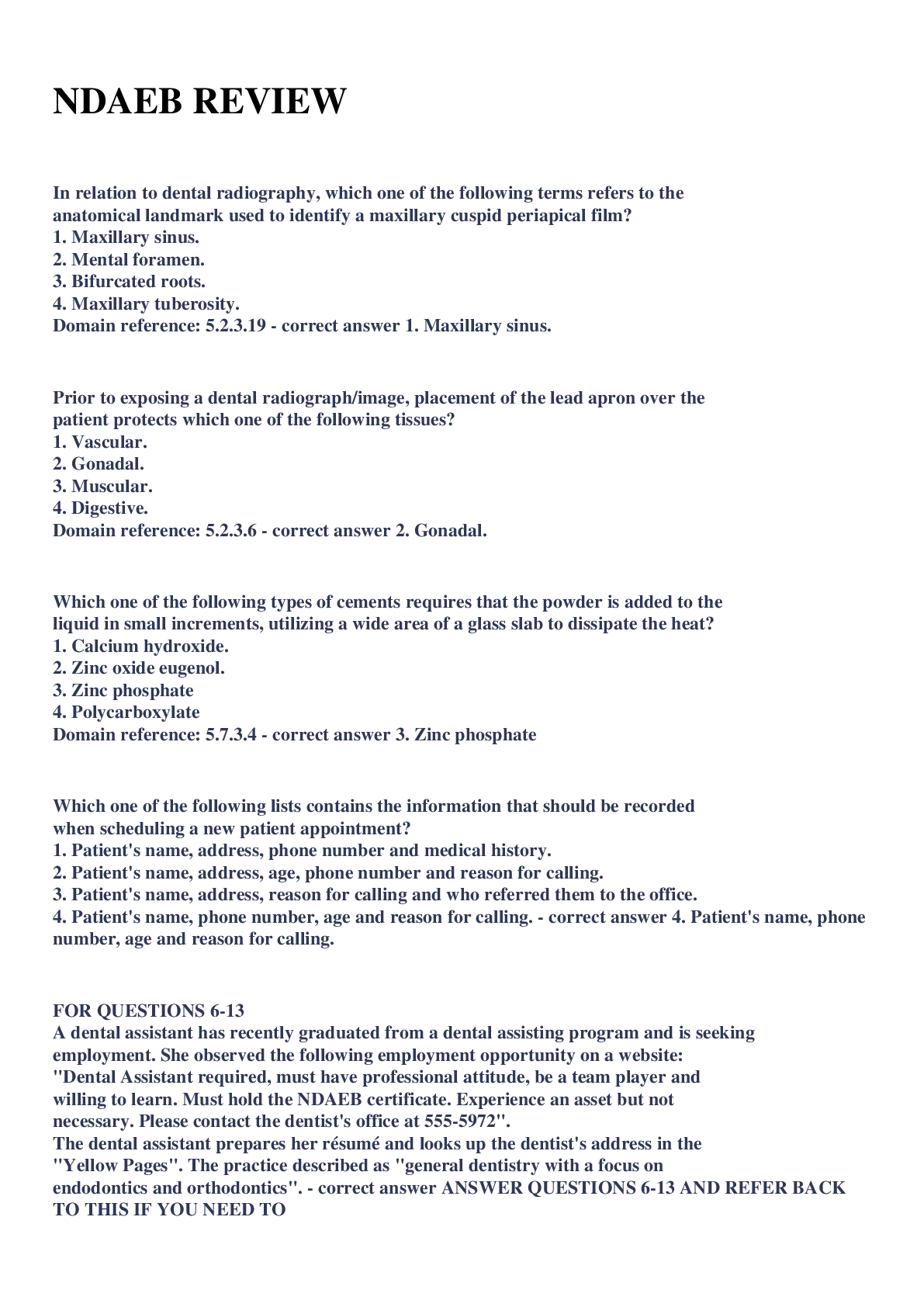
In relation to dental radiography, which one of the following terms refers to the
anatomical landmark used to identify a maxillary cuspid periapical film?
1. Maxillary sinus.
2. Mental foramen.
3. Bifurcated roots.
4. Maxillary tuberosity.
Domain reference: 5.2.3.19
1. Maxillary sinus.
Prior to exposing a dental radiograph/image, placement of the lead apron over the
patient protects which one of the following tissues?
1. Vascular.
2. Gonadal.
3. Muscular.
4. Digestive.
Domain reference: 5.2.3.6
2. Gonadal.
Which one of the following types of cements requires that the powder is added to the
liquid in small increments, utilizing a wide area of a glass slab to dissipate the heat?
1. Calcium hydroxide.
2. Zinc oxide eugenol.
3. Zinc phosphate
4. Polycarboxylate
Domain reference: 5.7.3.4
3. Zinc phosphate
Which one of the following lists contains the information that should be recorded
when scheduling a new patient appointment?
1. Patient's name, address, phone number and medical history.
2. Patient's name, address, age, phone number and reason for calling.
3. Patient's name, address, reason for calling and who referred them to the office.
4. Patient's name, phone number, age and reason for calling.
4. Patient's name, phone number, age and reason for calling.
FOR QUESTIONS 6-13
A dental assistant has recently graduated from a dental assisting program and is seeking
employment. She observed the following employment opportunity on a website:
"Dental Assistant required, must have professional attitude, be a team player and
willing to learn. Must hold the NDAEB certificate. Experience an asset but not
necessary. Please contact the dentist's office at 555-5972".
The dental assistant prepares her résumé and looks up the dentist's address in the
"Yellow Pages". The practice described as "general dentistry with a focus on
endodontics and orthodontics".
ANSWER QUESTIONS 6-13 AND REFER BACK TO THIS IF YOU NEED TO
How should the dental assistant make contact with the dentist's office?
1. Mail her résumé and cover letter.
2. A telephone call.
3. An interview.
4. To personally deliver her resume to the dentist.
2. A telephone call.
During the interview, the dentist states that he expects all of his employees to work within
their provincially approved scope-of-practice. If the dental assistant ignored her employer's
instructions and worked outside her scope-of-practice, which of the following would she be
violating?
1. Health and Welfare Canada Safety Code 30.
2. Principles of due care.
3. Acts of Omission.
4. Code of Ethics.
4. Code of Ethics.
The dentist explained that he treats many TMJ cases. He asked the dental assistant to name
two of the bones that form this joint. What should the dental assistant's response be?
1. Temporal and mandible.
2. Temporalis and mandible.
3. Temporal and maxilla.
4. Temporalis and malleus.
1. Temporal and mandible.
The dentist uses amalgam to restore posterior teeth. He asks the dental assistant how she
would store scrap amalgam. What should the dental assistant's response be?
1. In a 100% bleach solution.
2. In a tightly closed container.
3. In a well ventilated area.
4. In a glass container of developer solution.
2. In a tightly closed container
The dentist's new patient examination includes the recording of vital signs. When
asked over which artery the blood pressure cuff must be placed, the dental assistant's
response should be:
1. Pulmonary.
2. Carotid.
3. Radial.
4. Brachial.
4. Brachial.
During the interview, the dentist provides a short list of names to organize using the
rules for alphabetical filing. The dental assistant's response should be:
1. Cain, Edwin; Cain, E; McDonald, Sandra; McDonald, Susan; MacDonald, Susan;
Stanko, Patricia; St. Pierre, Alan.
2. Cain, E; Cain, Edwin; MacDonald, Susan; McDonald, Sandra; McDonald, Susan;
St. Pierre, Alan; Stanko, Patricia.
3. Cain, E; Cain, Edwin; MacDonald, Susan; McDonald, Susan; McDonald, Sandra;
Stanko, Patricia, St. Pierre, Alan.
4. Cain, E; Cain, Edwin; MacDonald, Susan; McDonald, Sandra; McDonald, Susan;
Stanko, Patricia, St. Pierre, Alan.
2. Cain, E; Cain, Edwin; MacDonald, Susan; McDonald, Sandra; McDonald, Susan;
The dentist expects the dental assistant to produce accurate diagnostic casts. This is
achieved by paying strict attention to three essential factors which are:
1. Water temperature, temperature of gypsum and force of mixing.
2. Water to powder ratio, mixing time and water temperature.
3. Force of mixing, length of vibration and water temperature.
4. Water to powder ratio, temperature of gypsum and force of mixing.
Domain reference:7.1
24
© 1998
2. Water to powder ratio, mixing time and water temperature.
[Show More]









![Preview of National Registry of Food Safety Professionals [Part 2] 2023 LATEST UPDATE](https://browseimages.nyc3.digitaloceanspaces.com/paper-images/2023/Aug/18/aCOGNEuW2023-08-18-04-5064dece4e0f60c.png)
![Preview of National Registry of Food Safety Professionals[Part 1] 2023 LATEST UPDATE](https://browseimages.nyc3.digitaloceanspaces.com/paper-images/2023/Aug/18/CWBDnioD2023-08-18-04-4864dece0bb2537.png)
![Preview of National Registry of Food Safety Professionals[Part 1] 2023 LATEST UPDATE](https://browseimages.nyc3.digitaloceanspaces.com/paper-images/2023/Aug/18/6YTcBd7N2023-08-18-04-4864dece0a49974.png)