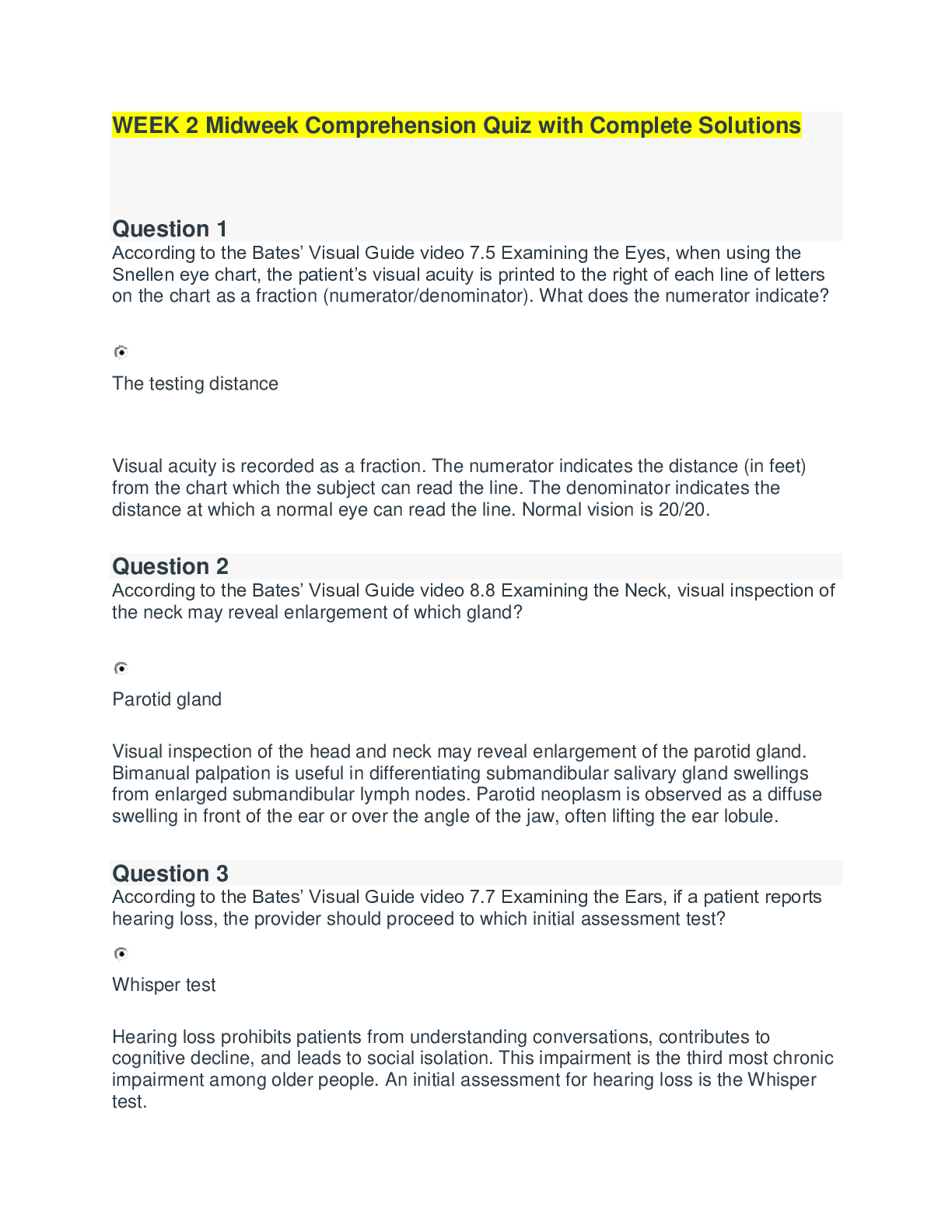
WEEK 2 Midweek Comprehension Quiz with Complete Solutions
Question 1
According to the Bates’ Visual Guide video 7.5 Examining the Eyes, when using the Snellen eye chart, the patient’s visual acuity is printed to
...
WEEK 2 Midweek Comprehension Quiz with Complete Solutions
Question 1
According to the Bates’ Visual Guide video 7.5 Examining the Eyes, when using the Snellen eye chart, the patient’s visual acuity is printed to the right of each line of letters on the chart as a fraction (numerator/denominator). What does the numerator indicate?
You
The testing distance
Visual acuity is recorded as a fraction. The numerator indicates the distance (in feet) from the chart which the subject can read the line. The denominator indicates the distance at which a normal eye can read the line. Normal vision is 20/20.
Question 2
According to the Bates’ Visual Guide video 8.8 Examining the Neck, visual inspection of the neck may reveal enlargement of which gland?
Correct!
Parotid gland
Visual inspection of the head and neck may reveal enlargement of the parotid gland. Bimanual palpation is useful in differentiating submandibular salivary gland swellings from enlarged submandibular lymph nodes. Parotid neoplasm is observed as a diffuse swelling in front of the ear or over the angle of the jaw, often lifting the ear lobule.
Question 3
According to the Bates’ Visual Guide video 7.7 Examining the Ears, if a patient reports hearing loss, the provider should proceed to which initial assessment test?
Whisper test
Hearing loss prohibits patients from understanding conversations, contributes to cognitive decline, and leads to social isolation. This impairment is the third most chronic impairment among older people. An initial assessment for hearing loss is the Whisper test.
Question 4
According to the lesson, which of the following physical examination techniques is not generally performed when assessing the respiratory system?
Palpation
The typical techniques used to assess the respiratory system are inspection, percussion, and auscultation. Inspect for symmetry, deformity, use of accessory muscles, and hair distribution. When performing percussion, you will tap on the surface to help determine the underlying structure. Auscultate for both normal and abnormal breath sounds, which are categorized as bronchial, bronchovesicular, vesicular, and adventitious sounds.
Question 5
According to the Bates’ Visual Guide video 8.8 Examining the Neck, which of the following findings should be noted while assessing lymph nodes? (Select all that apply)
Correct!
Tenderness
[Show More]







.png)


.png)


