TNCC Exam 8th edition study questions
with complete solutions
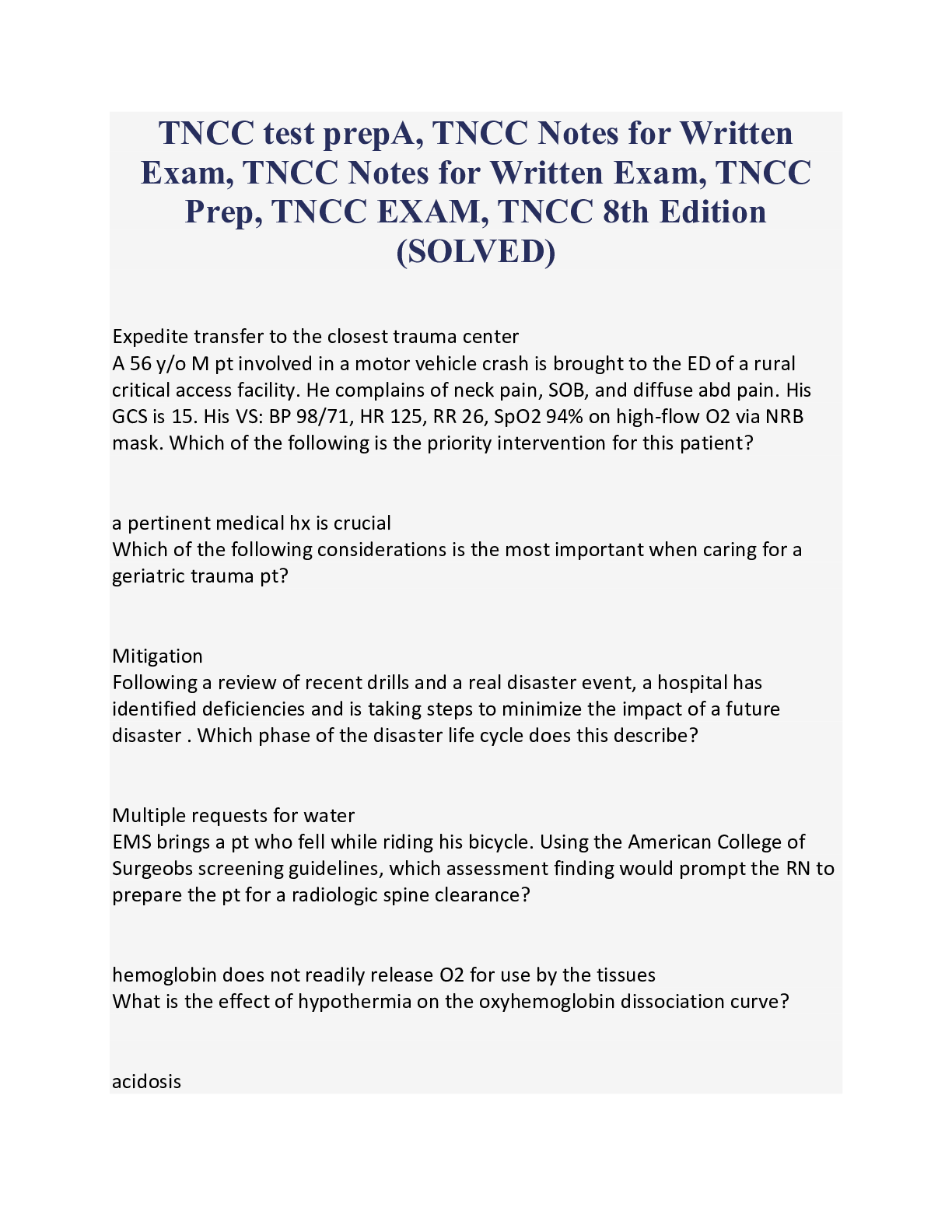
1.What is the effect of hypothermia on the oxyhemoglobin dissociation curve ✔✔Hemoglobin
does not readily release oxygen for use by the tissues A shift to
...
TNCC Exam 8th edition study questions
with complete solutions
1.What is the effect of hypothermia on the oxyhemoglobin dissociation curve ✔✔Hemoglobin
does not readily release oxygen for use by the tissues A shift to the left occurs in an environment
of low metabolic demand (hypothermia, hypocapnia, alkalosis), increasing hemoglobin's affinity
for oxygen.
EMS arrives with the intoxicated driver of a car involved in a motor vehicle crash. EMS reports
significant damage to the driver's side of the car. The patient is asking to have the cervical collar
removed. When it is appropriate to remove the cervical collar? ✔✔After a physical examination
if the patient has no radiologic abnormalities on CT A CT is recommended for spinal clearance
in an impaired patient.
The nurse is caring for a 120 kg male brought in after a warehouse fire and is calculating the
patient's fluid resuscitation needs. He has painful red blistering to the entire surface of both upper
extremities and superficial burns to the anterior chest. Using the modified Lund and Browder
chart to calculate the total body surface area burned, how much IV fluid would be administered
in the first 8 hours? ✔✔2280 mL Both upper arms = 8%, both lower arms = 6%, and both hands
= 5%, yielding 19 * 2 * 120 = 4560 mL. Half of the total is equal to 2280 mL. Superficial burns
are not included in the TBSA calculation for fluid resuscitation.
Which of the following is an expected finding in a patient with a tube thoracostomy connected to
a chest drainage system ✔✔Fluctuation in the water seal chamber Fluctuation in the water seal
chamber indicates the tube is placed correctly in the pleural space.
.A 35-year-old male presents with facial trauma after being struck in the face with a baseball. A
teardrop-shaped left pupil is noted on exam. What type of injury is suspected? ✔✔Globe rupture
A teardrop-shaped pupil suggests a globe rupture.
.A patient with a complete spinal cord injury in neurogenic shock will demonstrate hypotension
and which other clinical signs? ✔✔Bradycardia and absent motor function below the level of
injury Patients with a complete spinal cord injury will have absent motor function below the
level of the lesion. They become hypotensive and bradycardic due to loss of autonomic nervous
system function.
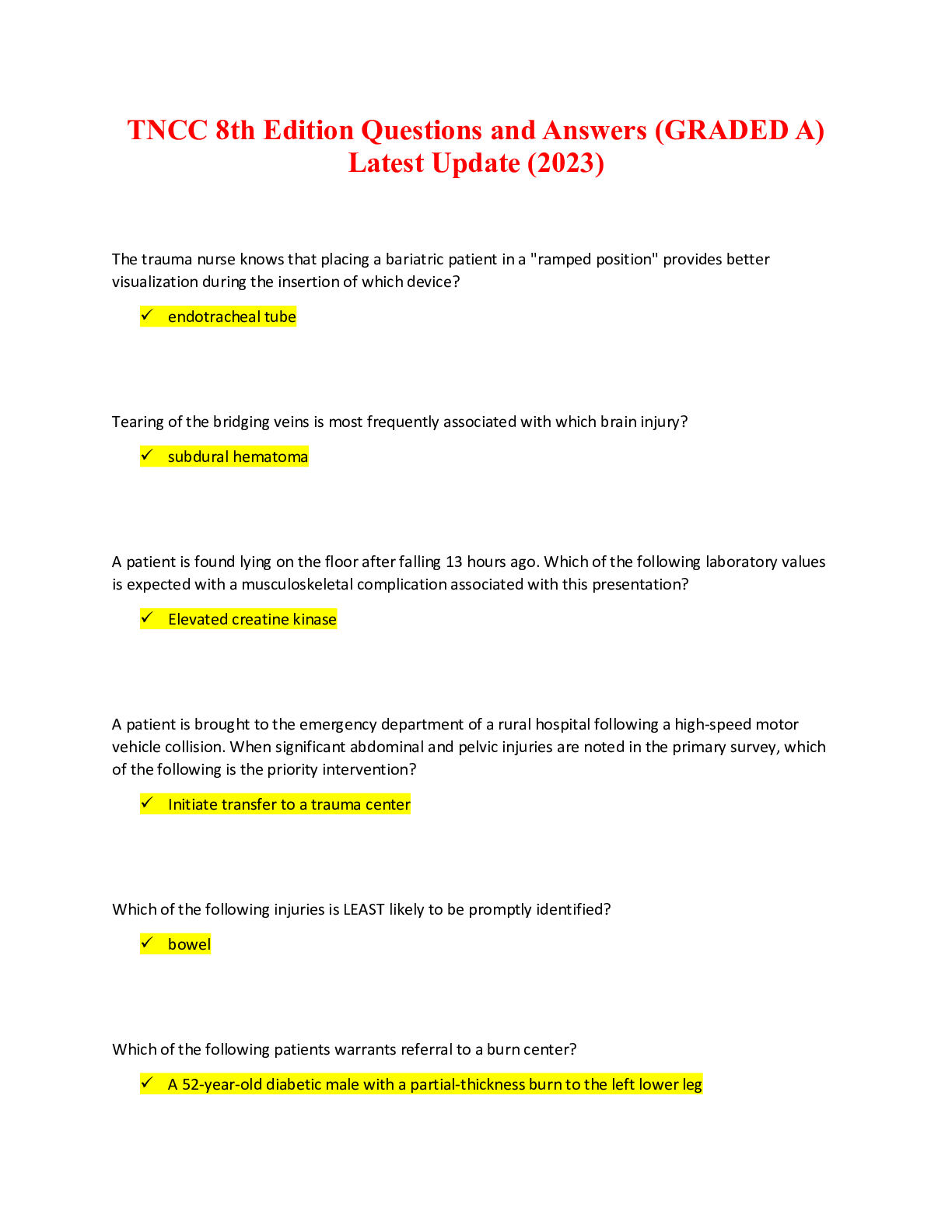
Which of the following patients warrants referral to a burn center? ✔✔A 52-year-old diabetic
male with a partial-thickness burn to the left lower leg This patient has a 7% TBSA burn with a
preexisting medical history that could complicate management, prolong recovery, or affect
mortality.
You are caring for a patient who was involved in a motor vehicle crash and is 32 weeks
pregnant. Findings of your secondary survey include abdominal pain on palpation, fundal height
at the costal margin, and some dark bloody show. Varying accelerations and decelerations are
noted on cardiotocography. These findings are most consistent with which of the following?
✔✔Placental abruption The findings of abdominal pain, elevated fundal height, dark bloody
show, and fetal distress are most consistent with placental abruption.
A 20-year-old male presents to the ED complaining of severe lower abdominal pain after landing
hard on the bicycle cross bars while performing an aerial BMX maneuver. Secondary assessment
reveals lower abdominal tenderness and scrotal ecchymosis. Which of the following orders
would the nurse question? ✔✔Straight catheter for urine sample Insertion of a urinary catheter is
contraindicated if urethral transection is suspected. Signs and symptoms of urethral injury
include blood at the meatus, perineal ecchymosis, scrotal ecchymosis, and a high-riding or nonpalpable prostate.
Which of the following occurs during the third impact of a motor vehicle crash? ✔✔The aorta is
torn at its attachment with the ligamentum arteriosum This occurs during the third impact.
All of these are considered a critical communication point in trauma care EXCEPT which of the
following? ✔✔Defusings A defusing is part of critical incident stress management but is not
considered a critical communication point in trauma care.
Which of the following mnemonics can help the nurse prioritize care for a trauma patient with
massive uncontrolled hemorrhage? ✔✔MARCH The MARCH mnemonic stands for massive
hemorrhage, airway, respiration, circulation, and head injury/hypothermia. The MARCH
mnemonic recognizes uncontrolled hemorrhage as the major cause of preventable death after
injury.
You are treating a 27-year-old male in respiratory distress who was involved in a house fire.
Calculating total body surface area (TBSA) burned is deferred due to the need for emergent
intubation. At what rate should you begin fluid resuscitation? ✔✔500 mL/hour Prior to
calculating TBSA, this is the recommended starting point for fluid resuscitation for patients 14
years of age and older
A 49-year-old restrained driver involved in a motor vehicle collision presents to the trauma
center complaining of abdominal, pelvic, and bilateral lower extremity pain. Vital signs are
stable. The nurse can anticipate all of these after a negative FAST exam EXCEPT which of the
following? ✔✔Diagnostic peritoneal lavage Diagnostic peritoneal lavage is indicated for
hemodynamically unstable patients or if FAST and CT are not available.
An elderly patient with a history of anticoagulant use presents after a fall at home today. She
denies any loss of consciousness. She has a hematoma to her forehead and complains of
headache, dizziness, and nausea. What is the most likely cause of her symptoms? ✔✔Subdural
hematoma Subdural hematomas are characterized by nausea, vomiting, headache, changes in
level of consciousness, ipsilateral dilated, nonreactive pupil, and unilateral weakness or
hemiparesis. These typically occur after a fall or assault.
Tearing of the bridging veins is most frequently associated with which brain injury?
✔✔Subdural hematoma Subdural hematomas are usually caused by tearing of the bridging veins
and associated with direct injury to the underlying brain tissue.
.During the primary survey of an unconscious patient with multi-system trauma, the nurse notes
snoring respirations. What priority nursing intervention should be performed next? ✔✔Insert an
oropharyngeal airway if there is no gag reflex Snoring respirations may indicate airway
obstruction from the tongue. Insert an airway adjunct to alleviate obstruction by the tongue.
Oropharyngeal airways can be used in patients without a gag reflex.
What bedside monitoring parameters are used to assess for adequacy of oxygenation and
effectiveness of ventilation? ✔✔Pulse oximetry and capnography Pulse oximetry measures the
percentage of hemoglobin saturated with oxygen. Capnography measures the amount of carbon
dioxide exhaled. Carbon dioxide is the end-product of ventilation and a reflection of metabolism
and pulmonary function.
Which of the following is NOT considered a benefit of debriefings? ✔✔Identifying individuals
who made mistakes during the traumatic event Debriefings are not used to single out individuals
who made mistakes. Debriefings are used to provide an opportunity to review performance and
identify areas for improvement with a sharing of individual responses.
Which of the following is NOT considered goal-directed therapy for cardiogenic shock?
✔✔Pericardiocentesis A pericardial tamponade is a form of obstructive, not cardiogenic, shock.
A patient is brought to the emergency department of a rural hospital following a high-speed
motor vehicle collision. When significant abdominal and pelvic injuries are noted in the primary
survey, which of the following is the priority intervention? ✔✔Initiate transfer to a trauma center
Early consideration for transfer to a trauma center is essential to ensure optimal outcomes.
The most reassuring finding for a male patient with hip pain after a fall is which of the
following? ✔✔Pelvic stability Uncontrolled hemorrhage is the major cause of preventable death
after injury. Unstable pelvic fractures increase the volume of the pelvic cavity and can be lifethreatening due to blood loss.
EMS brings a patient from a motor vehicle crash. Vital signs are BP 90/49 mm Hg, heart rate 48
beats/minute, respiratory rate 12 breaths/minute, temperature 97.2°F (36.2° C). The patient
exhibits urinary incontinence and priapism. These assessment findings are most consistent with
which of the following types of spinal cord injury? ✔✔Complete Incontinence, priapism, and
hypotension with bradycardia are manifestations of a complete spinal cord injury.
What physiologic change in the elderly population increases the risk of traumatic injury?
✔✔Decreased subcutaneous fat Decreased subcutaneous fat and thinning of the skin increases
the risk of injuries from soft tissue trauma and increases the risk of hypothermia
If a patient has received multiple transfusions of banked blood preserved with citrate, which
electrolyte is most likely to drop and require supplementation? ✔✔Calcium Hypocalcemia is a
concern with massive transfusion because citrate is added to banked blood to prevent
coagulation. Citrate chelates (binds with) calcium, rendering it inactive.
Which of the following is a possible complication of positive-pressure ventilation?
✔✔Worsening pneumothorax Positive-pressure ventilation can lead to increased air in the chest
cavity without a route of escape, worsening a pneumothorax and possibly leading to a tension
pneumothorax.
An intubated and sedated patient in the emergency department has multiple extremity injuries
with the potential for causing compartment syndrome. What is the most reliable indication of
compartment syndrome in a patient who is unconscious? ✔✔Pressure Pressure can be assessed
in the limb by palpation or direct measurement. The compartment or limb will feel tight or tense
upon palpation. The skin may also appear taut and shiny.
A patient arrives with a large open chest wound after being assaulted with a machete. Prehospital
providers placed a nonporous dressing over the chest wound and taped it on three sides. He is
now showing signs of anxiety, restlessness, severe respiratory distress, cyanosis and decreasing
blood pressure. Which of the following is the MOST appropriate immediate intervention?
✔✔Dressing removal This is the fastest effective intervention for this decompensating patient. A
nonporous dressing taped on three sides is temporary and has variable effectiveness. If signs and
symptoms of tension pneumothorax develop after the application of the dressing
Which of the following is a component of the trauma triad of death? ✔✔Acidosis The three
components of the trauma triad of death are acidosis, hypothermia and coagulopathy.
When is the tertiary survey completed for a trauma patient? ✔✔Within 24 hours of the trauma
The tertiary survey consists of a complete examination performed following the primary and
secondary surveys and within 24 hours after trauma to identify any injuries missed during the
initial assessment.
A 36-year-old female has a deformity of the left wrist after a fall. She is reluctant to move her
hand due to pain. Which of the following is the most appropriate intervention? ✔✔Apply a splint
and elevate the extremity above the level of the heart Splinting the injured extremity stabilizes
the extremity and reduces further injury. Elevation above the level of the heart promotes venous
return and may reduce swelling.
A trauma patient is restless and repeatedly asking "Where am I?" Vital signs upon arrival were
BP 110/60 mm Hg, HR 96 beats/minute and RR 24 breaths/minute. Her skin is cool and dry.
Current vital signs are BP 104/84 mm Hg, HR 108 beats/minute, and RR 28 breaths/minute. The
patient is demonstrating signs and symptoms of which stage of shock? ✔✔Compensated Patients
in compensated shock exhibit subtle changes in level of consciousness and vital signs including a
narrowed pulse pressure.
Why is a measure of serum lactate obtained in the initial assessment of a trauma patient? ✔✔To
gauge end-organ perfusion and tissue hypoxia The serum lactate is an indicator of end-organ
tissue perfusion and tissue hypoxia.
A patient with a lower extremity fracture complains of severe pain and tightness in his calf,
minimally relieved by pain medications. Which of the following is the priority nursing
intervention? ✔✔Elevating the extremity to the level of the heart Elevating the extremity higher
than the heart can reduce circulation and tissue perfusion if compartment syndrome is suspected.
Which of the following pulse pressures indicate early hypovolemic shock? ✔✔Narrowed A
rising diastolic blood pressure, reflecting peripheral vasoconstriction, results in a narrowed pulse
pressure.
EMS brings a patient who fell while riding his bicycle. Using the American College of Surgeons
screening guidelines, which assessment finding would prompt the nurse to prepare the patient for
radiologic spine clearance? ✔✔Smell of alcohol on breath Suspected intoxication warrants
radiologic spine clearance.
A 5-year-old child presents to the ED with bruises to the upper arms and buttocks in various
stages of healing and multiple small, clean, round burns to the back. There are no abnormalities
found based on the pediatric assessment triangle or primary survey. Which of the following is the
priority nursing intervention? ✔✔Report your suspicion of maltreatment in accordance with
local regulations Nurses are mandated reporters in most jurisdictions. With no alterations in the
primary survey, this is the priority intervention.
A toddler who fell off a trampoline is making eye contact with the family and is consolable.
There is no increased work of breathing and the skin color is pink. The nurse asks the patient to
open his mouth, but the patient does not respond to commands. The nurse recognizes this as an
expected finding due to which of the following conditions? ✔✔Developmental stage An alert or
older infant or toddler will recognize his or her caregiver but be cautious of strangers and my not
respond to commands This is normal.
There has been a mass casualty incident a block from the hospital. The hospital is receiving
dozens of patients. A truck arrives with an unresponsive patient in the back with obvious chest
and abdominal trauma. Agonal respirations do not improve with airway positioning. Using the
START triage algorithm, you would triage tag this patient as which of the following? ✔✔Black
This patient is unlikely to survive given the severity of their injuries and is triaged as expectant.
Resources should be reserved for individuals considered to be more salvageable.
A patient has been in the emergency department for several hours waiting to be admitted. He
sustained multiple rib fractures and a femur fracture after a fall. He has been awake, alert, and
complaining of leg pain. His wife reported that he suddenly became anxious and confused. Upon
reassessment, the patient is restless with respiratory distress and petechiae to his neck. The
patient is exhibiting signs and symptoms most commonly associated with which of the following
conditions? ✔✔Fat embolism Symptoms of fat embolism include decreased mental status,
restlessness, agitation, respiratory distress, and a petechial rash to the head, neck, anterior thorax,
conjunctivae, buccal mucous membranes, and axillae.
The trauma nurse knows that placing a bariatric patient in a "ramped position" provides better
visualization during the insertion of which device? ✔✔Endotracheal tube The ramped position is
described as elevation of the head with the external auditory canal parallel with the sternal notch
to provide better visualization of pharyngeal landmarks. This position is useful during intubation.
The nurse is assessing a patient with a fractured forearm that was splinted three hours ago.
Which symptom is of most concern as a late sign of an evolving complication? ✔✔Weak radial
pulse A weak radial pulse is evidence of an actual compromise in circulation.
Which of the following is true about the log-roll? ✔✔It can worsen cord damage from an
unstable spinal injury The log-roll maneuver has been shown to cause spinal motion that can
worsen damage from an unstable spinal injury.
What factor contributes most to the kinetic energy of a body in motion? ✔✔Velocity Kinetic
energy is equal to one half the mass multiplied by the square of the velocity. Doubling the
velocity quadruples its contribution to kinetic energy. Doubling the mass only doubles its
contribution to kinetic energy.
An unresponsive trauma patient has an oropharyngeal airway in place, shallow and labored
respirations, and dusky skin. The trauma team has administered medications for drug-assisted
intubation and attempted intubation but was unsuccessful. What is the most appropriate
immediate next step? ✔✔Ventilate with a bag-mask device Assist ventilations with a bag-mask
device until a definitive airway is obtained is the priority.
Which of the following is a late sign of increased intracranial pressure? ✔✔Decreased
respiratory effort Other late signs of increased intracranial pressure include dilated, nonreactive
pupils, unresponsiveness, abnormal motor posturing, and the Cushing response.
Which of the following injuries is LEAST likely to be promptly identified? ✔✔Bowel Hollow
organ injury signs and symptoms may be subtle and delayed but are associated with a high
mortality rate if not identified.
A 56-year-old male patient involved in a motor vehicle crash is brought to the emergency
department of a rural critical access facility. He complains of neck pain, shortness of breath, and
diffuse abdominal pain. His Glasgow Coma Score is 15. His vital signs are as follows: BP 98/71
mm Hg, HR 125 beats/minute, RR 26 breaths/minute, SpO2 94% on high-flow oxygen via nonrebreather mask. Which of the following is the priority intervention for this patient? ✔✔Expedite
transfer to the closest trauma center The American College of Surgeons recommends that
patients with significant injuries be transported to a trauma center for definitive care. This
patient's injuries might not be definitively diagnosed, but his symptoms and vital signs indicate
the need for
Which of the following is most likely to contribute to inadequate oxygenation and ventilation?
✔✔Advanced age Older patients are more likely to have pulmonary comorbidities and decreased
pulmonary reserve.
Which of the following assessment findings differentiates a tension pneumothorax from a simple
pneumothorax? ✔✔Hypotension that worsens with inspiration Hypotension that worsens with
inspiration is associated with tension pneumothorax due to compression of the heart and great
vessels (obstructive shock). The increased intrathoracic pressure with inspiration worsens the
hypotension.
[Show More]