The gray matter on the surface of the cerebral hemispheres is called the:
a. cerebrum.
b. cerebellum.
c. cerebral cortex.
d. corpus callosum.
c. cerebral cortex.
Term that refers to the most severe allerg
...
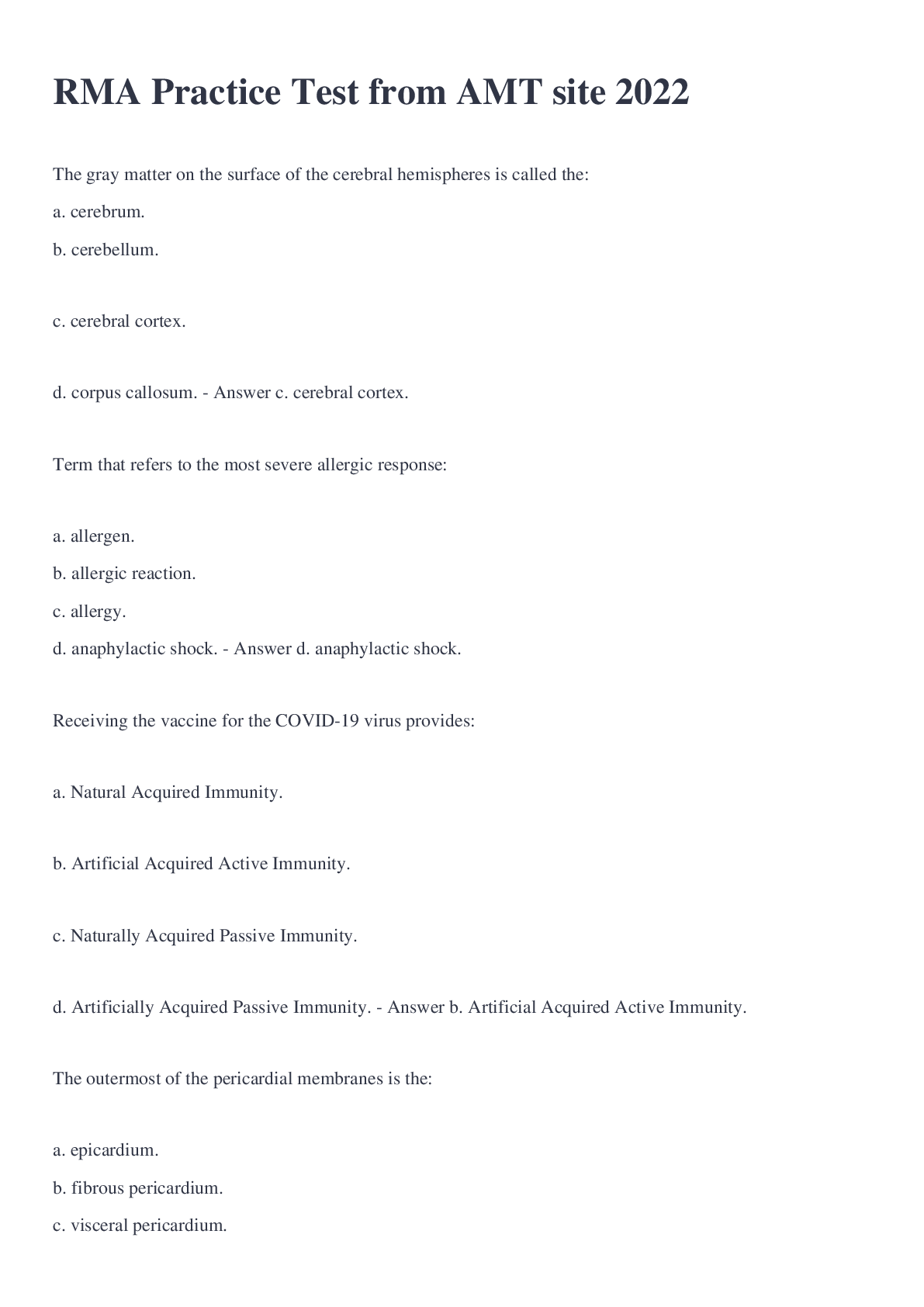
The gray matter on the surface of the cerebral hemispheres is called the:
a. cerebrum.
b. cerebellum.
c. cerebral cortex.
d. corpus callosum.
c. cerebral cortex.
Term that refers to the most severe allergic response:
a. allergen.
b. allergic reaction.
c. allergy.
d. anaphylactic shock.
00:01
01:41
Receiving the vaccine for the COVID-19 virus provides:
a. Natural Acquired Immunity.
b. Artificial Acquired Active Immunity.
c. Naturally Acquired Passive Immunity.
d. Artificially Acquired Passive Immunity.
b. Artificial Acquired Active Immunity.
The outermost of the pericardial membranes is the:
a. epicardium.
b. fibrous pericardium.
c. visceral pericardium.
d. parietal pericardium.
b. fibrous pericardium.
The vitamin produced by the normal flora of the colon, in amounts sufficient to meet a person's daily need, is vitamin:
a. A
b. E
c. K
d. D
c. K
The origin of a muscle is:
a. where the muscle ends.
b. always attached to a bone.
c. where the muscle begins.
d. attached to another muscle
c. where the muscle begins
What is the blood type that determines if people are universal recipients?
a. Type A
b. Type B
c. Type AB
d. Type O
Type AB
A genetic disorder characterized by the inability of the blood to clot properly is:
a. galactosemia.
b. hemophilia.
c. thalassemia.
d. thrombocythemia.
b.hemophilia.
What test can detect down's syndrome during pregnancy?
a. Amniocenteses
b. Complete blood count
c. Spinal tap
d. CT scan
a. Amniocenteses
Many of the questions on patient history forms are used to determine:
a. conditions at their place of employment or home.
b. lifestyle choices such as smoking and drinking.
c. frequency of travel outside of the state.
d. occupation of immediate family members.
b. lifestyle choices such as smoking and drinking
Prostatic hypertrophy is:
a. an enlarged prostate.
b. an inflamed prostate.
c. no prostate.
d. decreased size of the prostate.
a. an enlarged prostate
The largest bone of the body is the:
a. ulna
b. tibia
c. radius
d. femur
d. femur
[Show More]