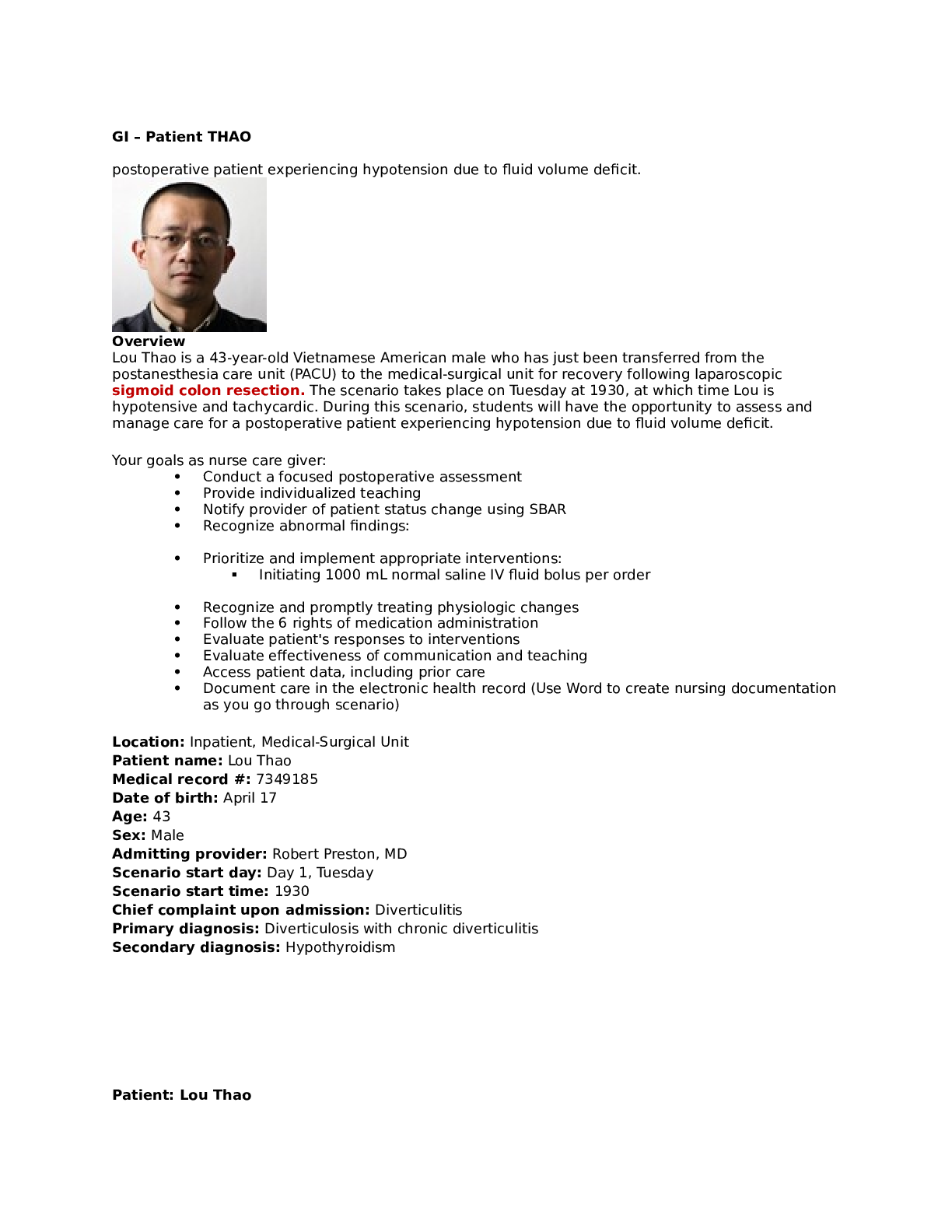
Lou Thao is a 43-year-old Vietnamese American male who has just been transferred from the
postanesthesia care unit (PACU) to the medical-surgical unit for recovery following laparoscopic
sigmoid colon resection. The sc
...
Lou Thao is a 43-year-old Vietnamese American male who has just been transferred from the
postanesthesia care unit (PACU) to the medical-surgical unit for recovery following laparoscopic
sigmoid colon resection. The scenario takes place on Tuesday at 1930, at which time Lou is
hypotensive and tachycardic. During this scenario, students will have the opportunity to assess and
manage care for a postoperative patient experiencing hypotension due to fluid volume deficit.
Your goals as nurse care giver:
Conduct a focused postoperative assessment
Provide individualized teaching
Notify provider of patient status change using SBAR
Recognize abnormal findings:
Prioritize and implement appropriate interventions:
Initiating 1000 mL normal saline IV fluid bolus per order
Recognize and promptly treating physiologic changes
Follow the 6 rights of medication administration
Evaluate patient's responses to interventions
Evaluate effectiveness of communication and teaching
Access patient data, including prior care
Document care in the electronic health record (Use Word to create nursing documentation
as you go through scenario)
Location: Inpatient, Medical-Surgical Unit
Patient name: Lou Thao
Medical record #: 7349185
Date of birth: April 17
Age: 43
Sex: Male
Admitting provider: Robert Preston, MD
Scenario start day: Day 1, Tuesday
Scenario start time: 1930
Chief complaint upon admission: Diverticulitis
Primary diagnosis: Diverticulosis with chronic diverticulitis
Secondary diagnosis: Hypothyroidism
Patient: Lou Thao
Lou Thao is a 43-year-old Vietnamese American male who has just been transferred from the
postanesthesia care unit (PACU) to the medical-surgical unit for recovery following laparoscopic
sigmoid colon resection. The scenario takes place on Tuesday at 1930. During the scenario, Lou is
experiencing fluid volume deficit and has low blood pressure and an increased heart rate. He is dizzy,
thirsty, and groggy. He feels scared and vulnerable. He explains his symptoms very clearly but has no
idea what is going on. His wife May is at the bedside and is supportive. She voices concern regarding
Lou's condition.
Patient response guide: Explain each of these developments, why they have occurred, and
necessary management.
General Please call me Lou.
My birth date is April 17.
I don't have any allergies.
During initial
assessment
Lou is experiencing fluid volume deficit. He is also beginning
to experience postoperative pain, but his primary complaints
are related to fluid deficit. Until fluids are given, Lou should
express worsening dizziness, thirst, and weakness.
I am dizzy and feel like I could pass out. The
room is spinning around.
I feel groggy.
I am very thirsty.
I don't feel right.
Oh! I am so dizzy.
Lou's pain increases throughout the scenario.
The pain is about 6 on a 10-point scale and
constant.
It hurts when I breathe deeply. It especially hurts
in my lower abdomen.
My pain is getting worse. Is the anesthetic
wearing off?
The nurse in the recovery area told me I would get
to use a button to give myself pain medication.
Can you give me that now?
If IV fluid bolus is
initiated
Why does he have these responses?
I feel less dizzy.
What is going on? Why did I feel so strange?
If IV fluid bolus is
NOT
administered
Why does he have these responses?
Oh! I am so light-headed! I think I'm going to
faint!
Lou becomes unresponsive.
Time: 1930-1939
Physiologic State 1
T = 97.4 F (36.3 C)
BP = 78/42
P = 132
RR = 22
O2 Sat = 95% (2 L/min via nasal cannula)
Heart sounds: Regular
Lung sounds: Clear
Bowel sounds: Absent
Pulses: 1+ bilaterally
Pain: 6/10
Lou states, "I am dizzy and feel like I
could pass out. The room is spinning
around. I am very thirsty."
Situation/Transition
Lou Thao is lying in bed with the head of bed at 15 degrees. He is alert and oriented but groggy after
surgery. He is complaining of dizziness, weakness, and light-headedness related to fluid volume deficit.
Vital signs indicate hypotension and tachycardia. Urine in indwelling catheter bag is concentrated and
amber. Lou's anxious wife is in the room asking many questions.
When notified, the provider gives the following orders:
Administer 1 liter normal saline bolus x 1 now over 1 hour.
I'll be in to evaluate him shortly.
Call me immediately if he gets worse before I get there.
I'll enter the order in the EHR.
Expected Student Performance
1. Conducts initial and focused assessments.
2. Recognizes abnormal findings: Pulse is high, BP low, RR high, O2 kind of low, bowl
sounds absent, 1+ bilaterally pulses, pain 6, pt states being dizzy, and thirsty.
3. Notifies provider of patient status using SBAR:
S: Mr. Lou is groggy, coma playing of dizziness , weakness, and light headedness
B: Lou Thao is a 43-year-old Vietnamese American male who has just been transferred from the
postanesthesia care unit (PACU) to the medical-surgical unit for recovery following laparoscopic
sigmoid colon resection.
A: vital signs indicate hypotension and tachycardia, urine is concentrated and amber due to
fluid volume deficit
R: push fluids and monitor
4. Describe use of therapeutic communication with patient and wife:
Prioritize the physical , mental and emotional well being of the pt , provide with support and
information while maintaining a level of professional distance and objectivity.
[Show More]




, 6e by Russell Hoye, Katie Misener, Michael Naraine, Catherine Ordway.png)
.png)