INTERNATIONAL LAW LCP4801
EXAMINATION PAPER OCT/NOV 2000
QUESTION 1
(a) List the differences between public international law and municipal law (5)
Municipal law Public International law
Full legislative body. The l
...
INTERNATIONAL LAW LCP4801
EXAMINATION PAPER OCT/NOV 2000
QUESTION 1
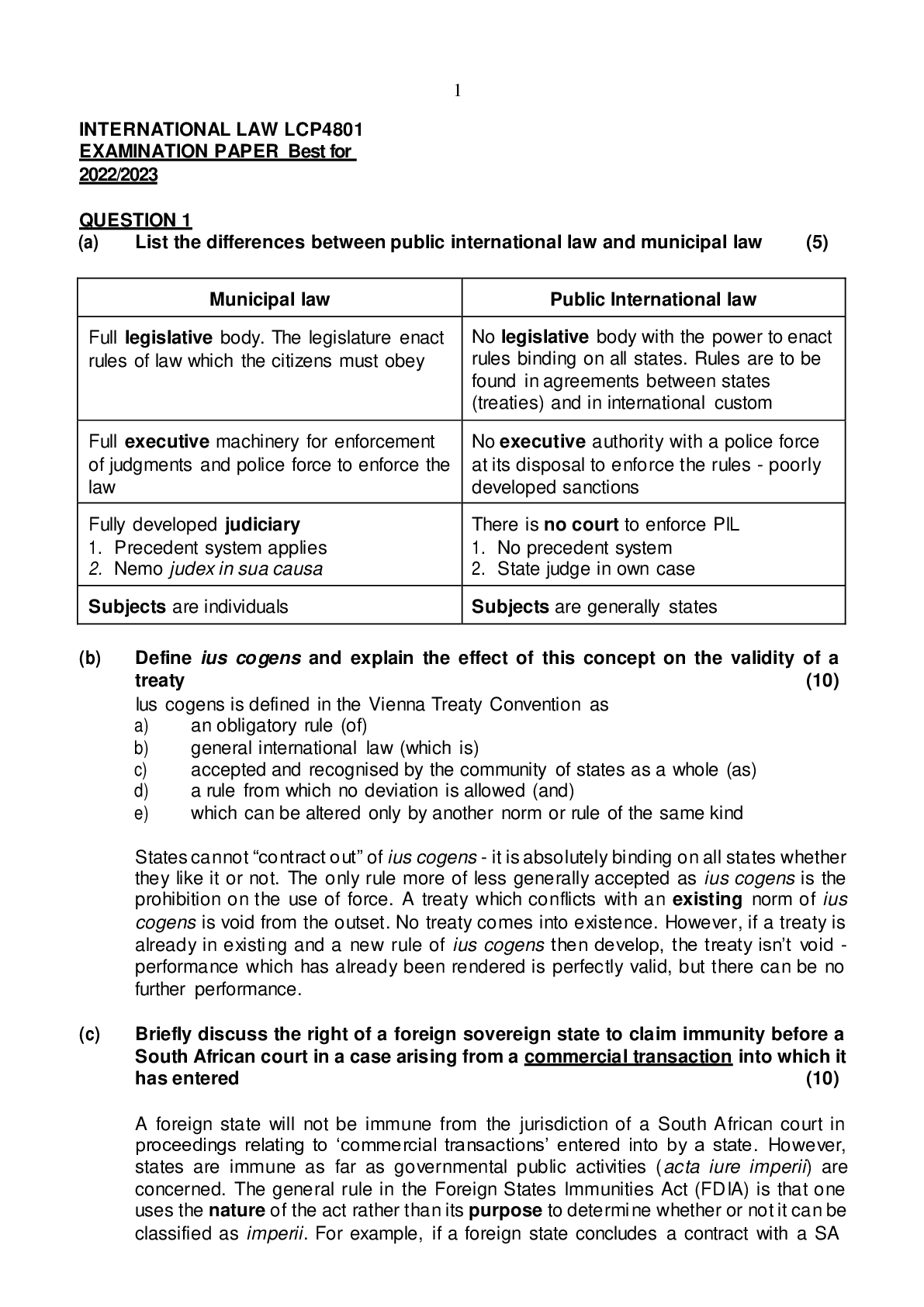
(a) List the differences between public international law and municipal law (5)
Municipal law Public International law
Full legislative body. The legislature enact
rules of law which the citizens must obey
No legislative body with the power to enact
rules binding on all states. Rules are to be
found in agreements between states
(treaties) and in international custom
Full executive machinery for enforcement
of judgments and police force to enforce the
law
No executive authority with a police force
at its disposal to enforce the rules - poorly
developed sanctions
Fully developed judiciary
1. Precedent system applies
2. Nemo judex in sua causa
There is no court to enforce PIL
1. No precedent system
2. State judge in own case
Subjects are individuals Subjects are generally states
(b) Define ius cogens and explain the effect of this concept on the validity of a
treaty (10)
Ius cogens is defined in the Vienna Treaty Convention as
a) an obligatory rule (of)
b) general international law (which is)
c) accepted and recognised by the community of states as a whole (as)
d) a rule from which no deviation is allowed (and)
e) which can be altered only by another norm or rule of the same kind
States cannot “contract out” of ius cogens - it is absolutely binding on all states whether
they like it or not. The only rule more of less generally accepted as ius cogens is the
prohibition on the use of force. A treaty which conflicts with an existing norm of ius
cogens is void from the outset. No treaty comes into existence. However, if a treaty is
already in existing and a new rule of ius cogens then develop, the treaty isn’t void -
performance which has already been rendered is perfectly valid, but there can be no
further performance.
(c) Briefly discuss the right of a foreign sovereign state to claim immunity before a
South African court in a case arising from a commercial transaction into which it
has entered (10)
A foreign state will not be immune from the jurisdiction of a South African court in
proceedings relating to ‘commercial transactions’ entered into by a state. However,
states are immune as far as governmental public activities (acta iure imperii) are
concerned. The general rule in the Foreign States Immunities Act (FDIA) is that one
uses the nature of the act rather than its purpose to determine whether or not it can be
classified as imperii. For example, if a foreign state concludes a contract with a SA
2
Company to supply army boots and then refuses to pay, will the foreign state be able to
raise immunity in a subsequent action. If we apply the nature of the contract we will find
that we are dealing with a normal contract of sale, which will not attract immunity, but if
we apply the purpose of the contract, things will be different. In this case we have to
ask what purpose the boots serve. Without boots the army cannot function, and the
army is there for the defence of the state. The contract of sale would therefore be
classified as a governmental act which will attract immunity.
The American Case Victory Transport Inc laid down certain acts which can be regarded
as imperii.
a) internal administrative acts
b) legislative acts
c) acts related to the armed forces
d) acts related to diplomatic activity
e) public loans
The trend in Public International law is however, to restrict immunity where possible.
QUESTION 2
Although there is no formal agreement on the use of water resources between South
Africa and Lesotho, Lesotho has for 30 years allowed South Africa to draw water from a
dam in Lesotho.
After a democratic general election, a new government comes to power in Lesotho. This
government immediately closes down the pumping station, cutting off the supply of
water to South Africa. Dr Zuma, the South African Minister of Foreign Affairs, delivers a
formal protest to her Lesotho counterpart. The Lesotho government acknowledges that
it is legally bound to re-open the pumping station and does so immediately.
One month later, however, the Lesotho government again closes the pumping station
declaring that in the light of the unequal distribution of wealth in Southern Africa, it is no
longer prepared to allow South Africa access to cheap water.
South Africa claims that Lesotho’s actions amount to a violation of a norm of public
international law.
Discuss fully, using the facts above and relating them to international case law, whether
Lesotho has violated a norm of public international law and what body South Africa
should approach to enforce its claim (20)
For Lesotho to have violated a norm of public international law, the violation must be based on
either a treaty or custom. In the above case there was no treaty between Lesotho and South
Africa. We will therefore have to consider whether Lesotho violated a custom of public
international law. For a custom to arise two requirements must be met, usus and opinio iuris.
In the Asylum case usus is defined as “constant and uniform usage”. In terms of the North Sea
Continental Shelf cases a state must feel that if it did not comply with the usage it would be
committing an international “wrong”, it would be breaching public international law. Following a
rule simply because you feel that it is morally correct, is not sufficient. This case also states
that universal acceptance is not necessary.
3
A practice which has continued for 30 years is surely “constant and uniform” enough to create a
custom. Lesotho declared expressly that it was legally bound to re-open the pumping station,
the legal obligation demanded by opinio iuris. So yes, there is a customary rule and by closing
the station a second time, Lesotho is violating the rule and South Africa has a claim and should
approach the International Court of Justice to settle the dispute.
The fact that only two states are involved is of no concern. The Passage over Indian Territory
case confirms that regional customs are possible and that these can develop between two
states.
QUESTION 3
You are approached by a client who wishes to enforce rights embodied in a treaty before
a South African municipal court. Explain clearly to him, with reference to relevant case
and constitutional provisions, how you would go about establishing whether he may
enforce his rights under the treaty if it had been concluded on the following dates:
[Show More]
.png)


.png)
 EXAM.png)

.png)



.png)