Pathophysiology  >  EXAMs  >  NSG5003 ADVANCED PATHOPYSIOLOGY (All)

NSG5003 ADVANCED PATHOPYSIOLOGY

Document Content and Description Below

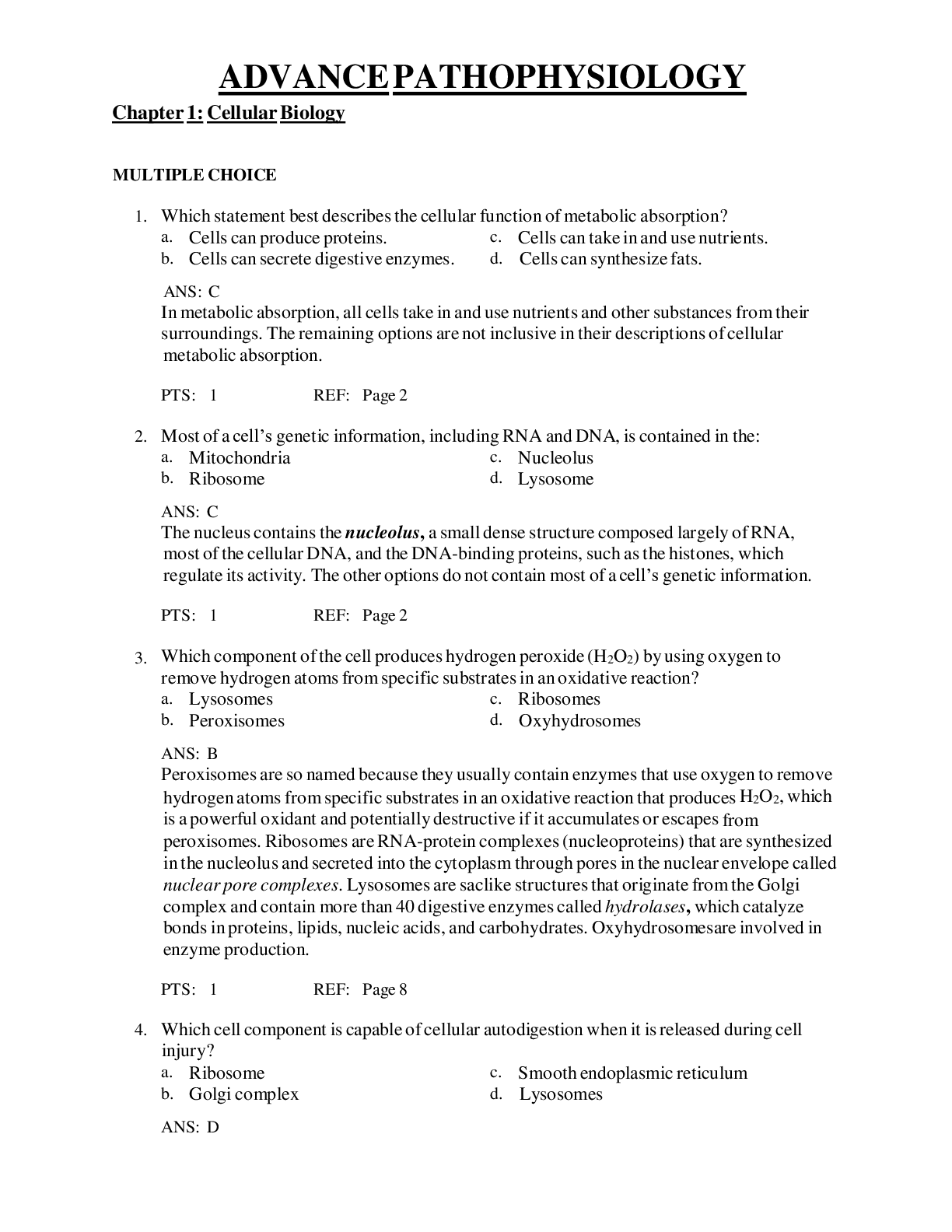
Which statement best describes the cellular function of metabolic absorption? a. Cells can produce proteins. c. Cells can take in an d use nutrients. b. Cells can secrete digestive enzymes. d. Cells c ... an synthesize fats. ANS: C In metabolic absorption, all cells take in and use nutrients and other substances from their surroundings. The remaining options are not inclusive in their descriptions of cellular metabolic absorption. PTS: 1 REF: Page 2 2. Most of a cell’s genetic information, including RNA and DNA, is contained in the: a. Mitochondria c. Nucleolus b. Ribosome d. Lysosome ANS: C The nucleus contains the nucleolus, a small dense structure composed largely of RNA, most of the cellular DNA, and the DNA-binding proteins, such as the histones, which regulate its activity. The other options do not contain most of a cell’s genetic information. PTS: 1 REF: Page 2 3. Which component of the cell produces hydrogen peroxide (H2O2) by using oxygen to remove hydrogen atoms from specific substrates in an oxidative reaction? a. Lysosomes c. Ribosomes b. Peroxisomes d. Oxyhydrosomes ANS: B Peroxisomes are so named because they usually contain enzymes that use oxygen to remove hydrogen atoms from specific substrates in an oxidative reaction that produces H2O2, which is a powerful oxidant and potentially destructive if it accumulates or escapes from peroxisomes. Ribosomes are RNA-protein complexes (nucleoproteins) that are synthesized in the nucleolus and secreted into the cytoplasm through pores in the nuclear envelope called nuclear pore complexes. Lysosomes are saclike structures that originate from the Golgi complex and contain more than 40 digestive enzymes called hydrolases, which catalyze bonds in proteins, lipids, nucleic acids, and carbohydrates. Oxyhydrosomes are involved in enzyme production. PTS: 1 REF: Page 8 4. Which cell component is capable of cellular autodigestion when it is released during cell injury? a. Ribosome c. Smooth endoplasmic reticulum b. Golgi complex d. Lysosomes ANS: D [Show More]

Last updated: 3 years ago

Preview 1 out of 13 pages

Buy Now

Instant download

We Accept:

Payment methods accepted on Scholarfriends (We Accept)
Preview image of NSG5003 ADVANCED PATHOPYSIOLOGY document

Buy this document to get the full access instantly

Instant Download Access after purchase

Buy Now

Instant download

We Accept:

Payment methods accepted on Scholarfriends (We Accept)

Reviews( 0 )

$11.00

Buy Now

We Accept:

Payment methods accepted on Scholarfriends (We Accept)

Instant download

Can't find what you want? Try our AI powered Search

112
0

Document information


Connected school, study & course


About the document


Uploaded On

Aug 18, 2021

Number of pages

13

Written in

All

Seller


Profile illustration for acetutor
acetutor

Member since 4 years

0 Documents Sold

Additional information

This document has been written for:

Uploaded

Aug 18, 2021

Downloads

 0

Views

 112

Document Keyword Tags

Recommended For You

Get more on EXAMs »

$11.00
What is Scholarfriends

Scholarfriends.com Online Platform by Browsegrades Inc. 651N South Broad St, Middletown DE. United States.

We are here to help

We're available through e-mail, Twitter, Facebook, and live chat.
 FAQ
 Questions? Leave a message!

Follow us on
 Twitter

Copyright © Scholarfriends · High quality services·