Management Information Systems (MIS) > CASE STUDY > NETW 583 Week 1 Case Study 1: apple case analysis (All)
NETW 583 Week 1 Case Study 1: apple case analysis
Document Content and Description Below
Last updated: 3 years ago
Preview 1 out of 6 pages
Instant download
.png)
Buy this document to get the full access instantly
Instant Download Access after purchase
Reviews( 0 )
Document information
Connected school, study & course
About the document
Uploaded On
Aug 01, 2021
Number of pages
6
Written in
All

Additional information
This document has been written for:
Uploaded
Aug 01, 2021
Downloads
0
Views
171
Document Keyword Tags
Recommended For You
Get more on CASE STUDY » (1).png)
NETW 583 Week 1 Case Study 1: Apple Case Analysis WITH CORRECT...
.png)
NETW 583 Week 1 Case Study 1: Apple Case Analysis (GRADED A)
.png)

DeVry University, Keller Graduate School of Management NETW 58...
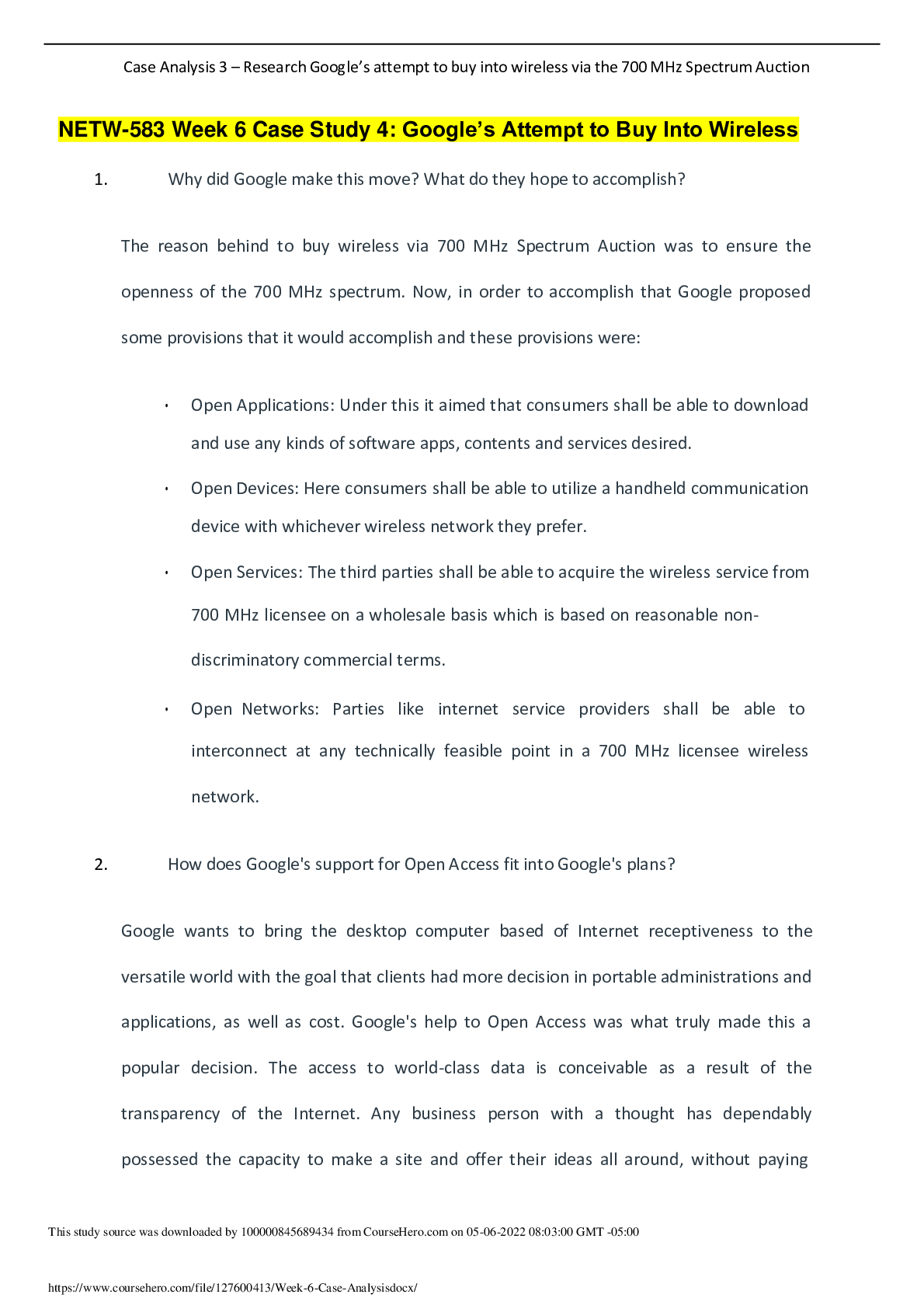
NETW-583 Week 6 Case Study 4: Google’s Attempt to Buy Into Wir...

DeVry University, Austin NETW 583 WEEK 3 - COURSE PROJECT LATE...


NETW 583 Week 4 Midterm Exam (version 1) all the answers provi...

NETW 583 Strategic Management of Technology Keller Graduate Sc...


NETW 583 Week 6 Discussion, The New Product Development Proces...

TEST BANK for Management Information Systems Managing the Digi...
Using MIS, 12e David Kroenke, Randall Boyle (Solution Manual)


Experiencing MIS, 5th Canadian Edition, 5e David Kroenke, And...
Modern Systems Analysis and Design, 9th Edition by Valacich TE...
Management of Information Security, 6th Edition by Michael Whi...

Test Bank for MIS (Management Information Systems), 10th Editi...


.png)