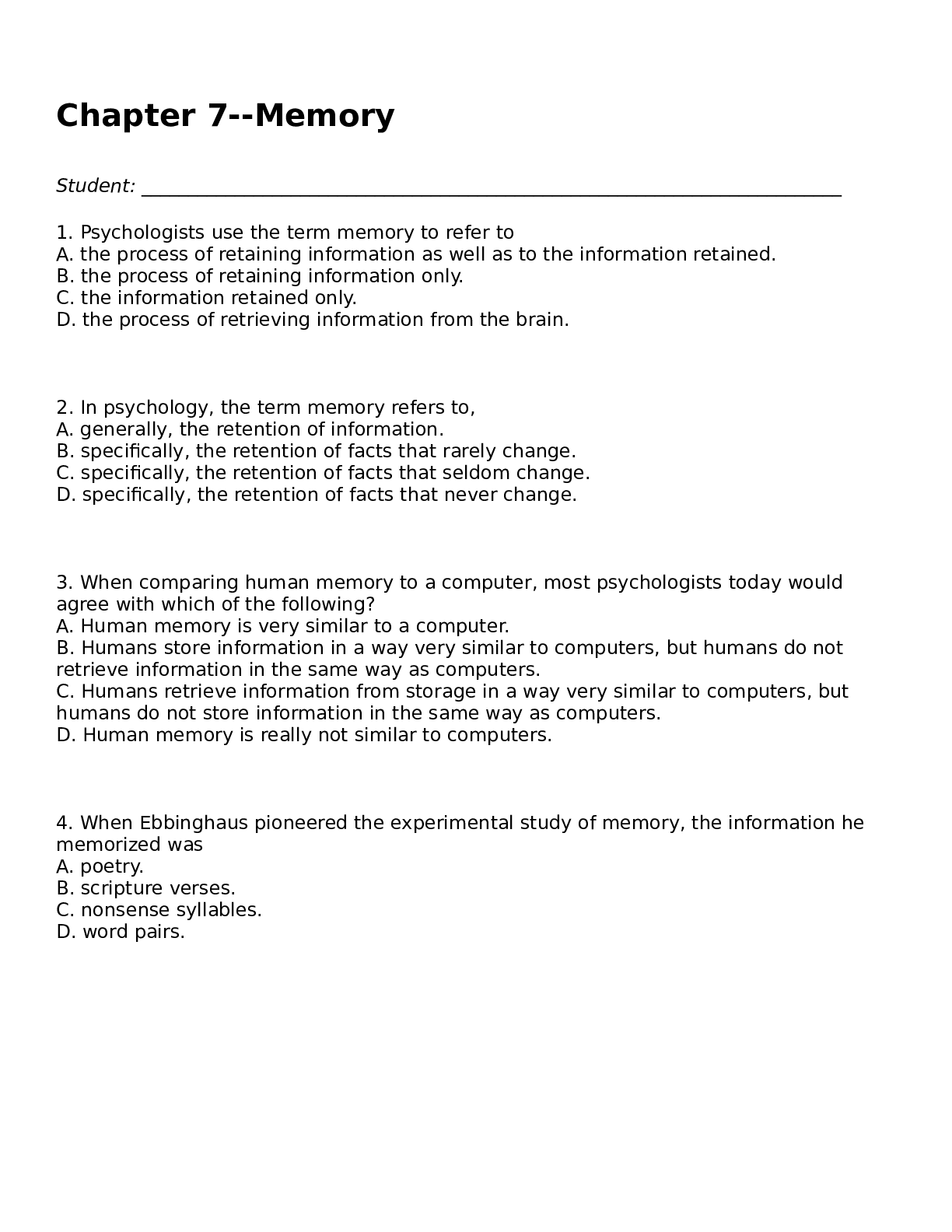
Chapter 7--Memory
Student: ___________________________________________________________________________
1. Psychologists use the term memory to refer to
A. the process of retaining information as well as to the informa
...
Chapter 7--Memory
Student: ___________________________________________________________________________
1. Psychologists use the term memory to refer to
A. the process of retaining information as well as to the information retained.
B. the process of retaining information only.
C. the information retained only.
D. the process of retrieving information from the brain.
2. In psychology, the term memory refers to,
A. generally, the retention of information.
B. specifically, the retention of facts that rarely change.
C. specifically, the retention of facts that seldom change.
D. specifically, the retention of facts that never change.
3. When comparing human memory to a computer, most psychologists today would
agree with which of the following?
A. Human memory is very similar to a computer.
B. Humans store information in a way very similar to computers, but humans do not
retrieve information in the same way as computers.
C. Humans retrieve information from storage in a way very similar to computers, but
humans do not store information in the same way as computers.
D. Human memory is really not similar to computers.
4. When Ebbinghaus pioneered the experimental study of memory, the information he
memorized was
A. poetry.
B. scripture verses.
C. nonsense syllables.
D. word pairs.5. In Ebbinghaus's studies of memorization of nonsense syllables, who did the
memorizing?
A. students in Ebbinghaus's General Psychology course
B. mentally retarded adults
C. Ebbinghaus's children
D. Ebbinghaus himself
6. In order to be sure that the items on the lists that he learned would be unfamiliar,
Ebbinghaus
A. learned lists of foreign words.
B. spelled all the words backwards.
C. invented nonsense syllables.
D. had his students make up the lists.
7. Ebbinghaus used nonsense syllables in his experiments on memory because nonsense
syllables are
A. highly interesting to most people.
B. immune to the von Restorff effect.
C. unfamiliar.
D. easier to remember than real words.
8. Why did Ebbinghaus use nonsense syllables in his memory experiments?
A. People have no previous learning of nonsense syllables.
B. It is easy for computers to generate nonsense syllables.
C. Nonsense syllables are distinctive and meaningful.
D. Nonsense syllables do not generate proactive or retroactive interference.
9. If asked to tell your social security number (without looking it up), you are being asked
to perform a __________ memory test.
A. recognition
B. cued-recall
C. free recall
D. savings10. Professor Yawnmore asks you to write by memory a list of all the recipients of the
Nobel Peace Prize. What kind of memory test is this?
A. free recall
B. cued recall
C. recognition
D. savings
11. Your friend asks you to name the seven dwarves from "Snow White". This is a
memory test that psychologists would call a __________ test.
A. free recall
B. cued recall
C. recognition
D. relearning
12. An essay exam is best described as a __________ test of memory.
A. cued recall
B. free recall
C. recognition
D. relearning
13. Suppose I asked you to tell me the names of the members of your third-grade class.
To help you out, I provide all of their first and last initials. This is an example of what kind
of memory test?
A. savings
B. relearning
C. free recall
D. cued recall
14. Your history professor gives you a list of the initials of all the U.S. presidents and vice
presidents and asks you to fill in the names. What kind of memory test is this?
A. free recall
B. cued recall
C. recognition
D. savings15. Which kind of memory test are you taking right now?
A. free recall
B. cued recall
C. recognition
D. savings
16. Professor Lord gives you a list of 400 names and asks you to check the ones that
appeared in the book of Deuteronomy. What kind of memory test is this?
A. free recall
B. cued recall
C. recognition
D. savings
17. You say you cannot remember the geography you learned in junior high school.
Someone tests whether you can relearn it faster than you learned it the first time. Which
method of testing m
[Show More]




.png)
.png)