• Client summary: presentation, medical history and background, physical assessment findings, medications, diagnostics
• brief summary of pathophysiology and rationale for clinical manifestations
That patient is Jackso
...
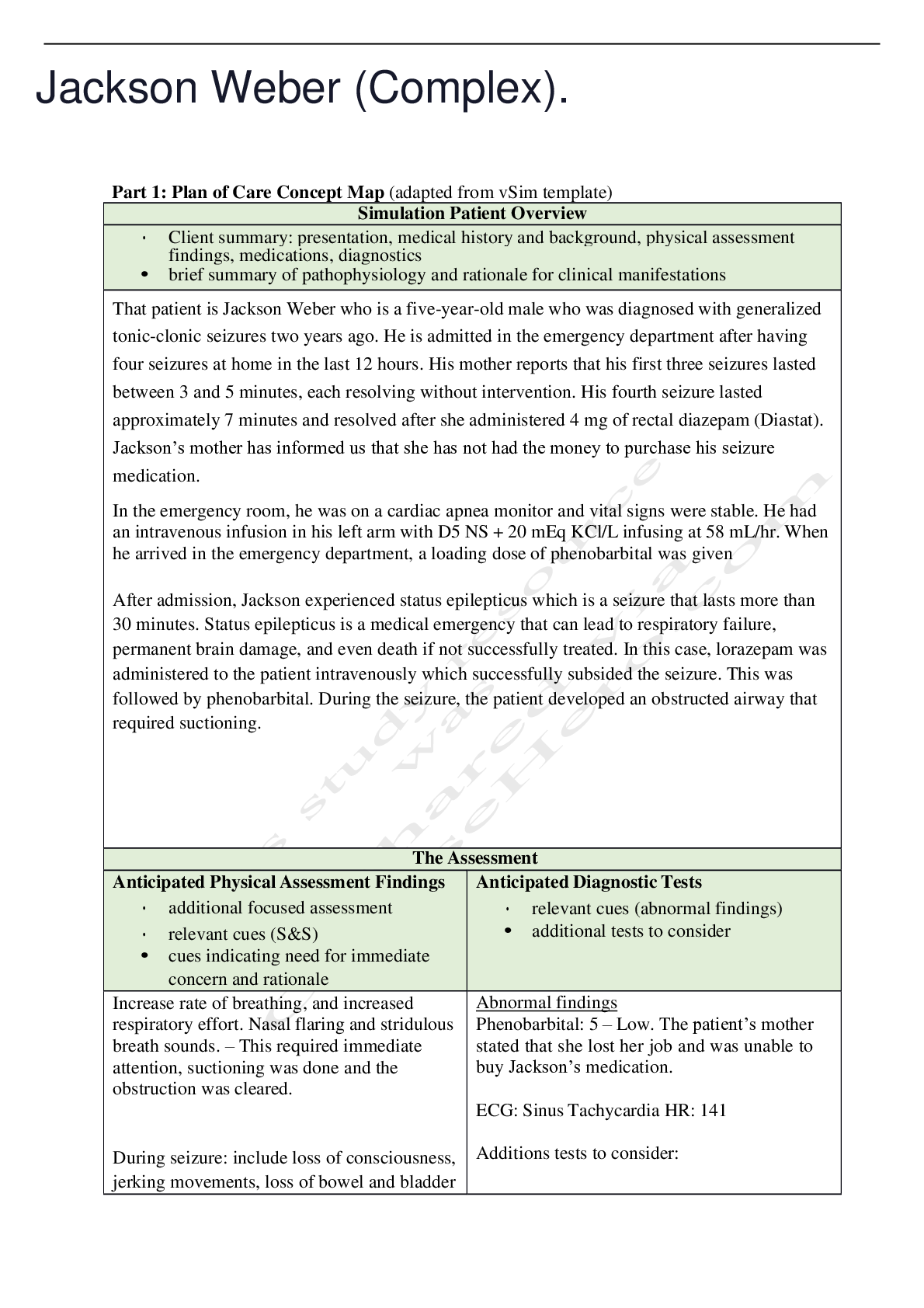
• Client summary: presentation, medical history and background, physical assessment findings, medications, diagnostics
• brief summary of pathophysiology and rationale for clinical manifestations
That patient is Jackson Weber who is a five-year-old male who was diagnosed with generalized tonic-clonic seizures two years ago. He is admitted in the emergency department after having four seizures at home in the last 12 hours. His mother reports that his first three seizures lasted between 3 and 5 minutes, each resolving without intervention. His fourth seizure lasted approximately 7 minutes and resolved after she administered 4 mg of rectal diazepam (Diastat). Jackson’s mother has informed us that she has not had the money to purchase his seizure medication.
In the emergency room, he was on a cardiac apnea monitor and vital signs were stable. He had an intravenous infusion in his left arm with D5 NS + 20 mEq KCl/L infusing at 58 mL/hr. When he arrived in the emergency department, a loading dose of phenobarbital was given
After admission, Jackson experienced status epilepticus which is a seizure that lasts more than 30 minutes. Status epilepticus is a medical emergency that can lead to respiratory failure, permanent brain damage, and even death if not successfully treated. In this case, lorazepam was administered to the patient intravenously which successfully subsided the seizure. This was followed by phenobarbital. During the seizure, the patient developed an obstructed airway that required suctioning.
The Assessment
Anticipated Physical Assessment Findings
• additional focused assessment
• relevant cues (S&S)
• cues indicating need for immediate
concern and rationale Anticipated Diagnostic Tests
• relevant cues (abnormal findings)
• additional tests to consider
Increase rate of breathing, and increased respiratory effort. Nasal flaring and stridulous breath sounds. – This required immediate attention, suctioning was done and the obstruction was cleared.
During seizure: include loss of consciousness, jerking movements, loss of bowel and bladder Abnormal findings
Phenobarbital: 5 – Low. The patient’s mother stated that she lost her job and was unable to buy Jackson’s medication.
ECG: Sinus Tachycardia HR: 141 Additions tests to consider:
[Show More]