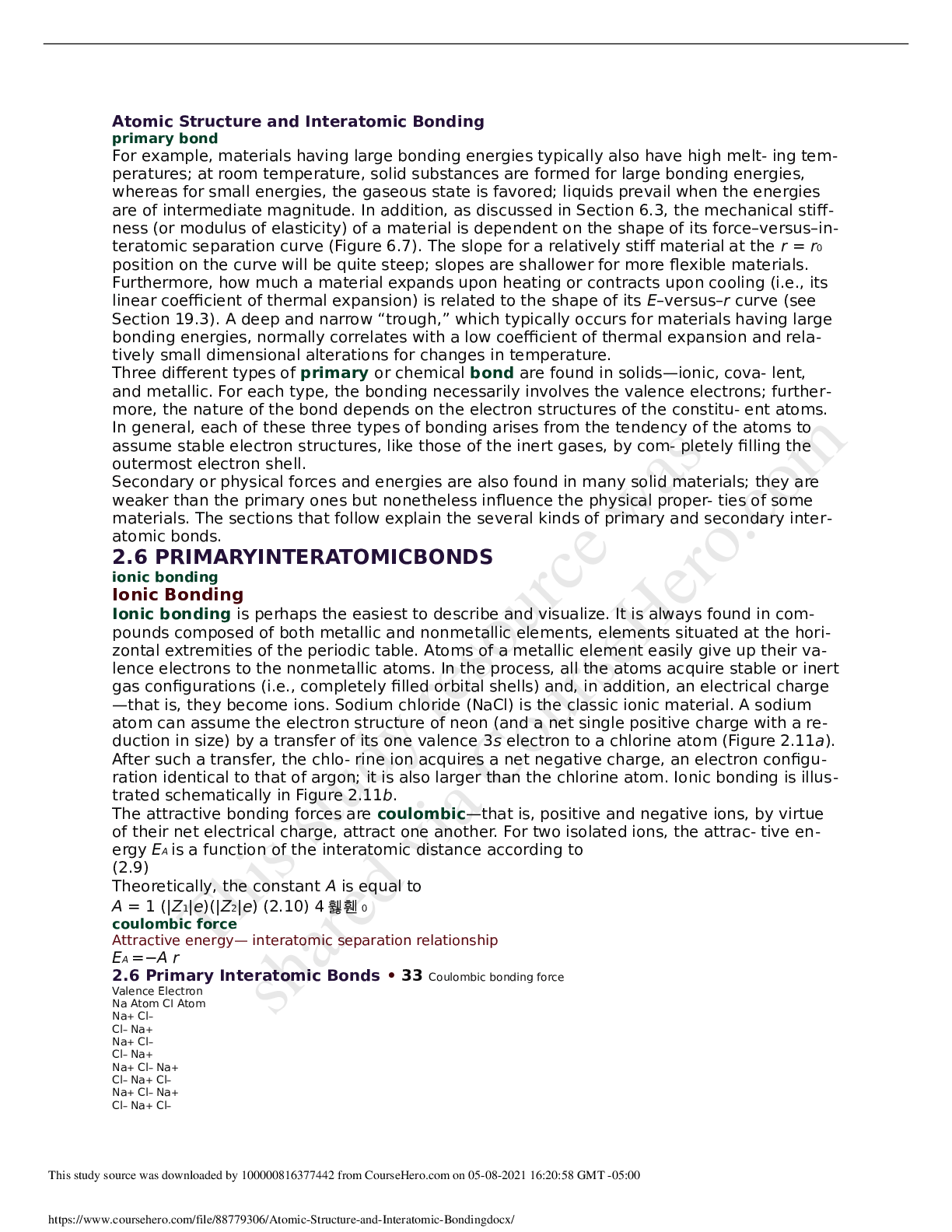
Atomic Structure and Interatomic Bonding.
Document Content and Description Below
Atomic Structure and Interatomic Bonding
primary bond
For example, materials having large bonding energies typically also have high melt- ing temperatures; at room temperature, solid substances are formed for large bon
...
[Show More]
Last updated: 3 years ago
Preview 1 out of 2 pages
Instant download
Buy this document to get the full access instantly
Instant Download Access after purchase
Reviews( 0 )
Document information
Connected school, study & course
About the document
Uploaded On
May 09, 2021
Number of pages
2
Written in
All

Additional information
This document has been written for:
Uploaded
May 09, 2021
Downloads
0
Views
179
Document Keyword Tags
Recommended For You
Get more on ESSAY »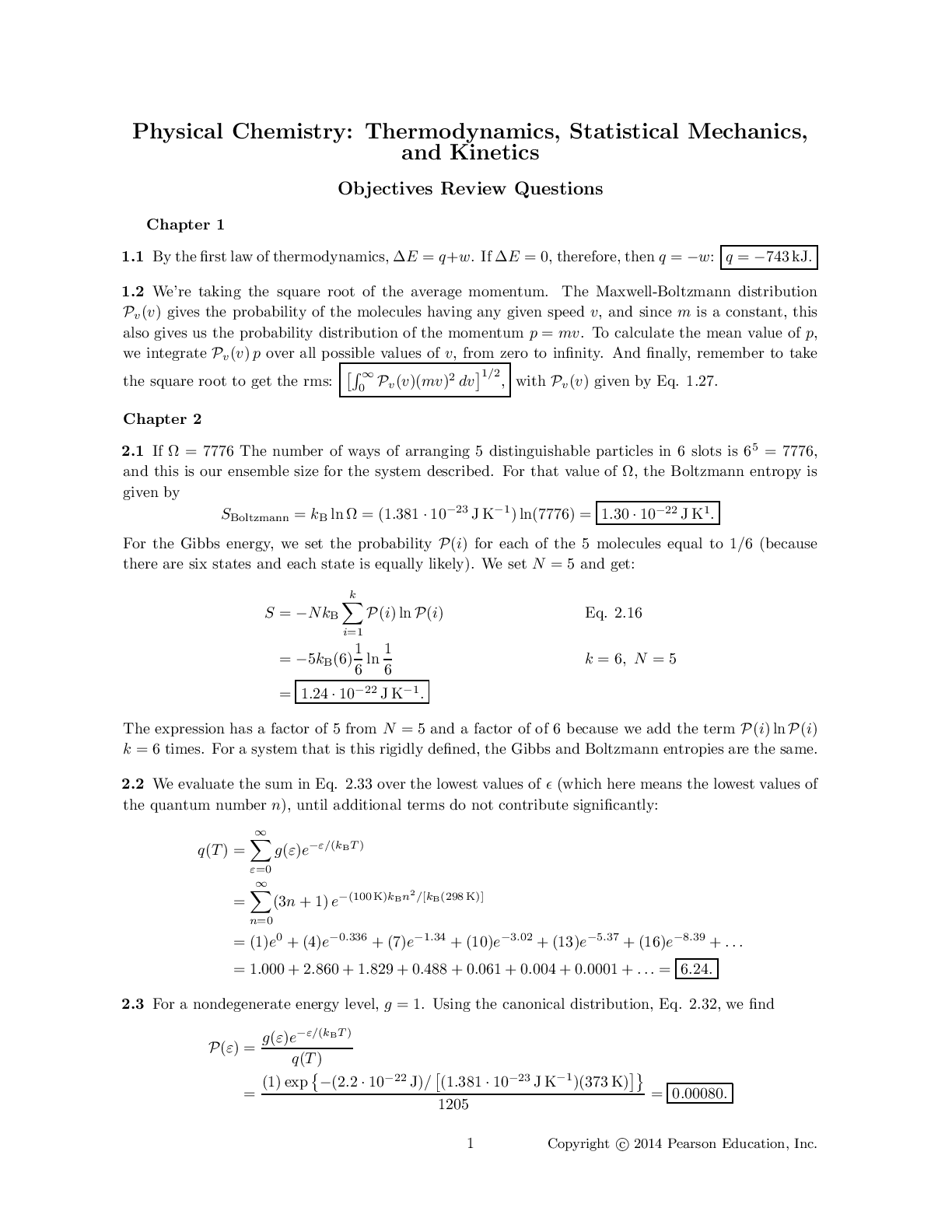
$20
237 Pages
Physical Chemistry Thermodynamics Statistical Mechanics and Ki...
$15
1104 Pages
Solutions Manual for Organic Chemistry Student Study Guide 3rd...
$19
389 Pages
General Organic and Biological Chemistry 1st Edition by Kalyn...
$15.5
292 Pages
Test Bank: Maternal-Newborn Nursing: The Critical Components o...
$7
2 Pages
HESI A2 Chemistry (V1) What is true about water - Water is not...

More related documents below