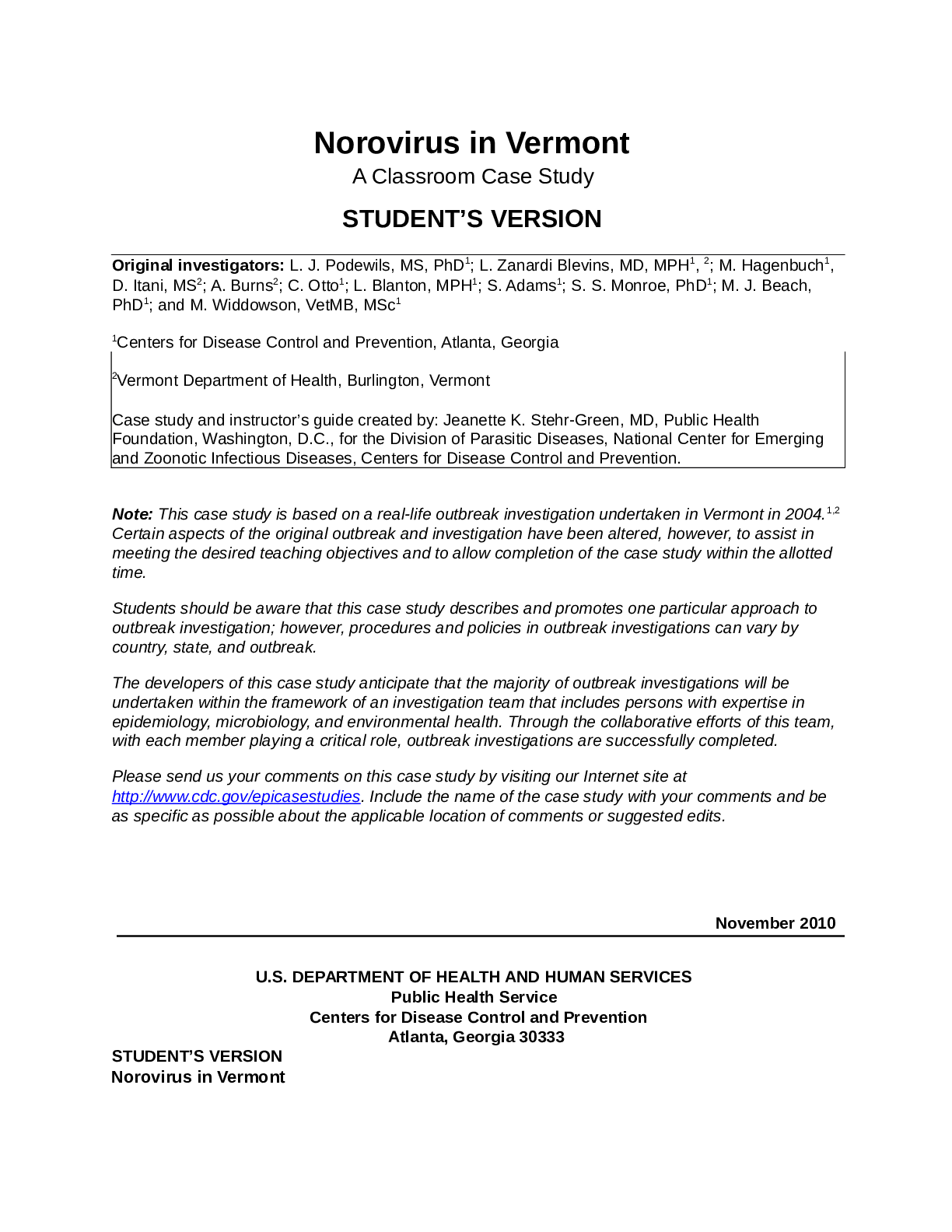
Norovirus in Vermont
A Classroom Case Study
STUDENT’S VERSION
Original investigators: L. J. Podewils, MS, PhD1; L. Zanardi Blevins, MD, MPH1, 2; M. Hagenbuch1,
D. Itani, MS2; A. Burns2; C. Otto1; L. Blanton, MPH1; S.
...
Norovirus in Vermont
A Classroom Case Study
STUDENT’S VERSION
Original investigators: L. J. Podewils, MS, PhD1; L. Zanardi Blevins, MD, MPH1, 2; M. Hagenbuch1,
D. Itani, MS2; A. Burns2; C. Otto1; L. Blanton, MPH1; S. Adams1; S. S. Monroe, PhD1; M. J. Beach,
PhD1; and M. Widdowson, VetMB, MSc1
1Centers for Disease Control and Prevention, Atlanta, Georgia
2Vermont Department of Health, Burlington, Vermont
Case study and instructor’s guide created by: Jeanette K. Stehr-Green, MD, Public Health
Foundation, Washington, D.C., for the Division of Parasitic Diseases, National Center for Emerging
and Zoonotic Infectious Diseases, Centers for Disease Control and Prevention.
Note: This case study is based on a real-life outbreak investigation undertaken in Vermont in 2004.1,2
Certain aspects of the original outbreak and investigation have been altered, however, to assist in
meeting the desired teaching objectives and to allow completion of the case study within the allotted
time.
Students should be aware that this case study describes and promotes one particular approach to
outbreak investigation; however, procedures and policies in outbreak investigations can vary by
country, state, and outbreak.
The developers of this case study anticipate that the majority of outbreak investigations will be
undertaken within the framework of an investigation team that includes persons with expertise in
epidemiology, microbiology, and environmental health. Through the collaborative efforts of this team,
with each member playing a critical role, outbreak investigations are successfully completed.
Please send us your comments on this case study by visiting our Internet site at
http://www.cdc.gov/epicasestudies. Include the name of the case study with your comments and be
as specific as possible about the applicable location of comments or suggested edits.
November 2010
U.S. DEPARTMENT OF HEALTH AND HUMAN SERVICES
Public Health Service
Centers for Disease Control and Prevention
Atlanta, Georgia 30333
STUDENT’S VERSION
Norovirus in VermontNorovirus in Vermont – pg. 2
(STUDENT’S VERSION)
Learning Objectives:
After completing this case study, the student should be able to
1. list categories and examples of questions that should be asked of key informants who
report a suspected infectious disease outbreak;
2. discuss considerations in working with businesses that might be identified as a possible
source of an outbreak;
3. outline components of swimming pool design and operation that help prevent the
transmission of pathogenic agents;
4. discuss the action of chlorine to disinfect water and factors that influence its effectiveness;
5. interpret test results for chlorine and pH with respect to swimming pool water quality;
6. identify activities that increase a person’s risk for exposure to pathogens in recreational
water;
7. interpret results from a cohort study, including attack rates, relative risks, and P values; and
8. describe the steps for management of fecal incidents in treated recreational water venues.
PART I. OUTBREAK DETECTION
On the morning of February 5, the mother of a young child called the Vermont Department of Health
(VDH) to report a possible foodborne outbreak. The woman’s child, age 5 years, and two
neighborhood children, ages 7 and 10 years, had become ill with vomiting and diarrhea within 12
hours of each other. The child aged 5-years had become so sick that her mother had taken her to the
emergency department at the local hospital.
Question 1: What questions (or types of questions) would you ask the mother to help determine the
seriousness of this problem and the steps needed to explore the problem further?
The types of questions you would ask the mother would be:
WHAT is the problem (a description of the illness, whether a physician was consulted, if tests were
performed or treatments were provided, or whether anyone was hospitalized or died)? WHO became
ill ( their names, characteristics [ age, sex, and occupation], and relationship to each other)? WHEN
did the affected person(s) become ill (date and time of illness onset)? WHERE are the affected
persons located (including addresses and telephone numbers)? WHY (and HOW) do they think they
became ill (risk factors, suspected exposures and modes of transmission, and clues based on who
else did and did not become ill)?
The steps needed to explore the problem further would be:
1) Always collect as much information as possible from the person reporting the illness during the
first contact because talking with that person again might become difficult. If the complainant cannot
provide critical pieces of information, find out who might be able to do so. Be sure to ask the
complainant how he or she can be reached and if anyone else has been notified of this problem.
2) Remember that illnesses that can be acquired through foods often can be acquired through other
means (water, person-to-person contact, and animal-to-person contact). Keep an open mind about
possible sources and do not assume that food is the responsible vehicle. Collect information on all
possible modes of transmission.
3) If the illness is consistent with a potential foodborne illness, collect a complete food history.
Regardless of the source, complainants often associate illness with the last food or meal theyNorovirus in Vermont – pg. 3
consumed before becoming ill, particularly if it was at a commercial establishment. If the etiologic
agent is unknown, obtain a 72-hour food history or longer ( all foods/beverages/meals consumed
during the 72 hours before illness onset). For illnesses in which diarrhea is the predominant symptom
(as opposed to vomiting), collect a 5-day food history because incubation periods for diarrheal
diseases tend to be longer than illnesses that include only vomiting. If the etiologic agent is known,
ask about foods/beverages/meals eaten within the incubation period for that illness.If more than one
person is ill, focus on foods/beverages/meals common to all persons but still collect complete food
histories for the appropriate periods for all persons.
4) Be sure to accurately record symptoms, dates and times of illness onset, and dates and times of
exposures.
5) Collect and record information on pertinent negatives as well as pertinent positives
[Show More]