Ch: 3, 5, 6, 9, 10, 11, 47
Definition of family: two or more people who live in the same household (usually), share a common emotional bond, and
perform certain interrelated social tasks.
Family of orientation (the fa
...
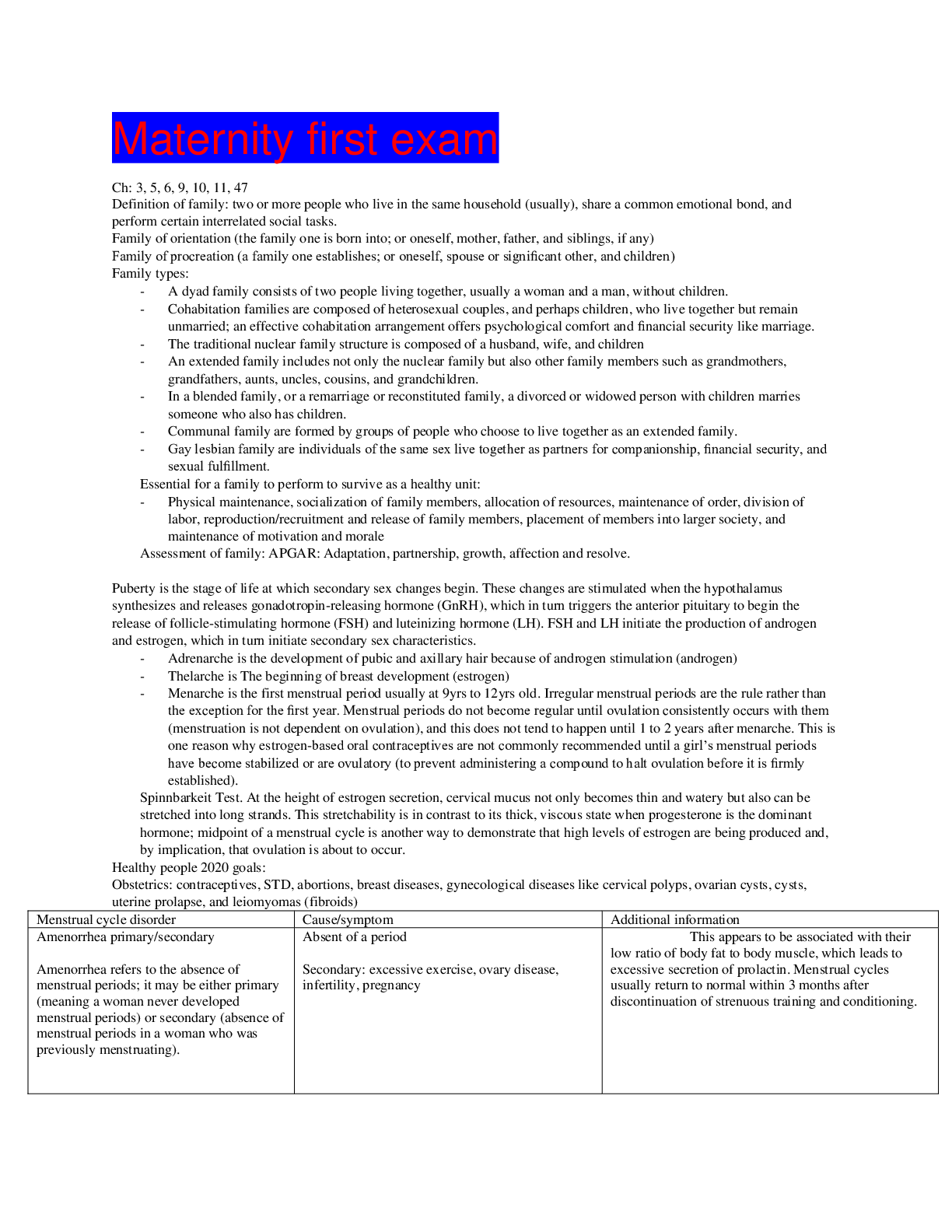
Ch: 3, 5, 6, 9, 10, 11, 47
Definition of family: two or more people who live in the same household (usually), share a common emotional bond, and
perform certain interrelated social tasks.
Family of orientation (the family one is born into; or oneself, mother, father, and siblings, if any)
Family of procreation (a family one establishes; or oneself, spouse or significant other, and children)
Family types:
- A dyad family consists of two people living together, usually a woman and a man, without children.
- Cohabitation families are composed of heterosexual couples, and perhaps children, who live together but remain
unmarried; an effective cohabitation arrangement offers psychological comfort and financial security like marriage.
- The traditional nuclear family structure is composed of a husband, wife, and children
- An extended family includes not only the nuclear family but also other family members such as grandmothers,
grandfathers, aunts, uncles, cousins, and grandchildren.
- In a blended family, or a remarriage or reconstituted family, a divorced or widowed person with children marries
someone who also has children.
- Communal family are formed by groups of people who choose to live together as an extended family.
- Gay lesbian family are individuals of the same sex live together as partners for companionship, financial security, and
sexual fulfillment.
Essential for a family to perform to survive as a healthy unit:
- Physical maintenance, socialization of family members, allocation of resources, maintenance of order, division of
labor, reproduction/recruitment and release of family members, placement of members into larger society, and
maintenance of motivation and morale
Assessment of family: APGAR: Adaptation, partnership, growth, affection and resolve.
Puberty is the stage of life at which secondary sex changes begin. These changes are stimulated when the hypothalamus
synthesizes and releases gonadotropin-releasing hormone (GnRH), which in turn triggers the anterior pituitary to begin the
release of follicle-stimulating hormone (FSH) and luteinizing hormone (LH). FSH and LH initiate the production of androgen
and estrogen, which in turn initiate secondary sex characteristics.
- Adrenarche is the development of pubic and axillary hair because of androgen stimulation (androgen)
- Thelarche is The beginning of breast development (estrogen)
- Menarche is the first menstrual period usually at 9yrs to 12yrs old. Irregular menstrual periods are the rule rather than
the exception for the first year. Menstrual periods do not become regular until ovulation consistently occurs with them
(menstruation is not dependent on ovulation), and this does not tend to happen until 1 to 2 years after menarche. This is
one reason why estrogen-based oral contraceptives are not commonly recommended until a girl’s menstrual periods
have become stabilized or are ovulatory (to prevent administering a compound to halt ovulation before it is firmly
established).
Spinnbarkeit Test. At the height of estrogen secretion
[Show More]




 A Graded.png)