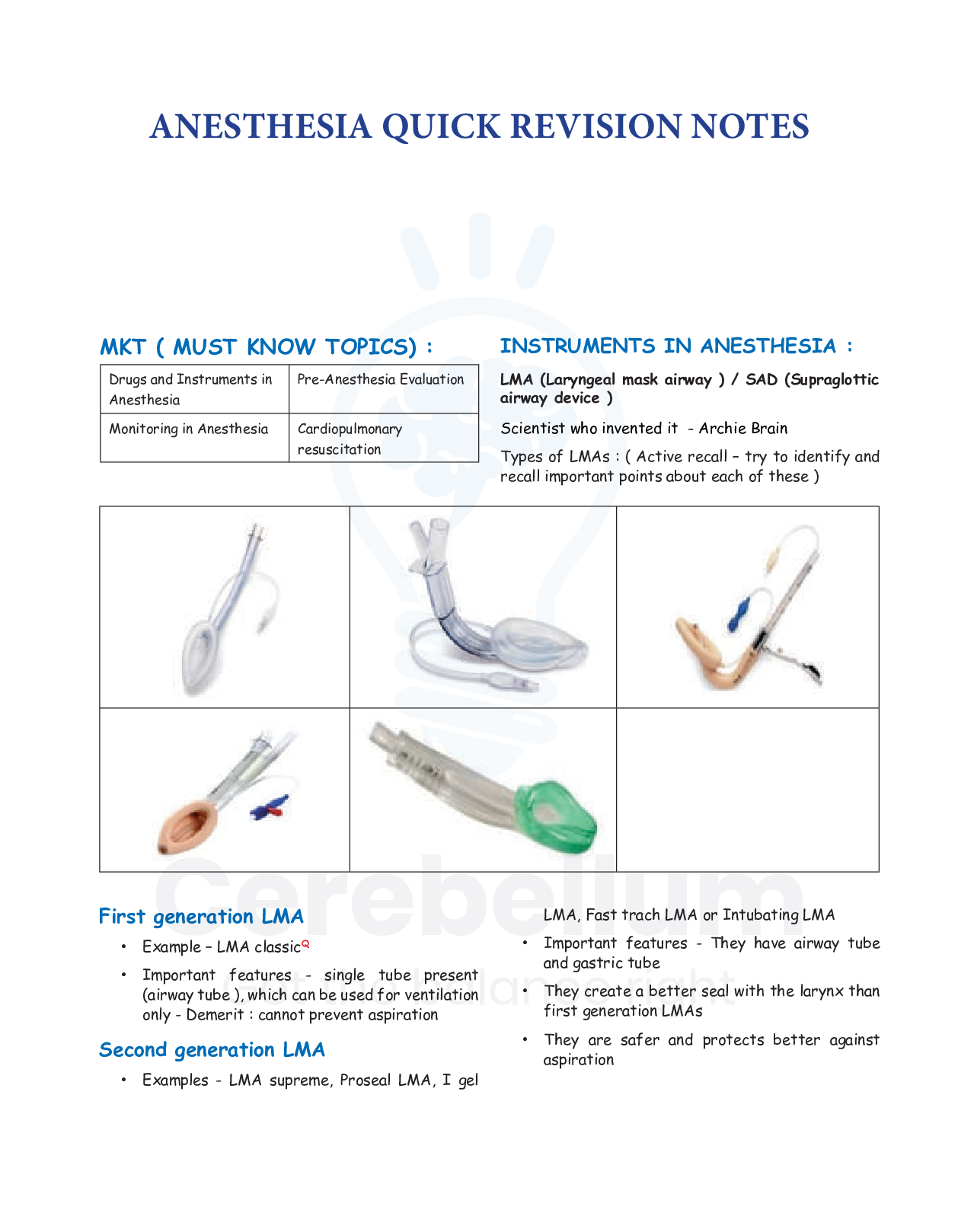
INSTRUMENTS IN ANESTHESIA :
LMA (Laryngeal mask airway ) / SAD (Supraglottic
airway device )
Scientist who invented it - Archie Brain
Types of LMAs : ( Active recall – try to identify and
recall important points abo
...
INSTRUMENTS IN ANESTHESIA :
LMA (Laryngeal mask airway ) / SAD (Supraglottic
airway device )
Scientist who invented it - Archie Brain
Types of LMAs : ( Active recall – try to identify and
recall important points about each of these )
First generation LMA
•• Example – LMA classicQ
•• Important features - single tube present
(airway tube ), which can be used for ventilation
only - Demerit : cannot prevent aspiration
Second generation LMA
•• Examples - LMA supreme, Proseal LMA, I gel
LMA, Fast trach LMA or Intubating LMA
•• Important features - They have airway tube
and gastric tube
•• They create a better seal with the larynx than
first generation LMAs
•• They are safer and protects better against
aspiration
84
Cerebellum Quick Revision Notes
LMA CLASSIC
•• First generation LMA
•• Important features - single tube present
(airway tube )
•• Demerit : cannot prevent aspiration
LMA supreme
•• Second generation LMAQ
•• Disposable
Fast track LMA or Intubating LMA
•• Made up of Silicone
•• Non disposable
•• Can be used upto 40 times
•• Pilot Balloon is present
•• It has a special endotracheal tube used for
intubating ‘through’ the LMA
•• It is sterilized by Autoclaving
PROSEAL LMA
•• It is made up of Silicone
•• It is reusable / non disposable
•• Pilot balloon is present
•• It forms a good seal with the larynx preventing
aspiration of gastric contents. Hence, it is
called as ‘Proseal’
It is the LMA preferred for Day care Surgery /
Laproscopic Surgery
I - gel LMA
•• Main identification feature – It does not have
a pilot balloon
•• It is made up of Thermoelastic polymer
Recommended size of the laryngeal mask airway
according to the patient's body weightQ.
Size Patient's weight
1 <5 kg
1.5 5-9 kg
2 10-19 kg
2.5 20-29 kg
3 30-49 kg
4 50-69 kg
5 Large adult, 70-100 kg
Ideal patient position preferred for intubation :
Sniffing the morning air position / barking dog
position Q
85
Anesthesia
Extension of
atlanto
occipital joint
Flexion of
cervical spine
Flexion at Atlantoaxial joint and extension at Atlantooccipital
joint
Steps of Intubation
1. Insert the Laryngoscope in the right corner of
the mouth
2. Sweep the tongue from right to leftQ
3. Then lift the laryngoscope
4. Once the vocal cords are seen pass the
endotracheal tube
5. Inflate the cuff of the endotracheal tube and
connect the anesthesia circuit
6. Confirm intubation by capnography (gold standard)
or by auscultation or chest XrayQ
Identification of types of
laryngoscope: (Active recall)
MacIntosh laryngoscope
•• It has a Curved blade
•• It is used in Adults
McCoy laryngoscopeQ
•• It has a curved blade with a lever which helps in
lifting the epiglottis
•• It is used for difficult intubation
Millers laryngoscope
•• It has a straight blade
•• It is used in pediatric patients
[Show More]