AN INTRODUCTION TO SOME FUNDAMENTALS
A. What is Property
1. In legal discourse, property is what the law defines as proper ty. If a claim
to a resource is not recognized by law, it is not proper ty in a legal sense.
...
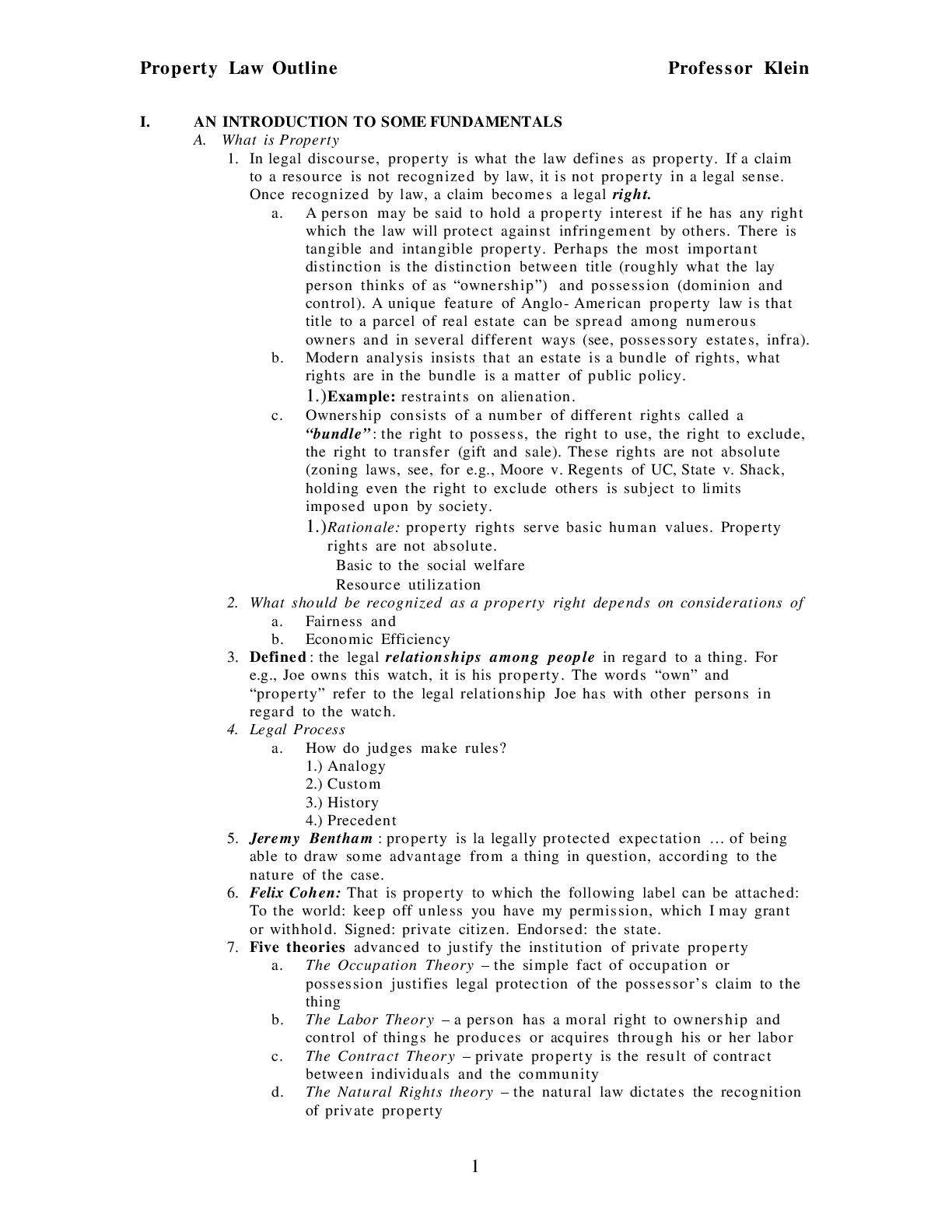
AN INTRODUCTION TO SOME FUNDAMENTALS
A. What is Property
1. In legal discourse, property is what the law defines as proper ty. If a claim
to a resource is not recognized by law, it is not proper ty in a legal sense.
Once recognized by law, a claim becomes a legal right.
a. A person may be said to hold a proper ty interest if he has any right
which the law will protect against infringement by others. There is
tangible and intangible property. Perhaps the most important
distinction is the distinction between title (roughly what the lay
person thinks of as “ownership”) and possession (dominion and
control). A unique feature of Anglo- American property law is that
title to a parcel of real estate can be spread among numerous
owners and in several different ways (see, possessory estates, infra).
b. Modern analysis insists that an estate is a bundle of rights, what
rights are in the bundle is a matter of public policy.
1.)Example: restraints on alienation.
c. Ownership consists of a number of different rights called a
“bundle” : the right to possess, the right to use, the right to exclude,
the right to transfer (gift and sale). These rights are not absolute
(zoning laws, see, for e.g., Moore v. Regents of UC, State v. Shack,
holding even the right to exclude others is subject to limits
imposed upon by society.
1.)Rationale: property rights serve basic human values. Property
rights are not absolute.
Basic to the social welfare
Resource utilization
2. What should be recognized as a property right depends on considerations of
a. Fairness and
b. Economic Efficiency
3. Defined : the legal relationships among people in regard to a thing. For
e.g., Joe owns this watch, it is his proper ty. The words “own” and
“property” refer to the legal relationship Joe has with other persons in
regard to the watch.
4. Legal Process
a. How do judges make rules?
1.) Analogy
2.) Custom
3.) History
4.) Precedent
5. Jeremy Bentham : property is la legally protected expectation … of being
able to draw some advantage from a thing in question, according to the
nature of the case.
6. Felix Cohen: That is property to which the following label can be attached:
To the world: keep off unless you have my permission, which I may grant
or withhold. Signed: private citizen. Endorsed: the state.
7. Five theories advanced to justify the institution of private property
a. The Occupation Theory – the simple fact of occupation or
possession justifies legal protection of the possessor’s claim to the
thing
b. The Labor Theory – a person has a moral right to ownership and
control of things he produces or acquires through his or her labor
c. The Contract Theory – private property is the result of contract
between individuals and the community
d. The Natural Rights theory – the natural law dictates the recognition
of private property
1
Property Law Outline Professor Klein
e. The Social Utility Theory – the law should promote the maximum
fulfillment of human needs and aspirations, and that legal
protection of private proper ty does promote such fulfillment.
f. Economic Theory – the legal protection of property rights has an
important economic function: to create incentives to use resources
efficiently
g. Equality Rights: the institution of private property really protected
man’s natural equality of rights. Equality of rights means that every
man has the right to grab. The institution pf proper ty was an
agreement among men legalizing what each had already grabbed.
II. CHAPTER 1. FIRST POSSESSION: ACQUISITION OF PROPERTY BY DISCOVERY,
CAPTURE, AND CREATION: RIGHTS OF POSSESSORS: TITLE FROM POSSESSION –
(1) WILD ANIMALS (2) FINDING LOST ARTICLES (3) ADVERSE POSSESSION.
Normally one gains title to something by acquiring it from another
with the others consent. There are a few ways to gain title from
posses sion, (1) wild animals, (2) finding lost articles, and (3) adverse
posses sion are the best examples of this. Keep in mind that the concept of
possession is important because once a person has gained possession she
has rights superior to the rest of the world. The problems below revolve
around the question of What constitutes possession? For the finder to
acquire these special rights he must take the proper ty into his possession
(intent to assume dominion and physical control over the goods.)
2
Property Law Outline Professor Klein
A. Acquisition by Discovery – FIRST IN TIME1
1. Land - - The US government traces its title back to the original discovery
and conquest of America by white European explorers. Obviously, Native
Americans were here before the white man arrived. However, American
courts have held that although Indians had “possession” of the land on
which they lived, they did not have “title” to it, and could not convey title.
Therefore, a title derived from the federal government, or from one of the
states or colonies, has priority over an earlier purpor ted “grant” from one
Indian Tribe. Johnson v. M’Intosh, 21 U.S. (8 Wheat) 543 (1832).
a. Note: Discovery gave an exclusive right to extinguish the Indian title
of occupancy, either by purchase or by conquest. The first
“discoverer” had a preemptive right to deal with the Indians as
against subsequent discoverers.
b. Note: the European settlers had the power to impose a point of view
on the Indians, to privilege an ideology and the use the privilege to
justify the power. Property confers and rests upon power.
c. Note: the discovery of the Indian occupied lands vested absolute
title in the discoverers and rendered the Indian inhabitants
incapable of transferring absolute title in others.
B. Acquisition by Capture
1. Rule of Capture : Wild Animals are not owned by anyone, but once a person
has gained possession of such an animal, he has rights in that animal
superior to those of the rest of the world. Capture is sufficient. The mere
fact that one has spotted or chased an animal is not sufficient to
constitute possession. Property in wild animals is only acquired by
occupancy, pursuit alone does not constitute occupancy or vest any right
on the pursuer.
2. Example : A is on a horse pursuing a fox,
[Show More]






![Preview of Fundamentals of Planning Buildings and Facilities of Animal and Poultry production[ARABIC]](https://browseimages.nyc3.digitaloceanspaces.com/paper-images/2023/Nov/17/1QvD0aZg2023-11-17-07-376556edf4bbbb3.png)