FDNY G60 PRACTICE TEST (2022/2023)
Rated A+
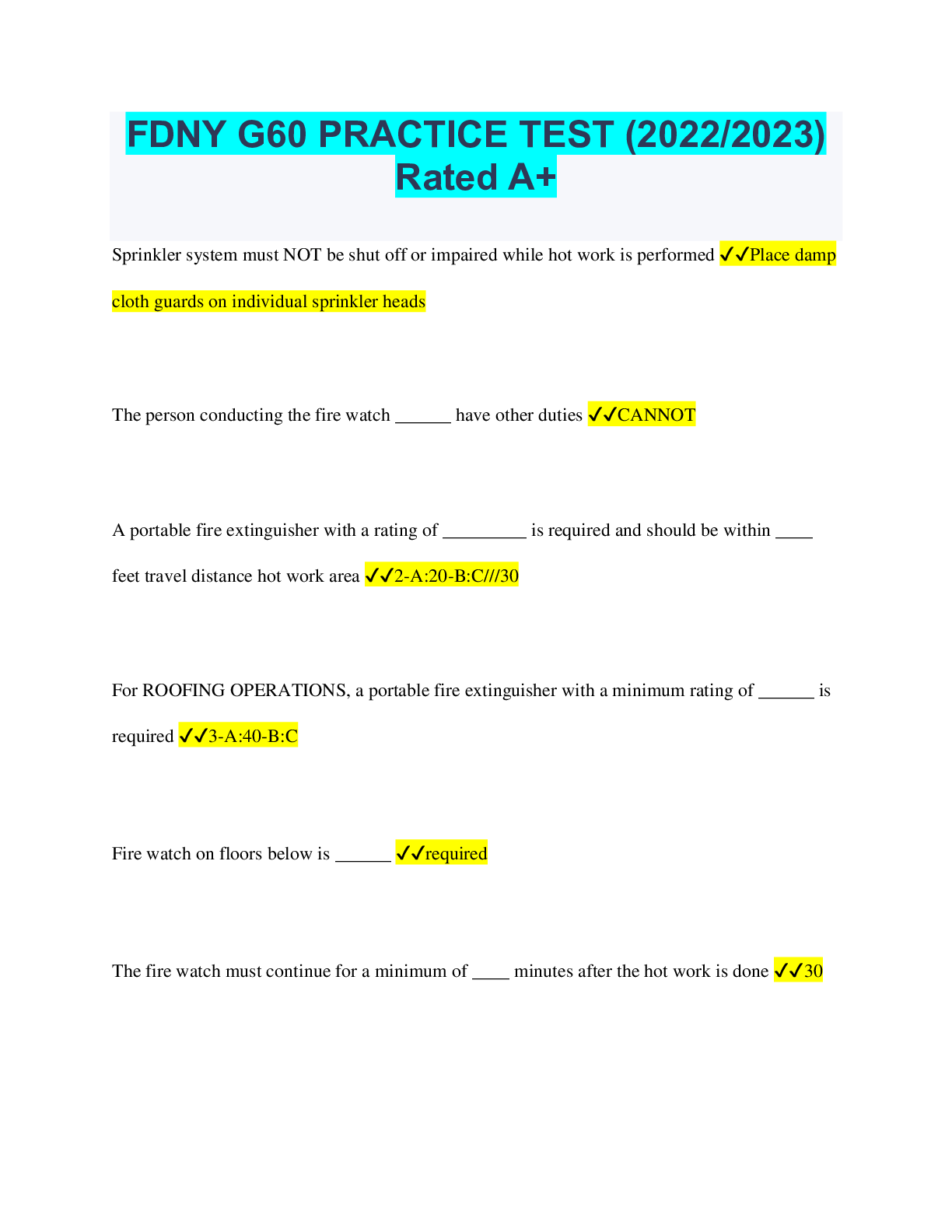
Sprinkler system must NOT be shut off or impaired while hot work is performed ✔✔Place damp
cloth guards on individual sprinkler heads
The person conducting the fire watch _
...
FDNY G60 PRACTICE TEST (2022/2023)
Rated A+
Sprinkler system must NOT be shut off or impaired while hot work is performed ✔✔Place damp
cloth guards on individual sprinkler heads
The person conducting the fire watch ______ have other duties ✔✔CANNOT
A portable fire extinguisher with a rating of _________ is required and should be within ____
feet travel distance hot work area ✔✔2-A:20-B:C///30
For ROOFING OPERATIONS, a portable fire extinguisher with a minimum rating of ______ is
required ✔✔3-A:40-B:C
Fire watch on floors below is ______ ✔✔required
The fire watch must continue for a minimum of ____ minutes after the hot work is done ✔✔30
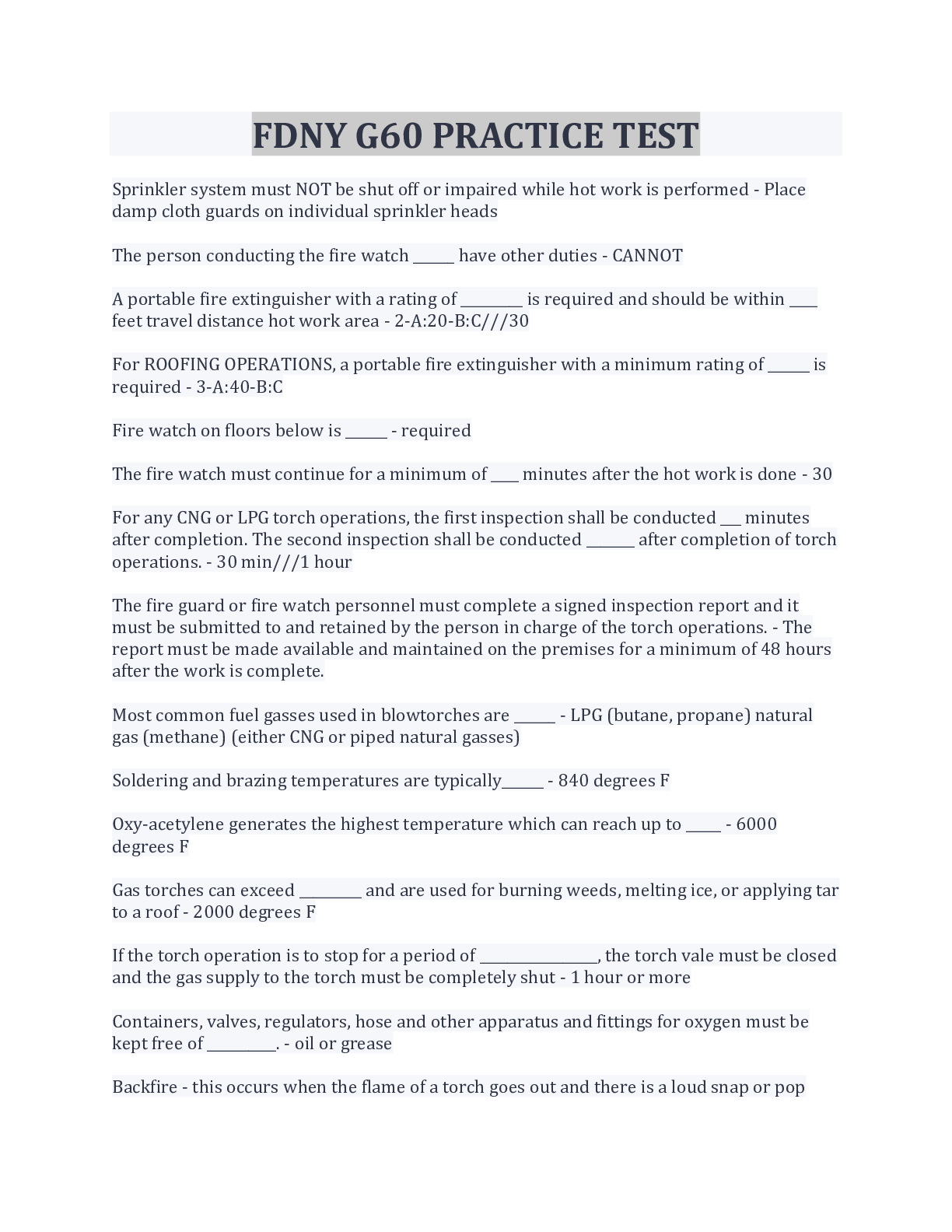
For any CNG or LPG torch operations, the first inspection shall be conducted ___ minutes after
completion. The second inspection shall be conducted _______ after completion of torch
operations. ✔✔30 min///1 hour
The fire guard or fire watch personnel must complete a signed inspection report and it must be
submitted to and retained by the person in charge of the torch operations. ✔✔The report must be
made available and maintained on the premises for a minimum of 48 hours after the work is
complete.
Most common fuel gasses used in blowtorches are ______ ✔✔LPG (butane, propane) natural
gas (methane) (either CNG or piped natural gasses)
Soldering and brazing temperatures are typically______ ✔✔840 degrees F
Oxy-acetylene generates the highest temperature which can reach up to _____ ✔✔6000 degrees
F
Gas torches can exceed _________ and are used for burning weeds, melting ice, or applying tar
to a roof ✔✔2000 degrees F
If the torch operation is to stop for a period of _________________, the torch vale must be
closed and the gas supply to the torch must be completely shut ✔✔1 hour or more
Containers, valves, regulators, hose and other apparatus and fittings for oxygen must be kept free
of __________. ✔✔oil or grease
Backfire ✔✔this occurs when the flame of a torch goes out and there is a loud snap or pop
Flashback ✔✔This occurs when the cutting or welding flame burns inside the torch or the hoses
and it is usually accompanied by a whistle or hissing noise. As soon as it is noticed, the torch
control valves should be closed. This indicated there is something wrong with the equipment,
either damage or blockage
A hot work area should be _____ ✔✔well ventilated
Whoever is working with hot work equipment CANNOT wear _____________ since it is
susceptible to burning and ignition ✔✔frayed clothing
Empty containers must be __________ ✔✔handled in the same manner as full ones
Gas containers must be replaced when empty. ✔✔It is ILLEGAL to refill gas container
All gas containers, whether CNG or LPG, must be secured in an __________ ✔✔upright
position and must not be stacked or stored on shelves
All gas containers and related equipment must be _________ ✔✔protected from extreme
temperature and physical damage
The control valve of any gas container must be _______ ✔✔opened by hand
Acetylene valves shall not be opened more than ______ ✔✔1 ½ turns
The purpose of a regulator is to ________ ✔✔control the flow of gas and lower the pressure
from the container to the appliance. It also acts like a safely barrier between the high pressure of
the gas container and the end use appliance
Hoses must be as _______ protecting from mechanical injury ✔✔short as practical
No hose is allowed to exceed ____feet ✔✔30
A compressed gas container MUST NOT ________ ✔✔be rolled on its side or its rim, only by
approved lifting equipment
Ropes, chains or slings shall NOT be used to ________ ✔✔suspend compressed gas containers
unless such containers have been designed for such handling
CNG and LPG containers must be located _______ ✔✔away from electric power lines, piping
containing flammable or combustible liquids, piping containing flammable gasses, and piping
containing oxidizing materials
Fuel gas or oxygen containers in storage must be separated from any combustible materials by a
minimum distance of _____ ✔✔20 feet
Oxidizing gasses shall NOT be stored or used or come in contact with _______ ✔✔oil, grease or
other petroleum bases
A permit is required for any storage area storing any flammable gas in excess of ____ or any
oxygen in excess of ____ ✔✔400 SCF///504 SCF
Copper tubing should NEVER ______ ✔✔be used to splice the acetylene hose because the
copper with react with the acetylene and it can cause an explosion
NEVER set the regulator for LPG above ____ as the acetylene will decompose explosively
✔✔15 PSI
Examples of LPG ✔✔Propane, propylene, butane, and butylene
Most commonly used LPG is ____ ✔✔butane and propane
LPG is most commonly referred to as _____ ✔✔bottled gas
LPG is naturally _______ ✔✔colorless and odorless
LPG is heavier than _____ ✔✔air
LPG containers must be tested by DOT approved vendors every _______ ✔✔5 years
LPG containers can be a maximum weight of _____ ✔✔100 pounds
LPG must be only used in _________, not underground ✔✔well ventilated areas
LPG containers with a weight of _______ shall be provided with transportation plugs ✔✔20
pounds
CNG is mainly composed of ____ ✔✔Methane
Any single CNG container MUST NOT exceed ______ ✔✔381 SCF
The C of F holder MUST NOT _______ ✔✔attempt to do any repairs, but only take the
equipment out of service
Always check leaks with _______ ✔✔SOAP AND WATER
PASS ✔✔Pull, Aim, Squeeze, Sweep
NO fire extinguisher is allowed to be ______ ✔✔placed on the floor
Always approach a fire from a _______ ✔✔upwind direction
Class A =
Class B =
Class C =
Class D =
Class K = ✔✔combustible materials (paper, cardboard)
flammables (oil, kerosene)
electrical equipment
combustible metals
cooking stuff
Fire extinguishers are to be inspected and checked _______ ✔✔monthly
[Show More]






![Preview of [SOLVED] EDCO 740 / EDCO740 Quiz 1 (LATES 2021/2022 Graded A)](https://scholarfriends.com/storage/EDCO_740_Quiz_1.png)


