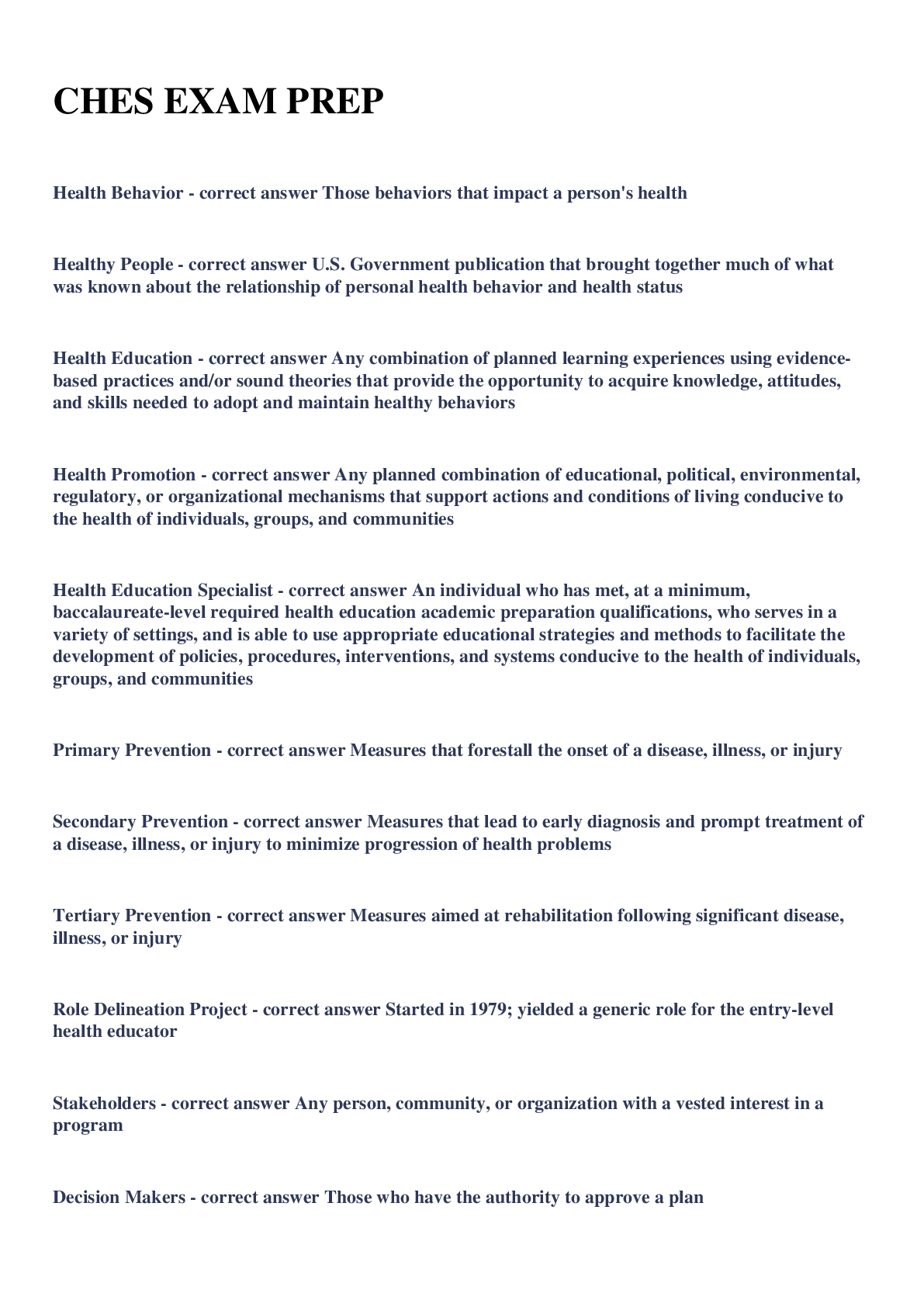
Health Behavior
Those behaviors that impact a person's health
Healthy People
U.S. Government publication that brought together much of what was known about the relationship of personal health behavior and health
...
Health Behavior
Those behaviors that impact a person's health
Healthy People
U.S. Government publication that brought together much of what was known about the relationship of personal health behavior and health status
Health Education
Any combination of planned learning experiences using evidence-based practices and/or sound theories that provide the opportunity to acquire knowledge, attitudes, and skills needed to adopt and maintain healthy behaviors
Health Promotion
Any planned combination of educational, political, environmental, regulatory, or organizational mechanisms that support actions and conditions of living conducive to the health of individuals, groups, and communities
Health Education Specialist
An individual who has met, at a minimum, baccalaureate-level required health education academic preparation qualifications, who serves in a variety of settings, and is able to use appropriate educational strategies and methods to facilitate the development of policies, procedures, interventions, and systems conducive to the health of individuals, groups, and communities
Primary Prevention
Measures that forestall the onset of a disease, illness, or injury
Secondary Prevention
Measures that lead to early diagnosis and prompt treatment of a disease, illness, or injury to minimize progression of health problems
Tertiary Prevention
Measures aimed at rehabilitation following significant disease, illness, or injury
Role Delineation Project
Started in 1979; yielded a generic role for the entry-level health educator
Stakeholders
Any person, community, or organization with a vested interest in a program
Decision Makers
Those who have the authority to approve a plan
Community
A collective body of individuals identified by common characteristics such as geography, interests, experiences, concerns, or values
Priority Population
Those for whom the program is intended to serve
Steps of Generalized Model
Assessing Needs, Setting Goals/objectives, Developing an intervention, Implementing the intervention, Evaluating the results
Capacity Assessment
Measure of actual and potential individual, group, and community resources that can be inherent to and/or brought to bear for health maintenance and enhancement.
Needs Assessment
Systematic identification of needs within a population and the determination of the degree to which those needs are being met
Social Determinants of Health
Conditions in which people are born, live, work, play, and age that affect their health risk, health, daily functioning, and quality of life
Health Disparities
Particular type of health difference that is closely linked with social, economic, and/or environmental disadvantage
Health Equity
Attainment of highest level of health for all people
Maslow's Hierarchy of Needs
Physiological, Safety, Social, Esteem, Self-Actualization
ARCS Motivation Model
Attention, Relevance, Confidence, Satisfaction
Gagne's Theory of Instruction
Gain attention, Inform learners of objectives, build on prior knowledge, present the stimulus, provide guidance, provide feedback, assess performance, enhance retention & transfer
Bloom's Taxonomy
Knowledge, Comprehension, Application, Analysis, Synthesis, Evaluation
Area of Responsibility I
Assess Needs, Assets, and Capacity for Health Education
Area of Responsibility II
Plan Health Education/Promotion
Community-Based Organization (CBO)
Public or private, nonprofit organization of demonstrated effectiveness that is representative of a community or significant segments of a community and provides educational or related services to individuals in the community
Coalition
Group of diverse organizations and constituencies working together toward a common goal
Program Objective
Changes in health status, morbidity, mortality, quality of life
Environmental Objective
Environmental or non behavioral influences on a health problem
Behavioral Objective
Behaviors or actions of priority population to resolve the problem
Learning Objectives
Short-term, specific descriptions of awareness, knowledge, attitudes, and skills in relation to the content being taught
Administrative/Process Objectives
Detail the tasks/activities completed by program facilitators for the program to succeed
PRECEDE-PROCEED Step #1
Social Assessment-define the quality of life of the priority population
PRECEDE-PROCEED Step #2
Epidemiological Assessment- identify the health problems of the priority population and prioritize behavioral & environmental risk factors associated with health problem
PRECEDE-PROCEED Step #3
Educational and Ecological Assessment- determine predisposing, enabling, and reinforcing factors
PRECEDE-PROCEED Step #4
Administrative & Policy Assessment- determine the resources available for the program
PRECEDE-PROCEED Step #5
Implementation- select strategies and activities; begin program
PRECEDE-PROCEED Step #6
Process Evaluation- document program feasibility
PRECEDE-PROCEED Step #7
Impact Evaluation- Assess the immediate effect of an intervention
PRECEDE-PROCEED Step #8
Outcome Evaluation- determines whether long-term program goals were met
Multilevel Approach to Community Health (MATCH)
Goals Selection, Intervention Planning, Program Development, Implementation Preparation, Evaluation
CDCynergy Phases
Define & describe the problem
Analyze the problem
Identify and profile the audience
Develop communication strategies
Develop evaluation plan
Launch the plan and obtain feedback
[Show More]
.png)