PSPO Exam Practice Questions
In order to make investment decisions, the Product Owner is likely to look at the Total Cost of
Ownership (TCO) of the product being built. What costs will a Product Owner take into account
...
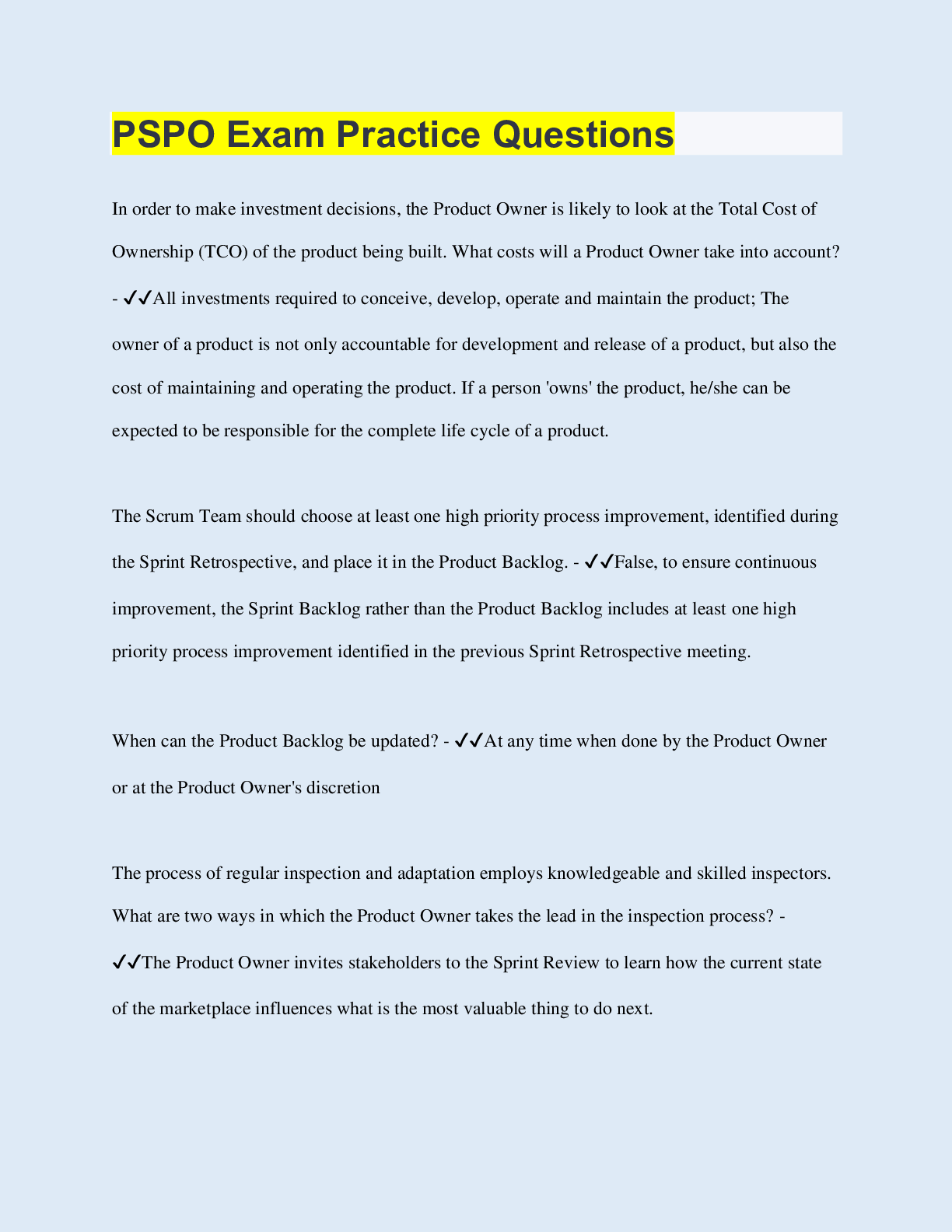
PSPO Exam Practice Questions
In order to make investment decisions, the Product Owner is likely to look at the Total Cost of
Ownership (TCO) of the product being built. What costs will a Product Owner take into account?
- ✔✔All investments required to conceive, develop, operate and maintain the product; The
owner of a product is not only accountable for development and release of a product, but also the
cost of maintaining and operating the product. If a person 'owns' the product, he/she can be
expected to be responsible for the complete life cycle of a product.
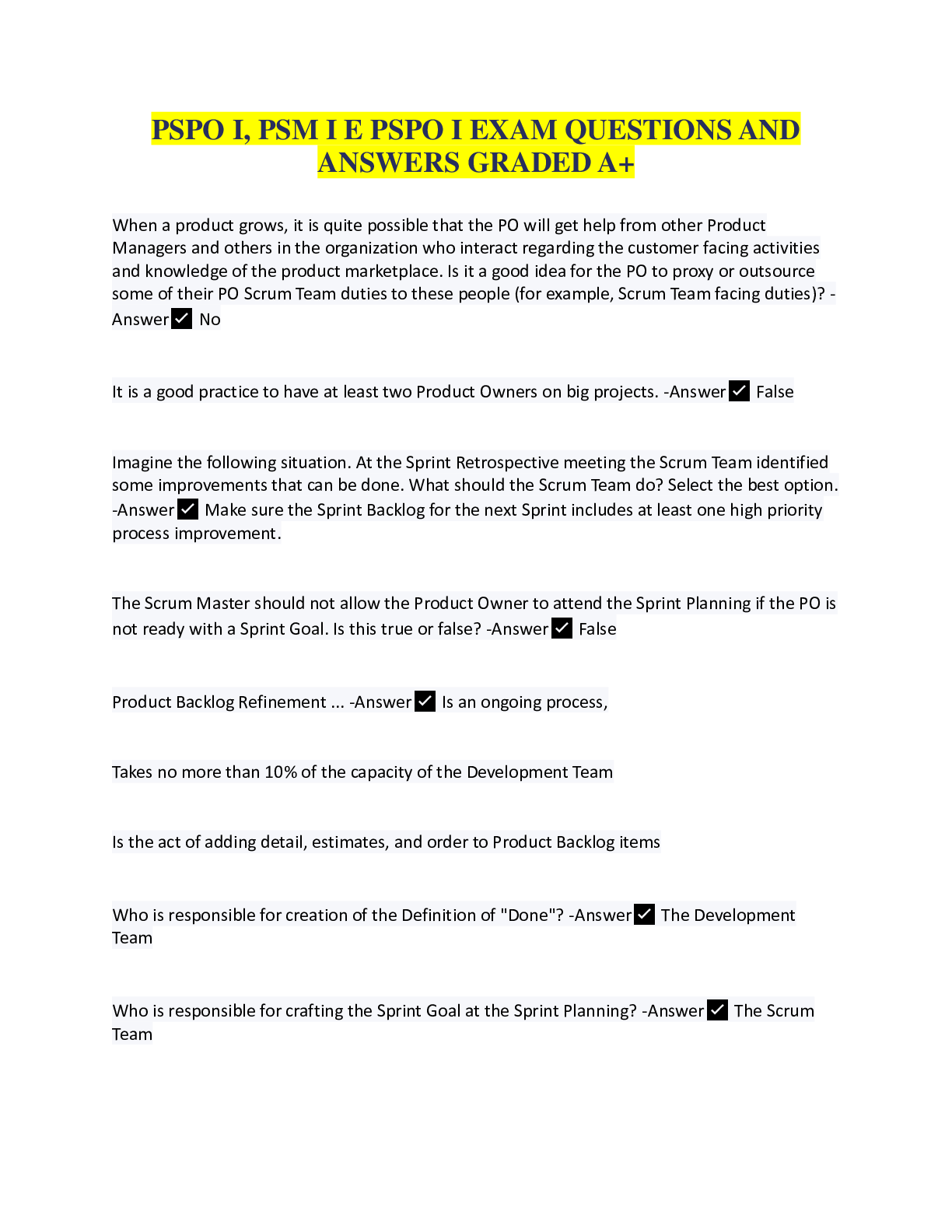
The Scrum Team should choose at least one high priority process improvement, identified during
the Sprint Retrospective, and place it in the Product Backlog. - ✔✔False, to ensure continuous
improvement, the Sprint Backlog rather than the Product Backlog includes at least one high
priority process improvement identified in the previous Sprint Retrospective meeting.
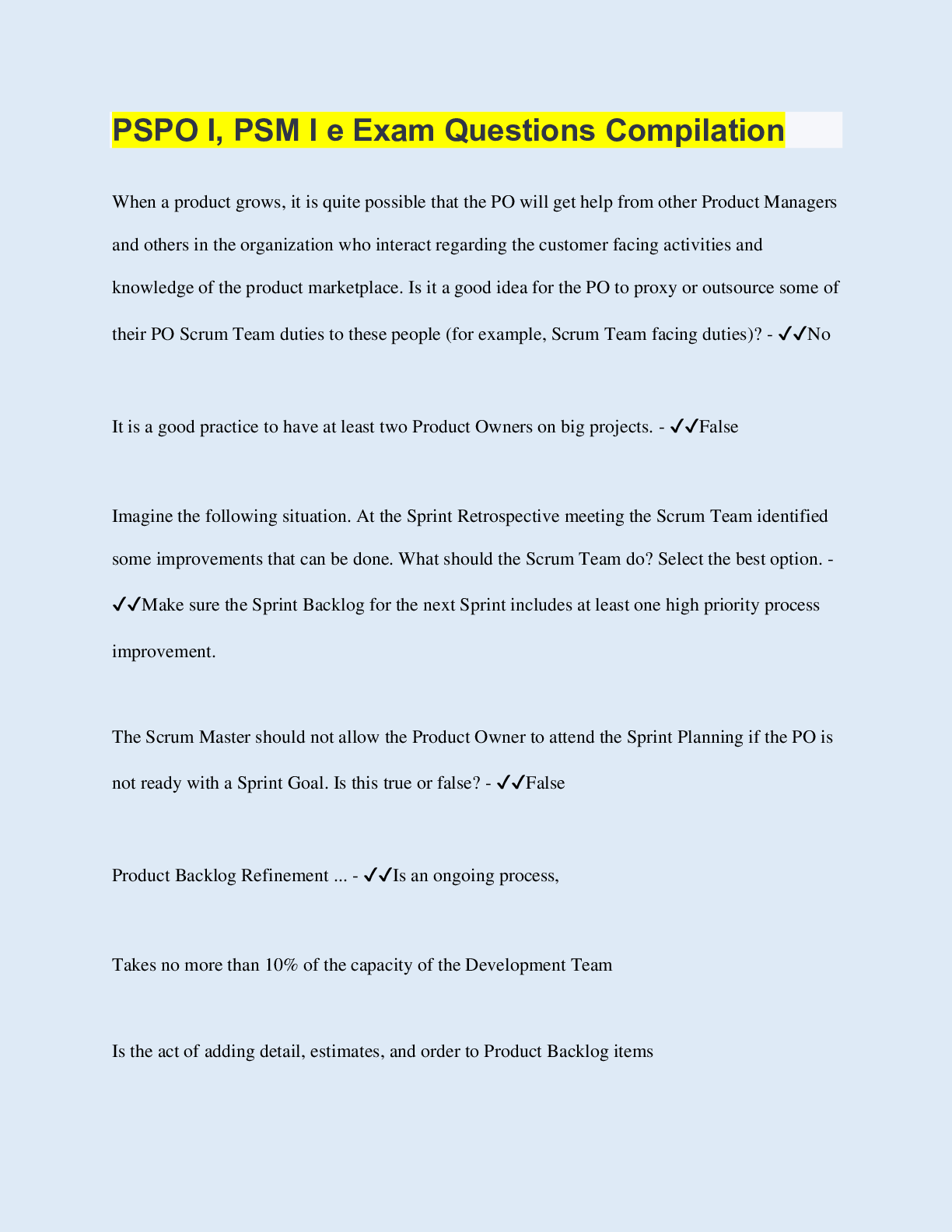
When can the Product Backlog be updated? - ✔✔At any time when done by the Product Owner
or at the Product Owner's discretion
The process of regular inspection and adaptation employs knowledgeable and skilled inspectors.
What are two ways in which the Product Owner takes the lead in the inspection process? -
✔✔The Product Owner invites stakeholders to the Sprint Review to learn how the current state
of the marketplace influences what is the most valuable thing to do next.
At the Sprint Review the Product Owner shares the current state of Product Backlog, which,
combined with the inspection of the Increment, leads to an updated Product Backlog.
How does an organization know that a product built through Scrum is successful? - ✔✔By
releasing often, and updating key performance indicators (KPIs) on value after every release and
feeding this information back into work on the Product Backlog
Which two statements explain why the definition of "Done" is important to the Product Owner? -
✔✔It creates transparency regarding progress within the Scrum Team.
It assures the Increment reviewed at the Sprint review is usable so the Product Owner may
choose to release it.
Who creates the definition of "Done"? - ✔✔The development organization (or Development
Team if none is available from the development organization);
If the definition of "done" is part of the conventions, standards or guidelines of the development
organization, all Scrum Teams must follow it as a minimum. The Development Team of the
Scrum Team can complement it with elements specific for the product or context.
A Product Owner is entitled to postpone the start of a new Sprint after the conclusion of a
previous Sprint for the following reason: - ✔✔There is no acceptable reason. A new Sprint starts
immediately after the conclusion of the previous Sprint.
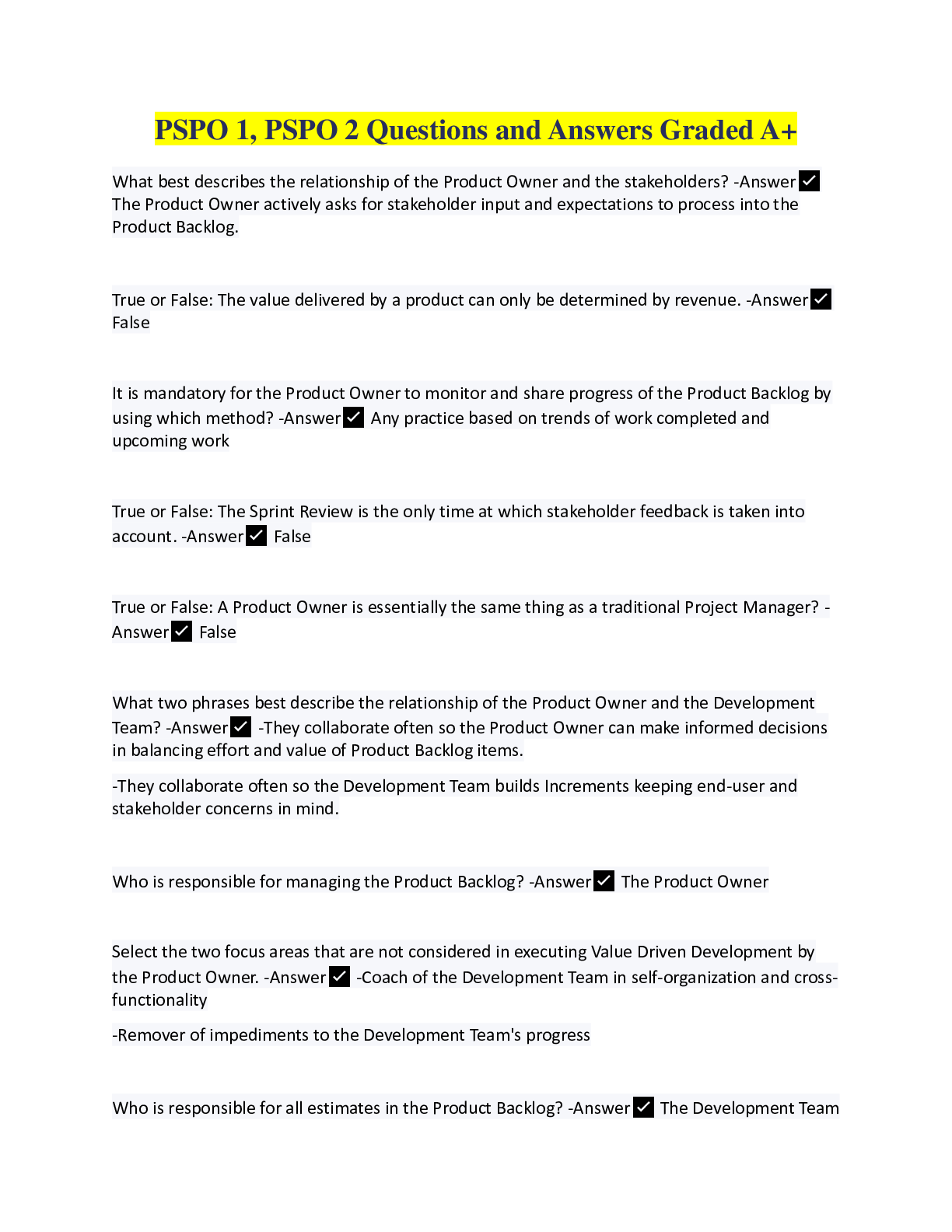
A Product Owner is essentially the same thing as a traditional Project Manager? - ✔✔False
The value delivered by a product can only be determined by revenue. - ✔✔False; Value is likely
to vary across products and organizations.
What is the Product Owner accountable for in Scrum? - ✔✔Clearly expressing a Product
Backlog that maximizes value and represents the needs of the stakeholders
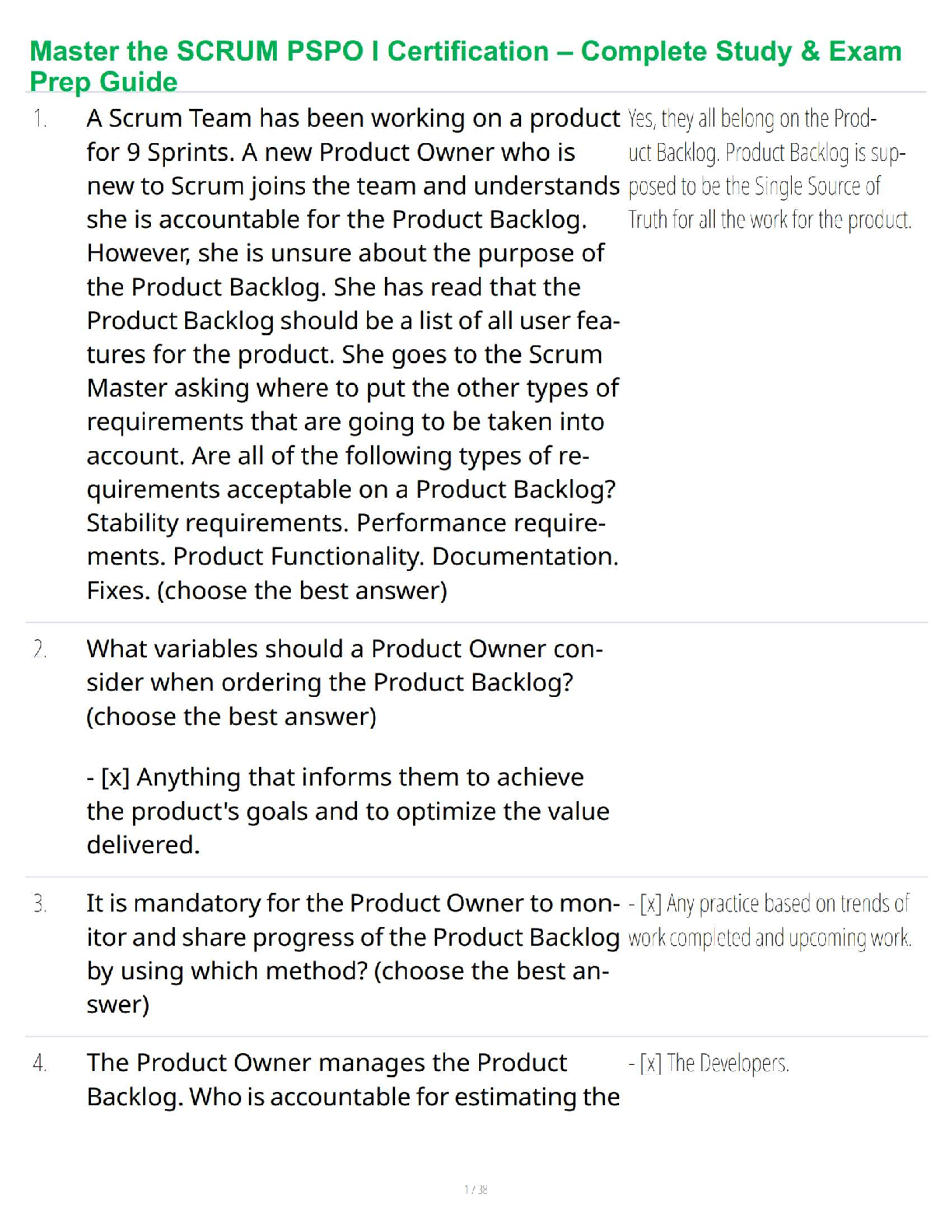
The Product Owner manages the Product Backlog. Who is accountable for estimating the effort
to complete the Product Backlog items? - ✔✔The Development Team. As a collective, they have
a complete view of the work needed to transform Product Backlog items into Increments of
product.
The Product Owner's authority to change and update the Product Backlog is unlimited, except
for: - ✔✔Nothing. The entire organization must respect a Product Owner's decisions.
Learning turns into 'validated learning' when assumptions and goals can be assessed through
results. What is a key way for a Product Owner to apply validated learning? - ✔✔Release an
Increment to the market to learn about the business assumptions built into the product.;
The Product Owner manages Product Backlog against the assumption that value will be
generated. This assumption remains invalidated when not checked against users and market.
The Sprint Review is the only time at which stakeholder feedback is taken into account. -
✔✔False
To what extent does technical debt limit the value a Product Owner can get from a product? -
✔✔Technical debt causes a greater percentage of the product's budget to be spent on
maintenance of the product.
The velocity at which new functionality can be created is reduced when you have technical debt.
What are two typical activities for a Product Owner in a Sprint? - ✔✔Work with the
Development Team on Product Backlog refinement.
Collaborate with stakeholders, user communities, and subject matter experts.
Must the Product Owner be present at the Sprint Retrospective?(choose the best answer) - ✔✔It
is mandatory. The Sprint Retrospective is an opportunity for the Scrum Team to assess its
performance and improve itself.
Which description best fits the role of the Pro
[Show More]







![Preview of [SOLVED] EDCO 740 / EDCO740 Quiz 1 (LATES 2021/2022 Graded A)](https://www.scholarfriends.com/storage/EDCO_740_Quiz_1.png)