I. Sources of Criminal Law
Criminal Law Outline
A. English common law
B. Social morals
C. Modern legislation
D. Model penal code
II. Proving guilt at a trial
A. Right to a trial by jury: Under the Sixth A
...
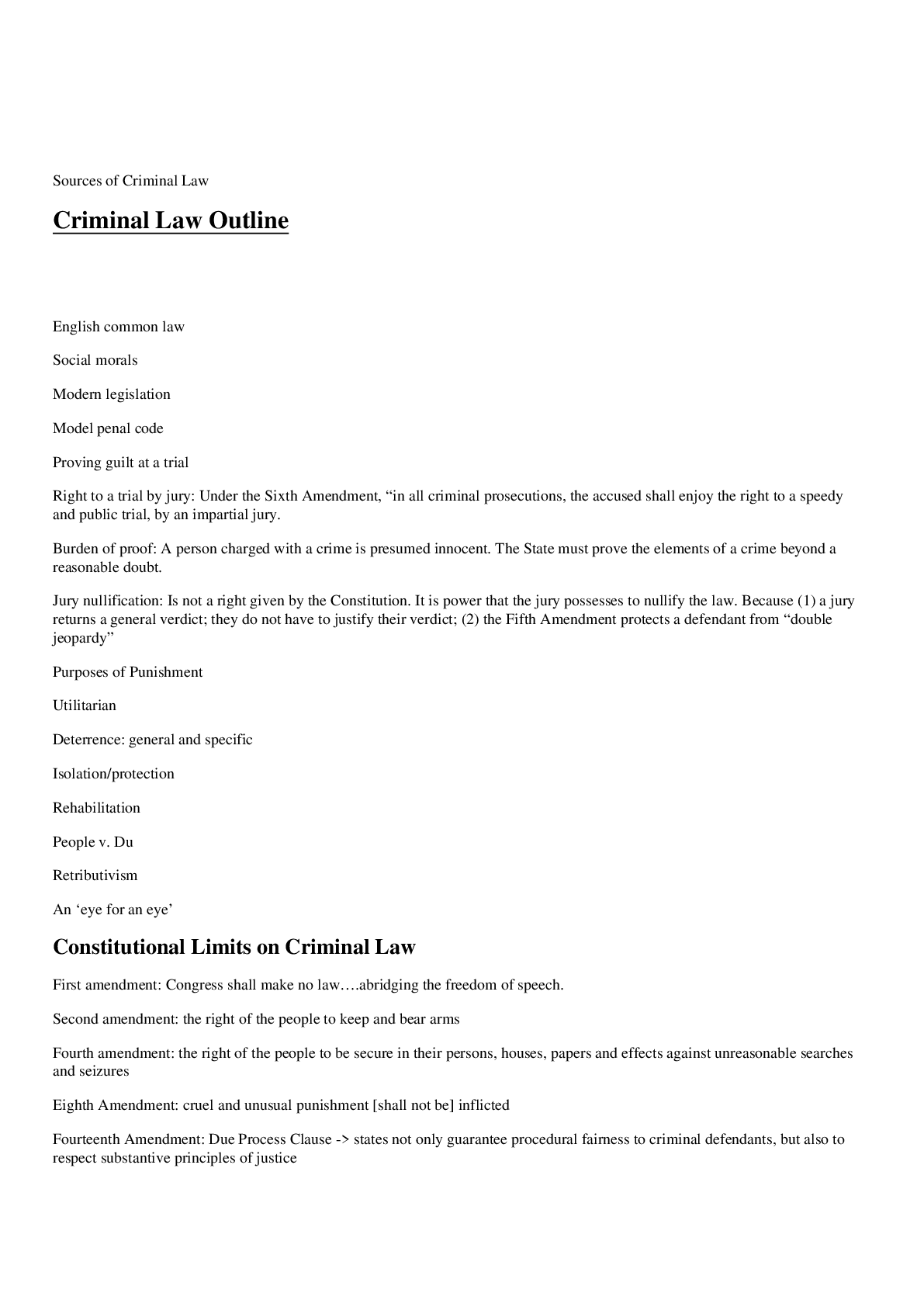
I. Sources of Criminal Law
Criminal Law Outline
A. English common law
B. Social morals
C. Modern legislation
D. Model penal code
II. Proving guilt at a trial
A. Right to a trial by jury: Under the Sixth Amendment, “in all criminal prosecutions, the accused shall enjoy the right to a speedy and public trial, by an impartial jury.
B. Burden of proof: A person charged with a crime is presumed innocent. The State must prove the elements of a crime beyond a reasonable doubt.
C. Jury nullification: Is not a right given by the Constitution. It is power that the jury possesses to nullify the law. Because (1) a jury returns a general verdict; they do not have to justify their verdict; (2) the Fifth Amendment protects a defendant from “double jeopardy”
III. Purposes of Punishment
A. Utilitarian
1. Deterrence: general and specific
2. Isolation/protection
3. Rehabilitation
a) People v. Du
B. Retributivism
1. An ‘eye for an eye’
Constitutional Limits on Criminal Law
I. First amendment: Congress shall make no law….abridging the freedom of speech.
II. Second amendment: the right of the people to keep and bear arms
III. Fourth amendment: the right of the people to be secure in their persons, houses, papers and effects against unreasonable searches and seizures
IV. Eighth Amendment: cruel and unusual punishment [shall not be] inflicted
V. Fourteenth Amendment: Due Process Clause -> states not only guarantee procedural fairness to criminal defendants, but also to respect substantive principles of justice
I. Due process
Statutory Analysis
A. Burden of proof - on the govt in criminal cases
B. Standard of proof - beyond a reasonable doubt
II. Notice
A. Principle of legality - nullum crimen sine lege, nulla poena sine lege
1. No retroactive expansion/application of criminal laws
2. Compare: ex post facto (legislative), Art. I, Sections 9,10 of the Constitution.
B. Void for Vagueness Doctrine
1. Definiteness
2. Minimum guidelines to prevent arbitrary and discriminatory enforcement of the laws
3. Inhibits exercise of 1st amendment rights
C. Rule of Strict construction/doctrine of lenity(p 113): statutory interpretation in favor of the defendant and against the government.
1. Legislative intent
2. Common law
3. Plain meaning/dictionary
4. Purpose/policy
5. Statutes in pari materia
6. Legislative history
III. Principle of legality v ex post facto (how are they different)
A. Ex post facto applies to legislative
1. 10th amendment
2. No retroactive creation or expansion of crimes
B. Principle of legality applies to judicial branch
1. No retroactive creation or expansion of crimes
Elements of a Crime
I. Actus Reus - Acts and Omissions
A. The criminal act Voluntary act or failure to act w/ legal duty
B. Failure to act: a legal duty and the failure to do so
C. MPC Under 2.01: Voluntary Act or Omission to Perform an Act of which the Actor is Physically Capable
1. Voluntary: not reflexive, volitional, compare: intentional, deliberate, purposeful OR legal duty
2. Statute: if a statute tells one that they have legal duty to help
a) Example: hit someone with a car dont leave or hit and run
3. Status: relationship status
4. Contract
5. Creation of risk
6. Assumption of duty
a) Example: lifeguard, security guard
b) If you assume the duty you have to finish it
D. All crimes have an actus reus, but not all crimes have a mens rea
II. Mens Rea - State of Mind
A. MPC SECTION 2.02 - Four mental States for Criminal Culpability
1. Purposely (aka intentionally) - conscious object to engage in conduct of the nature or to cause such a result and if the element involves attendant circumstances, is are of their existence or believes or hopes those circumstances exist
2. Knowingly - aware that his conduct is of that nature or that such circumstances exist and if the element involves a result of his conduct
a) Knowledge of high probability
b) Willful blindness = knowingly (same rule under the common law)
3. Recklessly - consciously disregards a substantial and unjustifiable risk. (subjective standard) t
[Show More]