ACLS Exam 2021/2022 with complete
solution
Which class of medications commonly given to patients with acute coronary syndromes
may be adversely affected by morphine administration
A. Phosphodiesterase inhibitors
B.
...
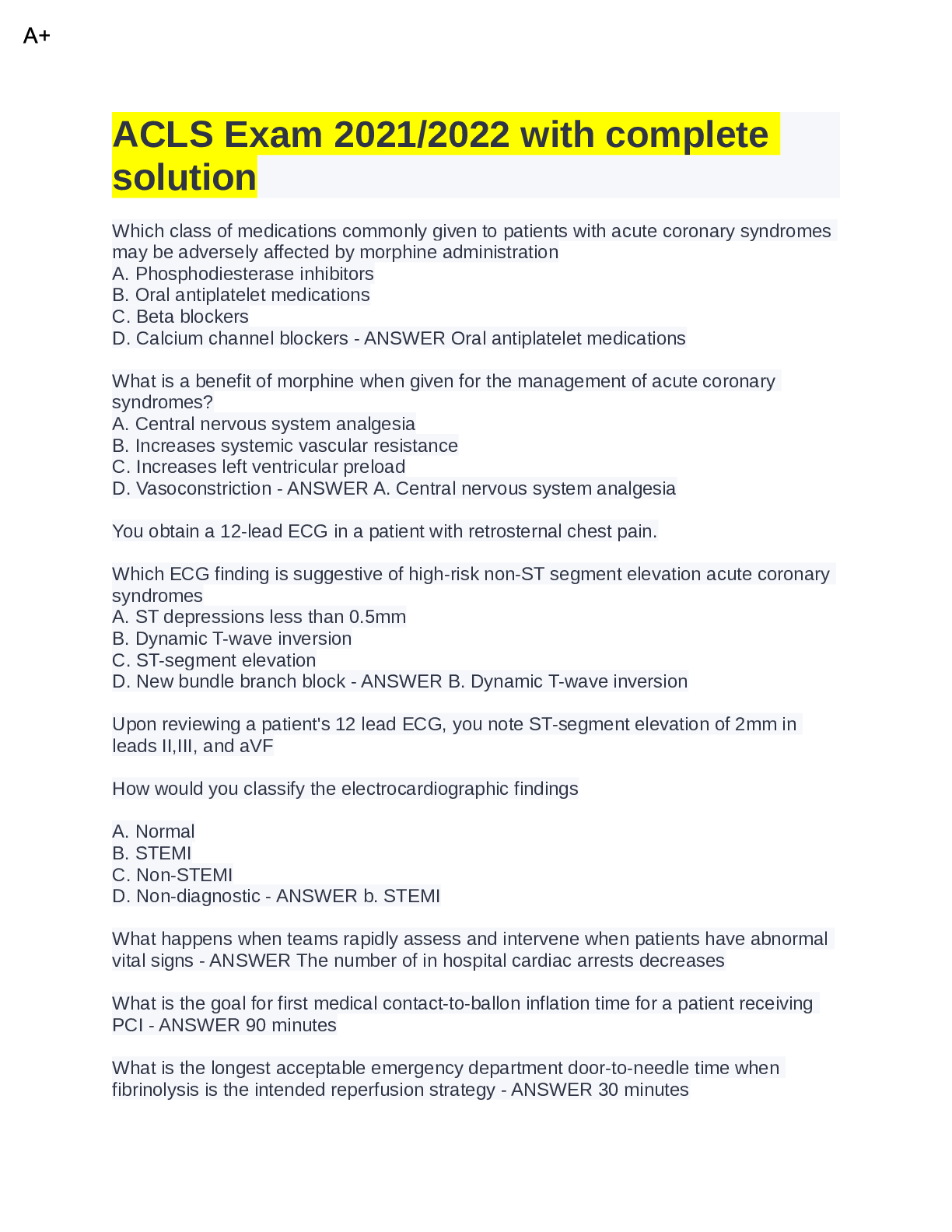
ACLS Exam 2021/2022 with complete
solution
Which class of medications commonly given to patients with acute coronary syndromes
may be adversely affected by morphine administration
A. Phosphodiesterase inhibitors
B. Oral antiplatelet medications
C. Beta blockers
D. Calcium channel blockers - ANSWER Oral antiplatelet medications
What is a benefit of morphine when given for the management of acute coronary
syndromes?
A. Central nervous system analgesia
B. Increases systemic vascular resistance
C. Increases left ventricular preload
D. Vasoconstriction - ANSWER A. Central nervous system analgesia
You obtain a 12-lead ECG in a patient with retrosternal chest pain.
Which ECG finding is suggestive of high-risk non-ST segment elevation acute coronary
syndromes
A. ST depressions less than 0.5mm
B. Dynamic T-wave inversion
C. ST-segment elevation
D. New bundle branch block - ANSWER B. Dynamic T-wave inversion
Upon reviewing a patient's 12 lead ECG, you note ST-segment elevation of 2mm in
leads II,III, and aVF
How would you classify the electrocardiographic findings
A. Normal
B. STEMI
C. Non-STEMI
D. Non-diagnostic - ANSWER b. STEMI
What happens when teams rapidly assess and intervene when patients have abnormal
vital signs - ANSWER The number of in hospital cardiac arrests decreases
What is the goal for first medical contact-to-ballon inflation time for a patient receiving
PCI - ANSWER 90 minutes
What is the longest acceptable emergency department door-to-needle time when
fibrinolysis is the intended reperfusion strategy - ANSWER 30 minutes
A+
What is the time goal for how quickly you should complete a fibronolytic checklist once
the patient arrives in the emergency department - ANSWER 10 minutes
What is the recommended time window after symptom onset for early fibronolytic
therapy or direct catheter-based reperfusion for patients with STEMI and no
contraindication - ANSWER Within 12 hours
a 49 yo says that he has had chest discomfort and excessive sweating for the past 25
minutes. Within the first 10 minutes, on the basis of the patient showing symptoms
suggestive of MI, what will your first actions include? - ANSWER Provide prehospital
notification to the receiving hospital
Administer aspirin
if considering prehospital fibrinolysis, use the fibrinolytic checklist
assess ABC
Obtain EKG
consider oxygen, nitroglycerin, and morphine if needed
His initial vital signs are HR 120/min BP 135/88 RR 23 O2 87%
When considering oxygen saturation, what is your course of actions? - ANSWER Start
oxygen at 4L
What additional questions help you determine next steps - ANSWER When did the
symptoms start
Do you take any medication
Do you have any allergies
Your patient continues to say that he has chest discomfort
What treatment can you repeat as long as it is not contraindicated by vital signs -
ANSWER Nitroglycerin sublingual every 3-5min
What is your interpretation of the patient's EKG tracing
STEMI in V2-6 - ANSWER Anterior STEMI
With the possible diagnosis of STEMI, what is the most probable treatment - ANSWER
Admission for PCI/fibrinolysis
[Show More]


, 1e by Cristiane Surbeck, Jeff Kuo.png)