Week 6 Knowledge Check Quiz Advanced Patho NSG 5003
Week 6
Quiz 100% all an
...
Week 6 Knowledge Check Quiz Advanced Patho NSG 5003
Week 6
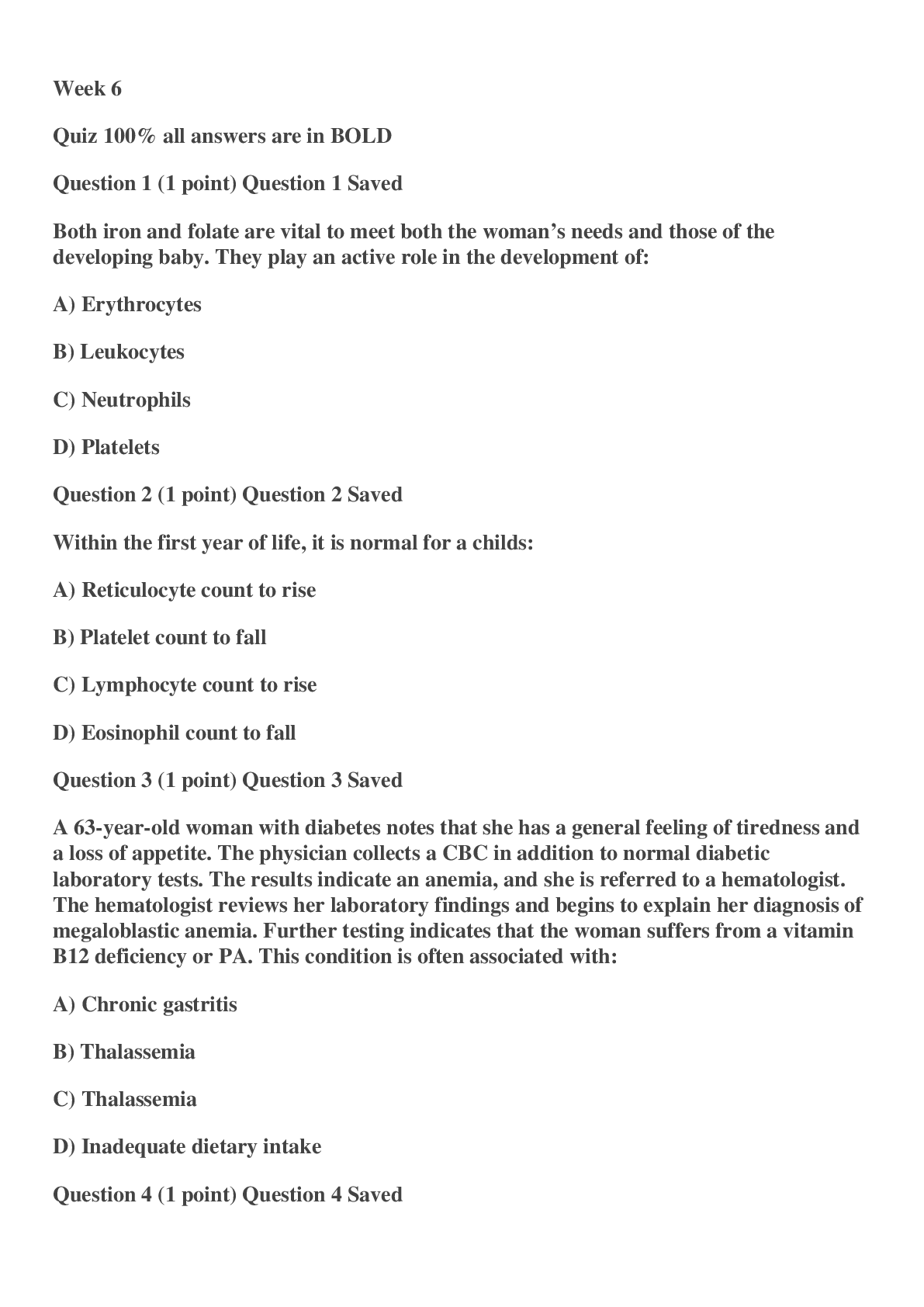
Quiz 100% all answers are in BOLD
Question 1 (1 point) Question 1 Saved
Both iron and folate are vital to meet both the woman’s needs and those of the developing baby. They play an active role in the development of:
Question 2 (1 point) Question 2 Saved
Within the first year of life, it is normal for a childs:
Question 3 (1 point) Question 3 Saved
A 63-year-old woman with diabetes notes that she has a general feeling of tiredness and a loss of appetite. The physician collects a CBC in addition to normal diabetic laboratory tests. The results indicate an anemia, and she is referred to a hematologist. The hematologist reviews her laboratory findings and begins to explain her diagnosis of megaloblastic anemia. Further testing indicates that the woman suffers from a vitamin B12 deficiency or PA. This condition is often associated with:
Question 4 (1 point) Question 4 Saved
The treatment for iron overload is
Question 5 (1 point) Question 5 Unsaved
DIC is secondary to a wide variety of well-defined clinical conditions, specifically those that activate the clotting cascade. The clotting may result in the consumption of platelets, and clotting factors may lead to severe bleeding that is caused by:
Week 5
100% Answers are in BOLD
Quiz
Note: It is recommended that you save your response as you complete each question.
Question 1 (1 point) Question 1 Unsaved
Which statement best describes the major characteristic of bronchiolitis?
Question 2 (1 point) Question 2 Unsaved
Which of the following physiologic abnormalities is characteristic of emphysema?
Question 3 (1 point) Question 3 Unsaved
Which of the following describes an asthma that is common in children and adolescents, with bronchospasm occurring within 3 minutes of activity?
Question 4 (1 point) Question 4 Unsaved
Which of the following values is consistent with acute respiratory failure?
Question 5 (1 point) Question 5 Unsaved
What is the most life-threatening type of croup usually caused by Haemophilus influenzae?
[Show More]