NSG 5003 Week 9 Knowledge Check Quiz
...
NSG 5003 Week 9 Knowledge Check Quiz
NSG 5003 Week 9 STUDY GUIDE: South University (Already graded A)
NSG 5003 Week 9 (Latest): Advanced Pathophysiology: South University (Already graded A)
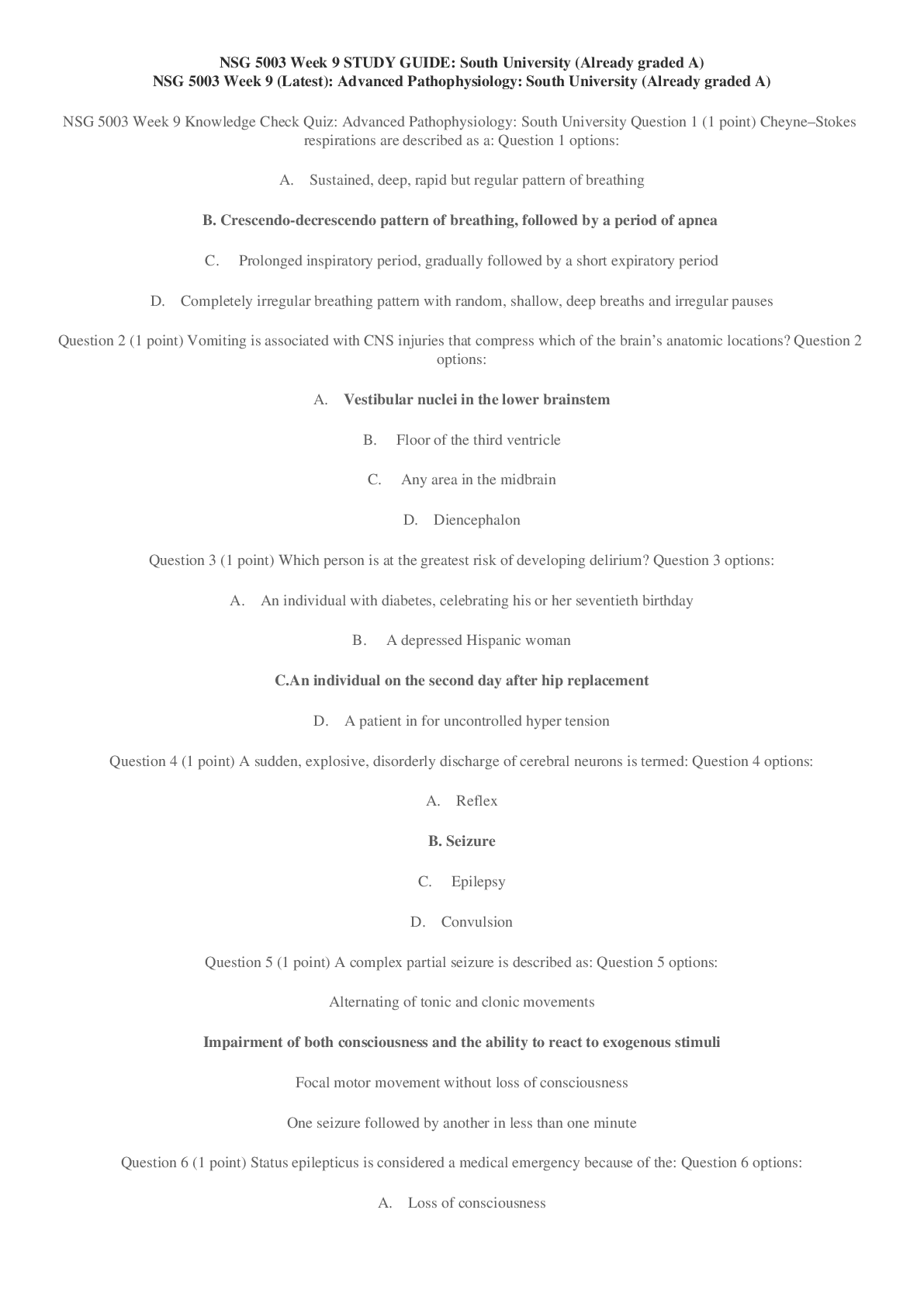
NSG 5003 Week 9 Knowledge Check Quiz: Advanced Pathophysiology: South University Question 1 (1 point) Cheyne–Stokes respirations are described as a: Question 1 options:
Question 2 (1 point) Vomiting is associated with CNS injuries that compress which of the brain’s anatomic locations? Question 2 options:
Question 3 (1 point) Which person is at the greatest risk of developing delirium? Question 3 options:
Question 4 (1 point) A sudden, explosive, disorderly discharge of cerebral neurons is termed: Question 4 options:
Question 5 (1 point) A complex partial seizure is described as: Question 5 options:
Alternating of tonic and clonic movements
Impairment of both consciousness and the ability to react to exogenous stimuli
Focal motor movement without loss of consciousness
One seizure followed by another in less than one minute
Question 6 (1 point) Status epilepticus is considered a medical emergency because of the: Question 6 options:
Question 7 (1 point) Tremors at rest, rigidity, akinesia, and postural abnormalities are a result of the atrophy of neurons in the: Question 7 options:
Question 8 (1 point) Diffuse axonal injuries (DAIs) of the brain often result in: Question 8 options:
Question 9 (1 point) Which group is most at risk of spinal cord injury from minor trauma? Question 9 options:
Question 10 (1 point) What indicates that spinal shock is terminating? Question 10 options:
Question 11 (1 point) Which term is used to describe a complication that can result from a spinal cord injury above T6 that is producing paroxysmal hypertension, as well as piloerection and sweating above the spinal cord lesion? Question 11 options:
Question 12 (1 point) Why does a person who has a spinal cord injury experience faulty control of sweating? Question 12 options:
Question 13 (1 point) Spinal cord injuries most likely occur in which region? Question 13 options:
Question 14 (1 point) The most likely rationale for body temperature fluctuations after cervical spinal cord injury is that the person has: Question 14 options:
Question 15 (1 point) Multiple sclerosis is best described as a(an): Question 15 options:
16 (1 point) What is the most common opportunistic infection associated with acquired immunodeficiency syndrome (AIDS)? Question 16 options:
Question 17 (1 point) It is true that Guillain–Barré syndrome (GBS): Question 17 options:
)
Question 18 (1 point) It is true that myasthenia gravis: Question 18 options:
Question 19 (1 point) In which disorder are acetylcholine receptor antibodies (immunoglobulin G [IgG] antibodies) produced against acetylcholine receptors? Question 19 options:
Question 20 (1 point) Question 20 options: What data confer the link between bipolar disorders and schizophrenia?
[Show More]




.png)