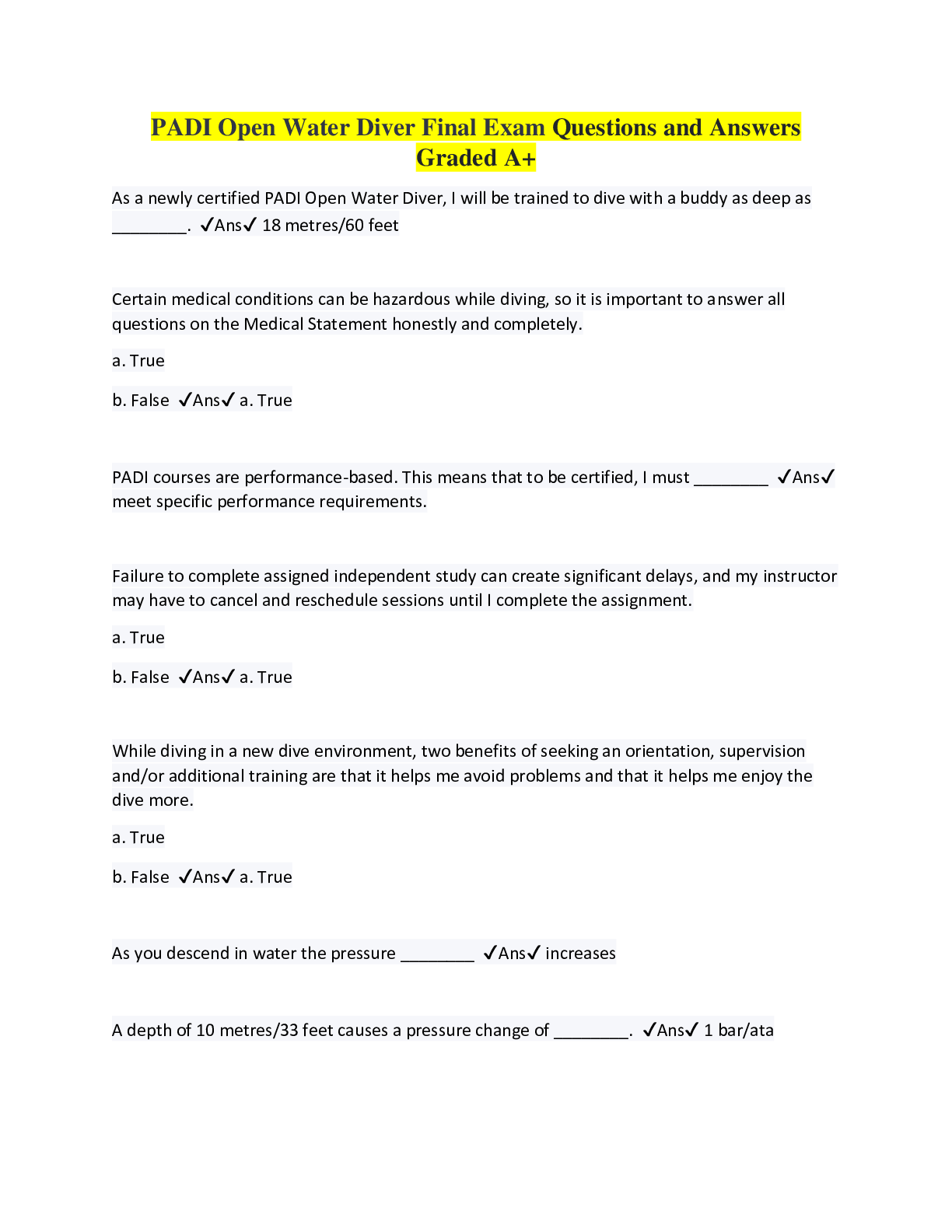
ISYE 6414 Final Exam Review with complete solution
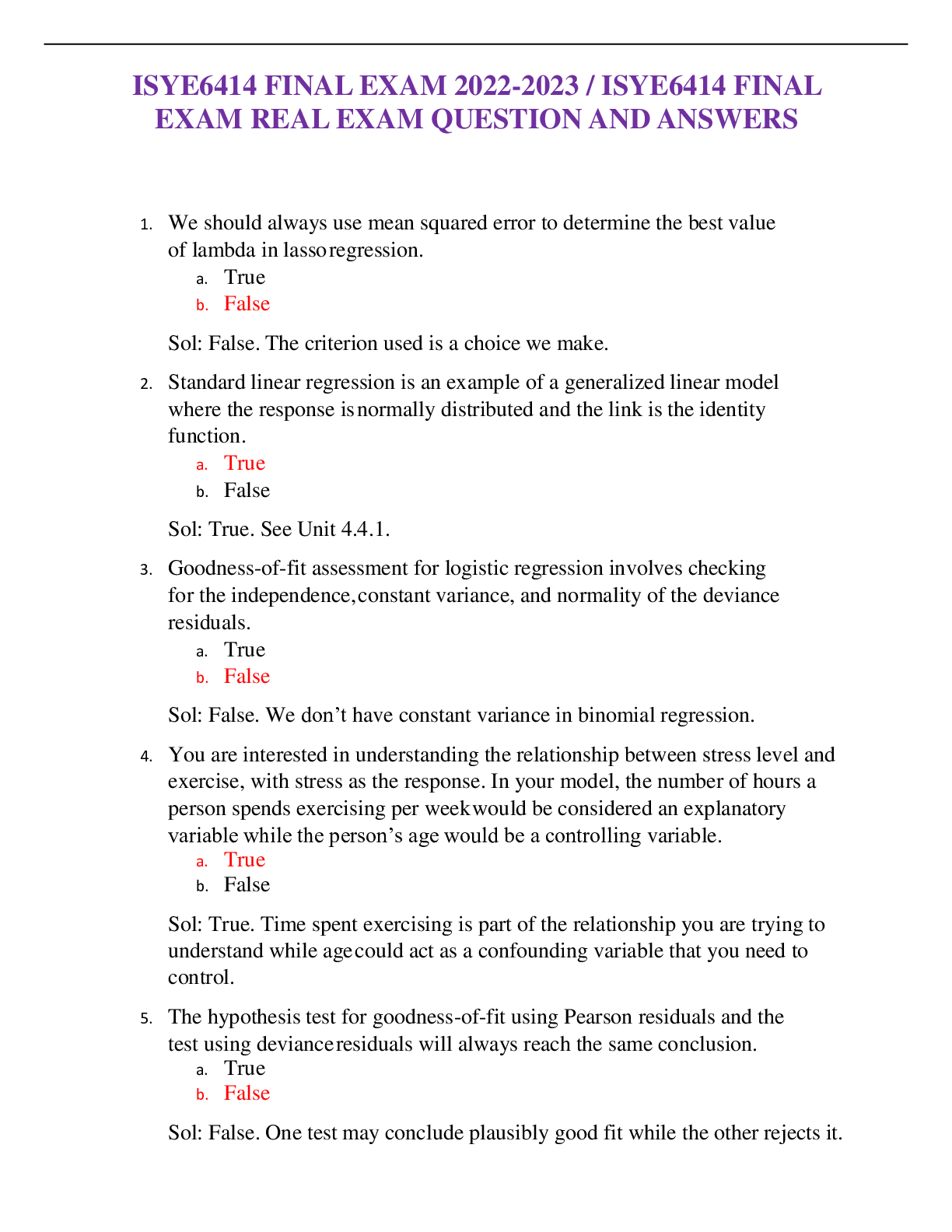
Least Square Elimination (LSE) cannot be applied to GLM models. ✔✔ False - it is applicable but does not use data distribution information fully.
In multiple linea
...
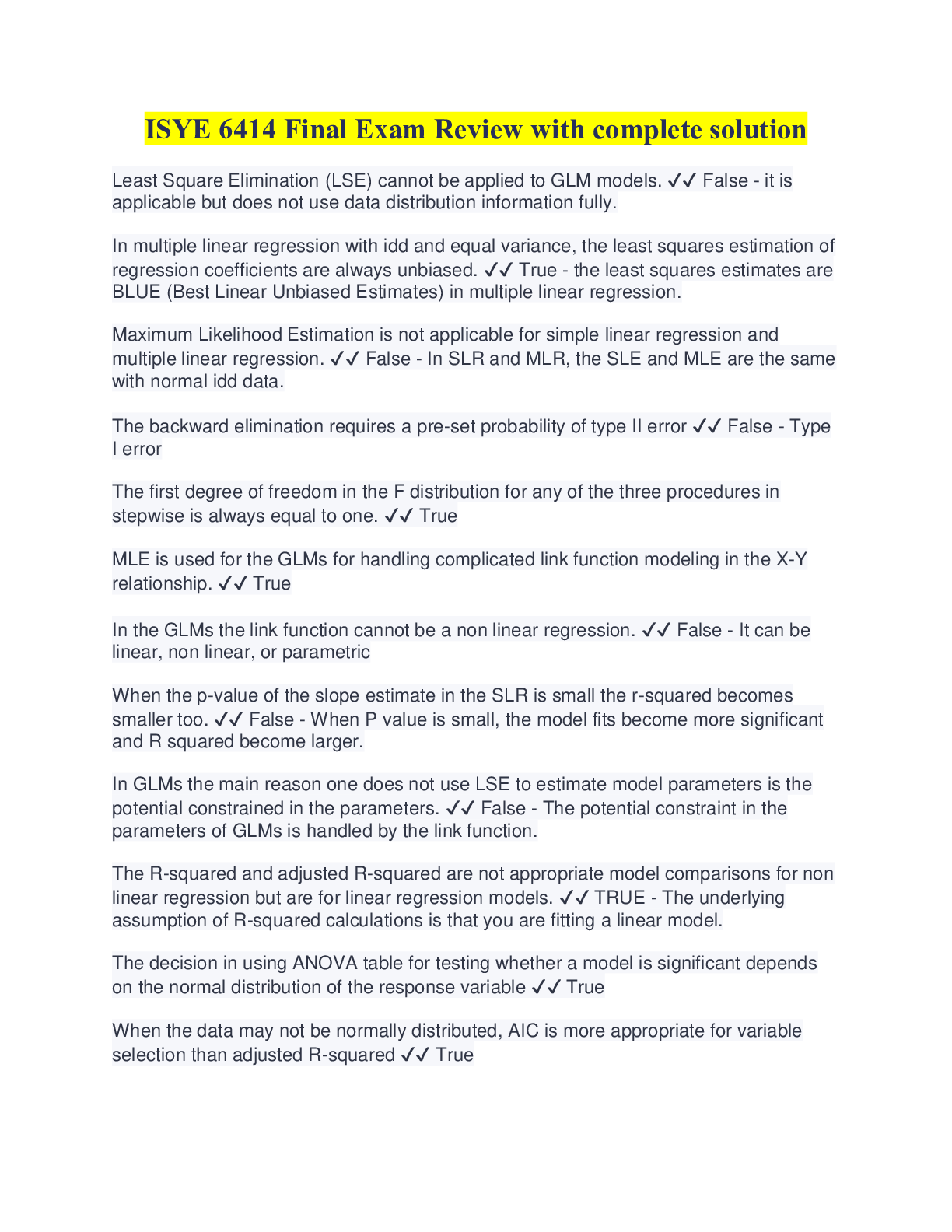
ISYE 6414 Final Exam Review with complete solution
Least Square Elimination (LSE) cannot be applied to GLM models. ✔✔ False - it is applicable but does not use data distribution information fully.
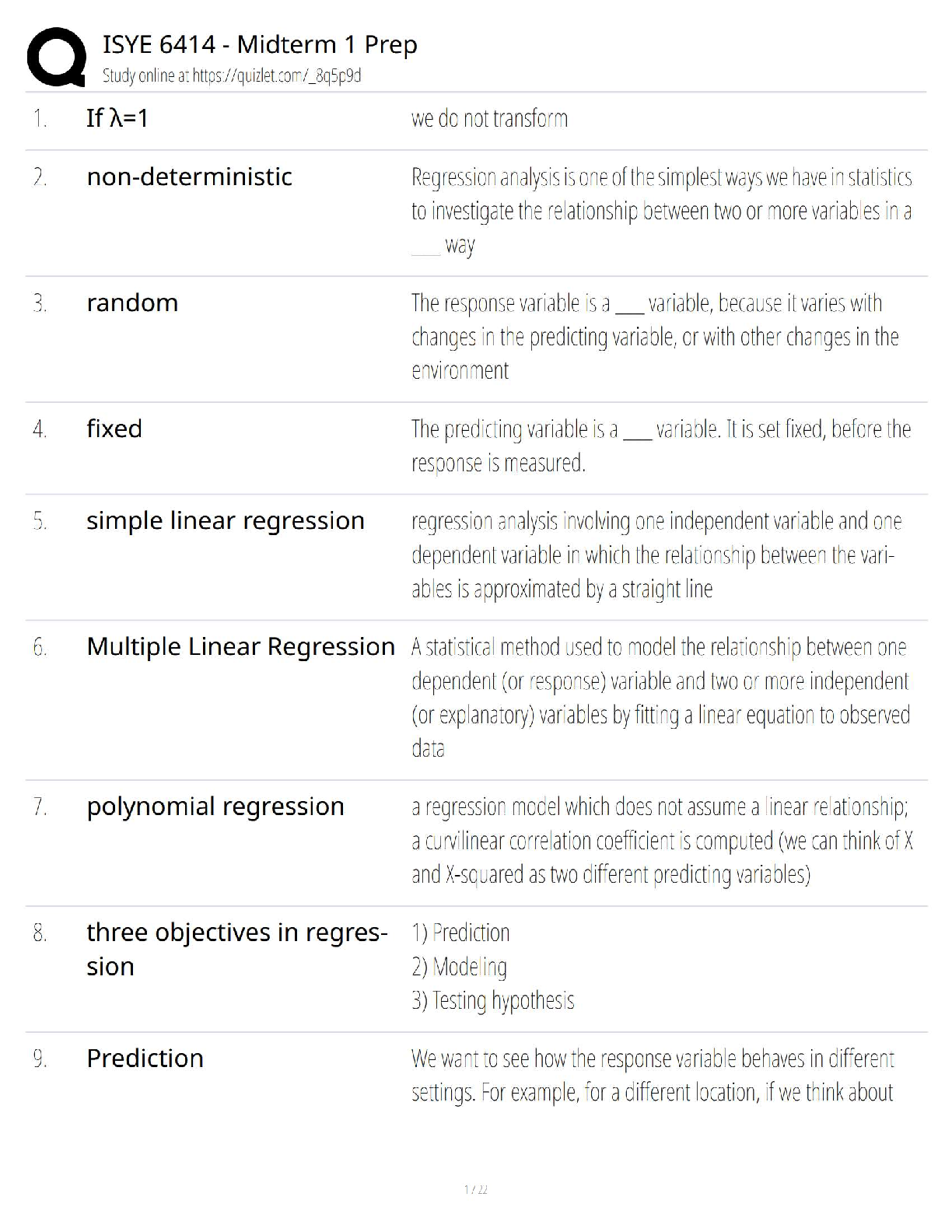
In multiple linear regression with idd and equal variance, the least squares estimation of regression coefficients are always unbiased. ✔✔ True - the least squares estimates are BLUE (Best Linear Unbiased Estimates) in multiple linear regression.
Maximum Likelihood Estimation is not applicable for simple linear regression and multiple linear regression. ✔✔ False - In SLR and MLR, the SLE and MLE are the same with normal idd data.
The backward elimination requires a pre-set probability of type II error ✔✔ False - Type I error
The first degree of freedom in the F distribution for any of the three procedures in stepwise is always equal to one. ✔✔ True
MLE is used for the GLMs for handling complicated link function modeling in the X-Y relationship. ✔✔ True
In the GLMs the link function cannot be a non linear regression. ✔✔ False - It can be linear, non linear, or parametric
When the p-value of the slope estimate in the SLR is small the r-squared becomes smaller too. ✔✔ False - When P value is small, the model fits become more significant and R squared become larger.
In GLMs the main reason one does not use LSE to estimate model parameters is the potential constrained in the parameters. ✔✔ False - The potential constraint in the parameters of GLMs is handled by the link function.
The R-squared and adjusted R-squared are not appropriate model comparisons for non linear regression but are for linear regression models. ✔✔ TRUE - The underlying assumption of R-squared calculations is that you are fitting a linear model.
The decision in using ANOVA table for testing whether a model is significant depends on the normal distribution of the response variable ✔✔ True
When the data may not be normally distributed, AIC is more appropriate for variable selection than adjusted R-squared ✔✔ True
The slope of a linear regression equation is an example of a correlation coefficient. ✔✔ False - the correlation coefficient is the r value. Will have the same + or - sign as the slope.
In multiple linear regression, as the value of R-squared increases, the relationship
between predictors becomes stronger ✔✔ False - r squared measures how much variability is explained by the model, NOT how strong the predictors are.
When dealing with a multiple linear regression model, an adjusted R-squared can
be greater than the corresponding unadjusted R-Squared value. ✔✔ False - the adjusted rsquared value take the number and types of predictors into account. It is lower than the r squared value.
In a multiple regression problem, a quantitative input variable x is replaced by x −
mean(x). The R-squared for the fitted model will be the same ✔✔ True
The estimated coefficients of a regression line is positive, when the coefficient of
determination is positive. ✔✔ False - r squared is always positive.
If the outcome variable is quantitative and all explanatory variables take values 0 or
1, a logistic regression model is most appropriate. ✔✔ False - More research is necessary to determine the correct model.
After fitting a logistic regression model, a plot of residuals versus fitted values is
useful for checking if model assumptions are violated. ✔✔ False - for logistic regression use deviance residuals.
In a greenhouse experiment with several predictors, the response variable is the
number of seeds that germinate out of 60 that are planted with different treatment
combinations. A Poisson regression model is most appropriate for modeling this
data ✔✔ False - poisson regression models rate or count data.
For Poisson regression, we can reduce type I errors of identifying statistical
significance in the regression coefficients by increasing the sample size. ✔✔ True
Both LASSO and ridge regression always provide greater residual sum of squares
than that of simple multiple linear regression. ✔✔ True
If data on (Y, X) are available at only two values of X, then the model Y = \beta_1 X
+ \beta_2 X^2 + \epsilon provides a better fit than Y = \beta_0 + \beta_1 X +
\epsilon. ✔✔ False - nothing to determine of a quadratic model is necessary or required.
If the Cook's distance for any particular observation is greater than one, that data
point is definitely a record error and thus needs to be discarded. ✔✔ False - must see a comparison of data points. Is 1 too large?
We can use residual analysis to conclusively determine the assumption of
independence ✔✔ False - we can only determine uncorrelated errors.
It is possible to apply logistic regression when the response variable Y has 3
classes. ✔✔ True
. A correlation coefficient close to 1 is evidence of a cause-and-effect relationship
between the two variables. ✔✔ False- cause and effect can only be determined by a well designed experiment.
Multiplying a variable by 10 in LASSO regression, decreases the chance that the
coefficient of this variable is nonzero. ✔✔ False - I am not sure why anyone would think this would be true.
In regression inference, the 99% confidence interval of coefficient \beta_0 is always
wider than the 95% confidence interval of \beta_1. ✔✔ False- can only compare beta1 with beta1 and beta0 with beta0
The regression coefficients for the Poisson regression model can be estimated in
exact/closed form. ✔✔ False - MLE is NOT closed form.
Mean square error is commonly used in statistics to obtain estimators that may be biased, but less uncertain than unbiased ones. And that's preferred. ✔✔ True
Regression models are only appropriate for continuous response variables. ✔✔ False - logistic and poisson model probability and rate
The assumptions in logistic regression are - Linearity, Independence of response variable, and the link function is the logit function. ✔✔ True - linearity is measured through the link, , the g of the probability of success and the predicted variable.
The log odds function, also called the logit function, which is the log of the ratio between the probability of a success and the probability of a failure ✔✔ True
In logistic regression we interpret the Betas in terms of the response variable. ✔✔ False - we interpret it in terms of the odds of success or the log odds of success
In logistic regression we have an additional error term to estimate. ✔✔ False - there is not error term in logistic regression.
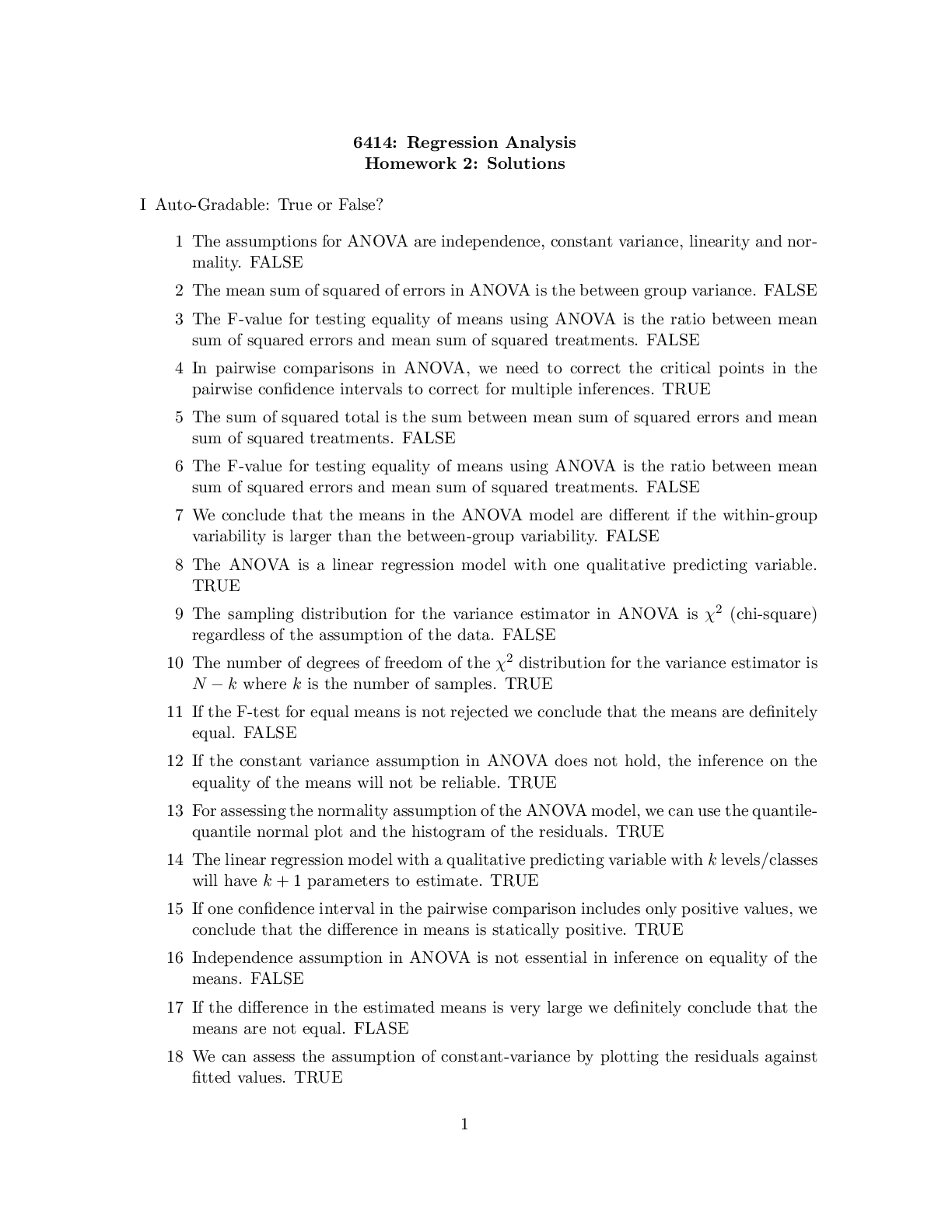
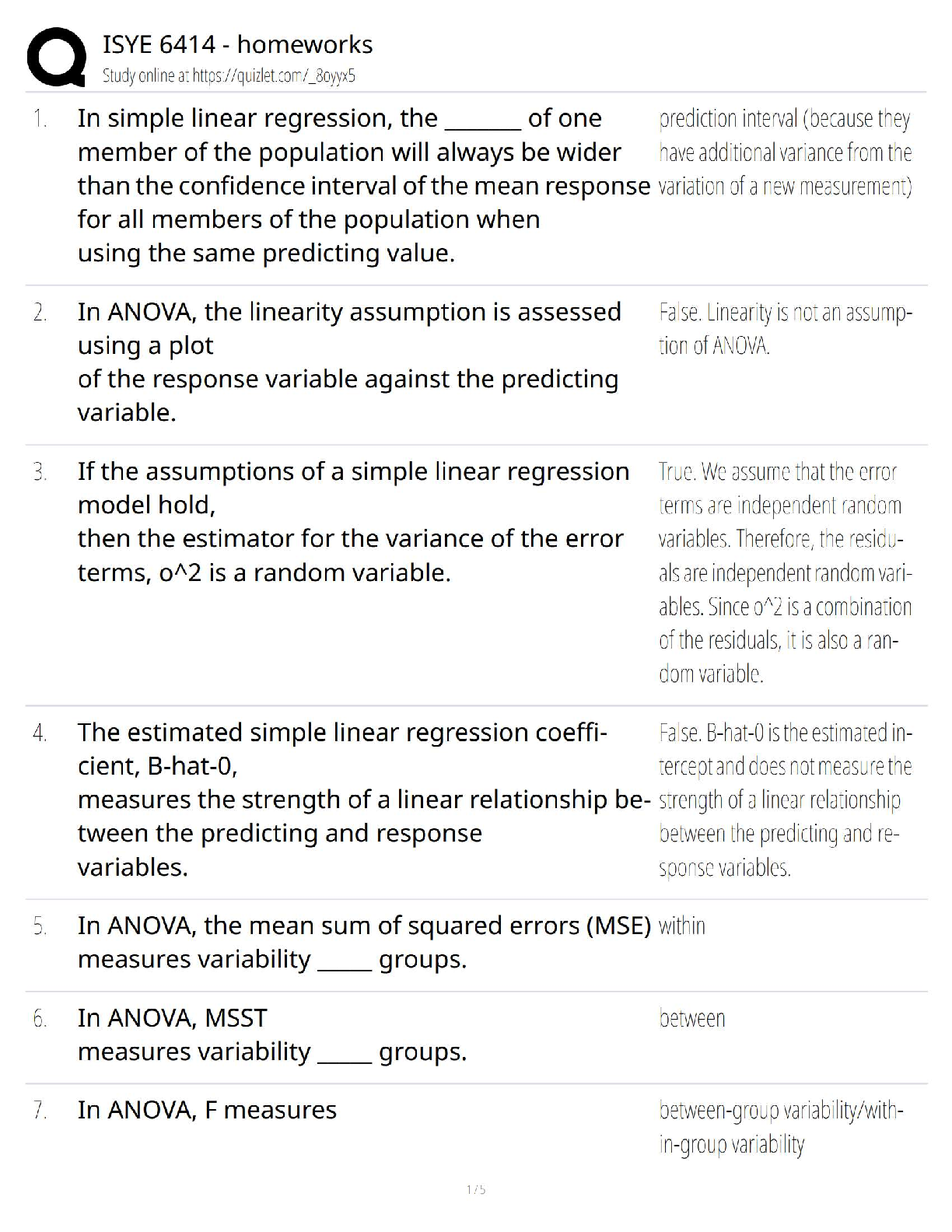
The least square estimation for the standard regression model is equivalent with Maximum Likelihood Estimation, under the assumption of normality. ✔✔ True
The variance estimator in logistic regression has a closed form expression. ✔✔ False - use statistical software to obtain the variance-co-variance matrix
We can use the z value to determine if a coefficient is equal to zero in logistic regression. ✔✔ True - z value = (Beta-0)/(SE of Beta)
In testing for a subset of coefficients in logistic regression the null hypothesis is that the coefficient is equal to zero ✔✔ True
Like standard linear regression we can use the F test to test for overall regression in logistic regression. ✔✔ False - It's 1-pchisq(null deviance-residual deviance, DFnull-DFresidual)
For logistic regression we can define residuals for evaluating model goodness of fit for models with and without replication. ✔✔ False - can only be with replication under the assumption that Yi is binary and n1 is greater than 1
The deviance residuals are the signed square root of the log-likelihood evaluated at the saturated model ✔✔ True
From the binomial approximation with a normal distribution using the central limit theorem, the Pearson residuals have an approximately standard chi-squared distribution. ✔✔ False - Normal distribution
Visual Analytics for logistic regression
Normal probability plot of residuals
Residuals vs predictors
Logit of success rate vs predictors ✔✔ True
Normal probability plot of residuals - Normality
Residuals vs predictors - Linearity/Independence
Logit of success rate vs predictors - Linearity
Under the null hypothesis of good fit for logistic regression, the test statistic has a Chi-Square distribution with n- p- 1 degrees of freedom ✔✔ True - don't forget, we want large P values
For the testing procedure for subsets of coefficients, we compare the likelihood of a reduced model versus a full model. This is a goodness of fit test ✔✔ False - it provides inference of the predictive power of the model
Predictive power means that the predicting variables predict the data even if one or more of the assumptions do not hold. ✔✔ True
[Show More]











 Answered 2023.png)