Module 6 Exam: HESI VN TXGRP
7/19/2021 Module 6 Exam: HESI VN TXGRP 1912COHORT(VNE 39)
https://concorde.instructure.com/courses/18612/quizzes/83900?module_item_id=1519722 1/109
Question 1 1 / 1 pts
Which event woul
...
Module 6 Exam: HESI VN TXGRP
7/19/2021 Module 6 Exam: HESI VN TXGRP 1912COHORT(VNE 39)
https://concorde.instructure.com/courses/18612/quizzes/83900?module_item_id=1519722 1/109
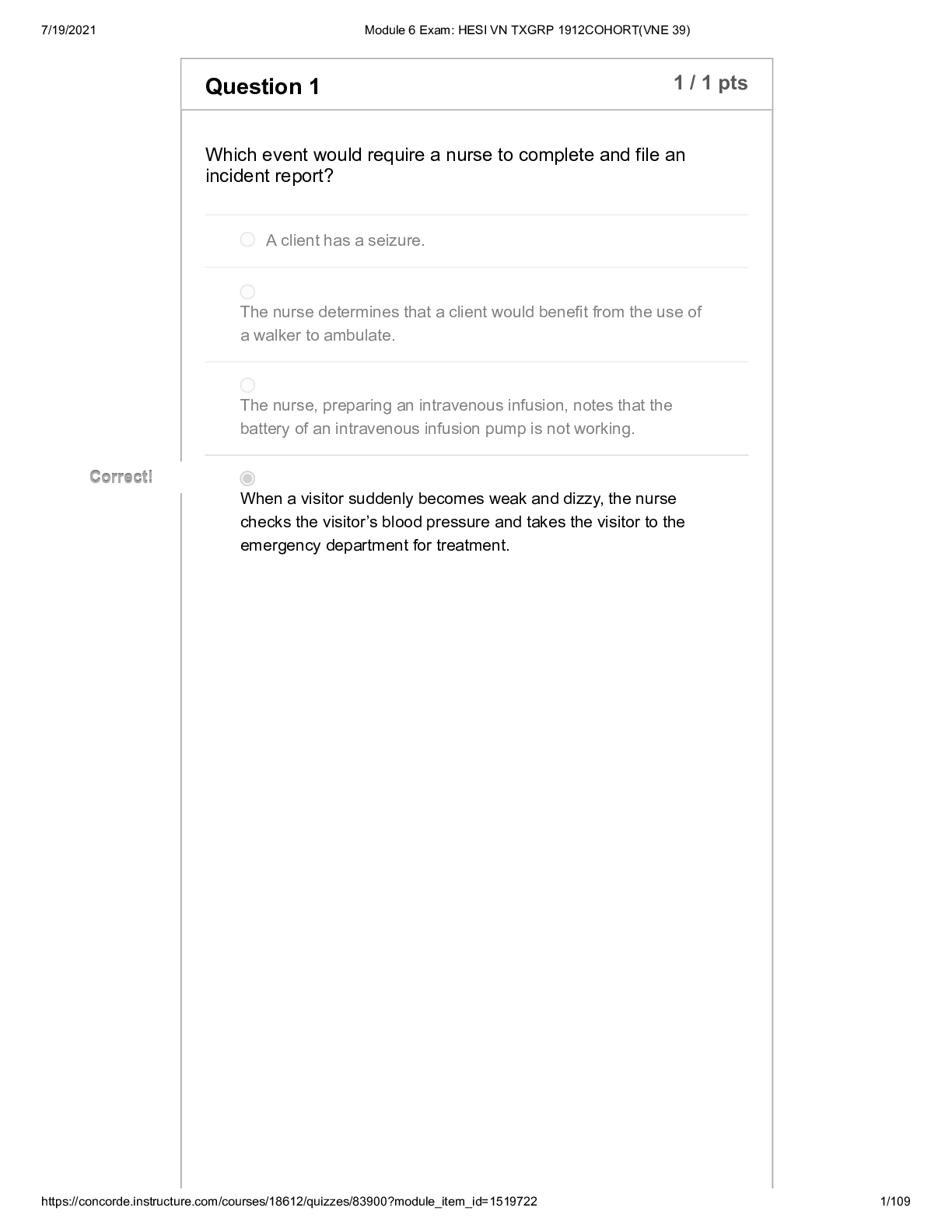
Question 1 1 / 1 pts
Which event would require a nurse to complete and file an
incident report?
A client has a seizure.
The nurse determines that a client would benefit from the use of
a walker to ambulate.
The nurse, preparing an intravenous infusion, notes that the
battery of an intravenous infusion pump is not working.
When a visitor suddenly becomes weak and dizzy, the nurse
checks the visitor’s blood pressure and takes the visitor to the
emergency department for treatment.
Correct! Correct!7/19/2021 Module 6 Exam: HESI VN TXGRP 1912COHORT(VNE 39)
https://concorde.instructure.com/courses/18612/quizzes/83900?module_item_id=1519722 2/109
Rationale: An incident is any event that is not consistent
with the routine operation of a health care unit or routine
care of a client. Examples of incidents include client falls,
needlestick injuries, a visitor having symptoms of illness,
medication administration errors, accidental omission of
prescribed therapies, and circumstances leading to injury
or a risk for injury. An incident report does not need to be
filed if a client has a seizure unless the client sustains
injury as a result of the seizure. If the nurse determines
that a client would benefit from the use of a walker to
ambulate, he or she should take the appropriate action to
obtain one. If the nurse notes that the battery of an
intravenous infusion pump is not working, he or she
should obtain a functioning pump and send the
nonfunctioning pump to the appropriate department for
repair.
Test-Taking Strategy: Use knowledge of the subject,
reasons for filing an incident report, to assist you with the
process of elimination. Read each option carefully.
Recalling that an incident is any event that is not
consistent with the routine operation of a health care unit
or routine care of a client will direct you to the correct
option. Review the reasons for filing an incident report if
you had difficulty with this question.
Cognitive Ability: Applying
Client Needs: Safe and Effective Care Environment
Integrated Process: Nursing Process/Implementation
Content Area: Ethical/Legal
Question 2 1 / 1 pts
A nurse, charting the administration of medications to an
assigned client at 9 p.m., notes that atenolol (Tenormin) was
prescribed to be administered at 9 a.m. instead of 9 p.m. The
nurse checks the client’s vital signs, completes an incident report,
and calls the health care provider to report the error. The health
care provider tells the nurse that an incident report is not needed
but instructs her to monitor the client during the night for
hypotension. What action should the nurse take?7/19/2021 Module 6 Exam: HESI VN TXGRP 1912COHORT(VNE 39)
https://concorde.instructure.com/courses/18612/quizzes/83900?module_item_id=1519722 3/109
Notifying the nursing supervisor
Tearing up and discarding the incident report
Telling the health care provider that the error warrants the
completion of an incident report
Correct! Correct!
Telling the nursing supervisor that the health care provider did not
want an incident report completed and filed
Rationale: Incident reports are an important part of a
health care agency’s quality improvement program. An
incident is any event that is not consistent with the routine
operation of a health care unit or routine care of a client.
An example of an incident is administering a medication at
a time at which it is not prescribed to be given. Whenever
an incident occurs, an incident report is completed and
filed in accordance with agency guidelines. The nursing
supervisor would be notified of the incident; however, on
the basis of the data in the question, the nurse should tell
the health care provider that the error warrants completion
and follow-through with an incident report. Therefore, the
other options are incorrect.
Test-Taking Strategy: Focus on the subject of the
question, the health care provider’s telling the nurse that
an incident report is not needed. Eliminate the comparable
or alike options that involve notifying the nursing
supervisor. To select from the remaining options, recall the
purpose of an incident report to select the correct option.
Review the procedures involved in completing and filing
incident reports if you had difficulty with this question.
Cognitive Ability: Applying
Client Needs: Safe and Effective Care Environment
Integrated Process: Nursing Process/Implementation
Content Area: Ethical/Legal
Question 3 1 / 1 pts7/19/2021 Module 6 Exam: HESI VN TXGRP 1912COHORT(VNE 39)
https://concorde.instructure.com/courses/18612/quizzes/83900?module_item_id=1519722 4/109
Contact precautions are initiated for a client with methicillinresistant Staphylococcus aureus (MRSA) infection. The nurse,
providing instructions to a nursing assistant about caring for the
client, tells the assistant to take which action?
To transfer the client to a semiprivate room
That gloves only are needed to care for the client
To wear gloves and a gown when changing the client’s bed linen
Correct! Correct!
To wear a gown when caring for the client and remove the gown
immediately after leaving the client s room
Rationale: Contact precautions require the use of gloves,
gown, and goggles if direct client contact is anticipated.
The client should be placed in a private room or, if a
private room is not available, in a semiprivate room with
another client who has active infection with the same
microorganism but no other infection. The nursing
assistant would remove the protective gear before leaving
the client’s room.
Test-Taking Strategy: Use the process of elimination.
Eliminate the option that includes the closed-ended word
“only.” Next eliminate the option that involves removal of
the gown after leaving the client’s room. To select from the
remaining options, read each carefully and visualize the
procedure instituted for contact precautions, which will
direct you to the correct option. If you had difficulty with
this question, review contact precautions.
Cognitive Ability: Applying
Client Needs: Safe and Effective Care Environment
Integrated Process: Teaching and Learning
Content Area: Leadership/Management
Question 4 1 / 1 pts7/19/2021 Module 6 Exam: HESI VN TXGRP 1912COHORT(VNE 39)
https://concorde.instructure.com/courses/18612/quizzes/83900?module_item_id=1519722 5/109
The mother of a 3-year-old calls a neighbor who is a nurse and
reports that her child just drank some window cleaner that had
been stored in a cabinet. The nurse should instruct the mother to
immediately take which action?
Correct! Correct! Call a poison control center.
Administer an excessive amount of fluids to induce vomiting.
Call an ambulance to bring the child to the emergency
department.
Leave a message at the health care provider answering service
about the incident.7/19/2021 Module 6 Exam: HESI VN TXGRP 1912COHORT(VNE 39)
https://concorde.instructure.com/courses/18612/quizzes/83900?module_item_id=1519722 6/109
Rationale: When a poisoning occurs, a poison center
should be called immediately. Vomiting should not be
induced if the victim is unconscious or if the substance
ingested was a strong corrosive or petroleum product.
Also, vomiting should not be induced unless a health care
provider has given specific instructions to induce vomiting.
Neither calling an ambulance nor calling the health care
provider’s answering service is the immediate action,
because either would delay treatment. Additionally, the
health care provider would immediately make a referral to
the poison control center. The poison control center may
advise the mother to bring the child to the emergency
department; if this is the case, the mother should then call
an ambulance.
Test-Taking Strategy: Note the strategic word
“immediately” in the query of the question. First, recalling
that vomiting should not be induced without appropriate
advice to do so will help you eliminate the option that
involves inducing vomiting. Next eliminate the comparable
or alike options that will delay treatment (i.e., calling an
ambulance and leaving a message with the answering
service). Review immediate poison control measures if
you had difficulty with this question.
Cognitive Ability: Applying
Client Needs: Safe and Effective Care Environment
Integrated Process: Nursing Process/Implementation
Content Area: Safety
Question 5 1 / 1 pts
A hurricane is forecast to make landfall in 48 hours, and the staff
of the emergency department of an area hospital is advised to
prepare for casualties. Which action should the nurse who
receives the telephone call regarding this warning take first?
Correct! Correct! Activating the agency disaster plan
Supplying the triage rooms with additional equipment7/19/2021 Module 6 Exam: HESI VN TXGRP 1912COHORT(VNE 39)
https://concorde.instructure.com/courses/18612/quizzes/83900?module_item_id=1519722 7/109
Increasing the number of nursing staff for the day on which the
hurricane is expected
Calling the hospital maintenance department to secure the
building against the storm
Rationale: In an external disaster, many people may be
brought to the emergency department for treatment.
Although increasing the nursing staff and supplying the
triage rooms with additional equipment may be steps in
preparing for casualties, the initial action by the nurse
manager must be activation of the disaster plan. Calling
the hospital maintenance department to secure the
building from the storm is not a responsibility that falls
within the scope of nursing management.
Test-Taking Strategy: Note the strategic word “first” in the
query of the question. Use the process of elimination in
determining the priority action. Note that the correct option
is the umbrella option. Also remember that other
necessary activities will be initiated once the agency
disaster plan has been activated. Review procedures
related to management in times of disaster if you had
difficulty with this question.
Cognitive Ability: Applying
Client Needs: Safe and Effective Care Environment
Integrated Process: Nursing Process/Implementation
Content Area: Disasters
Question 6 1 / 1 pts
A home health nurse has instructed a client about safety
measures during the use of an oxygen concentrator in the home.
Which statements by the client indicate to the nurse that the client
has understood the directions? Select all that apply.
Correct! Correct! “I need to follow the oxygen prescription exactly.”7/19/2021 Module 6 Exam: HESI VN TXGRP 1912COHORT(VNE 39)
https://concorde.instructure.com/courses/18612/quizzes/83900?module_item_id=1519722 8/109
“I can use my electric razor while I’m using oxygen.”
“I have to keep the oxygen concentrator out of direct sunlight.”
Correct! Correct!
“I need to keep the oxygen concentrator as close to the wall as
possible or put it in a corner.”
“I have to tell everyone that they can’t smoke or have an open
flame within 10 feet of the oxygen concentrator.”
Correct! Correct!
Rationale: The client should follow the oxygen prescription
exactly. The use of electric razors or other equipment that
could emit sparks should be avoided while oxygen is in
use, because fire and injury to the client could result. The
oxygen concentrator is kept out of direct sunlight and
slightly away from walls and corners to permit adequate
air flow. The client should not allow smoking or any type of
flame within 10 feet of the oxygen source. Other measures
include having telephone numbers for the health care
provider, nurse, and oxygen vendor available and teaching
the client signs and symptoms requiring emergency care.
Test-Taking Strategy: Recall knowledge of the subject,
oxygen safety measures, to assist you with eliminating
options. Recall that one hazard associated with oxygen is
ignition, which could result from heat in the form of flames
or sparks. Evaluating the question from this perspective,
eliminate the options that are unsafe. Review oxygen
safety measures if you had difficulty with this question.
Cognitive Ability: Evaluating
Client Needs: Safe and Effective Care Environment
Integrated Process: Nursing Process/Evaluation
Content Area: Safety
Question 7 1 / 1 pts7/19/2021 Module 6 Exam: HESI VN TXGRP 1912COHORT(VNE 39)
https://concorde.instructure.com/courses/18612/quizzes/83900?module_item_id=1519722 9/109
A nurse is providing instructions to a nursing student who will be
caring for a client in hand restraints. The nurse instructs the
nursing student to release the restraints to permit muscle
exercise how frequently?
Correct! Correct! Every 2 hours
Every 3 hours
Every 4 hours
Every 30 minutes
Rationale: The nurse should assess the restraints and the
client’s circulatory status and skin integrity every 30
minutes. Restraints must be released at least every 2
hours to permit muscle exercise and promote circulation.
Agency guidelines regarding the use of restraints should
always be followed.
Test-Taking Strategy: Knowledge regarding the subject,
the use of restraints, is necessary to answer this question.
Noting the strategic words “release the restraints” will help
direct you to the correct option. Review nursing
responsibilities regarding the use of restraints if you had
difficulty with this question.
Cognitive Ability: Applying
Client Needs: Safe and Effective Care Environment
Integrated Process: Teaching and Learning
Content Area: Safety
Question 8 1 / 1 pts
A community health nurse working in a school setting is
concerned because parents are not participating in health
activities designed to promote child safety. In this situation, which
is the most appropriate initial action?7/19/2021 Module 6 Exam: HESI VN TXGRP 1912COHORT(VNE 39)
https://concorde.instructure.com/courses/18612/quizzes/83900?module_item_id=1519722 10/109
Implementing a child safety program
Planning a focused child safety program
Performing an analysis of health problems related to child safety
Determining the appropriateness of the planned health activity
Correct! Correct!
Rationale: In this situation, the best initial action would be
to determine the appropriateness of the planned health
activities. This would be followed by analysis, planning,
and implementation.
Test-Taking Strategy: Use the steps of the nursing process
to answer the question. Note that the correct option
involves the process of data collection, the first step of the
nursing process. Review the procedure for planning health
activities to provide safety if you had difficulty with this
question.
Cognitive Ability: Applying
Client Needs: Safe and Effective Care Environment
Integrated Process: Nursing Process/Implementation
Content Area: Safety
Question 9 1 / 1 pts
The nurse administers a dose of ramipril 2.5 mg to a client at 9
a.m. While documenting administration of the medication, the
nurse discovers that 1.25 mg, not 2.5 mg, was the prescribed
dose. The nurse assesses the client, completes an incident
report, and notifies the health care provider and nursing
supervisor of the error. What statement does the nurse add to the
client’s record?
An incident report was completed and filed.7/19/2021 Module 6 Exam: HESI VN TXGRP 1912COHORT(VNE 39)
https://concorde.instructure.com/courses/18612/quizzes/83900?module_item_id=1519722 11/109
Correct! Correct! Ramipril (Altace) 2.5 mg was administered at 9 a.m.
Twice the amount of the prescribed ramipril was administered at
9 a.m.
Client’s blood pressure was 128/82 mm Hg after the
administration of the incorrect dose of ramipril.
Rationale: After an incident, the nurse would document a
concise and objective description of what occurred and
any follow-up actions taken in the client’s record. The
nurse would not document in the client’s record that an
incident report was completed. Nor would the nurse
document that twice the prescribed dose was given or that
an incorrect dose was given.
Test-Taking Strategy: Focus on the data in the question.
Recall that notes made in a client’s record must be
objective. Eliminate the comparable or alike options that
indicate that an incorrect dose of medication was
administered. Next note that the correct option clearly and
accurately describes the incident in an objective manner.
Review documentation of a medication error or other
incident if you had difficulty with this question.
Cognitive Ability: Applying
Client Needs: Safe and Effective Care Environment
Integrated Process: Communication and Documentation
Content Area: Ethical/Legal
Question 10 1 / 1 pts
A home health nurse has been called to the home of an older
postoperative cardiovascular client by the client’s son. The son
tells the nurse, “We’re using a hospital bed here at home, but my
mother has fallen out of bed three times.” Which observation by
the nurse reflects an increased risk of this client’s falling out of
bed?7/19/2021 Module 6 Exam: HESI VN TXGRP 1912COHORT(VNE 39)
https://concorde.instructure.com/courses/18612/quizzes/83900?module_item_id=1519722 12/109
The client’s bed is in a low position.
The client is oriented to person, place, and time.
The caregiver uses the overbed table for feedings.
The caregiver leaves both siderails down while the client is in
bed.
Correct! Correct!
Rationale: Leaving the siderails of older client’s bed down
may increase the client’s risk of falling. The aging process
also increases this client’s potential for falls; therefore,
evaluating the safety of the environment is a necessity.
Keeping the client’s bed in a low position, orientating the
client to the environment, and using the overbed table for
feedings are all ways to help ensure the client’s safety.
Test-Taking Strategy: Use the process of elimination,
focusing on the subject, an observation of an unsafe
practice. Noting that the question indicates that the bed is
in the low position and that the client is oriented will assist
you in eliminating these options. To select from the
remaining options, choose the one that identifies an
unsafe practice. Review the causes of falls in an older
client if you had difficulty with this question.
Cognitive Ability: Evaluating
Client Needs: Safe and Effective Care Environment
Integrated Process: Nursing Process/Data Collection
Content Area: Safety
Question 11 1 / 1 pts
A community health nurse is providing information to local
residents about the transmission of anthrax. Through which body
systems does the nurse tell the residents that anthrax can be
contracted? Select all that apply.7/19/2021 Module 6 Exam: HESI VN TXGRP 1912COHORT(VNE 39)
https://concorde.instructure.com/courses/18612/quizzes/83900?module_item_id=1519722 13/109
Correct! Correct! Skin
Correct! Correct! Lungs
Immune
Urinary
Lymphatic
Correct! Correct! Gastrointestinal
Rationale: Anthrax, caused by Bacillus anthracis, can be
contracted through the gastrointestinal system, abrasions
in the skin, or inhalation. It is not contracted through the
immune system, urinary tract, or lymphatic system.
Test-Taking Strategy: Specific knowledge of the subject,
the routes of infection with B. anthracis, is needed to
answer this question. Remember that anthrax can be
contracted through the gastrointestinal system, skin, or
lungs. Review content on anthrax and its modes of
transmission if you had difficulty with this question.
Cognitive Ability: Understanding
Client Needs: Safe and Effective Care Environment
Integrated Process: Teaching and Learning
Content Area: Biological/chemical warfare
Question 12 1 / 1 pts
A nurse is removing a partially empty chemotherapy infusion bag
that was used to administer to a client with a diagnosis of
Hodgkin disease. Which precaution should the nurse take while
working with this intravenous (IV) infusion?
Wearing gloves and a mask7/19/2021 Module 6 Exam: HESI VN TXGRP 1912COHORT(VNE 39)
https://concorde.instructure.com/courses/18612/quizzes/83900?module_item_id=1519722 14/109
Wearing gloves and a gown
Correct! Correct! Wearing gloves, a mask, and eye protection
Wearing gloves, a mask, and a head covering
Rationale: When handling chemotherapeutic agents, the
nurse should wear disposable latex gloves, a mask that
covers the nose and mouth, and eye protection, especially
if a biological hood is not available. Wearing gloves and a
mask or gloves and a gown will not provide adequate
protection. A head covering is not necessary.
Test-Taking Strategy: Knowledge regarding the subject,
precautions for handling chemotherapeutic agents, is
necessary to answer this question. Think about the effects
and cytotoxic nature of chemotherapy to answer the
question. Select the option that will provide the greatest
degree of protection to the nurse handling
chemotherapeutic agents. If you had difficulty with this
question, review the precautions for handling a
chemotherapy infusion.
Cognitive Ability: Applying
Client Needs: Safe and Effective Care Environment
Integrated Process: Nursing Process/Implementation
Content Area: Safety
Question 13 1 / 1 pts
A nurse is preparing a continuous intravenous (IV) infusion at the
medication cart. As the nurse goes to attach the IV tubing port to
the solution bag, the tubing drops, hitting the top of the
medication cart. Which action should the nurse take to maintain
asepsis?
Correct! Correct! Obtaining new IV tubing
Obtaining a new IV solution bag7/19/2021 Module 6 Exam: HESI VN TXGRP 1912COHORT(VNE 39)
https://concorde.instructure.com/courses/18612/quizzes/83900?module_item_id=1519722 15/109
Scrubbing the tubing port with an alcohol swab
Wiping the tubing port with povidone-iodine solution (Betadine)
Rationale: If IV tubing becomes contaminated as a result
of coming into contact with some nonsterile object, the
nurse should obtain new IV tubing. Contaminated tubing
could cause systemic infection in the client. The IV
solution bag has not been contaminated and does not
need replacement. Wiping the tubing port with Betadine or
scrubbing it with alcohol is insufficient and would be
contraindicated regardless, because the tubing will be
attached directly to a catheter in the client’s vein.
Test-Taking Strategy: Visualize the situation as you read
the question. Use your knowledge of the subject, basic
infection control measures and IV therapy, to answer this
question. Also, focus on the data in the question and note
that the IV tubing has become contaminated. Review
aseptic technique if you had difficulty with this question.
Cognitive Ability: Applying
Client Needs: Safe and Effective Care Environment
Integrated Process: Nursing Process/Implementation
Content Area: Infection Control
Question 14 0 / 1 pts
A home health nurse is visiting a client with tuberculosis (TB).
Which action by the client tells the nurse that the client
understands the necessary infection control precautions to be
taken at home?
Y You Answered ou Answered Staying secluded in the bedroom
Wearing an oxygen mask at all times7/19/2021 Module 6 Exam: HESI VN TXGRP 1912COHORT(VNE 39)
https://concorde.instructure.com/courses/18612/quizzes/83900?module_item_id=1519722 16/109
Keeping the house closed up to minimize the spread of disease
Disposing of contaminated tissues in a container with a leakproof bag
Correct Answer Correct Answer
Rationale: The client under infection control precautions at
home does not need to remain secluded; the client would
not be at home if he or she were infectious. However,
proper respiratory precautions are necessary. The house
should be properly ventilated, and the windows should be
opened as much as possible. Wearing an oxygen mask at
all times is not a respiratory precaution, and there is no
information in the question to indicate that oxygen is
necessary. Contaminated tissues should be discarded in
container with a leak-proof bag and then placed in an
outdoor trash bin. Tissues should not be left lying around.
Test-Taking Strategy: Use the process of elimination.
Focus on the client’s diagnosis and the subject, infection
control precautions at home. Recalling the mode of
transmission and home care measures for TB will direct
you to the correct option. Also note the words “secluded,”
“all times,” and “closed up” in the incorrect options. If you
had difficulty answering this question, review the
precautions that should be taken by the client with TB who
has been discharged home.
Cognitive Ability: Evaluating
Client Needs: Safe and Effective Care Environment
Integrated Process: Nursing Process/Evaluation
Content Area: Infection Control
Question 15 1 / 1 pts
A home health nurse teaches a client about home modifications
to reduce the risk of falls. Which statements by the client indicate
a need for further teaching? Select all that apply.7/19/2021 Module 6 Exam: HESI VN TXGRP 1912COHORT(VNE 39)
https://concorde.instructure.com/courses/18612/quizzes/83900?module_item_id=1519722 17/109
“I need to use nightlights.”
Correct! Correct! “I need to remove my wall-to-wall carpeting.”
“I need to get handrails put up in the bathroom.”
“I need to use the staircase handrails when I go up the stairs.”
“I should walk barefoot as much as possible so that I’ll know
about any wet spots on the floor.”
Correct! Correct!
Rationale: Home modifications to reduce the risk of falls
include ensuring ample lighting, removing scatter rugs,
placing handrails in bathrooms, and using handrails on all
staircases. The client should wear flat rubber-soled shoes
to prevent slips and falls. Walking barefoot will not reduce
the risk of injury; in fact, it could actually increase the risk
of foot injury and of slipping and falling. Removal of wallto-wall carpeting is not necessary.
Test-Taking Strategy: Note the strategic words “need for
further teaching.” These words indicate a negative event
query and the need to select the incorrect options. Answer
this question by eliminating the options that involve
providing physical support for the client and that you know
are needed in this situation (e.g., nightlights, handrails).
Review home care measures to ensure safety and prevent
falls if you had difficulty with this question.
Cognitive Ability: Evaluating
Client Needs: Safe and Effective Care Environment
Integrated Process: Teaching and Learning
Content Area: Safety
Question 16 1 / 1 pts
A nurse caring for a client who is under airborne precautions
notes that the client is scheduled for a nuclear scan. Which action
on the part of the nurse is appropriate?7/19/2021 Module 6 Exam: HESI VN TXGRP 1912COHORT(VNE 39)
https://concorde.instructure.com/courses/18612/quizzes/83900?module_item_id=1519722 18/109
Planning to have the nuclear scan performed at the bedside
Asking the technicians in the nuclear scan department to wear
masks
Placing a HEPA mask on the client for transport and for contact
with other individuals
Correct! Correct!
Calling the nuclear medicine department and telling the
technician that the test will have to be delayed until airborne
precautions have been discontinued
Rationale: If the client is under airborne precautions, client
movement and transport should be limited as much as
possible. If transport or movement is necessary, the nurse
can minimize the dispersal of droplet nuclei from the client
by placing a HEPA mask on the client. Having the scan
performed at the bedside is not feasible. Asking the
technicians in the nuclear medicine department to wear
masks would not prevent the dispersal of airborne nuclei
from the client. The health care provider is the individual
who would prescribe the cancellation or delay of a
diagnostic test. Additionally, delaying the test until airborne
precautions have been discontinued is not within the role
of the nurse.
Test-Taking Strategy: Use the process of elimination and
focus on the subject of the question, airborne precautions.
Knowing that a nurse should not delay a prescribed test
will help you eliminate this option. Eliminate the option of
having the scan at the bedside because this action is
unreasonable. To select from the remaining options, recall
the route and mode of transmission of an airborne
infection. This should direct you to the correct option.
Review airborne precautions if you had difficulty with this
question.
Cognitive Ability: Applying
Client Needs: Safe and Effective Care Environment
Integrated Process: Nursing Process/Implementation
Content Area: Infection Control7/19/2021 Module 6 Exam: HESI VN TXGRP 1912COHORT(VNE 39)
https://concorde.instructure.com/courses/18612/quizzes/83900?module_item_id=1519722 19/109
Question 17 1 / 1 pts
A nurse employed in a health care provider’s office hears a client
in the waiting room call out, “Help! Fire!” The nurse rushes to the
waiting room and finds that the wastebasket is on fire. The nurse
immediately takes which action?
Confines the fire
Extinguishes the fire
Activates the fire alarm
Correct! Correct! Removes the clients from the waiting room
Rationale: The immediate priority in the event of a fire is
removing any clients in immediate danger. The next step
is activating the fire alarm. The nurse would then confine
the fire by closing all of the doors and, finally, extinguish
the fire.
Test-Taking Strategy: Use knowledge of the subject, fire
safety, to assist you with this question. Remember the
mnemonic RACE to prioritize actions in the event of a
fire: Rescue clients in immediate danger, sound
the alarm, confine the fire by closing all doors,
and extinguish. If you had difficulty with this question,
review the principles of fire safety.
Cognitive Ability: Applying
Client Needs: Safe and Effective Care Environment
Integrated Process: Nursing Process/Implementation
Content Area: Safety
Question 18 1 / 1 pts7/19/2021 Module 6 Exam: HESI VN TXGRP 1912COHORT(VNE 39)
https://concorde.instructure.com/courses/18612/quizzes/83900?module_item_id=1519722 20/109
A nurse enters the laundry room to empty a bag of dirty linen and
discovers a fire in a laundry basket. What action should the nurse
take first?
Confining the fire
Extinguishing the fire
Correct! Correct! Activating the fire alarm
Running for the fire extinguisher
Rationale: The immediate priority in the event of a fire is
rescuing the clients in immediate danger. In this situation,
no clients are in immediate danger. The next step is to
activate the fire alarm. The nurse then confines the fire by
closing all doors and, finally, extinguishes the fire.
Test-Taking Strategy: Use knowledge of the subject, fire
safety, to assist you with this question. Use the mnemonic
RACE to remember priorities in the event of a
fire: rescueclients in immediate danger, sound
the alarm, confine the fire by closing all doors,
and extinguish. If you had difficulty with this question,
review the principles of fire safety.
Cognitive Ability: Applying
Client Needs: Safe and Effective Care Environment
Integrated Process: Nursing Process/Implementation
Content Area: Safety
Question 19 1 / 1 pts
The safety department is providing a yearly educational session
on fire safety and the use of fire extinguishers. A nurse is asked
to demonstrate the use of a fire extinguisher after the session.
The nurse demonstrates appropriate use of the fire extinguisher
by first taking which action?7/19/2021 Module 6 Exam: HESI VN TXGRP 1912COHORT(VNE 39)
https://concorde.instructure.com/courses/18612/quizzes/83900?module_item_id=1519722 21/109
Aiming at the base of the fire
Correct! Correct! Pulling the pin on the fire extinguisher
Squeezing the handle of the extinguisher
Sweeping from the top to the bottom of the fire with the
extinguisher
Rationale: To use a fire extinguisher, pull the pin first.
Next, aim the extinguisher at the base of the fire. Squeeze
the handle of the extinguisher, then extinguish the fire by
sweeping from side to side to coat the area evenly.
Test-Taking Strategy: Use knowledge of the subject, fire
safety, to assist you with this question. Use the mnemonic
PASS to remember the steps in the use of a fire
extinguisher: Pull the pin, aim at the base of the
fire, squeeze the handle, and sweep from side to side to
coat the area evenly. If you had difficulty with this
question, review the appropriate use of a fire extinguisher.
Cognitive Ability: Applying
Client Needs: Safe and Effective Care Environment
Integrated Process: Nursing Process/Implementation
Content Area: Safety
Question 20 1 / 1 pts
A nurse provides instruction to a new nurse employee regarding
the application of a restraint to a client. The nurse watches as the
nurse employee applies the restraint. What observation tells the
nurse that the nurse employee is using correct procedure?
The employee applies a tie knot in the restraint strap.7/19/2021 Module 6 Exam: HESI VN TXGRP 1912COHORT(VNE 39)
https://concorde.instructure.com/courses/18612/quizzes/83900?module_item_id=1519722 22/109
The employee attaches the restraint straps securely to the
siderails.
The employee applies the restraint so that the strap does not
tighten when force is applied against it.
Correct! Correct!
The employee secures the restraint in such a way that it is
impossible to slip a finger between the restraint and the client’s
skin.
Rationale: A half-bow or safety knot should be used to
apply a restraint, because it does not tighten when force is
applied against it and because it allows quick, easy
removal of the restraint in the event of an emergency. The
restraint strap is secured to the bed frame, never to the
side rails, to help prevent accidental injury in the event that
the siderail is released. A restraint should be secured in
such a way that one or two fingers can be easily slipped
between the restraint and the client’s skin.
Test-Taking Strategy: Note the strategic words “correct
procedure” in the query. This indicates that you are looking
for an option that involves an accurate measure of how a
restraint is applied. Use the process of elimination and
your knowledge of safety measures and the use of
restraints to answer the question. Noting the words “tie
knot,” “siderails,” and “impossible to slip” will assist you in
eliminating these options. Review guidelines for the
application of restraints if you had difficulty with this
question.
Cognitive Ability: Evaluating
Client Needs: Safe and Effective Care Environment
Integrated Process: Teaching and Learning
Content Area: Leadership/Management
Question 21 1 / 1 pts7/19/2021 Module 6 Exam: HESI VN TXGRP 1912COHORT(VNE 39)
https://concorde.instructure.com/courses/18612/quizzes/83900?module_item_id=1519722 23/109
A nurse is instructing a group of nursing assistants in the
principles of body mechanics. Which observations tell the nurse
that a nursing assistant is using the principles
appropriately? Select all that apply.
The assistant leans forward when turning a client in bed.
The assistant positions a box that is to be lifted between his
knees.
Correct! Correct!
The assistant turns his back to change position while moving a
client.
The assistant keeps the object to be moved as close to his body
as possible.
Correct! Correct!
The assistant helps a client requiring total care into a chair
without additional assistance.7/19/2021 Module 6 Exam: HESI VN TXGRP 1912COHORT(VNE 39)
https://concorde.instructure.com/courses/18612/quizzes/83900?module_item_id=1519722 24/109
Rationale: When moving an object, the nursing assistant
should position the object between his knees. The
assistant should keep the client or object to be moved as
close to his body as possible. When turning a client, the
assistant should keep his back straight and take small
steps with the feet. The assistant should turn his feet,
rather than twisting his back, if a change in direction is
necessary when carrying an object or a client. The
assistant should seek out assistance when transferring a
client who requires total care.
Test-Taking Strategy: Use the process of elimination and
your knowledge of the subject, body mechanics, to answer
the question. Visualize each of the items in the options to
determine which actions could result in injury. Review the
principles of body mechanics if you had difficulty with this
question.
Cognitive Ability: Evaluating
Client Needs: Safe and Effective Care Environment
Integrated Process: Teaching and Learning
Content Area: Leadership/Management
Question 22 1 / 1 pts
A home care nurse visits a client during the winter, who lives in a
small apartment, to perform a dressing change . During the
lengthy procedure, the client asks the nurse whether it is safe to
use a space heater. What is the appropriate response by the
nurse?
“A space heater should never be used in an apartment.”
“A space heater can be used as long as it is kept at a low setting
at all times.”
“A space heater can be used as long as it is kept in the bedroom
at night in case a fire occurs.”7/19/2021 Module 6 Exam: HESI VN TXGRP 1912COHORT(VNE 39)
https://concorde.instructure.com/courses/18612/quizzes/83900?module_item_id=1519722 25/109
“A space heater can be used as long as it’s placed at least 3 feet
from anything that may ignite.”
Correct! Correct!
Rationale: Space heaters must be used appropriately
because of the risk of fire. A space heater should be
placed at least 3 feet from anything that may ignite. A
space heater may be used in an apartment if there is
ample space and safety precautions are followed. A low
setting does not reduce the risk of fire. Placing a heater in
a bedroom does not guarantee that it will be 3 feet from
anything that may ignite.
Test-Taking Strategy: Use the process of elimination,
keeping in mind the subject, fire safety. Eliminate the
options that include the closed-ended words “never” and
“all.” To select from the remaining options, note that the
correct option is the only one that specifically defines a
safety measure involving the use of a space heater.
Review fire safety measures in the home if you had
difficulty with this question.
Cognitive Ability: Applying
Client Needs: Safe and Effective Care Environment
Integrated Process: Teaching and Learning
Content Area: Safety
Question 23 1 / 1 pts
A nurse is preparing to initiate a continuous tube feeding, using a
tube-feeding pump. On bringing the pump to the bedside and
preparing to plug in the pump, the nurse discovers that there is
no available plug in the wall socket. What should the nurse do?
Plug in the pump cord into an available plug above the sink.
Ask the health care provider to change the prescription to
intermittent feedings.7/19/2021 Module 6 Exam: HESI VN TXGRP 1912COHORT(VNE 39)
https://concorde.instructure.com/courses/18612/quizzes/83900?module_item_id=1519722 26/109
Determine the need for the appliances now plugged into the
needed wall socket.
Correct! Correct!
Use a regular extension cord to allow the use of more than one
electrical appliance.
Rationale: It is most appropriate for the nurse to assess
the situation and determine the need for the appliances
already plugged into the needed wall socket. The use of
electrical appliances near a sink presents a hazard. It is
not appropriate (and is premature) to ask the health care
provider to change the prescription, because the
prescription is based on the client’s needs. A regular
extension cord should not be used because it poses a risk
of fire.
Test-Taking Strategy: Use process of elimination and the
steps of the nursing process to answer the question. The
only option that addresses collecting data is the one that
involves determining the need for the appliances currently
plugged into the needed wall socket. Review electrical
safety procedures if you had difficulty with this question.
Cognitive Ability: Applying
Client Needs: Safe and Effective Care Environment
Integrated Process: Nursing Process/Implementation
Content Area: Safety
Question 24 1 / 1 pts
View video. A nurse, preparing a sterile field on which to perform
a dressing change, places the sterile drape on the overbed table.
Which actions on the part of the nurse indicate correct
understanding of the principles of aseptic technique? Select all
that apply.
Holding the pair of sterile forceps below waist level area7/19/2021 Module 6 Exam: HESI VN TXGRP 1912COHORT(VNE 39)
https://concorde.instructure.com/courses/18612/quizzes/83900?module_item_id=1519722 27/109
Correct! Correct! Positioning the sterile field so that it remains in full view
Reaching across the sterile field to pick up a sterile gauze
Leaving the room to obtain a bottle of sterile normal saline
solution
Picking up a pair of sterile scissors from the sterile field with a
sterile gloved hand
Correct! Correct!
Pouring sterile wound cleansing solution into a sterile cup before
donning sterile gloves
Correct! Correct!
Rationale: View video. The principles of surgical asepsis
must be followed in the preparation of a sterile field.
Among these principles are the following: a sterile object
remains sterile only when touched by other sterile objects;
only sterile objects may be placed on a sterile field; a
sterile object or field out of the range of vision or an object
held below the nurse’s waist is to be considered
contaminated; a sterile object or field becomes
contaminated with prolonged exposure to air; when a
sterile surface comes in contact with a wet, contaminated
surface, the sterile object or field becomes contaminated
by way of capillary action; fluid flows in the direction of
gravity; and a 1-inch edge of a sterile field or container is
to be considered contaminated.
Test-Taking Strategy: Focus on the subject, use of the
principles of aseptic technique. Reading each option
carefully and recalling the principles of aseptic technique
will direct you to the correct options. Review aseptic
technique and the procedure for preparing a sterile field if
you had difficulty with this question.
Cognitive Ability: Applying
Client Needs: Safe and Effective Care Environment
Integrated Process: Nursing Process/Implementation
Content Area: Infection Control7/19/2021 Module 6 Exam: HESI VN TXGRP 1912COHORT(VNE 39)
https://concorde.instructure.com/courses/18612/quizzes/83900?module_item_id=1519722 28/109
Question 25 1 / 1 pts
A licensed practical nurse (LPN) tells the registered nurse (RN)
that she administered acetaminophen (Tylenol) to a client by way
of the rectal route rather than the prescribed oral route because
the client was extremely nauseated. The RN most appropriately
takes which action?
Correct! Correct! Asks the LPN to complete and file an incident report
Asks the LPN to check the client in 30 minutes to see whether
the nausea has subsided
Tells the LPN that she made a sound judgment in administering
the medication by way of the rectal route
Instructs the LPN to write “pr” (per rectum) on the medication
record next to the time at which the medication was administered7/19/2021 Module 6 Exam: HESI VN TXGRP 1912COHORT(VNE 39)
https://concorde.instructure.com/courses/18612/quizzes/83900?module_item_id=1519722 29/109
Rationale: If a medication is prescribed to be administered
by way of the oral route, the nurse may not use an
alternate route to administer the medication unless the
change is prescribed by the health care provider. The
nurse would ask the LPN to complete and file an incident
report because the LPN, legally speaking, made a
medication error. Telling the LPN that she made a sound
judgment in administering the medication by way of the
rectal route is incorrect. Although the client must be
reassessed and the LPN would document administration
of the medication by way of the rectal route in the client’s
record, the most appropriate option given is having the
LPN complete and file an incident report.
Test-Taking Strategy: Use the process of elimination, and
note the strategic words “most appropriately.” Focusing on
the data in the question indicates that the LPN made a
medication error. This will direct you to the correct option.
Review the appropriate actions in the event of a
medication error if you had difficulty with this question.
Cognitive Ability: Applying
Client Needs: Safe and Effective Care Environment
Integrated Process: Communication and Documentation
Content Area: Ethical/Legal
Question 26 1 / 1 pts
A nurse receives a telephone call from the admissions office and
is told that a client scheduled for an internal radiation implant will
be admitted to the nursing unit. Which precaution does the nurse
include in the client’s plan of care?
Correct! Correct! Wearing gloves when emptying the client’s bedpan
Allowing the client to ambulate in the hall only once a day
Placing the client in a semiprivate room at the end of a hallway7/19/2021 Module 6 Exam: HESI VN TXGRP 1912COHORT(VNE 39)
https://concorde.instructure.com/courses/18612/quizzes/83900?module_item_id=1519722 30/109
Placing used linen in double bags and sending a bag to the
laundry room every evening
Rationale: A primary goal of care for the client with an
internal radiation implant is to prevent exposure of others
to radiation. Therefore, a client with an internal radiation
implant is required to remain in a private room to prevent
accidental exposure of other clients, staff, and visitors to
radiation. For this reason, a private room with a private
bath is essential. All client linens should be kept in the
client’s room until the implant is removed. Wearing gloves
when emptying the client’s bedpan is the only appropriate
intervention, of those provided, for a client with an internal
radiation implant.
Test-Taking Strategy: Use the process of elimination.
Eliminate the option that includes the closed-ended word
“only.” Also eliminate the option involving the use of a
semiprivate room. To select from the remaining options,
use your knowledge of standard precautions and
precautions for a client with an internal radiation implant.
This will direct you to the correct option. Review radiation
safety principles if you had difficulty with this question.
Cognitive Ability: Applying
Client Needs: Safe and Effective Care Environment
Integrated Process: Nursing Process/Planning
Content Area: Safety
Question 27 1 / 1 pts
A nursing instructor is observing a nursing student who is
practicing the use of standard precautions in the nursing
laboratory. Which observation by the instructor indicates a need
for further teaching?
The nursing student changes gloves between tasks and
procedures.7/19/2021 Module 6 Exam: HESI VN TXGRP 1912COHORT(VNE 39)
https://concorde.instructure.com/courses/18612/quizzes/83900?module_item_id=1519722 31/109
The nursing student washes hands before making contact with
the client.
The nursing student wears a gown to change the bed of an
incontinent client.
The nursing student washes her hands before glove removal
after emptying a Foley bag.
Correct! Correct!
Rationale: Standard precautions require that gloves be
removed promptly after use and before the wearer
touches noncontaminated surfaces or other clients.
Gloves are not washed before removal because splashing
of contaminated material may result. Changing gloves
between tasks and procedures, washing the hands before
making contact with the client, and wearing a gown to
change the bed of an incontinent client reflect correct
understanding of the principles of standard precautions.
Test-Taking Strategy: Note the strategic words “need for
further teaching.” These words indicate a negative event
query and the need to select the incorrect action. Use the
process of elimination, visualizing each of the procedures
described in the options. Thinking about the principles of
standard precautions will direct you to the correct option.
Review the principles associated with standard
precautions if you had difficulty with this question.
Cognitive Ability: Evaluating
Client Needs: Safe and Effective Care Environment
Integrated Process: Teaching and Learning
Content Area: Infection Control
Question 28 0.67 / 1 pts
A health care provider writes a prescription for the application of a
heating pad to a client’s back. Which actions should the nurse
take when implementing this prescription? Select all that apply.7/19/2021 Module 6 Exam: HESI VN TXGRP 1912COHORT(VNE 39)
https://concorde.instructure.com/courses/18612/quizzes/83900?module_item_id=1519722 32/109
Placing the heating pad under the client
Adjusting the heating pad to the high setting
Correct! Correct! Frequently monitoring the client’s skin for signs of burns
Reviewing the client’s medical history and risk factors for burns
Correct! Correct!
Examining the heating pad periodically for proper electrical
function
Correct Answer Correct Answer
Question 29 1 / 1 pts
A home care nurse is instructing a client in the use of ice packs to
treat an eye injury. The nurse instructs the client to take which
action?
Place the ice pack directly on the eye.
Avoid the use of commercially prepared ice bags.
Keep the ice pack on the eye continuously for 24 hours.
Wrap a plastic bag filled with ice in a pillowcase and place it on
the eye.
Correct! Correct!7/19/2021 Module 6 Exam: HESI VN TXGRP 1912COHORT(VNE 39)
https://concorde.instructure.com/courses/18612/quizzes/83900?module_item_id=1519722 33/109
Rationale: An ice pack placed directly against the skin or
left in place for an extended period carries a risk of tissue
damage similar to that of a hot water bottle. To help
prevent tissue damage resulting from excessive cold
exposure, the ice pack should be removed in most cases
after 30 minutes; after a short time it may be reapplied. An
ice pack should never be placed directly against the skin;
instead, it should be covered with a pillowcase or towel.
Commercially prepared ice bags are appropriate for use
as ice packs.
Test-Taking Strategy: Use knowledge of the subject, safety
measures for the use of ice packs, to assist you with the
process of elimination to answer the question. Eliminate
the options that include the words “directly” and
“continuously.” From the remaining options, recall that the
use of commercially prepared ice bags for the purpose
described in the question is acceptable. Review safety
measures for the use of ice packs if you had difficulty with
this question.
Cognitive Ability: Applying
Client Needs: Safe and Effective Care Environment
Integrated Process: Teaching and Learning
Content Area: Safety
Question 30 1 / 1 pts
A fever develops in a client who has been hospitalized for 2
months and is receiving parenteral nutrition by way of a central
venous line, and central venous line–related sepsis is diagnosed.
The nurse interprets this finding as meaning that this is which
type of infection?
An iatrogenic infection
A result of bacterial colonization
A community-acquired infection7/19/2021 Module 6 Exam: HESI VN TXGRP 1912COHORT(VNE 39)
https://concorde.instructure.com/courses/18612/quizzes/83900?module_item_id=1519722 34/109
Correct! Correct! A health care–associated infection
Rationale: Infections that occur during hospitalization, or
are a result of hospitalization, are referred to as health
care–associated infections, hospital-acquired infections, or
nosocomial infections. Colonization is defined as a
condition in which microorganisms are present in body
tissues; there is no damage to the tissues, and no local
signs or symptoms of infection are evident. Iatrogenic
infections are infections that involve the client’s normal
flora. A community-acquired infection is an infection that
the person is admitted with or is incubating on admission
to the hospital.
Test-Taking Strategy: Focus on the data in the question.
Noting that the fever and sepsis developed while the client
was hospitalized will direct you to the correct option.
Review the various types of infection and the definition of
colonization if you had difficulty answering this question.
Cognitive Ability: Understanding
Client Needs: Safe and Effective Care Environment
Integrated Process: Nursing Process/Assessment
Content Area: Infection Control
Question 31 1 / 1 pts
A nurse educator is providing inservice sessions to the nursing
staff regarding employee safety and the prevention of
occupationally acquired HIV infection. Which precautions does
the nurse instruct the nursing staff to take as a means of
preventing accidental needlesticks? Select all that apply.
The use of latex gloves
Correct! Correct! The use of shielded needles
Correct! Correct! The use of recessed needles7/19/2021 Module 6 Exam: HESI VN TXGRP 1912COHORT(VNE 39)
https://concorde.instructure.com/courses/18612/quizzes/83900?module_item_id=1519722 35/109
Correct! Correct! The use of needleless devices
Correct! Correct! Disposal of needles in special puncture-resistant containers
Rationale: Although strict adherence to universal or
standard precautions can reduce significantly the
incidence of exposure to blood or body fluid, latex gloves
cannot prevent a needlestick. The use of recessed
needles, needleless devices, shielded needles, and
puncture-resistant containers for the disposal of needles
are all of significant benefit in the prevention of accidental
needlesticks.
Test-Taking Strategy: Focus on the subject, preventing
accidental needlesticks, to answer the question. Visualize
each of the options and how the action might or might not
prevent a needlestick. This will help you answer correctly.
Review standard precautions if you had difficulty with this
question.
Cognitive Ability: Applying
Client Needs: Safe and Effective Care Environment
Integrated Process: Teaching and Learning
Content Area: Infection Control
Question 32 1 / 1 pts
A nurse is preparing to clean up a blood spill on the client’s
bedside table that occurred when a blood tube containing a
specimen from the client broke. What steps should the nurse take
to clean up the blood spill? Select all that apply.
Correct! Correct! Using tongs to collect any broken glass
Correct! Correct! Wearing gloves for the cleanup procedure
Placing the pieces of broken glass in a plastic bag7/19/2021 Module 6 Exam: HESI VN TXGRP 1912COHORT(VNE 39)
https://concorde.instructure.com/courses/18612/quizzes/83900?module_item_id=1519722 36/109
Blotting up the spill with a face cloth or cloth towel
Disinfecting the area of the blood spill with a dilute bleach
solution
Correct! Correct!
Rationale: The nurse should blot the spill with an
absorbent disposable material such as disposable paper
towels or terry wipes, not a face cloth or towel. Tongs are
used to pick up any broken glass, and gloves are worn for
the procedure. The broken glass is disposed of in a
puncture-resistant container. The area is disinfected with a
dilute bleach solution or other agency-accepted product.
Test-Taking Strategy: Read each option carefully. Use
knowledge of the subject, cleaning up a blood spill, to
assist you with this question. Visualizing the actions
identified in each option and recalling the principles
associated with standard precautions will direct you to the
correct options. Review the procedure for cleaning up
blood spills if you had difficulty with this question.
Cognitive Ability: Applying
Client Needs: Safe and Effective Care Environment
Integrated Process: Nursing Process/Implementation
Content Area: Safety
Question 33 1 / 1 pts
The emergency department nurse who is on duty is informed by
the charge nurse that an airplane crash has occurred and
numerous casualties will be arriving at the ED. What should the
initial response by the nurse be?
Correct! Correct! “Has the disaster plan been activated?”
“Call as many nursing staff as you can to come in to work.”
“Make sure all of the rooms are well stocked with supplies.”7/19/2021 Module 6 Exam: HESI VN TXGRP 1912COHORT(VNE 39)
https://concorde.instructure.com/courses/18612/quizzes/83900?module_item_id=1519722 37/109
“Be sure that the nursing staff finds as many stretchers as they
can.”
Rationale: In an external disaster, many people will be
brought to the ED for treatment. Although ensuring that
rooms are well stocked with supplies, calling nursing staff
to come to work, and finding stretchers are components of
preparing for the casualties, the initial nursing action must
be activation of the disaster plan. Therefore the initial
response by the nurse should be “Has the disaster plan
been activated?”
Test-Taking Strategy: Note the strategic words “initial
response” in the query. Focus on the data in the question
and note that the correct option is the umbrella response.
Review procedures related to management of a disaster if
you had difficulty with this question.
Cognitive Ability: Applying
Client Needs: Safe and Effective Care Environment
Integrated Process: Nursing Process/Planning
Content Area: Disasters
Question 34 1 / 1 pts
A community health nurse is providing an educational session on
childhood poisoning at a local school. The nurse tells the group
that when an accidental poisoning occurs the first action is to take
which action?
Induce vomiting.
Call an ambulance.
Correct! Correct! Call the poison control center.
Bring the child to the emergency department (ED).7/19/2021 Module 6 Exam: HESI VN TXGRP 1912COHORT(VNE 39)
https://concorde.instructure.com/courses/18612/quizzes/83900?module_item_id=1519722 38/109
Rationale: When a poisoning occurs, a poison control
center should be contacted immediately and any
directions given regarding treatment followed. The poison
control center will provide directions regarding the
inducement of vomiting. However, vomiting should not be
induced if the victim is unconscious or if the substance
ingested is a strong corrosive or petroleum product. The
poison control center may advise the mother to bring the
child to the ED; if this is the case, the mother should call
an ambulance. Neither bringing the child to the ED nor
calling an ambulance would be the immediate actions
because either tactic would delay treatment.
Test-Taking Strategy: Note the strategic word “first” in the
query of the question. Eliminate the comparable or alike
options that involve a delay in starting treatment (calling
an ambulance and bringing the victim to the emergency
department). Recalling that vomiting should not be
induced in certain types of poisoning will help you
eliminate this option. Review immediate poison control
measures if you had difficulty with this question.
Cognitive Ability: Applying
Client Needs: Safe and Effective Care Environment
Integrated Process: Teaching and Learning
Content Area: Safety
Question 35 1 / 1 pts
A client undergoing chemotherapy is found to have an extremely
low white blood cell count, and neutropenic precautions, including
a low-bacteria diet, are immediately instituted. Which of these
food items will the client be allowed to consume? Select all that
apply.
Fresh apple
Raw celery
Correct! Correct! Italian bread7/19/2021 Module 6 Exam: HESI VN TXGRP 1912COHORT(VNE 39)
https://concorde.instructure.com/courses/18612/quizzes/83900?module_item_id=1519722 39/109
Tossed salad
Correct! Correct! Baked chicken
Correct! Correct! Well-cooked cheeseburger
Rationale: An extremely low white blood cell count puts
the client at risk for infection, necessitating the
implementation of a low-bacteria diet. The client must
avoid fresh fruits and vegetables, which may harbor
microorganisms that could cause infection, and ensure
that meat is thoroughly cooked. Italian bread, baked
chicken, and a well-done cheeseburger are all acceptable
foods for the client.
Test-Taking Strategy: Focus on the subject of the
question, a low-bacteria diet. Read each option carefully
and think about the foods that harbor bacteria. Recalling
that fresh fruits and vegetables are restricted in a lowbacteria diet will help you select the correct items. Review
interventions for the client on a low-bacteria diet if you had
difficulty with this question.
Level of Cognitive Ability: Applying
Client Needs: Safe and Effective Care Environment
Integrated Process: Nursing Process/Implementation
Content Area: Infection Control
Question 36 1 / 1 pts
Which actions should the nurse take in the event of an accidental
poisoning? Select all that apply.
Correct! Correct! Saving vomitus for laboratory analysis
Placing the client in the supine position
Correct! Correct! Determining the type and amount of substance ingested7/19/2021 Module 6 Exam: HESI VN TXGRP 1912COHORT(VNE 39)
https://concorde.instructure.com/courses/18612/quizzes/83900?module_item_id=1519722 40/109
Correct! Correct! Removing any visible materials from the nose and mouth
Inducing vomiting if a household cleaner has been ingested
Assessing the client s airway patency, breathing, and circulation
Correct! Correct!
Rationale: In the event of accidental poisoning, the poison
center is called before any attempt at interventions is
made. Additional interventions in an accidental poisoning
include assessing the client’s airway patency, breathing,
and circulation; removing any visible materials from the
nose and mouth to terminate exposure; determining the
type and amount of substance ingested, if possible, to
identify an antidote; saving vomitus for laboratory analysis,
which may aid further treatment; and positioning the victim
with the head to the side to prevent aspiration of vomitus
and help keep the airway open. Because of the risk of
aspiration, vomiting is never induced in an unconscious
client or in a client who is experiencing seizures.
Additionally, vomiting is not induced if lye, a household
cleaner, a hair-care product, grease, a petroleum product,
or furniture polish has been ingested because of the risk of
internal burns.
Test-Taking Strategy: Focus on the subject, interventions
in the event of accidental poisoning. Visualize each of the
interventions and how they might be helpful in treating the
poisoning. Use of the ABCs (airway, breathing, and
circulation) will also help you determine the correct
interventions. Remember, too, that caustic substances
may cause further injury to the client if vomiting is induced.
If you had difficulty with this question, review the
interventions for a victim of accidental poisoning.
Level of Cognitive Ability: Applying
Client Needs: Safe and Effective Care Environment
Integrated Process: Nursing Process/Implementation
Content Area: Safety
Question 37 1 / 1 pts7/19/2021 Module 6 Exam: HESI VN TXGRP 1912COHORT(VNE 39)
https://concorde.instructure.com/courses/18612/quizzes/83900?module_item_id=1519722 41/109
A nurse is assigned to care for a client with an infection caused
by methicillin-resistant Staphylococcus aureus (MRSA). The
client has an abdominal wound that requires irrigation and has a
tracheostomy attached to a mechanical ventilator that requires
frequent suctioning. While gathering the needed supplies before
entering the client’s room, which necessary protective items does
the nurse obtain? Select all that apply.f
Mask
Correct! Correct! Gown
Correct! Correct! Gloves
Correct! Correct! Face shield
Shoe protectors
Rationale: Infection caused by MRSA necessitates contact
precautions. The care of this client requires the use of
gown, gloves, and a face shield. The face shield is worn to
protect the face and the mucous membranes of the mouth,
nose, and eyes during interventions that could produce
splashes of blood, body fluids, secretions, and excretions
(e.g., wound irrigation and suctioning). Contact
precautions also require the use of gloves and a gown if
direct client contact is anticipated. A mask does not
provide adequate protection. Shoe protectors are not
necessary.
Test-Taking Strategy: Focus on the data in the question,
and think about the events that might occur during a
wound irrigation and suctioning. This will help you
determine the necessary items for the care of this client. If
you had difficulty with this question, review standard and
contact precautions.
Cognitive Ability: Applying
Client Needs: Safe and Effective Care Environment
Integrated Process: Nursing Process/Implementation
Content Area: Infection Control7/19/2021 Module 6 Exam: HESI VN TXGRP 1912COHORT(VNE 39)
https://concorde.instructure.com/courses/18612/quizzes/83900?module_item_id=1519722 42/109
Question 38 1 / 1 pts
A nurse is assisting with disaster relief after a tornado. The
nurse’s goal with the overall community is to prevent as much
injury and death resulting from the uncontrollable event as
possible. Finding safe housing for survivors, providing support to
families, organizing counseling sessions, and securing physical
care when needed are all examples of which level of prevention?
Initial
Primary
Correct! Correct! Tertiary
Secondary
Rationale: Tertiary prevention involves the reduction of the
amount and degree of disability, injury, and damage after a
crisis. Primary prevention is aimed at keeping a crisis from
ever occurring, and secondary prevention is focused on
reducing the intensity and duration of the crisis during the
actual crisis. There is no such thing as the initial
prevention level.
Test-Taking Strategy: Focus on the data in the question
and the nurse’s goal. Note that the goals of care involve
activities undertaken after the disaster. This will assist you
in identifying the correct level of prevention. If you had
difficulty with this question, review the levels of prevention.
Cognitive Ability: Applying
Client Needs: Safe and Effective Care Environment
Integrated Process: Nursing Process/Implementation
Content Area: Disasters
Question 39 1 / 1 pts7/19/2021 Module 6 Exam: HESI VN TXGRP 1912COHORT(VNE 39)
https://concorde.instructure.com/courses/18612/quizzes/83900?module_item_id=1519722 43/109
A nurse in a postanesthesia care unit (PACU) receives a client
from the operating room. For what finding should the PACU nurse
assess the client first?
Correct! Correct! Airway patency
Active bowel sounds
Adequate urine output
Orientation to surroundings
Rationale: After a client’s transfer from the operating room,
the PACU nurse performs an assessment, assessing
airway patency first. The client may not have active bowel
sounds at this time as a result of the effects of anesthesia.
Urine output and orientation to surroundings may also be
assessed, but these are not the first priorities.
Test-Taking Strategy: Note the strategic word “first.” Use
your knowledge of the ABCs—airway, breathing, and
circulation—to identify the correct option. Review the initial
actions to be taken in the care of a postoperative client if
you had difficulty with this question.
Cognitive Ability: Applying
Client Needs: Physiological Integrity
Integrated Process: Nursing Process/Implementation
Content Area: Delegating/Prioritizing
Question 40 1 / 1 pts
A staff nurse caring for a client with a head injury notes that the
client is restless and pulling at the intravenous (IV) line. The
client’s health care provider does not want to prescribe sedation,
and the family has requested that the client not be restrained.
Which action by the nurse is appropriate?7/19/2021 Module 6 Exam: HESI VN TXGRP 1912COHORT(VNE 39)
https://concorde.instructure.com/courses/18612/quizzes/83900?module_item_id=1519722 44/109
Asking a family member to sit with the client
Asking a nursing assistant to monitor the client
Staying with the client and consulting with the nurse manager
about the situation
Correct! Correct!
Telling the family that the application of wrist restraints is critical
in preventing injury to the client
Rationale: The nurse must stay with the client and consult
with the nurse manager about the situation. It may be
necessary for the nurse manager to call the supervisor to
request an additional staff member to care for the client.
Because the client has a head injury, the development of
increased intracranial pressure (ICP) is a major concern. A
nursing assistant is not trained to monitor the client for
increased ICP. It is inappropriate to ask a family member
to sit with the client. The application of restraints may
agitate the client, causing further restlessness and thus
increasing ICP.
Test-Taking Strategy: Use the process of elimination,
noting the strategic word “appropriate.” Focus on the data
in the question, noting that the client has sustained a head
injury, and remember that the client with a head injury is at
risk for increased ICP. Eliminate the comparable or alike
options (i.e., asking a family member or the nursing
assistant to stay with the client). To select from the
remaining options, recall that the application of restraints
could agitate the client. Review the guidelines for the use
of restraints and nursing responsibilities when a client
requires continuous monitoring if you had difficulty with
this question.
Cognitive Ability: Applying
Client Needs: Safe and Effective Care Environment
Integrated Process: Nursing Process/Implementation
Content Area: Safety7/19/2021 Module 6 Exam: HESI VN TXGRP 1912COHORT(VNE 39)
https://concorde.instructure.com/courses/18612/quizzes/83900?module_item_id=1519722 45/109
Question 41 1 / 1 pts
The licensed practical nurse (LPN), who is the unit charge nurse
of a long-term care facility, arrives at work to find the entire facility
has about an inch of standing water from a leak in the laundry
room. Some residents have minor lacerations from slipping in the
water. In addition, several nursing assistants and another staff
LPN have called in due to illnesses. Several new residents are
scheduled to be transferred to the long-term care facility from the
hospital today. The nurse should initially manage the situation by
taking which action?
Telling EMS to take the residents to another facility
Closing the facility temporarily to incoming residents
Calling the nursing supervisor to discuss activation of the disaster
plan T
Correct! Correct!
Demanding that the nurses from the night shift stay until all of the
victims have been treated7/19/2021 Module 6 Exam: HESI VN TXGRP 1912COHORT(VNE 39)
https://concorde.instructure.com/courses/18612/quizzes/83900?module_item_id=1519722 46/109
Rationale: Internal disasters occur within the facility and
will affect the facility’s ability to provide care. In this
situation, the nurse would initially call the nursing
supervisor to discuss the need for additional staffing and
activation of the disaster plan. The nurse would not ask
EMS to take the victims to another facility or temporarily
close the facility to incoming clients; such decisions are
made by facility administrators. The nurse should ask, not
demand, that nurses from the night shift stay until all of the
victims have been treated.
Test-Taking Strategy: Use the process of elimination,
noting the strategic word “initially” in the query of the
question. First eliminate the option containing the word
“demanding.” Next eliminate the comparable or alike
options that refer to the role of a facility administrator.
Review the procedures for management in times of
disaster if you had difficulty with this question.
Cognitive Ability: Applying
Client Needs: Safe and Effective Care Environment
Integrated Process: Nursing Process/Implementation
Content Area: Leadership/Management
Question 42 1 / 1 pts
A nurse responds to an external disaster that occurred in a large
city when a building collapsed. Numerous victims require
treatment. Which victim should the nurse attend to first?
A victim who has died of multiple serious injuries
A hysterical victim who has sustained a head injury
An alert victim who has numerous bruises on the arms and legs
A victim with a partial amputation of a leg who is bleeding
profusely
Correct! Correct!7/19/2021 Module 6 Exam: HESI VN TXGRP 1912COHORT(VNE 39)
https://concorde.instructure.com/courses/18612/quizzes/83900?module_item_id=1519722 47/109
Rationale: The nurse determines which victim will be
attended to first on the basis of the severity of injury of
each of the victims of the disaster. An injury that threatens
life, limb, or vision without immediate attention is
categorized as emergent and is the priority (in this case,
the victim with a partial amputation who is bleeding
profusely). A victim who requires treatment but whose life,
limbs, and vision are not threatened if care can be
provided within 1 to 2 hours is considered to represent an
urgent case and is the second priority (here, the hysterical
victim who has sustained a head injury). Local injuries that
require evaluation and possibly treatment but for which
time is not critical are categorized as nonurgent and
represent the third priority (here, the victim with numerous
bruises on the arms and legs). Caring for a victim who is
already dead is the final priority.
Test-Taking Strategy: Note the strategic word “first,” and
use your knowledge of the principles of to triage. Note the
words “bleeding profusely” in the correct option. Review
the principles of triage if you had difficulty with this
question.
Cognitive Ability: Applying
Client Needs: Safe and Effective Care Environment
Integrated Process: Nursing Process/Implementation
Content Area: Delegating/Prioritizing
Question 43 1 / 1 pts
A nurse giving a client a bed bath drops the towel on the floor.
The nurse should take which action?
Use a bath blanket as a towel.
Borrow a towel from the client’s roommate.
Wash her hands, pick up the towel, and shake the towel out.7/19/2021 Module 6 Exam: HESI VN TXGRP 1912COHORT(VNE 39)
https://concorde.instructure.com/courses/18612/quizzes/83900?module_item_id=1519722 48/109
Wash her hands and go to the linen room to obtain another
towel.
Correct! Correct!
Rationale: To avoid spreading the client’s microorganisms,
the nurse must wash her hands before leaving the client’s
room. Therefore the nurse should cover the client and
ensure that the client is safe, wash her hands, and go to
the linen room to obtain another towel. It is not appropriate
to use a bath blanket as a towel. It is never appropriate to
borrow other clients’ supplies because this is inconsistent
with the principles of infection control. The nurse would
never use linen that had been dropped on the floor. Also,
shaking linen spreads germs.
Test-Taking Strategy: Focus on the data in the question,
and note that the nurse has dropped the towel on the floor.
Read each option carefully, and use your knowledge of
infection control and the principles of bathing a client to
direct you to the correct option. Review the principles of
infection control if you had difficulty with this question.
Cognitive Ability: Applying
Client Needs: Safe and Effective Care Environment
Integrated Process: Nursing Process/Implementation
Content Area: Infection Control
Question 44 1 / 1 pts
A nurse is attending an inservice program on disaster
preparedness. Which event is described as an example of a
natural disaster?
Correct! Correct! Drought
Bus accident
Terrorist attack7/19/2021 Module 6 Exam: HESI VN TXGRP 1912COHORT(VNE 39)
https://concorde.instructure.com/courses/18612/quizzes/83900?module_item_id=1519722 49/109
Toxic waste spill
Rationale: A disaster is any human-made or natural event
that results in destruction and devastation that cannot be
alleviated without assistance (i.e., medical, local, or
federal government assistance). A natural disaster usually
cannot be prevented, whereas a human-made disaster
can be prevented. A drought is the only natural disaster
identified in the options. Bus accidents, terrorist attacks,
and toxic waste spills are all human-made disasters.
Test-Taking Strategy: Focus on the subject, a natural
disaster. Recalling that this type of disaster is one that
usually cannot be prevented will direct you to the correct
option. Review the types of disasters if you had difficulty
with this question.
Cognitive Ability: Understanding
Client Needs: Safe and Effective Care Environment
Integrated Process: Teaching and Learning
Content Area: Disasters
Question 45 0 / 1 pts
A licensed practical charge nurse in a long-term care facility tells
the nursing staff that the agency’s disaster preparedness plan will
be distributed to all employees for review. The nurse states that
the plan is an important component of disaster readiness
because it primarily has which purpose?
Identifies the location of health care supplies
Y You Answered ou Answered Identifies the types of disasters that may occur
Aids determination of how victims will be triaged7/19/2021 Module 6 Exam: HESI VN TXGRP 1912COHORT(VNE 39)
https://concorde.instructure.com/courses/18612/quizzes/83900?module_item_id=1519722 50/109
Describes a formal plan of action for the coordination of a
response
Correct Answer Correct Answer
Rationale: A disaster preparedness plan is a formal plan of
action for coordinating the response of a health care
agency’s staff in the event of a disaster in the agency itself
or in the surrounding community. Depending on the
agency, the disaster preparedness plan may be specific
and may include other information such as the location of
health care supplies, instructions for the triage of victims,
and the types of disasters that may occur.
Test-Taking Strategy: Use the process of elimination and
note the strategic word “primarily.” Note that the correct
option is the umbrella option. Review the description of a
disaster preparedness plan if you had difficulty with this
question.
Cognitive Ability: Understanding
Client Needs: Safe and Effective Care Environment
Integrated Process: Teaching and Learning
Content Area: Disasters
Question 46 1 / 1 pts
A nurse is reading an article about the role of the American Red
Cross (ARC) in a disaster. Which responsibility does the article
ascribe to the ARC?
Declaring a disaster
Correct! Correct! Providing disaster relief
Activating disaster medical assistant teams
Developing a federal disaster response plan7/19/2021 Module 6 Exam: HESI VN TXGRP 1912COHORT(VNE 39)
https://concorde.instructure.com/courses/18612/quizzes/83900?module_item_id=1519722 51/109
Rationale: The ARC has been given authority by the
federal government to provide disaster relief. This
organization works with the government in developing and
testing community disaster plans, identifying and training
personnel for disaster response, working with businesses
and labor organizations to identify resources and people
for disaster work, and educating the public about ways to
prepare for disasters. Other responsibilities include
operating shelters, providing assistance to meet
immediate emergency needs, and providing disaster
health services. Declaring a disaster, developing a federal
disaster response plan, and activating disaster medical
assistant teams are responsibilities of the Federal
Emergency Management Agency.
Test-Taking Strategy: Focus on the subject, the roles and
responsibilities of the ARC. Read each option carefully
and think about the parties involved in each action in the
options; this will direct you to the correct option. Review
the roles of the ARC in a disaster if you had difficulty with
this question.
Cognitive Ability: Understanding
Client Needs: Safe and Effective Care Environment
Integrated Process: Teaching and Learning
Content Area: Disasters
Question 47 1 / 1 pts
A nurse leading an educational session about terrorism for
members of the community is discussing anthrax. Which pieces
of information should the nurse provide to the group attending the
session? Select all that apply.
Anthrax is never fatal.
No vaccine to prevent anthrax is available.
Anthrax can be transmitted from person to person.7/19/2021 Module 6 Exam: HESI VN TXGRP 1912COHORT(VNE 39)
https://concorde.instructure.com/courses/18612/quizzes/83900?module_item_id=1519722 52/109
Correct! Correct! A blood test is available for the detection of anthrax.
Correct! Correct! One way that anthrax can be contracted is through the skin.
Rationale: Anthrax, which is caused by Bacillus anthracis,
can be contracted through the digestive system or
abrasions in the skin or by way of inhalation. In the lungs,
anthrax can cause a buildup of fluid, tissue decay, and
death; untreated pulmonary anthrax is fatal. A blood test
performed to detect anthrax magnifies DNA from the blood
sample and matches it to anthrax DNA. A vaccine exists,
but its availability is limited. Anthrax is usually treated with
ciprofloxacin, doxycycline, or penicillin.
Test-Taking Strategy: Knowledge regarding the subject,
the ways of contracting anthrax, is needed to answer this
question. Recalling that there are three modes of entry
into the body will assist in eliminating the option that
indicates that anthrax can be transmitted person to
person. Next eliminate the options using the closed ended
words “never” and “no.” Review information related to
anthrax infection if you had difficulty with this question.
Level of Cognitive Ability: Applying
Client Needs: Safe and Effective Care Environment
Integrated Process: Teaching and Learning
Content Area: Biological/chemical warfare
Question 48 1 / 1 pts
According to the Federal Emergency Management Agency
(FEMA) description of the phases of disaster management, in
which phase are the available resources for the care of infants,
older clients, the disabled, and people with chronic health
problems addressed?
Response
Recovery7/19/2021 Module 6 Exam: HESI VN TXGRP 1912COHORT(VNE 39)
https://concorde.instructure.com/courses/18612/quizzes/83900?module_item_id=1519722 53/109
Correct! Correct! Mitigation
Preparedness
Rationale: The mitigation phase consists of actions or
measures that can either prevent the occurrence of a
disaster or reduce a disaster’s damaging effects. The task
of determining the resources available for the care of
infants, older clients, the disabled, and people with chronic
health problems is addressed in this phase. The
preparedness phase involves actions that plan for rescue,
evacuation, and care of disaster victims. The response
phase involves putting disaster-planning services into
action and enumerating the actions needed to save lives
and prevent further damage. The recovery phase includes
actions taken to return to normal after the disaster.
Test-Taking Strategy: Focus on the subject, available
resources. Think about the definition of each item in the
options. This will help you determine the correct phase.
Review the phases of disaster management if you had
difficulty with this question.
Cognitive Ability: Understanding
Client Needs: Safe and Effective Care Environment
Integrated Process: Nursing Process/Planning
Content Area: Biological/Chemical Warfare
Question 49 1 / 1 pts
An older client is extremely anxious after admission, having never
been hospitalized before. To help provide a safe environment and
minimize the stress of hospitalization on the client, what does the
nurse plan to do? Select all that apply.
Keep visitors to a minimum
Correct! Correct! Acknowledge the client’s feelings7/19/2021 Module 6 Exam: HESI VN TXGRP 1912COHORT(VNE 39)
https://concorde.instructure.com/courses/18612/quizzes/83900?module_item_id=1519722 54/109
Correct! Correct! Provide information about hospital routines
Put the client in a room far from the nurses’ station
Keep the door open and the room lights on at all times
Allow the client to have as many choices regarding his care as
possible
Correct! Correct!
Rationale: Several general interventions can be used to
minimize stress in the hospitalized client. These include
acknowledging the client’s feelings, providing information,
providing social support, and giving the client control,
when possible, over choices related to care. Admitting the
client to a room far from the nurses’ station and limiting
visitors would both serve to increase the client’s anxiety.
Keeping the door open and the room lights on at all times
could cause further disruption in the client’s sleep pattern
in addition to the disruption created by the hospitalization.
Test-Taking Strategy: The strategic words are “safe” and
“minimize the stress.” This tells you that the correct
option(s) allay(s) the client’s fears and anxiety after
sudden placement in a foreign environment. Use your
knowledge of the principles of safety and stress reduction
to answer the question and review these principles if you
had difficulty with this question.
Cognitive Ability: Applying
Client Needs: Safe and Effective Care Environment
Integrated Process: Nursing Process/Planning
Content Area: Safety
Question 50 1 / 1 pts
A nurse is preparing a disaster preparedness checklist,
identifying emergency plans and supplies that will be needed in
the event of a disaster, for a community group. Which instructions
should be included on the list? Select all that apply.7/19/2021 Module 6 Exam: HESI VN TXGRP 1912COHORT(VNE 39)
https://concorde.instructure.com/courses/18612/quizzes/83900?module_item_id=1519722 55/109
Correct! Correct! Have a first aid kit available.
Have a firearm or other weapon available.
Correct! Correct! Plan a meeting place for family members.
Obtain a 1-day supply of water (1 gallon per person).
Correct! Correct! Have an adequate supply of prescription medications.
Have a battery-operated radio and a flashlight and batteries
available.
Correct! Correct!
Rationale: Personal preparedness for a disaster includes
planning a meeting place for family members, identifying
safe spots in the home for each type of disaster; having a
3-day supply of water (1 gallon per person per day) and a
3-day supply of nonperishable food; and having clothing
and blankets, a first aid kit, a battery-operated radio, a
flashlight, and batteries available. For safety reasons, the
nurse would not recommend that a weapon be kept.
Test-Taking Strategy: Focus on the subject, a disaster
preparedness checklist. Thinking about necessities in the
event of a disaster and about safety will assist you in
identifying the items needed. Review the items needed in
the event of a disaster if you had difficulty with this
question.
Cognitive Ability: Applying
Client Needs: Safe and Effective Care Environment
Integrated Process: Nursing Process/Planning
Content Area: Disasters
Question 51 1 / 1 pts
A triage nurse in an emergency department (ED) is attending to
the victims of a train crash. All victims are alert. Which of these7/19/2021 Module 6 Exam: HESI VN TXGRP 1912COHORT(VNE 39)
https://concorde.instructure.com/courses/18612/quizzes/83900?module_item_id=1519722 56/109
clients does the nurse assign to the emergent category? Select
all that apply.
Correct! Correct! A victim with respiratory distress
A victim with a fractured humerus
Correct! Correct! A victim with partial amputation of the foot
A victim with a forehead laceration that is not bleeding
A victim with multiple nonbleeding bruises of the arms and legs7/19/2021 Module 6 Exam: HESI VN TXGRP 1912COHORT(VNE 39)
https://concorde.instructure.com/courses/18612/quizzes/83900?module_item_id=1519722 57/109
Rationale: One rating system commonly used in the ED
consists of three tiers—emergent, urgent, and nonurgent
—with the categories sometimes identified with color
coding or numbers. The emergent classification (a.k.a. red
or priority 1) is given to clients with life-threatening injuries
(here, the clients with respiratory distress [airway] and
partial amputation of the foot [bleeding/circulation]) who
require immediate attention and continuous evaluation but
have a high chance of survival once their conditions have
been stabilized. The urgent (a.k.a. yellow or priority 2)
classification is given to clients whose injuries and
complications are not life-threatening (here, the client with
the fractured humerus), provided that they are treated
within 1 to 2 hours; such clients require evaluation every
30 to 60 minutes thereafter. The nonurgent (a.k.a. green
or priority 3) classification is given to clients with local
injuries (here, the clients with the forehead laceration and
bruises of the arms and legs) who do not have immediate
complications and can wait several hours for medical
treatment; these clients require evaluation every 1 to 2
hours thereafter.
Test-Taking Strategy: Use the ABCs—airway, breathing,
and circulation—which will easily direct you to the correct
options. Respiratory distress involves the airway, and the
victim with amputation is at risk for bleeding (i.e.,
circulation). Review the triage system and priorities of care
if you had difficulty with this question.
Cognitive Ability: Applying
Client Needs: Safe and Effective Care Environment
Integrated Process: Nursing Process/Implementation
Content Area: Disasters
Question 52 1 / 1 pts
A nurse is questioning a client about hazards in the home
environment. Which items in the home are an indication that the
client requires instruction about safety? Select all that apply.
Correct! Correct! Untacked rugs on the stairs7/19/2021 Module 6 Exam: HESI VN TXGRP 1912COHORT(VNE 39)
https://concorde.instructure.com/courses/18612/quizzes/83900?module_item_id=1519722 58/109
Correct! Correct! Small rugs in the living room
Carpet on stairs secured with tacks
Clothes hamper at the end of the hallway
Cereal boxes, canned foods, and infrequently used cooking
utensils stored on top of the refrigerator
Correct! Correct!
Rationale: Area rugs and runners should not be used on
or near stairs. Injuries in the home are frequently the result
of loose objects, including small rugs on the stairs or floor,
wet spots on the floor, or clutter on bedside tables, closet
shelves, the top of the refrigerator, and bookshelves. Care
should also be taken to ensure that end tables are secure
and have stable straight legs. Nonessential items should
be placed in drawers to eliminate clutter. If the stairs must
be carpeted, carpeting should be secured with the use of
tacks.
Test-Taking Strategy: Note the strategic words “requires
instruction.” These words indicate a negative event query
and the need to identify safety hazards in the environment.
Reading each option carefully will assist you in answering
correctly. Review safety hazards in the home if you had
difficulty with this question.
Cognitive Ability: Evaluating
Client Needs: Safe and Effective Care Environment
Integrated Process: Teaching and Learning
Content Area: Safety
Question 53 1 / 1 pts
A home health nurse is assisting with data collection of a client’s
skin. The nurse, noting multiple threadlike lines, both straight and
wavy, beneath the skin, recognizes the presence of scabies.
Which precautions should the nurse institute before completing
the assessment of the client?7/19/2021 Module 6 Exam: HESI VN TXGRP 1912COHORT(VNE 39)
https://concorde.instructure.com/courses/18612/quizzes/83900?module_item_id=1519722 59/109
Putting on a pair of gloves
Donning a mask and gloves
Correct! Correct! Putting on a gown and gloves
Avoiding sitting on the client’s furniture
Rationale: Scabies is usually transmitted from person to
person by way of direct skin contact. The Centers for
Disease Control and Prevention recommends the wearing
of gowns and gloves for close contact with a person
infested with scabies. Masks are not necessary.
Transmission by way of clothing and other inanimate
objects is uncommon. Everyone with whom the client has
had contact should be treated for scabies at the same
time.
Test-Taking Strategy: Consider the mode of transmission
of scabies and use knowledge of the subject to help you
with the process of elimination in answering the question.
Knowing that scabies is transmitted by way of direct skin
contact will assist you in answering correctly. If you had
difficulty with this question, review standard precautions
and the transmission of scabies.
Cognitive Ability: Applying
Client Needs: Safe and Effective Care Environment
Integrated Process: Nursing Process/Implementation
Content Area: Infection Control
Question 54 1 / 1 pts
An industrial nurse at a large factory provides information to the
employees in the mailroom and shipping department about the
signs of skin (cutaneous) anthrax. For which early sign of
cutaneous anthrax does the nurse tell the employees to check
their skin?7/19/2021 Module 6 Exam: HESI VN TXGRP 1912COHORT(VNE 39)
https://concorde.instructure.com/courses/18612/quizzes/83900?module_item_id=1519722 60/109
An open ulcer
Correct! Correct! An itchy bump
A weeping blister
A black skin area of skin
Rationale: Skin anthrax starts with an itchy bump (papule)
that looks like a mosquito bite. It progresses to a small
fluid-filled sac that becomes a painless ulcer with an area
of dead black tissue in the middle. (Toxins from the
anthrax spores destroy the surrounding tissue.)
Test-Taking Strategy: Focus on the data in the question.
Noting the strategic word “early” will direct you to the
correct option. Review the early signs of cutaneous
anthrax if you had difficulty with this question.
Cognitive Ability: Applying
Client Needs: Safe and Effective Care Environment
Integrated Process: Teaching and Learning
Content Area: Biological/Chemical Warfare
Question 55 0 / 1 pts
A nurse educator is providing an inservice program to emergency
department nurses about the signs of inhalation anthrax. The
nurse educator tells the nurses that which is an early indication of
inhalation anthrax?
Hemorrhage
Signs of shock
Correct Answer Correct Answer Flulike symptoms7/19/2021 Module 6 Exam: HESI VN TXGRP 1912COHORT(VNE 39)
https://concorde.instructure.com/courses/18612/quizzes/83900?module_item_id=1519722 61/109
Y You Answered ou Answered Respiratory distress
Rationale: Inhalation anthrax is caused by the inhalation of
spores from Bacillus anthracis, which multiply in the
alveoli. This form of anthrax begins with the same
symptoms as the flu, including fever, muscle aches, and
fatigue. Symptoms suddenly become more severe with the
development of breathing problems and shock. Toxins
from the anthrax spores cause hemorrhage and
destruction of lung tissue.
Test-Taking Strategy: Focus on the data in the question,
and note the strategic word “inhalation.” This will assist
you in eliminating the options that indicate hemorrhage
and signs of shock. To select from the remaining options,
note the word “early,” which will direct you to the correct
option. Review the signs of inhalation anthrax if you had
difficulty with this question.
Cognitive Ability: Applying
Client Needs: Safe and Effective Care Environment
Integrated Process: Teaching and Learning
Content Area: Biological/Chemical Warfare
Question 56 1 / 1 pts
A post office employee with suspected skin anthrax asks the
emergency department nurse whether the infection is curable.
What is the appropriate response by the nurse?
“You really need to ask your health care provider about that.”
“That’s hard to say. We won’t know for a week or two.”
“Antibiotic therapy is usually prescribed and will cure the
infection.”
Correct! Correct!7/19/2021 Module 6 Exam: HESI VN TXGRP 1912COHORT(VNE 39)
https://concorde.instructure.com/courses/18612/quizzes/83900?module_item_id=1519722 62/109
“It is not curable, but fortunately, unlike inhalation anthrax, it is
not deadly.”
Rationale: Skin anthrax starts with an itchy bump (papule)
that looks like a mosquito bite. It progresses to a small
fluid-filled sac that becomes a painless ulcer with an area
of dead black tissue in the middle. (Toxins from the
anthrax spores destroy surrounding tissue.) Antibiotic
treatment cures this infection, but untreated skin anthrax
can result in overwhelming septicemia and death.
Replying, “You really need to ask your health care provider
about that” or “That’s hard to say. We won’t know for a
week or two” is nontherapeutic and places the client’s
question on hold. Stating, “It is not curable, but fortunately,
unlike inhalation anthrax, it is not deadly” is incorrect.
Test-Taking Strategy: Use your knowledge of therapeutic
communication techniques to eliminate the options that
place the client’s question on hold. To select from the
remaining options, note that the correct option is the only
one that directly addresses the client’s question. Review
skin anthrax and therapeutic communication techniques if
you had difficulty with this question.
Cognitive Ability: Applying
Client Needs: Safe and Effective Care Environment
Integrated Process: Nursing Process/Implementation
Content Area: Biological/chemical warfare
Question 57 1 / 1 pts
The nursing staff in an emergency department is reviewing and
updating the disaster preparedness plan. The staff members,
discussing ways to help prevent the transmission of smallpox,
know that this infection is transmitted by which route?
Enteric
Correct! Correct! Inhalation7/19/2021 Module 6 Exam: HESI VN TXGRP 1912COHORT(VNE 39)
https://concorde.instructure.com/courses/18612/quizzes/83900?module_item_id=1519722 63/109
Gastrointestinal
Through open wounds
Rationale: Smallpox, transmitted in air droplets and in the
handling of contaminated materials, is highly contagious.
Symptoms include fever, back pain, vomiting, malaise, and
headache, followed 2 days later by the appearance of
papules that progress to pustular vesicles, which are
initially abundant on the face and extremities. Enteric,
gastrointestinal, and open wounds are not routes of
smallpox transmission.
Test-Taking Strategy: Specific knowledge regarding the
subject, the route of transmission of smallpox, is
necessary to answer this question. Remember that
smallpox is transmitted in air droplets and through the
handling of contaminated materials. Review the
characteristics of smallpox if you had difficulty with this
question.
Cognitive Ability: Understanding
Client Needs: Safe and Effective Care Environment
Integrated Process: Nursing Process/Planning
Content Area: Infection Control
Question 58 0.75 / 1 pts
A client with paraplegia has spasticity of the leg muscles. Which
interventions does the nurse expect to be included in the plan of
care for this client? Select all that apply.
The use of restraints to immobilize the limbs
Correct! Correct! Range-of-motion exercises of the affected limbs
Correct! Correct! An as-needed prescription for a muscle relaxant7/19/2021 Module 6 Exam: HESI VN TXGRP 1912COHORT(VNE 39)
https://concorde.instructure.com/courses/18612/quizzes/83900?module_item_id=1519722 64/109
Correct Answer Correct Answer Removal of potentially harmful objects near the client
The use of padding against the client’s legs when the client is
sitting in a wheelchair
Correct! Correct!
Question 59 1 / 1 pts
A military nurse who is in charge of planning a vaccination clinic
to administer the smallpox vaccine to military personnel is
preparing a pamphlet that sets forth guidelines for care of the
vaccination site. Which guideline should the nurse include in the
pamphlet?
Soak the scab that forms with warm water every day.
Keep the vaccination site open to air as much as possible.
Apply an antihistamine ointment to the scab to prevent itching.
Avoid sharing towels or other items that have come in contact
with the vaccination site.
Correct! Correct!7/19/2021 Module 6 Exam: HESI VN TXGRP 1912COHORT(VNE 39)
https://concorde.instructure.com/courses/18612/quizzes/83900?module_item_id=1519722 65/109
Rationale: A scab will form in the spot where the
vaccination was administered. This scab should be left
alone so that the vaccinia virus in the vaccine does not
spread to other parts of the body. The site is loosely
covered with a gauze bandage; this bandage, in turn, is
covered with a waterproof bandage during bathing.
Clothing is worn over the vaccination site as an extra
precaution. The hands must be washed frequently,
including whenever the site is touched or the bandage is
changed; the vaccinee should not touch the eyes or any
other part of the body after changing the bandage or
touching the vaccination site. The vaccinee must avoid
scratching or putting ointment on the vaccination site. The
vaccinee is told to avoid sharing towels and to launder
items that have touched the vaccination site because of
the risk of spread of the vaccina virus.
Test-Taking Strategy: Use knowledge of the subject, care
of the smallpox vaccination site, to assist you with the
process of elimination. Recalling that the scab should be
left alone so that the vaccinia virus in the vaccine doesn’t
spread to other parts of the body will direct you to the
correct option. Review care of the vaccination site after a
smallpox vaccination if you had difficulty with this question.
Level of Cognitive Ability: Applying
Client Needs: Safe and Effective Care Environment
Integrated Process: Teaching and Learning
Content Area: Infection Control
Question 60 1 / 1 pts
An older client in a long-term care facility is at risk for injury
because of confusion. Which device would be the best choice to
help prevent injury while the client is in bed?7/19/2021 Module 6 Exam: HESI VN TXGRP 1912COHORT(VNE 39)
https://concorde.instructure.com/courses/18612/quizzes/83900?module_item_id=1519722 66/1097/19/2021 Module 6 Exam: HESI VN TXGRP 1912COHORT(VNE 39)
https://concorde.instructure.com/courses/18612/quizzes/83900?module_item_id=1519722 67/109
Correct! Correct!7/19/2021 Module 6 Exam: HESI VN TXGRP 1912COHORT(VNE 39)
https://concorde.instructure.com/courses/18612/quizzes/83900?module_item_id=1519722 68/109
Rationale: If the client is confused, the least intrusive
method of restraint is the use of a bed alarm such as the
Bed-Check bed exit alarm device. It consists of a weightsensitive mat, placed on the client’s mattress, that sounds
an alarm when the sensor detects the removal of
pressure. A belt restraint secures the client to the bed or
stretcher. It restrains the center of gravity and prevents the
client from sitting up on or rolling off a stretcher or falling
out of bed. The extremity (ankle or wrist) restraint is used
to immobilize an extremity as a means of protecting the
client from injury resulting from a fall or the accidental
removal of a therapeutic device such as a Foley catheter.
The mitten restraint is a thumbless mitten device that is
used to restrain the client’s hand. It prevents the client
from dislodging invasive equipment, removing dressings,
or scratching himself or herself.
Test-Taking Strategy: Use the process of elimination and
knowledge of the various restraint methods and the ethical
and legal ramifications of using a restraint. The use of the
strategic words “best choice” will guide you to the correct
option. Also recall that the least invasive method of
restraint should be used; this will help you answer
correctly. Review the guidelines for the use of restraints if
you had difficulty with this question.
Cognitive Ability: Applying
Client Needs: Safe and Effective Care Environment
Integrated Process: Nursing Process/Implementation
Content Area: Safety
Question 61 1 / 1 pts
A nurse recognizes the need to place wrist restraints on a client,
but the client does not want the restraints applied. Which is the
appropriate nursing action?
Correct! Correct! Contact the health care provider.
Apply the restraints anyway7/19/2021 Module 6 Exam: HESI VN TXGRP 1912COHORT(VNE 39)
https://concorde.instructure.com/courses/18612/quizzes/83900?module_item_id=1519722 69/109
Medicate the client with a sedative, then apply the restraints
Compromise with the client and use only one wrist restraint
instead of two
Rationale: The use of restraints must be avoided if
possible. If it is determined that a restraint is necessary,
the nurse should discuss the issue with the family and
obtain a prescription from the health care provider. The
nurse should explain carefully to the client and family the
reasons that the restraint is necessary, the type of restraint
that has been selected, and the anticipated duration of use
of the restraint. If a client refuses restraints, the nurse
must contact the health care provider. Therefore the other
options are incorrect.
Test-Taking Strategy: Use the process of elimination.
Eliminate the comparable or alike options that involve the
application of restraints. Noting the strategic word
“appropriate” will also assist you in answering correctly.
Review the ethical and legal guidelines for the use of
restraints if you had difficulty with this question.
Cognitive Ability: Applying
Client Needs: Safe and Effective Care Environment
Integrated Process: Nursing Process/Implementation
Content Area: Ethical/Legal
Question 62 1 / 1 pts
After discussing the use of restraints with a client and family, a
health care provider has written a prescription for wrist restraints
to be applied to a client. The nurse instructs the nursing student
to apply the restraints. Which observations by the nurse indicates
that the nursing student is using the restraints safely and
correctly? Select all that apply.
The restraints are applied tightly.7/19/2021 Module 6 Exam: HESI VN TXGRP 1912COHORT(VNE 39)
https://concorde.instructure.com/courses/18612/quizzes/83900?module_item_id=1519722 70/109
Correct! Correct! The restraints are being released every 2 hours.
Correct! Correct! A safety knot has been used to secure the restraints.
The restraints have been tied to the siderails of the bed.
Correct! Correct! The call light has been placed within reach of the client.
Rationale: Restraints should never be applied tightly,
because this could impair circulation. They should be tied
to the bed frame (not the siderail) with the use of a safety
knot. The client could sustain injury if the siderail were
lowered with a restraint attached to it. A safety knot is
used because it can easily be released in an emergency.
Restraints must be released every 2 hours to facilitate
inspection of the skin, help ensure good circulation, and
permit movement of the joint through its range of motion.
The call light must always be within reach of the client in
case he or she needs assistance.
Test-Taking Strategy: Focus on the subject, the delivery of
safe care by the nursing student. Think about the
guidelines for the use of restraints. Note the word “tightly”
and “tied to the siderails” in the incorrect options. Review
the guidelines for the use of restraints if you had difficulty
with this question.
Cognitive Ability: Evaluating
Client Needs: Safe and Effective Care Environment
Integrated Process: Nursing Process/Evaluation
Content Area: Leadership/Management
Question 63 1 / 1 pts
A nurse caring for a 9-month-old who has undergone repair of a
cleft palate applies elbow restraints to the child. The mother visits
her child and asks the nurse to remove the restraints. According
to the guidelines for the use of restraints, what should the nurse
do in response to the mother’s request?7/19/2021 Module 6 Exam: HESI VN TXGRP 1912COHORT(VNE 39)
https://concorde.instructure.com/courses/18612/quizzes/83900?module_item_id=1519722 71/109
Remove both restraints.
Correct! Correct! Remove a restraint from one extremity.
Tell the mother that the restraints may not be removed.
Loosen the restraints after telling the mother that they may not be
removed.
Rationale: Elbow restraints are used after cleft palate
repair to prevent the child from touching the repair site,
which could cause rupture or tearing of the sutures. The
restraints may be removed one at a time only with a
parent or nurse in constant attendance. Removing both
restraints, telling the mother that the restraints may not be
removed, and loosening the restraints are all incorrect
nursing actions.
Test-Taking Strategy: Eliminate the comparable or alike
options that indicate that the restraints may not be
removed. To select from the remaining options, recall the
purpose of the restraints after this surgical procedure. This
will direct you to the correct option, the safe nursing
action. Also note the word “both” in the incorrect option.
Review nursing interventions after cleft palate repair if you
had difficulty with this question.
Cognitive Ability: Applying
Client Needs: Safe and Effective Care Environment
Integrated Process: Nursing Process/Implementation
Content Area: Safety
Question 64 1 / 1 pts
A community health nurse is asked to assist in developing a
community disaster plan. The nurse determines that this
responsibility is a component of which disaster management
phase identified by the Federal Emergency Management Agency
(FEMA)?7/19/2021 Module 6 Exam: HESI VN TXGRP 1912COHORT(VNE 39)
https://concorde.instructure.com/courses/18612/quizzes/83900?module_item_id=1519722 72/109
Response
Recovery
Mitigation
Correct! Correct! Preparedness
Rationale: The preparedness phase has many functions,
including planning for rescue, evacuation, and caring for
disaster victims; the training of disaster personnel and
gathering of resources, equipment, and other materials
needed in dealing with a disaster; identifying specific
responsibilities for various disaster response personnel;
establishing a community disaster plan and an effective
public communication system; setting up an emergency
medical system and a plan for its activation; checking for
proper function of emergency equipment; making
anticipatory provisions and setting up a location for food,
water, clothing, medication, shelter, and other supplies;
checking supplies on a regular basis and replenishing
outdated materials; and practicing community disaster
plans (mock-disaster drills). The mitigation phase refers to
actions or measures to either prevent the occurrence of a
disaster or reduce the damaging effects of a disaster. The
response phase includes putting disaster planning
services into action and the actions taken to save lives
and prevent further damage. The recovery phase includes
actions taken to return to a normal situation after the
disaster.
Test-Taking Strategy: Use the process of elimination. Note
the relationship between the subject, developing a
community disaster plan, and the correct option,
preparedness. Review the four disaster management
phases if you had difficulty with this question.
Cognitive Ability: Understanding
Client Needs: Safe and Effective Care Environment
Integrated Process: Nursing Process/Planning
Content Area: Disasters7/19/2021 Module 6 Exam: HESI VN TXGRP 1912COHORT(VNE 39)
https://concorde.instructure.com/courses/18612/quizzes/83900?module_item_id=1519722 73/109
Question 65 1 / 1 pts
A nurse is admitting a postoperative client from the
postanesthesia care unit to the surgical nursing unit. Which
measure should the nurse take for the safety of the client?
Asking the client to slide from the stretcher to the bed
Quickly moving the client from the stretcher to the bed
Putting the siderails up after moving the client from the stretcher
Correct! Correct!
Uncovering the client before making the transfer from the
stretcher to the bed7/19/2021 Module 6 Exam: HESI VN TXGRP 1912COHORT(VNE 39)
https://concorde.instructure.com/courses/18612/quizzes/83900?module_item_id=1519722 74/109
Rationale: Because the client may be experiencing
residual effects of anesthesia, the nurse should raise the
siderails after transferring the client from the stretcher to
the bed. Agency policy for the use of siderails is always
followed; some agencies’ policies set forth the number of
siderails that may be used. Because of the effects of
anesthesia and postoperative pain, it is not realistic to ask
the client to slide from the stretcher to the bed. Hurried
movements and rapid changes in position should be
avoided because they may trigger orthostatic hypotension.
The nurse should avoid exposing the postoperative client
during transfer because of the potential for heat loss,
respiratory infection, and shock.
Test-Taking Strategy: Use knowledge of the subject, client
safety, to assist you with the process of elimination. First
eliminate the options that are not standard nursing
interventions. Choose from the remaining options knowing
that the subject of the question is client safety. Noting the
words “asking the client to slide,” “quickly,” and “uncover”
will help you eliminate these options. Review care of the
postsurgical client if you had difficulty with this question.
Cognitive Ability: Applying
Client Needs: Safe and Effective Care Environment
Integrated Process: Nursing Process/Implementation
Content Area: Safety
Question 66 1 / 1 pts
A nurse prepares to teach a client with chronic vertigo about
safety measures to help prevent exacerbation of symptoms and
injury. Which instructions should the nurse provide to the
client? Select all that apply.
Correct! Correct! “Change positions slowly.”
Correct! Correct! “Remove clutter from your home.”
“Use public transportation as much as possible.”7/19/2021 Module 6 Exam: HESI VN TXGRP 1912COHORT(VNE 39)
https://concorde.instructure.com/courses/18612/quizzes/83900?module_item_id=1519722 75/109
“Drive your car only if you’re not feeling dizzy.”
“Turn your head slowly when someone speaks to you.”
Rationale: Any sudden movement could precipitate a
vertigo attack, so to help prevent vertigo attacks, the client
should avoid such movements. The client with chronic
vertigo should avoid driving; the use of public
transportation should also be avoided because of the
sudden movements that occur with this mode of transport.
The client should also change position slowly and should
turn the entire body, not just the head, when spoken to. If
vertigo does occur, the client should immediately sit down
or grasp the nearest piece of stable furniture. The client
should maintain the home in a state free of clutter and
remove throw rugs, because the effort of trying to regain
balance after slipping could trigger the onset of vertigo.
Test-Taking Strategy: Focus on the subject, safety
measures for a client with chronic vertigo. Read each
option carefully. Thinking about general safety principles
and those that are important for a client with chronic
vertigo will help you answer correctly. Review safety
measures for the client with chronic vertigo if you had
difficulty with this question.
Cognitive Ability: Applying
Client Needs: Safe and Effective Care Environment
Integrated Process: Teaching and Learning
Content Area: Safety
Question 67 1 / 1 pts
An emergency department (ED) nurse is triaging victims of an
explosion at a nearby manufacturing plant. To which victims
should the nurse assign the emergent (priority 1)
designation? Select all that apply.
Correct! Correct! A victim with a limb amputation7/19/2021 Module 6 Exam: HESI VN TXGRP 1912COHORT(VNE 39)
https://concorde.instructure.com/courses/18612/quizzes/83900?module_item_id=1519722 76/109
Correct! Correct! A victim who is alert but complaining of loss of vision
Correct! Correct! A victim who is bleeding profusely from a head laceration
A victim who is dazed and staggering around the other victims
A victim who has sustained minor bruising of an arm and the
lower legs7/19/2021 Module 6 Exam: HESI VN TXGRP 1912COHORT(VNE 39)
https://concorde.instructure.com/courses/18612/quizzes/83900?module_item_id=1519722 77/109
Rationale: The emergent designation (a.k.a. red or priority
1), the highest priority, is assigned to the victim who has
sustained life-threatening injuries and requires immediate
attention and continuous evaluation yet has a high
probability of survival once his or her condition has been
stabilized. In this scenario, emergent status should be
assigned to the victim with a limb amputation, the victim
with vision loss, and the victim who is bleeding profusely.
The urgent designation (a.k.a. yellow or priority 2) is given
to the victim who requires treatment but whose injuries
and their complications are not life threatening, provided
that they are treated within 1 to 2 hours. The victim who is
dazed and staggering around the other victims may be
assigned to this category because it is possible that the
client has sustained a head injury. The nonurgent (a.k.a.
green or priority 3) designation is given to the victim with
local injuries who does not exhibit immediate
complications and who will be able to wait several hours
for medical treatment; such victims require evaluation
every 1 to 2 hours thereafter. In this scenario, the victim
who has sustained minor bruises of the arm and lower
legs would be assigned to this category.
Test-Taking Strategy: Focus on the subject, the victims
that would be assigned to the emergent category. Use the
ABCs—airway, breathing, and circulation—to identify the
victim with a limb amputation and the victim bleeding
profusely from a head laceration as belonging in the
emergent category. Noting that another victim has lost
vision will help you determine that this victim requires
emergency care. Review the triage classification system
used in the ED if you had difficulty with this question.
Cognitive Ability: Applying
Client Needs: Safe and Effective Care Environment
Integrated Process: Nursing Process/Implementation
Content Area: Delegating/Prioritizing
Question 68 1 / 1 pts
A client with an infection is receiving antibiotics by way of
intramuscular (IM) injection. The client is also receiving
subcutaneous (SC) injections of heparin. Which precaution does7/19/2021 Module 6 Exam: HESI VN TXGRP 1912COHORT(VNE 39)
https://concorde.instructure.com/courses/18612/quizzes/83900?module_item_id=1519722 78/109
the nurse understand is most appropriate to help ensure the
safety of this client?
Doubling the dose of anticoagulant
Applying a pressure bandage to the site after each IM injection
Applying prolonged pressure to the sites of the IM and SC sites
Correct! Correct!
Decreasing the length of the needles used for the IM and SC
injections
Rationale: The use of anticoagulants puts the client at risk
for bleeding. Prolonged pressure over the site of an IM
injection will help prevent bleeding into the tissues
surrounding the injection site. Doubling the dose of
anticoagulants is incorrect. Decreasing the needle sizes
may be helpful but is not necessary. A pressure bandage
is not an appropriate measure and is also unnecessary.
Test-Taking Strategy: Use the process of elimination and
note the strategic words “most appropriate.” Eliminate the
option that involves doubling the dose. Next recall the
principles of medication administration, then eliminate the
option involving a decrease in needle length. To select
from the remaining options, visualize each. It is
inappropriate and unnecessary to apply a pressure
bandage after each injection. Review safety measures for
the client receiving injections and taking an anticoagulant
if you had difficulty with this question.
Cognitive Ability: Understanding
Client Needs: Safe and Effective Care Environment
Integrated Process: Nursing Process/Implementation
Content Area: Safety
Question 69 0 / 1 pts7/19/2021 Module 6 Exam: HESI VN TXGRP 1912COHORT(VNE 39)
https://concorde.instructure.com/courses/18612/quizzes/83900?module_item_id=1519722 79/109
A nurse who is assisting a client in preparing for discharge is
asking questions to determine whether there are any
environmental hazards in the home. Which statements, if made
by the client, would prompt the nurse to investigate
further? Select all that apply.
Y You Answered ou Answered “I live in a single-story house.”
Correct Answer Correct Answer “I don’t have any nightlights in the house.”
Y You Answered ou Answered “I’ve removed the scatter rugs from the house.”
“I keep my personal items within reach when I sit in my easy
chair.”
“I haven’t changed the batteries in the smoke detectors in my
home for quite a few years now.”
Correct Answer Correct Answer
Rationale: If the client tells the nurse that there are no
nightlights in the home, the nurse should further
investigate the situation. Nightlights help prevent falls by
the client who may need to get up during the night. The
batteries in smoke detectors should be changed at least
once a year, so the nurse must investigate further if the
client indicates that this has not been done for “quite a few
years.” The other statements by the client do not reflect
environmental hazards in the home.
Test-Taking Strategy: Note the strategic words “investigate
further.” These words indicate a negative event query and
the need to select the statements by the client that
indicate the presence of environmental hazards. Reading
each option carefully will direct you to the correct options.
Review environmental hazards in the home if you had
difficulty with this question.
Cognitive Ability: Evaluating
Client Needs: Safe and Effective Care Environment
Integrated Process: Nursing Process/Evaluation
Content Area: Safety7/19/2021 Module 6 Exam: HESI VN TXGRP 1912COHORT(VNE 39)
https://concorde.instructure.com/courses/18612/quizzes/83900?module_item_id=1519722 80/109
Question 70 1 / 1 pts
A nurse caring for a client with leukemia who is undergoing
chemotherapy reviews the latest laboratory results and notes that
the neutrophil count is below 500 cells/mm . Which interventions
does the nurse implement on the basis of this finding? Select all
that apply.
3
Providing a soft toothbrush for oral care
Correct! Correct! Monitoring the client’s oral temperature
Correct! Correct! Maintaining sterile occlusion of intravenous (IV) catheters
Requiring the client to use an electric shaver rather than a razor
Performing meticulous skin decontamination before venipuncture
Correct! Correct!
Avoiding overinflation of the blood pressure cuff and rotating the
cuff among several sites when measuring the blood pressure7/19/2021 Module 6 Exam: HESI VN TXGRP 1912COHORT(VNE 39)
https://concorde.instructure.com/courses/18612/quizzes/83900?module_item_id=1519722 81/109
Rationale: When the neutrophil count falls below 500
cells/mm , the client is at risk for infection. Monitoring of
the oral temperature, maintaining sterile occlusion of IV
and central venous catheters, and meticulous skin
decontamination before venipuncture are critical nursing
interventions for the client at risk for infection. The
remaining options are interventions that are necessary for
the client who has a low platelet count and is at risk for
bleeding.
Test-Taking Strategy: Focus on the information in the
question, and note that the client’s neutrophil count is low.
Recalling the relationship between a low neutrophil count
and the risk for infection will direct you to the correct
options. If you had difficulty with this question, review the
nursing plan of care for a client with leukemia who has a
low neutrophil count.
Cognitive Ability: Applying
Client Needs: Safe and Effective Care Environment
Integrated Process: Nursing Process/Implementation
Content Area: Infection Control
3
Question 71 1 / 1 pts
A client with a new diagnosis of tuberculosis (TB) is being
admitted to the hospital. During the collection of data from the
client, which consideration is especially important?
The religious affiliation or church of preference
Correct! Correct! The names of close friends and family members
What medications have been prescribed and what the client
knows about their side effects
The name of the person from whom the client contracted TB, so
that the person may be reported for follow-up care7/19/2021 Module 6 Exam: HESI VN TXGRP 1912COHORT(VNE 39)
https://concorde.instructure.com/courses/18612/quizzes/83900?module_item_id=1519722 82/109
Rationale: TB is a contagious disease that is spread in
respiratory droplets. The nurse needs to elicit the names
of close friends and family members so that these
individuals may be tested for exposure to TB. The client’s
religious affiliation or church of preference is a component
of the data collection process but is not the primary
consideration of the options provided. It is premature to
determine knowledge regarding medications, because
treatment measures may not yet have been prescribed.
The client may not know the name of the person from
whom the disease was contracted.
Test-Taking Strategy: Use the process of elimination and
note the strategic words “especially important.” Recalling
the route of transmission of TB will direct you to the
correct option. Review data collection techniques for the
client with a new diagnosis of TB if you had difficulty with
this question.
Cognitive Ability: Applying
Client Needs: Safe and Effective Care Environment
Integrated Process: Nursing Process/Assessment
Content Area: Infection Control
Unanswered Unanswered Question 72 0 / 1 pts
A client with osteoporosis is at risk for falls. Which statement by
the client indicates the need for instruction regarding measures to
prevent falls?
Correct Answer Correct Answer “I took the bathmat out of my tub.”
“I use a shower chair when I bathe.”
“I’ve placed nightlights in my hallway.”
“The railings on my stairs are sturdy and secure.”7/19/2021 Module 6 Exam: HESI VN TXGRP 1912COHORT(VNE 39)
https://concorde.instructure.com/courses/18612/quizzes/83900?module_item_id=1519722 83/109
Rationale: Home modifications to reduce the risk for falls
include use of sturdy, secure railings on all staircases and
ample lighting, including nightlights. Bathroom safety
equipment includes a shower chair, handrails in the
shower and near the toilet, and a mat in the tub to prevent
slipping.
Test-Taking Strategy: Note the strategic words “need for
instruction.” These words indicate a negative event query
and the need to select the incorrect client statement.
Begin to answer this question by eliminating the options
that involve the provision of physical support to the client,
because these measures are needed. Use of a nightlight,
which will enhance vision for the client getting up at night
to use the bathroom, is also warranted. The only
remaining option, which is the correct answer, is removing
the bathmat. Remember that mats prevent slips and falls.
Review the basic measures for the prevention of falls if
you had difficulty with this question.
Cognitive Ability: Evaluating
Client Needs: Safe and Effective Care Environment
Integrated Process: Teaching and Learning
Content Area: Safety
Question 73 1 / 1 pts
An adolescent client asks the nurse questions about the
transmission of the Epstein-Barr virus (infectious mononucleosis).
By which route should the nurse tell the client that the disease is
transmitted?
Fecal-oral
Airborne particles
Respiratory droplets
Correct! Correct! Close intimate contact7/19/2021 Module 6 Exam: HESI VN TXGRP 1912COHORT(VNE 39)
https://concorde.instructure.com/courses/18612/quizzes/83900?module_item_id=1519722 84/109
Rationale: Epstein-Barr virus is transmitted by way of
contact with infectious saliva, close intimate contact with
an infectious individual, or contact with infected blood. The
infectious period is unknown, but the virus is commonly
shed from before clinical onset of disease until 6 months
or longer after recovery. It is not transmitted by way of the
fecal-oral route, in airborne particles, or in respiratory
droplets.
Test-Taking Strategy: Use the process of elimination.
Eliminate the comparable or alike options (i.e., airborne
particles and respiratory droplets). To select from the
remaining options, it is necessary to know the route of
transmission of infectious mononucleosis. If you are
unfamiliar with transmission of the Epstein-Barr virus,
review this content.
Cognitive Ability: Applying
Client Needs: Safe and Effective Care Environment
Integrated Process: Teaching and Learning
Content Area: Infection Control
Question 74 1 / 1 pts
A teenage client returns to the gynecological (GYN) clinic for a
follow-up visit after diagnosis and initial treatment of a sexually
transmitted infection (STI). Which statement by the client
indicates the need for further teaching?
“I finished all the antibiotic, just like you said.”
“I know you won’t tell my parents that I’m sick.”
“I always make sure my boyfriend uses a condom.”
Correct! Correct! “My boyfriend doesn’t have to come in for treatment.”7/19/2021 Module 6 Exam: HESI VN TXGRP 1912COHORT(VNE 39)
https://concorde.instructure.com/courses/18612/quizzes/83900?module_item_id=1519722 85/109
Rationale: In the treatment of STIs, all sexual contacts
must be alerted and treated with medication. Any
treatment at a GYN clinic for teenagers is confidential, and
parents will not be contacted even if the client is under 18
years. The client should always finish the medication
prescribed by the health care provider. Every client who is
being treated for an STI or is at risk for an STI should use
a condom for any sexual contact
Test-Taking Strategy: Note the strategic words “need for
further teaching.” These words indicate a negative event
query and the need to select the incorrect client statement.
Read each option carefully. Using knowledge of safe sex
practices and the treatment of STIs will help you answer
this question. Review content related to the transmission
of STIs if you had difficulty with this question.
Cognitive Ability: Evaluating
Client Needs: Safe and Effective Care Environment
Integrated Process: Teaching and Learning
Content Area: Infection Control
Question 75 1 / 1 pts
A nurse has provided instructions to a mother regarding the use
of safety seats in car travel for her newborn infant. Which
statement by the mother indicates understanding of the
instructions?
“I’ll put the baby’s car seat in the front seat, facing forward and
reclined a little.”
“I’ll put the baby’s car seat in the front seat, facing backward and
reclined a little.”
“I’ll put the baby’s car seat in the middle back seat, facing forward
and reclined a little.”7/19/2021 Module 6 Exam: HESI VN TXGRP 1912COHORT(VNE 39)
https://concorde.instructure.com/courses/18612/quizzes/83900?module_item_id=1519722 86/109
“I’ll put the baby’s car seat in the middle back seat, facing
backward and reclined a little.”
Correct! Correct!
Rationale: The infant should be restrained in a car seat in
a semireclined, rear-facing position to allow the seat and
infant’s spine to bear the forces of impact should a
collision occur. The infant should never face forward or
ride in the front seat.
Test-Taking Strategy: Use knowledge of the subject, infant
car seat safety, to assist you with the process of
elimination. Visualize each of the descriptions in the
options with safety in mind. Recalling that an infant should
not be placed in the front seat or in a forward-facing
position will direct you to the correct option. If you had
difficulty with this question, review car safety measures for
the infant.
Cognitive Ability: Evaluating
Client Needs: Safe and Effective Care Environment
Integrated Process: Nursing Process/Evaluation
Content Area: Safety
Question 76 0 / 1 pts
During a laboratory training session, the nurse is watching as a
nursing assistant repositions a client. Which observation tells the
nurse that further training is necessary?
The nursing assistant positions himself close to the client.
The nursing assistant keeps his neck, back, pelvis, and feet
aligned.
Y You Answered ou Answered
The nursing assistant encourages the client to assist as much as
possible.7/19/2021 Module 6 Exam: HESI VN TXGRP 1912COHORT(VNE 39)
https://concorde.instructure.com/courses/18612/quizzes/83900?module_item_id=1519722 87/109
The nursing assistant keeps his knees straight and his feet close
together.
Correct Answer Correct Answer
Rationale: To help prevent injury, the nurse needs to use
and encourage staff members to use good body
mechanics and ergonomic principles in providing care.
When planning to reposition a client, the staff member
must assess the client’s ability to assist and encourage the
client to assist as much as possible. The nursing assistant
should position himself close to the client and keep the
back, neck, pelvis, and feet aligned, avoiding twisting; use
the arms and legs (not the back); and keep the knees
flexed and the feet wide apart.
Test-Taking Strategy: Note the strategic words “further
training is necessary.” These words indicate a negative
event query and the need to select the unsafe action by
the nursing assistant. Think about ergonomics and the
principles of good body mechanics as you visualize each
option. If you had difficulty with this question, review the
principles of good body mechanics.
Cognitive Ability: Evaluating
Client Needs: Safe and Effective Care Environment
Integrated Process: Teaching and Learning
Content Area: Safety
Question 77 1 / 1 pts
A nurse preparing to perform a sterile dressing change notes that
the covering of a package of sterile 4 × 4 gauze pads has a small
tear. Which action should the nurse take?
Correct! Correct! Discarding the package
Using the gauze pads because the tear was small7/19/2021 Module 6 Exam: HESI VN TXGRP 1912COHORT(VNE 39)
https://concorde.instructure.com/courses/18612/quizzes/83900?module_item_id=1519722 88/109
Examining the gauze pads and using them as long as they
appear untouched
Discarding the gauze pad closest to the outside of the package
and using the others
Rationale: When performing a surgically aseptic
procedure, the nurse must follow certain principles of
aseptic technique to ensure maintenance of asepsis. A
sterile object remains sterile only when touched by other
sterile objects. If the sterile state of an object is
questionable (e.g., if there is a tear or break in the
covering of a sterile object), the nurse must discard the
object because it is considered contaminated. Therefore
the nurse in this situation would not use the gauze pads.
Test-Taking Strategy: Focus on the data in the question,
and note that the package of sterile gauze is torn. Also
note that the incorrect options are comparable or alike in
that they indicate that it is acceptable to use the gauze in
the package. If you had difficulty with this question, review
the principles of aseptic technique.
Cognitive Ability: Applying
Client Needs: Safe and Effective Care Environment
Integrated Process: Nursing Process/Implementation
Content Area: Infection Control
Question 78 0 / 1 pts
A nurse employed on a medical care unit is administering
medications. She tells a client that she is going to administer his
furosemide (Lasix) through his intravenous (IV) line. The client
tells the nurse that he takes this medication orally at home every
day and is concerned that it is being administered by way of a
different route. The nurse should take which most appropriate
action?7/19/2021 Module 6 Exam: HESI VN TXGRP 1912COHORT(VNE 39)
https://concorde.instructure.com/courses/18612/quizzes/83900?module_item_id=1519722 89/109
Y You Answered ou Answered verifying the prescription
Correct Answers Correct Answers Verifying the health care provider’s prescription
Sitting and talking to the client to alleviate his concern
Explaining to the client that the oral route will not permit the
medication to exert an adequate effect
Letting the client know that most medications are administered by
way of the IV route when a client is hospitalized
Rationale: If the client questions a health care provider’s
prescription, the nurse must verify the prescription. This is
the most appropriate action. Although it is appropriate to
talk to the client and alleviate concerns, this is not the
most appropriate action of those provided. Although in
some client situations the IV route of administration of
certain medications is more effective than the oral route,
providing the client with this information is not the most
appropriate action of the options provided. Critical care
units in the hospital may administer most medications by
way the IV route, but this is not necessarily the situation in
a medical care unit.
Test-Taking Strategy: Use the process of elimination,
focusing on the data in the question. Noting that the client
is questioning the route of administration of the medication
will direct you to the correct option. Remember to always
verify a prescription if the client questions it. If you had
difficulty with this question, review nursing responsibilities
related to the administration of medications.
Cognitive Ability: Applying
Client Needs: Safe and Effective Care Environment
Integrated Process: Nursing Process/Implementation
Content Area: Ethical/Legal
Question 79 0.33 / 1 pts7/19/2021 Module 6 Exam: HESI VN TXGRP 1912COHORT(VNE 39)
https://concorde.instructure.com/courses/18612/quizzes/83900?module_item_id=1519722 90/109
At the beginning of the 7 a.m. to 3 p.m. shift, the nurse checks
her assigned clients and notes that a client with diabetes mellitus
has an intravenous (IV) bag of 5% dextrose in water hanging and
infusing instead of the prescribed 0.9% normal saline. The nurse
verifies the prescription and changes the IV solution to the correct
one. The nurse assesses the client noting that the blood glucose
level at 7:15 a.m. was 149 mg/dL, notifies the health care
provider, and completes an incident report. Which information
about the event is appropriate for inclusion on the incident
report? Select all that apply.
INCIDENT REPORT
Events That Occurred
Correct! Correct! The health care provider was contacted.
Correct! Correct! The blood glucose level at 7:15 a.m. was 149 mg/dL.
Correct Answer Correct Answer An IV solution of 5% dextrose in water was infusing at 7 a.m.
A solution of 5% dextrose in water was infusing instead of the
prescribed 0.9% normal saline solution.
Y You Answered ou Answered
A 5% dextrose in water solution is not usually prescribed for
clients with diabetes, and the solution was changed immediately
on its discovery.
Question 80 1 / 1 pts
A nurse performs an evaluation to determine whether a client’s
home is electrically safe. Which finding indicates the need for
further investigation and intervention?
Correct! Correct! Wiring for the television runs under the carpet.
Electrical cords are free of frayed and damaged wires.
Electrical kitchen appliances are located away from the sink.7/19/2021 Module 6 Exam: HESI VN TXGRP 1912COHORT(VNE 39)
https://concorde.instructure.com/courses/18612/quizzes/83900?module_item_id=1519722 91/109
A safety-type extension cord is secured to the floor with electrical
tape.
Rationale: Electrical safety guidelines must be followed to
help prevent fires and injuries. These guidelines include
the maintaining of electrical equipment in good working
order with proper grounding; periodically checking
electrical cords and outlets for exposed, frayed, or
damage wires and loose or missing parts; avoiding
overload of electrical circuits; reading warning labels on all
equipment; never operating unfamiliar equipment; using
safety-style extension cords and using such cords only
when absolutely necessary, securing them to the floor with
electrical tape; never running electrical wiring under a
carpet; never pulling a plug by the cord; never using
electrical appliances near sinks, bathtubs, or other water
sources; and disconnecting a plug from the outlet before
cleaning the equipment or appliance to which it is
attached.
Test-Taking Strategy: Note the strategic words “need for
further investigation and intervention.” These words
indicate a negative event query and the need to select the
unsafe finding. Note the words “runs under the carpet” in
the correct option. If you had difficulty with this question,
review electrical safety guidelines.
Cognitive Ability: Evaluating
Client Needs: Safe and Effective Care Environment
Integrated Process: Nursing Process/Evaluation
Content Area: Safety
Question 81 1 / 1 pts
Which safety guidelines should the nurse include in the plan of
care for a client with an internal radiation implant? Select all that
apply.
Correct! Correct! Wear a lead shield when in the client’s room.7/19/2021 Module 6 Exam: HESI VN TXGRP 1912COHORT(VNE 39)
https://concorde.instructure.com/courses/18612/quizzes/83900?module_item_id=1519722 92/109
Limit visits from family to 60 minutes per day.
Correct! Correct! Wear a dosimeter film badge when in the client’s room.
Allow children to visit the client as long as they are at least 12
years old.
Keep all bed linens and dressings in the client’s room until the
implant is removed.
Correct! Correct!
Rationale: Nursing responsibilities in the care of a client
with an internal radiation implant, which involve preventing
exposure to the radiation, include placing the client in a
private room with a private bath; rotating nursing
assignments and organizing nursing tasks to minimize
exposure to the radiation source; limiting time to 30
minutes per care provider per shift; wearing a dosimeter
film badge to measure radiation exposure; wearing a lead
shield to reduce the transmission of radiation; not allowing
pregnant women or children younger than 16 years to visit
the client; limiting visitors to 30 minutes per day (visitors
should stay at least 6 feet from the source); keeping all
bed linens and dressings in the client’s room until the
implant is removed; keeping a lead container in the client’s
room for housing the implant if it should be dislodged; and
avoiding touching a dislodged radiation source (longhandled forceps are used to place the source in the lead
container).
Test-Taking Strategy: Focus on the subject, safety
guidelines for the client with an internal radiation implant.
Recalling that the goal of care is to prevent exposure to
the radiation will direct you to the correct options. If you
had difficulty with this question, review radiation safety
guidelines.
Cognitive Ability: Applying
Client Needs: Safe and Effective Care Environment
Integrated Process: Nursing Process/Planning
Content Area: Safety7/19/2021 Module 6 Exam: HESI VN TXGRP 1912COHORT(VNE 39)
https://concorde.instructure.com/courses/18612/quizzes/83900?module_item_id=1519722 93/109
Question 82 1 / 1 pts
A sedated client is being transported to the radiology department
on a stretcher. Which type of restraint should the nurse suggest
applying to help ensure the client’s safety?
Correct! Correct! Belt
Wrist
Elbow
Mitten
Rationale: A belt restraint is a device that is wrapped
around the client’s waist to secure the client to bed or to a
stretcher. An elbow restraint consists of a piece of fabric
with slots into which tongue blades are inserted; the
device is wrapped around the elbow area to keep it
immobile. A mitten restraint is a thumbless device that
covers the client’s hand and is used to restrain the client’s
hand, preventing the client from dislodging invasive
equipment (e.g., an intravenous line). A wrist restraint is a
device used to immobilize an arm that does not allow
movement as a mitten restraint would.
Test Taking Strategy: Focus on the data in the question,
and note the strategic word “best.” Noting the words
“sedated” and “on a stretcher” will help direct you to the
correct option. Review the types of restraints and their
uses if you had difficulty with this question.
Level of Cognitive Ability: Applying
Client Needs: Safe and Effective Care Environment
Integrated Process: Nursing Process/Implementation
Content Area: Safety
Question 83 0 / 1 pts7/19/2021 Module 6 Exam: HESI VN TXGRP 1912COHORT(VNE 39)
https://concorde.instructure.com/courses/18612/quizzes/83900?module_item_id=1519722 94/109
A hospitalized client, experiencing confusion, is at risk of falling
because she continually tries to climb out of bed. Which of these
safety devices that the nurse might suggest is the least
restrictive?
Belt
Y You Answered ou Answered Wrist
Elbow
Correct Answer Correct Answer Ambularm
Rationale: The Ambularm device, worn on the leg, signals
when the client’s leg is in a dependent position. It is used
for clients who climb out of bed and are at risk for falling.
Ambularm devices that may be attached to the bed or
chair or to the client's mattress or nightgown are also
available. A belt restraint is a device that is wrapped
around the client’s waist to secure the client to bed or to a
stretcher. A wrist restraint is a device used to immobilize
an arm. An elbow restraint consists of a piece of fabric
with slots into which tongue blades are inserted, after
which the device is wrapped around the elbow area to
immobilize it. Of the options provided, the Ambularm is the
least restrictive safety device.
Test-Taking Strategy: Note the strategic words “least
restrictive.” Read each option, and think about where it
would be applied to the client and how it might affect the
client’s mobility; this will direct you to the correct option. If
you had difficulty with this question, review the various
types of security devices and how they affect a client’s
movement.
Cognitive Ability: Applying
Client Needs: Safe and Effective Care Environment
Integrated Process: Nursing Process/Implementation
Content Area: Safety7/19/2021 Module 6 Exam: HESI VN TXGRP 1912COHORT(VNE 39)
https://concorde.instructure.com/courses/18612/quizzes/83900?module_item_id=1519722 95/109
Question 84 1 / 1 pts
Which points should the nurse include when documenting
information about a client who is wearing wrist restraints? Select
all that apply.
The client’s temperature
The client’s 24-hour urine output
Correct! Correct! Skin integrity of the restrained body part
Correct! Correct! The procedure used in applying the restraint
Correct! Correct! The date and time of application of the restraint
Circulatory and neurovascular status of the restrained extremities
Correct! Correct!7/19/2021 Module 6 Exam: HESI VN TXGRP 1912COHORT(VNE 39)
https://concorde.instructure.com/courses/18612/quizzes/83900?module_item_id=1519722 96/109
Rationale: The nurse is responsible for documenting
specific information about the client who is wearing any
type of restraint. The points that must be included in such
documentation are the reason for the restraint; alternatives
to the restraint that were used; the method of restraint; the
procedure used in applying the restraint; date and time of
application of the restraint; client's response to application
of the restraint; condition of the restrained body part;
assessment of circulatory, neurovascular, and skin
integrity; periodic release from restraint with movement or
range-of-motion exercise; assessment of the need for
continued use of the restraint; the duration of use of the
restraint; and the client's response on removal of the
restraint.
Test-Taking Strategy: Focus on the subject,
documentation points for a client with restraints. Read
each option carefully to determine its association with the
use of restraints. Also note that the correct options make
specific reference to restraints. Review documentation of
the use of restraints if you had difficulty with this question.
Cognitive Ability: Applying
Client Needs: Safe and Effective Care Environment
Integrated Process: Communication and Documentation
Content Area: Ethical/Legal
Question 85 1 / 1 pts
The nurse is conducting inservice education for newly hired
nursing assistants covering the topic of standard precautions.
The nurse should explain that which actions are in keeping with
the principles of standard precautions? Select all that apply.
Correct! Correct! Handwashing between client contacts
Cleaning of blood spills with soap and warm water
Correct! Correct! Discarding needles in puncture-resistant containers7/19/2021 Module 6 Exam: HESI VN TXGRP 1912COHORT(VNE 39)
https://concorde.instructure.com/courses/18612/quizzes/83900?module_item_id=1519722 97/109
Handwashing before removal of a pair of soiled gloves
Wearing a face shield as a part of the protective garb during a
wound irrigation
Correct! Correct!
Wearing a gown and gloves when changing the linens on the bed
of a client with a draining lesion of the leg
Correct! Correct!
Rationale: Standard precautions must be practiced with all
clients in every setting. These precautions involve
handwashing and the use of gloves, masks, eye
protection, and gowns, as well as other protective devices,
when they are appropriate for client contact. These
precautions apply to contact with blood, body fluids,
nonintact skin, and mucous membranes. The hands are
always washed between client contacts and after (not
before) gloves are removed. Needles are not recapped
(unless the agency provides special and agency-approved
recapping devices for health care providers) and are
discarded in puncture-resistant containers. Spills of blood
or body fluids are cleaned up with a solution of bleach and
water (diluted 1:10) or other agency-approved disinfectant.
A mask, eye protection, or face shield is worn if client care
activities have the potential to result in splashes or
spraying of blood or body fluid. A gown is worn if soiling of
clothing is likely.
Test Taking Strategy: Focus on the subject, standard
precautions. Think about the purpose of standard
precautions and visualize each of the options. This will
help you answer correctly. Review the principles of
standard precautions if you had difficulty with this
question.
Level of Cognitive Ability: Applying
Client Needs: Safe and Effective Care Environment
Integrated Process: Nursing Process/Implementation
Content Area: Infection Control
Question 86 0.8 / 1 pts7/19/2021 Module 6 Exam: HESI VN TXGRP 1912COHORT(VNE 39)
https://concorde.instructure.com/courses/18612/quizzes/83900?module_item_id=1519722 98/109
A nurse is reading the history and physical examination findings
of an older client who has just been admitted to the hospital.
Which findings documented in the history indicate an increased
risk for accidents? Select all that apply.
Correct! Correct! The client’s range of motion is limited.
Correct! Correct! Transmission of heat impulses is delayed.
Correct! Correct! The client’s peripheral vision is decreased.
Correct! Correct! The client complains of frequent nocturia.
High-frequency hearing tones are perceptible.
Correct Answer Correct Answer Voluntary and autonomic reflexes are slowed.
Question 87 1 / 1 pts
The nurse plans to wear this protective mask (see figure) when
caring for clients with certain disorders. What are these
disorders? Select all that apply.
Scabies
Hepatitis A7/19/2021 Module 6 Exam: HESI VN TXGRP 1912COHORT(VNE 39)
https://concorde.instructure.com/courses/18612/quizzes/83900?module_item_id=1519722 99/109
Tuberculosis
Correct! Correct! Pharyngeal diphtheria
Correct! Correct! Streptococcal pharyngitis
Correct! Correct! Meningococcal pneumonia
Rationale: A standard mask is used as part of droplet
precautions to protect the nurse from acquiring the client’s
infection. Droplet precautions are those precautions used
to help prevent the spread of organisms that can spread
through the air but are unable to remain in the air farther
than 3 feet from the source. Many respiratory viral
infections require the use of a standard mask during client
care. Some of the disorders requiring the use of a
standard mask are pharyngeal diphtheria; rubella;
streptococcal pharyngitis; pertussis; mumps; pneumonia,
including meningococcal pneumonia; and pneumonic
plague. Scabies and hepatitis A, transmitted by way of
direct contact with an infected person, require the use of
contact precautions for protection. Tuberculosis requires
airborne precautions and the use of an individually fitted
particulate filter mask. A standard mask would not protect
the nurse from Mycobacterium tuberculosis.
Test-Taking Strategy: Focus on the data in the question,
noting the figure, and note that it depicts a nurse donning
a standard mask. This indicates the need for the nurse to
protect himself or herself from inhaling an organism. You
can eliminate tuberculosis by recalling that tuberculosis
requires the use of an individually fitted particulate filter
mask. Next eliminate the comparable or alike options (i.e.,
scabies and hepatitis A virus) in that these disorders are
not transmitted by way of the respiratory route. Also note
that the correct options are respiratory infections. Review
the indications for the use of a standard mask if you had
difficulty with this question.
Level of Cognitive Ability: Applying
Client Needs: Safe and Effective Care Environment
Integrated Process: Nursing Process/Implementation
Content Area: Infection Control7/19/2021 Module 6 Exam: HESI VN TXGRP 1912COHORT(VNE 39)
https://concorde.instructure.com/courses/18612/quizzes/83900?module_item_id=1519722 100/109
Question 88 1 / 1 pts
Wrist restraints have been prescribed for a client who is
constantly pulling at his gastrostomy tube. Which findings does
the nurse, following a care plan, recognize as unexpected
outcomes related to the use of restraints? Select all that apply.
Correct! Correct! The client is agitated.
Correct! Correct! The skin under the restraint is red.
Correct! Correct! The client’s left hand is pale and cold.
The client verbalizes the reason for the restraints.
The client is unable to reach the gastrostomy tube with his
hands.
The client slips his hand from its restraint and pulls at his
gastrostomy tube.
Correct! Correct!7/19/2021 Module 6 Exam: HESI VN TXGRP 1912COHORT(VNE 39)
https://concorde.instructure.com/courses/18612/quizzes/83900?module_item_id=1519722 101/109
Rationale: A physical restraint is a mechanical or physical
device used to immobilize a client or extremity. The
restraint restricts freedom of movement. Unexpected
outcomes in the use of restraints include signs of impaired
skin integrity, such as redness or skin breakdown; altered
neurovascular status, such as cyanosis, pallor, coldness of
the skin, or complaints of tingling, numbness, or pain;
increased confusion, disorientation, or agitation; and
escape from the restraint device that results in a fall or
injury. Client verbalization of the reason for the restraints
and the client’s inability to reach the gastrostomy tube with
his hands are expected outcomes.
Test-Taking Strategy: Note the strategic word
“unexpected.” This word indicates a negative event query
and asks you to select the options that indicate
undesirable effects of the use of the restraints. Focusing
on the data in the question and recalling the nursing
responsibilities in the care of a client in restraints will help
you answer the question. Review expected and
unexpected findings related to the use of restraints if you
had difficulty with this question.
Level of Cognitive Ability: Evaluating
Client Needs: Safe and Effective Care Environment
Integrated Process: Nursing Process/Evaluation
Content Area: Safety
Question 89 1 / 1 pts
A nurse is discussing accident prevention with the family of an
older client who is being discharged from the hospital after hip
surgery. Which items in the home increase the client’s risk for
injury? Select all that apply.
A nightlight in the bathroom
Elevated toilet seat with armrests
Correct! Correct! Cooking equipment such as a stove7/19/2021 Module 6 Exam: HESI VN TXGRP 1912COHORT(VNE 39)
https://concorde.instructure.com/courses/18612/quizzes/83900?module_item_id=1519722 102/109
Smoke and carbon monoxide detectors
Correct! Correct! Common household objects such as doormats
A water heater thermostat adjusted to a low setting
Rationale: Physical hazards in the environment place the
client at risk for accidental injury and death. Adequate
lighting, such as nightlights in dark hallways and
bathrooms, reduces the physical hazard by illuminating
areas in which a person moves about. An elevated toilet
seat with armrests and nonslip strips on the floor in front of
the toilet are useful in reducing the incidence of falls in the
bathroom. Cooking equipment and appliances, particularly
stoves, are a major cause of fires and related injuries in
the home. Smoke and carbon monoxide detectors should
be placed throughout the home to alert members of the
household to danger. A low thermostat setting on the
water heater reduces the risk of burns during the use of
hot water (e.g., bathing or showering). Injuries in the home
are often the result of tripping over or coming into contact
with such common household objects as a doormats,
small rugs on the floor or stairs, and clutter around the
house.
Test-Taking Strategy: Read each option carefully. Focus
on the subject of the question, the physical factors that put
the client at risk for injury at home. Next think about
whether the factor is safe or presents a potential for injury;
this will help you answer the question. Review the physical
factors that increase a client’s risk for injury at home if you
had difficulty with this question.
Level of Cognitive Ability: Applying
Client Needs: Safe and Effective Care Environment
Integrated Process: Teaching and Learning
Content Area: Safety
Question 90 1 / 1 pts7/19/2021 Module 6 Exam: HESI VN TXGRP 1912COHORT(VNE 39)
https://concorde.instructure.com/courses/18612/quizzes/83900?module_item_id=1519722 103/109
A home care nurse is visiting an older client who has been
recovering from a mild brain attack (stroke) affecting her left side.
The client lives alone but receives regular assistance from her
daughter and son, who both live within 10 miles. Which actions
should the nurse take to determine the client’s safety risk? Select
all that apply.
Correct! Correct! Assessing the client’s visual acuity
Correct! Correct! Observing the client’s gait and posture
Correct! Correct! Evaluating the client’s muscle strength
Correct! Correct! Looking for any hazards in the home environment
Asking a family member to move in with the client until her
recovery is complete
Requesting that the client transfer to an assisted living
environment for at least 1 month7/19/2021 Module 6 Exam: HESI VN TXGRP 1912COHORT(VNE 39)
https://concorde.instructure.com/courses/18612/quizzes/83900?module_item_id=1519722 104/109
Rationale: To assist with data collection, the nurse looks
for risk factors related to safety. The nurse should collect
data on visual acuity, gait and posture, and muscle
strength because alterations in these areas increase the
client’s risk for falls and injury. The nurse should also
examine the home environment, looking for any hazards
or obstacles that might affect safety. Asking a family
member to move in with the client until recovery is
complete and requesting that the client transfer to an
assisted living environment for at least 1 month are not
assessment activities. Additionally, nothing in the question
indicates that these actions are necessary; therefore,
these options are unrealistic and unreasonable.
Test-Taking Strategy: Focus on the subject, monitoring for
risk factors related to safety. Read each option carefully
and note that the incorrect options are unrelated to the
subject of the question. Review the items that should be
included in data collection for home safety if you had
difficulty with this question.
Level of Cognitive Ability: Applying
Client Needs: Safe and Effective Care Environment
Integrated Process: Nursing Process/Data Collection
Content Area: Safety
Question 91 1 / 1 pts
The nurse has conducted a review of sterile technique for
colleagues in the operating room. Which statements by the team
members reflect understanding of the principles of sterile
technique? Select all that apply.
The edge of a sterile field and a border 1 inch inward is unsterile.
Correct! Correct!
If a package is not labeled as sterile, it should be considered
unsterile.
Correct! Correct!7/19/2021 Module 6 Exam: HESI VN TXGRP 1912COHORT(VNE 39)
https://concorde.instructure.com/courses/18612/quizzes/83900?module_item_id=1519722 105/109
Sterile objects that come in contact with unsterile objects are to
be considered contaminated.
Correct! Correct!
Any part of a sterile field that hangs below the top of the table is
sterile as long as it is not touched.
When a sterile field becomes wet, it remains sterile as long as
the items on the field are not touched.
Items in a sterile package must be used immediately once the
package has been opened; otherwise they are considered
contaminated.
Correct! Correct!
Rationale: The term sterile means the absence of all
microorganisms. To maintain sterile technique, the nurse
must follow several principles. Among these principles:
The edge of a sterile field and 1 inch inward is unsterile;
sterile packages are labeled as sterile and, if the package
is not so labeled, it is considered unsterile; sterile objects
that come in contact with unsterile objects are considered
contaminated; any part of a sterile field that falls or hangs
below the top of the table is unsterile; a sterile field that
becomes wet will draw microorganisms from the surface
beneath, contaminating the field; and items in a sterile
package must be used immediately once the package has
been opened, or they will be considered contaminated.
Test-Taking Strategy: Focus on the subject, the accurate
principles of sterile technique. Visualize each of the
options and think about the principles of sterility to assist
in answering the question. Note the words “hangs below
the top of the table” and “becomes wet” in the incorrect
options. Review these principles of sterile technique if you
had difficulty with this question.
Level of Cognitive Ability: Evaluating
Client Needs: Safe and Effective Care Environment
Integrated Process: Nursing Process/Evaluation
Content Area: Infection Control7/19/2021 Module 6 Exam: HESI VN TXGRP 1912COHORT(VNE 39)
https://concorde.instructure.com/courses/18612/quizzes/83900?module_item_id=1519722 106/109
Question 92 0.67 / 1 pts
Which actions are means of maintaining medical asepsis to
reduce and prevent the spread of microorganisms? Select all
that apply.
Correct! Correct! Practicing hand hygiene
Y You Answered ou Answered Reapplying a sterile dressing
Sterilizing contaminated items
Applying a sterile gown and gloves
Correct! Correct! Routinely cleaning the hospital environment
Wearing clean gloves to prevent direct contact with blood or body
fluids
Correct! Correct!
Question 93 1 / 1 pts
Which interventions does a nurse, reviewing infection control
interventions with the nursing staff, tell the staff will reduce
reservoirs of infection? Select all that apply.
Correct! Correct! Keeping bedside table surfaces clean and dry
Placing tissues and soiled dressings in paper bags
Correct! Correct! Changing dressings that become wet or soiled
Placing capped needles and syringes in puncture-resistant
containers7/19/2021 Module 6 Exam: HESI VN TXGRP 1912COHORT(VNE 39)
https://concorde.instructure.com/courses/18612/quizzes/83900?module_item_id=1519722 107/109
Using soap and water to remove drainage, dried secretions, or
excess perspiration from a client’s skin
Correct! Correct!
Emptying urinary drainage systems (Foley catheter drainage) on
each shift unless prescribed otherwise by a health care provider
Correct! Correct!
Rationale: Measures to reduce reservoirs of infection
include keeping bedside table surfaces clean and dry;
placing tissues, soiled dressings, and soiled linens in
moisture resistant bags (not paper bags); changing
dressings that become wet or soiled; placing syringes and
uncapped (not capped) needles in puncture-resistant
containers; using soap and water to remove drainage,
dried secretions, or excess perspiration from a client’s
skin; and emptying all drainage systems on each shift
unless prescribed otherwise by a health care provider.
Test-Taking Strategy: Focus on the subject, interventions
to reduce reservoirs of infection. Read each option
carefully; note the words “paper” and “capped” in the
incorrect options. Review interventions that will reduce
reservoirs of infection if you had difficulty with this
question.
Level of Cognitive Ability: Applying
Client Needs: Safe and Effective Care Environment
Integrated Process: Teaching and Learning
Content Area: Infection Control
Question 94 1 / 1 pts
A nurse is performing sterile wound irrigation for an assigned
client. A nursing assistant enters the client’s room and tells the
nurse that a health care provider has telephoned and has asked
to speak to the nurse. What is the appropriate action by the
nurse?
Asking the nursing assistant to take a message7/19/2021 Module 6 Exam: HESI VN TXGRP 1912COHORT(VNE 39)
https://concorde.instructure.com/courses/18612/quizzes/83900?module_item_id=1519722 108/109
Covering the client and answering the telephone call
Finishing the wound irrigation while the health care provider waits
on the telephone
Asking the nursing assistant to obtain a telephone number from
the health care provider so that the nurse may return the call
after the wound irrigation is complete
Correct! Correct!
Rationale: Because wound irrigation is a sterile procedure
and a risk for infection exists with any open wound, the
nurse should ask the nursing assistant to obtain a
telephone number from the health care provider so that
the call may be returned after the wound irrigation is
complete. It is not appropriate to ask a health care
provider to wait while a procedure is being completed. It is
best to return the call. It is not the responsibility of the
nursing assistant to take a message.
Test-Taking Strategy: Note the strategic word
“appropriate,” and use your knowledge of the priorities of
care. Recalling that a wound irrigation is a sterile
procedure and that a risk for infection exists with any open
wound will direct you to the correct option. Remember that
the client is the priority and must be protected from the risk
of infection. With that in mind, you must select the option
of returning the call to the health care provider once the
irrigation is complete. Review the principles of priorities of
care if you had difficulty with this question.
Cognitive Ability: Applying
Client Needs: Safe and Effective Care Environment
Integrated Process: Nursing Process/Implementation
Content Area: Infection Control
Question 95 1 / 1 pts
A nurse is watching as a newly hired nurse suctions a client with
a diagnosis of acquired immunodeficiency syndrome (AIDS).7/19/2021 Module 6 Exam: HESI VN TXGRP 1912COHORT(VNE 39)
https://concorde.instructure.com/courses/18612/quizzes/83900?module_item_id=1519722 109/109
Which protective devices worn by the newly hired nurse would
cause the nurse to determine that the new employee was
performing the procedure safely?
Gloves and mask
Gloves and gown
Correct! Correct! Gloves, gown, and face shield.
Gown and protective eyewear
Rationale: Standard precautions include use of gloves
whenever there will be actual contact with blood or body
fluids or the potential for contact exists. Therefore the
nurse must wear gloves. The nurse also needs to protect
the eyes, nose, and mouth from contact with the client’s
respiratory secretions; a face shield will provide this
protection. A mask or protective eyewear does not provide
adequate protection. Gowns are worn in those instances
when it is anticipated that there will be contact with body
fluid or blood.
Test-Taking Strategy: Note that the question addresses
suctioning, so remember that airborne secretions and
possibly airborne particles of blood are a possibility with
this procedure. Basic knowledge of the subject, standard
precautions, should guide you to look for an option that
includes adequate protection during this procedure. This
[Show More]