Module 3 Exam: HESI VN TXGRP
7/19/2021 Module 3 Exam: HESI VN TXGRP 1912COHORT(VNE 39)
https://concorde.instructure.com/courses/18612/quizzes/83923?module_item_id=1519719 1/146
Question 1 1 / 1 pts
The mother of a
...
Module 3 Exam: HESI VN TXGRP
7/19/2021 Module 3 Exam: HESI VN TXGRP 1912COHORT(VNE 39)
https://concorde.instructure.com/courses/18612/quizzes/83923?module_item_id=1519719 1/146
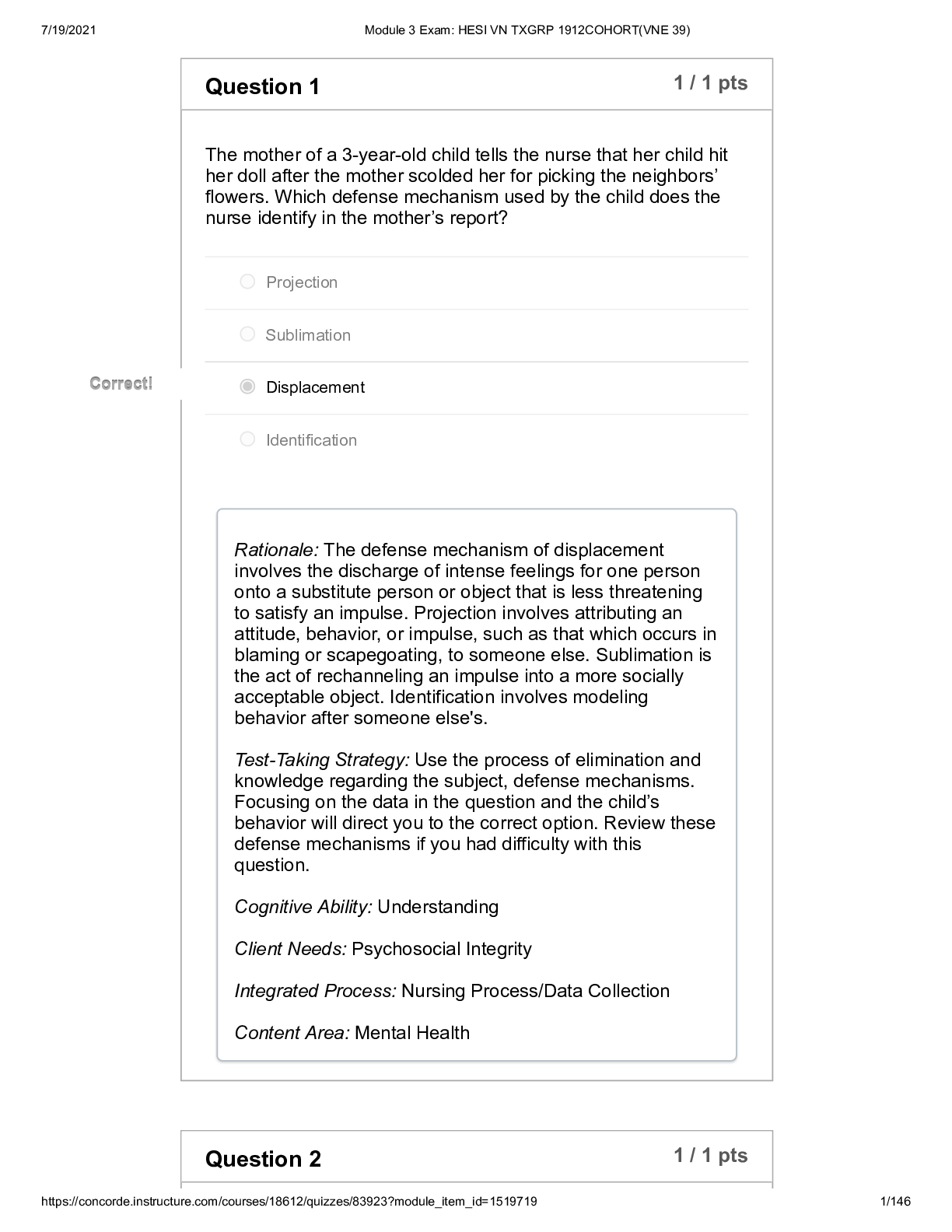
Question 1 1 / 1 pts
The mother of a 3-year-old child tells the nurse that her child hit
her doll after the mother scolded her for picking the neighbors’
flowers. Which defense mechanism used by the child does the
nurse identify in the mother’s report?
Projection
Sublimation
Correct! Correct! Displacement
Identification
Rationale: The defense mechanism of displacement
involves the discharge of intense feelings for one person
onto a substitute person or object that is less threatening
to satisfy an impulse. Projection involves attributing an
attitude, behavior, or impulse, such as that which occurs in
blaming or scapegoating, to someone else. Sublimation is
the act of rechanneling an impulse into a more socially
acceptable object. Identification involves modeling
behavior after someone else's.
Test-Taking Strategy: Use the process of elimination and
knowledge regarding the subject, defense mechanisms.
Focusing on the data in the question and the child’s
behavior will direct you to the correct option. Review these
defense mechanisms if you had difficulty with this
question.
Cognitive Ability: Understanding
Client Needs: Psychosocial Integrity
Integrated Process: Nursing Process/Data Collection
Content Area: Mental Health
Question 2 1 / 1 pts7/19/2021 Module 3 Exam: HESI VN TXGRP 1912COHORT(VNE 39)
https://concorde.instructure.com/courses/18612/quizzes/83923?module_item_id=1519719 2/146
A client says to the nurse, “I’ve been following my diet and taking
my medication. What else do you want to talk about today?”
Which response would be most helpful during the working phase
of the therapeutic alliance?
“Sounds fine to me. Let’s meet again in 6 months.”
“I don’t believe that you have been following your diet because
you haven’t lost any weight.”
“Well, you’ve talked about diet in your terms, but perhaps I
should test you on specific things.”
“Some people have added exercise to diet and medication
therapy and gotten positive results. Do you think that this would
work for you?”
Correct! Correct!
Rationale: Although suggestion or overt giving of advice is
sometimes nontherapeutic, these strategies are
therapeutic when used in the working phase, because in
this situation they will increase the client’s perception of all
available options in the treatment plan. Answering
“Sounds fine to me. Let’s meet again in 6 months” stops
the communication process. Stating to the client that he or
she has not lost any weight implies disbelief and does not
explore the reasons for the client’s failure to lose weight.
“Testing” challenges the client and is nontherapeutic.
Test-Taking Strategy: Use the process of elimination and
therapeutic communication techniques. Noting the words
“working phase” in the question will direct you to the
correct option. Review therapeutic communication
techniques if you had difficulty with this question.
Cognitive Ability: Applying
Client Needs: Psychosocial Integrity
Integrated Process: Communication and Documentation
Content Area: Mental Health7/19/2021 Module 3 Exam: HESI VN TXGRP 1912COHORT(VNE 39)
https://concorde.instructure.com/courses/18612/quizzes/83923?module_item_id=1519719 3/146
Question 3 1 / 1 pts
As the nurse prepares to interview a client being admitted to the
mental health unit, the client says, “I asked my family to bring me
in here to talk to someone, but now I don’t know where to begin.”
Which response by the nurse would be most helpful?
“Why not just start talking and see where it takes you?”
“If I were you, I’d begin with what you were doing this morning.”
“Perhaps you can start by sharing some of your most recent
concerns.”
Correct! Correct!
“Don’t worry. Everyone who comes in here for the first time feels
reluctant to talk.”7/19/2021 Module 3 Exam: HESI VN TXGRP 1912COHORT(VNE 39)
https://concorde.instructure.com/courses/18612/quizzes/83923?module_item_id=1519719 4/146
Rationale: The intake interview is usually the first contact
with the client. It is intended to establish rapport, to help
the nurse understand the client’s current problem and
level of functioning, and to help the nurse formulate a
nursing care plan. The clinician usually allows the client to
set the pace of the interview and uses open-ended
questions to elicit a comprehensive diagnostic picture of
the client’s problems and level of coping. Sharing
concerns is a good place to start the conversation
because it will allow the client to express feelings. The
response “Why not just start talking and see where it takes
you?” is too general and does not provide the client with a
focus on self. Telling the client not to worry is
nontherapeutic and avoids addressing the client’s
concerns.
Test-Taking Strategy: Use your knowledge of therapeutic
communication techniques. Focusing on the client’s
feelings will direct you to the correct option. Review
therapeutic communication techniques if you had difficulty
with this question.
Cognitive Ability: Applying
Client Needs: Psychosocial Integrity
Integrated Process: Communication and Documentation
Content Area: Mental Health
Question 4 1 / 1 pts
During a mental health intake interview, a young adult client who
lives with his family rent free says, “I’m tired of not being able to
offer my friends a beer just because my folks don’t believe in
taking a drink socially.” Which nursing response would be
therapeutic?
“Well, I guess you could move out and live on your own if you
wanted to.”
“It seems that your parents expect you to follow their rules when
you live under their roof.”
Correct! Correct!7/19/2021 Module 3 Exam: HESI VN TXGRP 1912COHORT(VNE 39)
https://concorde.instructure.com/courses/18612/quizzes/83923?module_item_id=1519719 5/146
“You tell me you live rent free, yet you expect the same privileges
as an adult who supports the household?”
“Well, if you directly discussed your concerns with them, I guess
it’s a case of ‘When in Rome, do as the Romans do.’”
Rationale: The therapeutic nursing response uses
reflection, in which the nurse directs the content of the
client’s message back for the client to review from a new
perspective. This technique also includes an element of
focusing on the crux of the issue—in this case, that it is his
parents’ home and they set the rules for living in their
home, just as he someday will in his. Telling the client to
move out is giving advice or suggestions to the client
prematurely. Although this technique can be useful in the
working phase, it is usually nontherapeutic when the nurse
needs to promote client understanding and selfexploration. Stating “You tell me you live rent free, yet you
expect the same privileges as an adult who supports the
household?” is judgmental and poorly timed in that it
humiliates the client unnecessarily. The client has
acknowledged that he pays no rent, so there is no helpful
purpose in reemphasizing this fact. Stating “Well, if you
directly discussed your concerns with them, I guess it’s a
case of ‘When in Rome, do as the Romans do’” is
nontherapeutic in that it offers a cliché and expresses
hopelessness and powerlessness, two emotions that the
client is no doubt already experiencing.
Test-Taking Strategy: Use your knowledge of therapeutic
communication techniques. This will direct you to the
correct option, the nursing response that focuses on the
client’s concerns and feelings. Review therapeutic
communication techniques if you had difficulty with this
question.
Cognitive Ability: Applying
Client Needs: Psychosocial Integrity
Integrated Process: Communication and Documentation
Content Area: Mental Health7/19/2021 Module 3 Exam: HESI VN TXGRP 1912COHORT(VNE 39)
https://concorde.instructure.com/courses/18612/quizzes/83923?module_item_id=1519719 6/146
Question 5 1 / 1 pts
A nurse is participating in a care planning conference regarding
care for a client whose spouse recently died. The registered
nurse formulates a nursing diagnosis of dysfunctional grieving.
Which priority intervention does the nurse expect to see
incorporated into the plan?
Monitoring the client’s sleep pattern
Obtaining a physician’s prescription for an antidepressant
Determining the client’s risk for violence toward self and others
Correct! Correct!
Assisting the client in resolving the grief through emotional,
cognitive, and behavioral means
Rationale: The priority intervention for a client with
dysfunctional grieving is assessing the client’s risk for
violence toward self and others. Although the nurse will
assist the client in resolving the grief and will monitor the
client’s sleep pattern, these are not priorities in the list of
options given. Obtaining a physician’s prescription for an
antidepressant is not a priority.
Test-Taking Strategy: Use the process of elimination and
the steps of the nursing process. Both monitoring the
client’s sleep pattern and determining the client’s risk for
violence toward self and others involve assessment. From
these options, select the one that addresses the safety of
the client. Review interventions for a client with
dysfunctional grieving if you had difficulty with this
question.
Cognitive Ability: Applying
Client Needs: Psychosocial Integrity
Integrated Process: Communication and Documentation
Content Area: Mental Health7/19/2021 Module 3 Exam: HESI VN TXGRP 1912COHORT(VNE 39)
https://concorde.instructure.com/courses/18612/quizzes/83923?module_item_id=1519719 7/146
Question 6 1 / 1 pts
A client in the mental health unit tells the nurse, “My husband
makes all the decisions about money, but I’m the one who’s
making the money now, not him. He needs to back off, but he’s
always directing every decision we make.” Which nursing
response would be the most therapeutic?
“Have you told your husband to back off”?
“You’re making the most money, so the decisions should be left
to you.”
“How do you feel the money decisions could best be handled in
your household?”
Correct! Correct!
“You seem frustrated with your husband’s habit of controlling
financial decisions.”7/19/2021 Module 3 Exam: HESI VN TXGRP 1912COHORT(VNE 39)
https://concorde.instructure.com/courses/18612/quizzes/83923?module_item_id=1519719 8/146
Rationale: The therapeutic nursing response is the one
that provides a broad opening or statement and is focused
on the client’s feelings. In this response, the nurse will be
able to assess what the client believes concerning family
financial decision-making. Asking “Have you told your
husband to ‘back off’?” is improperly paraphrasing the
client and assumes that the client’s stance is correct.
Stating that “You’re making the most money, so decisions
should be left to you” is inappropriate restating and
provides an opinion; this response may be seen by the
client as reassurance that her interpretation is being
judged as correct. By stating “You seem to feel
frustrated…,” the nurse is sharing perceptions, which may
appear to be challenging to the client when used in this
context.
Test-Taking Strategy: Use your knowledge of therapeutic
communication techniques. Remember to focus on the
client’s feelings and to provide the client the opportunity to
communicate. This will direct you to the correct option.
Review therapeutic communication techniques if you had
difficulty with this question.
Cognitive Ability: Applying
Client Needs: Psychosocial Integrity
Integrated Process: Communication and Documentation
Content Area: Mental Health
Question 7 1 / 1 pts
A nurse is attending a care planning conference for a client who
recently received a diagnosis of acquired immunodeficiency
syndrome and is experiencing difficulty adjusting to the illness.
The nurse should question which planned intervention for this
client?
Monitoring the client for signs of self-harm
Helping the client verbalize concerns related to fear
Assisting the client with problem-solving and decision-making7/19/2021 Module 3 Exam: HESI VN TXGRP 1912COHORT(VNE 39)
https://concorde.instructure.com/courses/18612/quizzes/83923?module_item_id=1519719 9/146
Discouraging social networking to prevent the spread of infection
Correct! Correct!
Rationale: In planning care for a client experiencing
difficulty in adjusting to an illness, the nurse develops
interventions to promote (not discourage) social
networking that will provide needed information to the
client. The other options are appropriate interventions.
Test-Taking Strategy: Use the process of elimination and
note the strategic word “question.” Recalling that social
support is important will direct you to the correct option.
Also, note the relationship between the word “question” in
the question and “discouraging” in the correct option.
Review interventions for a client experiencing difficulty in
adjusting to an illness if you had difficulty with this
question.
Cognitive Ability: Applying
Client Needs: Psychosocial Integrity
Integrated Process: Nursing Process/Planning
Content Area: Mental Health
Question 8 0.75 / 1 pts
How does a client who has lost a spouse show that she is
successfully completing the tasks of mourning? Select all that
apply.
Relating that its better “he went first”
Correct! Correct! Reporting that sleeping alone was hard at first
Correct! Correct! Purchasing a smaller car she is comfortable driving
Correct Answer Correct Answer Heard explaining to family that illness “took” her husband
Correct! Correct! Heard explaining to family that illness took her husband7/19/2021 Module 3 Exam: HESI VN TXGRP 1912COHORT(VNE 39)
https://concorde.instructure.com/courses/18612/quizzes/83923?module_item_id=1519719 10/146
Question 9 1 / 1 pts
A nurse is caring for a 15-year-old girl who has been hospitalized
on the mental health unit for bipolar disorder. The client tells the
nurse that she had her hair styled just like her young math
teacher, whom she admires. The nurse recognizes that the client
is using which defense mechanism?
Projection
Regression
Correct! Correct! Identification
Intellectualization
Rationale: Identification is the process by which a person
tries to become like someone he or she admires by taking
on the beliefs, mannerisms, or tastes of that person.
Projection is attributing one’s thoughts or impulses to
another person. Regression is retreating to a behavior
characteristic of an earlier level of development.
Intellectualization is excessive reasoning or logic used to
avoid experiencing disturbed feelings.
Test-Taking Strategy: Use the process of elimination,
focusing on the data in the question. Noting that the client
is mimicking a characteristic of another person will direct
you to the correct option. Review these defense
mechanisms if you had difficulty with this question.
Cognitive Ability: Applying
Client Needs: Psychosocial Integrity
Integrated Process: Communication and Documentation
Content Area: Mental Health7/19/2021 Module 3 Exam: HESI VN TXGRP 1912COHORT(VNE 39)
https://concorde.instructure.com/courses/18612/quizzes/83923?module_item_id=1519719 11/146
Question 10 1 / 1 pts
A mental health home care nurse says to the client, “Do you feel
ready to try attending a group session at the clinic?” The client
shakes his head. Which nursing statement would be therapeutic?
“No? Why not?”
“You seem to be saying no. Would you tell me more about your
reluctance?”
Correct! Correct!
“OK, but I hope you will let me know when you feel ready to
attend a group session at the clinic.”
“Perhaps a group session would be too overwhelming for you
right now. How about just seeing me?”7/19/2021 Module 3 Exam: HESI VN TXGRP 1912COHORT(VNE 39)
https://concorde.instructure.com/courses/18612/quizzes/83923?module_item_id=1519719 12/146
Rationale: The therapeutic nursing statement is seeking
clarification. In this statement, the nurse is asking the
client to put his ideas into words and explain what he
means or feels. This encourages the client to express his
reluctance and to try to work out any reservations about
attending the group session. In responding, “No? Why
not?” the nurse is using a confrontational style, which
could lead to a regressive struggle. The nurse expresses
doubt and uses a laissez-faire style regarding attending a
group session at the clinic when the nurse states “… let
me know when you feel ready to attend.” In stating
“Perhaps a group session would be too overwhelming for
you right now. How about just seeing me?” the nurse
prematurely guesses the reasons for the client’s refusal,
and this is not appropriate.
Test-Taking Strategy: Draw on your knowledge of
therapeutic communication techniques to answer this
question. First eliminate the option containing the word
“why.” To select from the remaining options, focus on the
information in the question. The correct option provides
the client the opportunity to verbalize feelings. Review
therapeutic communication techniques if you had difficulty
with this question.
Cognitive Ability: Applying
Client Needs: Psychosocial Integrity
Integrated Process: Communication and Documentation
Content Area: Mental Health
Question 11 1 / 1 pts
A single parent whose son was suspended from school for
carrying a gun into the school says to the nurse, “I know he has
no dad, but I’ve brought him up to know better, and anyway,
where did he get the stupid gun? What should I do? He just won’t
listen to me.” Which nursing response would be helpful at this
time?
“Boys who are cared for only by their moms are at highest risk for
violent behavior.”7/19/2021 Module 3 Exam: HESI VN TXGRP 1912COHORT(VNE 39)
https://concorde.instructure.com/courses/18612/quizzes/83923?module_item_id=1519719 13/146
“There is quite a bit that you can do. Let’s talk about what you’re
already doing first.”
Correct! Correct!
“Do you know all of your son’s friends, or is he left alone after
school because you work?”
“Many young people die of gunshots every day in this country, so
your son’s behavior is unacceptable.”
Rationale: It is important to help parents to identify
children at risk for violent behavior. Unfortunately, this
young person has already engaged in threatening and
potentially violent behavior, but there are parenting
measures and therapies that this single parent can use to
help her son express his feelings of anger verbally rather
than by acting out. The nurse responds nontherapeutically
in telling the mother that boys who are cared for only by
their mothers are at high risk for violence; this response
could generate guilt in the mother. Asking “Do you know
all of your son’s friends, or is he left alone after school
because you work?” is both inappropriate and premature.
Telling the woman that her son’s behavior is unacceptable
is lecturing an upset parent, which is inappropriate.
Test-Taking Strategy: Use your knowledge of therapeutic
communication techniques, and focus on the information
in the question. Note that the client of the question (the
mother) is asking the nurse for assistance. The correct
option is the only option that addresses the mother’s
concern and encourages verbalization. Review therapeutic
communication techniques if you had difficulty with this
question.
Cognitive Ability: Applying
Client Needs: Psychosocial Integrity
Integrated Process: Communication and Documentation
Content Area: Mental Health
Question 12 1 / 1 pts7/19/2021 Module 3 Exam: HESI VN TXGRP 1912COHORT(VNE 39)
https://concorde.instructure.com/courses/18612/quizzes/83923?module_item_id=1519719 14/146
A client says to the nurse, “My health care provider says he
thinks I’m ready to taper off my pain medication, but the new
painkiller he prescribed doesn’t relieve my pain the way the other
pill did. I get pain when I try to do things.” Which nursing
response would be most supportive to the client?
“Your physician feels that your body is physically ready to make
the change in medication.”
“I think you need to listen to your physician when it comes to
taking such strong medication.”
“Well, your health care provider is concerned that you will
become physically dependent on the first painkiller.”
“Perhaps if I medicate you about a half-hour before you plan to
start your daily activities, the medicine will be more effective.”
Correct! Correct!7/19/2021 Module 3 Exam: HESI VN TXGRP 1912COHORT(VNE 39)
https://concorde.instructure.com/courses/18612/quizzes/83923?module_item_id=1519719 15/146
Rationale: The most supportive response is the one that
addresses the client’s concern and provides a plan that
will help minimize the client’s pain. If this nursing measure
does not afford pain relief, then the nurse can report the
client’s continued pain to the physician. In stating “Your
physician feels that your body is physically ready to make
the change in medication,” the nurse is shifting attention
from the client’s feelings to the physician’s view. In telling
the client that he or she needs to listen to the physician,
the nurse is nontherapeutically giving advice and
patronizing the client. Stating “Well, your health care
provider is concerned that you will become physically
dependent on the first painkiller” is a defensive response,
and the nurse’s assertion about dependence may not be
based on fact.
Test-Taking Strategy: Use your knowledge of therapeutic
communication techniques and focus on the subject, the
client’s concern about pain relief. Eliminate the
comparable or alike options that focus on the physician,
not the client. From the remaining options, select the one
that addresses the client’s concern. Review therapeutic
communication techniques if you had difficulty with this
question.
Cognitive Ability: Applying
Client Needs: Psychosocial Integrity
Integrated Process: Communication and Documentation
Content Area: Mental Health
Question 13 1 / 1 pts
A client who was employed as a corporate manager before being
laid off says to the nurse, “My wife thinks that I should work in a
menial job to maintain our lifestyles until I find another job as a
corporate manager, but I don’t feel I should have to humiliate
myself like that.” Which nursing response would be therapeutic?
Correct! Correct! “Have you shared your feelings with your wife?”7/19/2021 Module 3 Exam: HESI VN TXGRP 1912COHORT(VNE 39)
https://concorde.instructure.com/courses/18612/quizzes/83923?module_item_id=1519719 16/146
“You seem to feel that a less prestigious job would be humiliating
for you.”
“Oh, I agree with you. Let her get another job if she needs that
much money.”
“How soon will you be able to find work? If this is permanent, you
may need to swallow your pride.”
Rationale: The therapeutic response is the one that helps
determine whether the client is sharing his feelings with
his wife and providing her with the opportunity to join in the
decision-making process. Stating “You seem to feel that a
less prestigious job would be humiliating for you” is
reflection to some degree; however, its focus is
nontherapeutic because the nurse is making a premature
judgment of the client’s concerns. In stating “Oh, I agree
with you. Let her get another job if she needs that much
money,” the nurse is using a nontherapeutic response of
giving approval. “How soon will you be able to find work? If
this is permanent, you may need to swallow your pride” is
a probing question that the client is probably unable to
answer and gives an unsolicited opinion, which is a
nontherapeutic communication.
Test-Taking Strategy: Use your knowledge of therapeutic
communication techniques. Note the words “shared your
feelings” in the correct option. Remember to focus on the
client’s feelings. Review therapeutic communication
techniques if you had difficulty with this question.
Cognitive Ability: Applying
Client Needs: Psychosocial Integrity
Integrated Process: Communication and Documentation
Content Area: Mental Health
Question 14 1 / 1 pts7/19/2021 Module 3 Exam: HESI VN TXGRP 1912COHORT(VNE 39)
https://concorde.instructure.com/courses/18612/quizzes/83923?module_item_id=1519719 17/146
A young woman who has been divorced twice says to the nurse,
“I’ve decided not to date men ever again! It never works out for
me. Now I’m left with two children to bring up.” Which nursing
response would be therapeutic?
“Oh, me too. I always pick the worst kind of men, so I know just
how you feel.”
“Divorce is more difficult for children. Maybe you should focus on
them for now.”
“You’ve been unfortunate, but you seem to be focusing on
yourself and what you have to do.”
“You talk about how the divorces affected you. Tell me how your
children are dealing with the loss.”
Correct! Correct!7/19/2021 Module 3 Exam: HESI VN TXGRP 1912COHORT(VNE 39)
https://concorde.instructure.com/courses/18612/quizzes/83923?module_item_id=1519719 18/146
Rationale: When clients experience loss, they can become
self-absorbed. In responding, “You talk about how the
divorces affected you. Tell me how your children are
dealing with the loss,” the nurse is trying to refocus the
client’s attention on her children and their needs during
this time. By stating “Oh, me too. I always pick the worst
kind of men, so I know just how you feel,” the nurse
personalizes and exaggerates the client’s problems, using
a nontherapeutic response. In stating “Divorce is more
difficult for children. Maybe you should focus on them for
now,” the nurse is being judgmental when he or she
should be refocusing the client’s energies. In stating
“You’ve been unfortunate, but you seem to be focusing on
yourself and what you have to do,” the nurse is responding
with empathy, but the choice of wording suggests that the
nurse is judging and blaming the client for not focusing on
her children.
Test-Taking Strategy: Use your knowledge of therapeutic
communication techniques. Eliminate the option that is a
nontherapeutic response and does not focus on the
client’s concern. To select from the remaining options,
note that the correct option is the only option that
encourages the client to discuss the loss and its effect on
her children. Review therapeutic communication
techniques if you had difficulty with this question.
Cognitive Ability: Applying
Client Needs: Psychosocial Integrity
Integrated Process: Communication and Documentation
Content Area: Mental Health
Question 15 1 / 1 pts
A client says to the nurse, “What does my psychiatrist mean
when she says that my illness is biologically based?” Which
nursing statement would be the most informative?
“Mental illness always has its roots in the family.”
“Mental illness is a result of environmental factors.”7/19/2021 Module 3 Exam: HESI VN TXGRP 1912COHORT(VNE 39)
https://concorde.instructure.com/courses/18612/quizzes/83923?module_item_id=1519719 19/146
“Today we know that all mental illness is genetically inherited.”
“There are many possible physical causes of mental illness, and
they include problems in the brain.”
Correct! Correct!
Rationale: Biologically based mental illnesses are caused
by neurotransmitter dysfunction, abnormal brain structure,
inherited genetic factors, or other biological causes.
Biologically influenced illnesses include schizophrenia,
bipolar disorder, major depression, obsessive-compulsive
disorder, panic disorder, posttraumatic stress disorder,
autism, anorexia nervosa, and attentiondeficit/hyperactivity disorder. Stating that all mental illness
is a result of genetic factors or that it is caused by
environmental factors or family dynamics is incorrect and
not associated with a biologically based disorder.
Test-Taking Strategy: Use the process of elimination.
Eliminate the options that include the closed-ended words
“always” and “all.” To select from the remaining options,
focus on the words “biologically based” in the question,
which will direct you to the correct answer. Review the
causes of mental illness if you had difficulty with this
question.
Cognitive Ability: Applying
Client Needs: Psychosocial Integrity
Integrated Process: Nursing Process/Implementation
Content Area: Mental Health
Question 16 1 / 1 pts
A nurse is caring for a 39-year-old client who has experienced a
mild brain attack (stroke). The client is recently widowed, is very
active physically, and has two young sons. The client says to the
nurse, “I don’t know what my sons will do if anything permanent
happens to me. We have no other relatives, even on my late
wife’s side.” Which nursing response would be therapeutic?7/19/2021 Module 3 Exam: HESI VN TXGRP 1912COHORT(VNE 39)
https://concorde.instructure.com/courses/18612/quizzes/83923?module_item_id=1519719 20/146
Correct! Correct! “You seem to be feeling very troubled.”
“You are working to get better, but you’re worrying about things
that aren’t going to happen.”
“You seem to be feeling very powerless right now, yet you’re
getting better, so why worry about what won’t happen?”
“I am troubled that you are worried over the worst possible things
that could happen rather than worrying about the efforts needed
to strengthen your family situation.”7/19/2021 Module 3 Exam: HESI VN TXGRP 1912COHORT(VNE 39)
https://concorde.instructure.com/courses/18612/quizzes/83923?module_item_id=1519719 21/146
Rationale: The client has suffered two major losses and is
expressing worry and concern about his health and his
children. The correct response conveys the nurse’s
expression of empathy and willingness to understand and
help the client explore ways of coping with difficulties. In
stating “You are working to get better and are doing so.
But you are worrying about things that aren’t going to
happen,” the nurse is making a pat and clichéd response
that may or may not be true. In stating “You seem to be
feeling very powerless right now, yet you’re getting better,
so why worry about what won’t happen?” the nurse is
displaying empathy but also minimizing the client’s
feelings with a false reassurance. In stating “I am troubled
that you are worried over the worst possible things that
could happen rather than worrying about the efforts
needed to strengthen your family situation,” the nurse is
not focusing on the client’s concern, and the statement
could be interpreted as minimizing or belittling by the
client.
Test-Taking Strategy: Use your knowledge of therapeutic
communication techniques. Select the option that focuses
on the client’s feelings and encourages the client to
express his feelings. Review therapeutic communication
techniques if you had difficulty with this question.
Cognitive Ability: Applying
Client Needs: Psychosocial Integrity
Integrated Process: Nursing Process/Implementation
Content Area: Mental Health
Question 17 1 / 1 pts
A client who has been admitted to a surgical unit with a diagnosis
of cancer is scheduled for surgery in the morning. When the
nurse enters the room and begins the surgical preparation, the
client states, “I’m not having surgery—you must have the wrong
person! My test results were negative. I’ll be going home
tomorrow.” The nurse recognizes that the client is engaging in the
use of which defense mechanism?
Correct! Correct! Denial7/19/2021 Module 3 Exam: HESI VN TXGRP 1912COHORT(VNE 39)
https://concorde.instructure.com/courses/18612/quizzes/83923?module_item_id=1519719 22/146
Psychosis
Delusions
Displacement
Rationale: Defense mechanisms protect us against
anxiety. Denial is the defense mechanism used to block
out painful or anxiety-inducing events or feelings. In this
case, the client cannot deal with the upcoming cancer
surgery and therefore denies that he or she is ill.
Psychosis and delusions are not defense mechanisms.
Displacement is acting out in anger or frustration with
people who did not arouse the feelings.
Test-Taking Strategy: Use the process of elimination and
focus on the subject, defense mechanisms. First, eliminate
the options that are not defense mechanisms. From the
remaining options, focus on the data in the question to find
the correct option. Review defense mechanisms if you had
difficulty with this question
Cognitive Ability: Understanding
Client Needs: Psychosocial Integrity
Integrated Process: Nursing Process/Data Collection
Content Area: Mental Health
Question 18 1 / 1 pts
A young adult client who is dying says to the nurse, “I keep
asking my wife what I can do for her and our daughter before I
die, but she refuses to tell me.” On the basis of the client’s
statement, what is the appropriate nursing intervention?
Teaching the client’s wife to write down her thoughts and feelings
and to read them to her husband7/19/2021 Module 3 Exam: HESI VN TXGRP 1912COHORT(VNE 39)
https://concorde.instructure.com/courses/18612/quizzes/83923?module_item_id=1519719 23/146
Saying to the client, “It sounds to me like your wife is truly
comfortable and doesn’t want you to worry needlessly.”
Talking with both the client and his wife about the importance of
expressing their feelings and how to do it in healthy ways
Correct! Correct!
Talking with all family members, including the daughter, about the
importance of expressing their concerns and feelings to the dying
client
Rationale: The appropriate nursing intervention is to help
the client and spouse describe feelings that, left unspoken,
might cause disruption and delay resolution. Teaching the
client’s wife to write down her thoughts and feelings and
read them to her husband is inappropriate without a prior
determination of the wife’s feelings. In saying to the client,
“It sounds to me as if your wife is truly comfortable and
doesn’t want you to worry needlessly,” the nurse
verbalizes a statement without a basis in fact, a
nontherapeutic technique. Talking with all family members
is inappropriate and could violate client confidentiality.
Test-Taking Strategy: Use your knowledge of therapeutic
communication techniques. Eliminate the option that does
not address the client’s feelings and places the client’s
feelings on hold. Next, eliminate the comparable or alike
options because they both address an intervention with a
family member before determining their feelings. Review
therapeutic communication techniques if you had difficulty
with this question.
Cognitive Ability: Applying
Client Needs: Psychosocial Integrity
Integrated Process: Nursing Process/Implementation
Content Area: Mental Health
Question 19 1 / 1 pts7/19/2021 Module 3 Exam: HESI VN TXGRP 1912COHORT(VNE 39)
https://concorde.instructure.com/courses/18612/quizzes/83923?module_item_id=1519719 24/146
A 45-year-old client says to the nurse, “Since I left my wife and
children, I can hardly make ends meet between child support and
trying to support myself. I don’t know why I bother going to work
when my wife and kids take just about everything I make.” Which
nursing statement would be therapeutic?
“I wonder why you left your wife and children.”
“What would you expect your wife and children to do? They didn’t
leave you.”
“You seem to be very angry about carrying out your responsibility
to your children.”
“Do you feel that child support is designed to help children, not
punish spouses who leave?”
Correct! Correct!7/19/2021 Module 3 Exam: HESI VN TXGRP 1912COHORT(VNE 39)
https://concorde.instructure.com/courses/18612/quizzes/83923?module_item_id=1519719 25/146
Rationale: The nurse employs the therapeutic
communication technique of seeking clarification to
support the client in processing his feelings more
specifically. In maintaining a neutral, unbiased, and
nonjudgmental stance, the nurse can establish a trusting
relationship with the client. In stating “I wonder why you
left your wife and children,” the nurse changes the focus of
the client’s concern and uses a “why” question that implies
criticism and could cause the client to become defensive.
“What would you expect your wife and children to do?
They didn’t leave you” is sarcasm, which is nontherapeutic
and alienates the client. In stating “You seem very angry
about carrying out your responsibility to your children,” the
nurse is making an interpretation and labeling the client’s
feelings prematurely.
Test-Taking Strategy: Use your knowledge of therapeutic
communication techniques. Eliminate the option
containing the word “why.” Next, eliminate the option that
is sarcastic and the option that labels the client’s feelings.
Also note that the correct option is the only option that
focuses on the client’s concern and encourages the client
to further verbalize feelings. Review therapeutic
communication techniques if you had difficulty with this
question.
Cognitive Ability: Applying
Client Needs: Psychosocial Integrity
Integrated Process: Communication and Documentation
Content Area: Mental Health
Question 20 1 / 1 pts
A survivor of a nightclub fire that killed more than 100 people
says to the nurse, “It should have been me. How come I got out
and they didn’t?” Which response by the nurse is appropriate?
“I don’t know what to say. It was a terrible fire. I’m so sorry this
happened.”7/19/2021 Module 3 Exam: HESI VN TXGRP 1912COHORT(VNE 39)
https://concorde.instructure.com/courses/18612/quizzes/83923?module_item_id=1519719 26/146
“It seems that you’re blaming yourself for something that was
beyond your control.”
Correct! Correct!
“It seems to me that you’re making this all about you when many
people died in that fire.”
“You should be thankful that you’re a survivor. The victims and
their families lost, not you.”
Rationale: The correct option involves the use of the
communication technique of reflection and encourages the
client to further verbalize his thoughts and feelings. In
stating “I don’t know what to say. It was a terrible fire. I’m
so sorry this happened,” the nurse is using a social
response and the nontherapeutic communication
technique of agreeing. In stating “It seems to me that
you’re making this all about you when many people died in
that fire,” the nurse is using the nontherapeutic
communication techniques of disapproval and judging. In
stating “You should be thankful that you’re a survivor. The
victims and their families lost, not you,” the nurse is
nontherapeutically lecturing the client.
Test-Taking Strategy: Use your knowledge of therapeutic
communication techniques. The correct option is the only
option that is therapeutic, involves the use of reflection,
and encourages verbalization of the client’s feelings.
Review therapeutic communication techniques if you had
difficulty with this question.
Cognitive Ability: Applying
Client Needs: Psychosocial Integrity
Integrated Process: Communication and Documentation
Content Area: Mental Health
Question 21 1 / 1 pts7/19/2021 Module 3 Exam: HESI VN TXGRP 1912COHORT(VNE 39)
https://concorde.instructure.com/courses/18612/quizzes/83923?module_item_id=1519719 27/146
When assisting with the plan of care of a client dying of cancer,
the nurse seeks to have the client verbalize acceptance of his
impending death. Which statement indicates to the nurse that this
goal has been met?
Correct! Correct! “I’d like to have my family here when I die.”
“I’ll be ready to die once my daughter gets married.”
“I want to go to my family reunion; then I’ll be ready to die.”
“I just want to live to see my grandchildren graduate from
college.”
Rationale: Acceptance is often characterized by plans for
death. Often the client wants loved ones near. Therefore
the statement “I’d like to have my family here when I die”
indicates acceptance of impending death. The incorrect
options reflect the bargaining stage of coping, in which the
client tries to negotiate with his or her God or with fate.
Test-Taking Strategy: Use the process of elimination.
Eliminate the comparable or alike options that
demonstrate negotiation for something else to happen
before death occurs. The correct option is the option that
reflects acceptance. Review the stages of death and dying
if you had difficulty with this question.
Cognitive Ability: Evaluating
Client Needs: Psychosocial Integrity
Integrated Process: Nursing Process/Evaluation
Content Area: Mental Health
Question 22 1 / 1 pts
A client says to the nurse at the mental health clinic, “My husband
and sister-in-law both have terminal illnesses, and my family7/19/2021 Module 3 Exam: HESI VN TXGRP 1912COHORT(VNE 39)
https://concorde.instructure.com/courses/18612/quizzes/83923?module_item_id=1519719 28/146
thinks that because I’m a nurse I should be able to handle
everything.” Which nursing response would be therapeutic?
“Are you saying you are overly involved and will need to
emotionally distance yourself to be therapeutic for your family?”
“Shame on them for expecting so much from you. Perhaps we
need to schedule a family meeting so I can help you set them
straight.”
“I’m sorry to hear that your loved ones are so ill. As a nurse, you
should be able to assist them by using your professional
expertise. Perhaps that’s what your family expects from you.”
“You’ve seen your loved ones dealing with some troubling events
recently. Sounds as if you feel that your family expects more from
you than from others in the family because you’re a nurse.”
Correct! Correct!7/19/2021 Module 3 Exam: HESI VN TXGRP 1912COHORT(VNE 39)
https://concorde.instructure.com/courses/18612/quizzes/83923?module_item_id=1519719 29/146
Rationale: The therapeutic response is the one in which
the nurse makes observations and then clarifies his or her
perception of what the client has said. Stating “Are you
saying you are overly involved and will need to emotionally
distance yourself to be therapeutic for your family?” is
paraphrasing, a therapeutic technique, but this response is
premature and reflects unfounded assumptions. In stating
“Shame on them for expecting so much from you. Perhaps
we need to schedule a family meeting so I can help you
set them straight,” the nurse expresses disapproval, a
nontherapeutic communication technique, and then offers
to “beat up” the family verbally in a family intervention. The
statement “I’m sorry to hear that your loved ones are so ill.
As a nurse, you should be able to assist them, using your
professional expertise. Perhaps that’s what your family
expects from you,” expresses sympathy but also lectures
the client.
Test-Taking Strategy: Use your knowledge of therapeutic
communication techniques. The correct option is the only
option that specifically addresses the client’s feelings and
encourages verbalization about the client’s concern.
Review therapeutic communication techniques if you had
difficulty with this question.
Cognitive Ability: Applying
Client Needs: Psychosocial Integrity
Integrated Process: Communication and Documentation
Content Area: Mental Health
Question 23 1 / 1 pts
A 79-year-old client, recently widowed, says to the nurse, “My
wife kept up our condominium single-handedly, and now my kids
expect me to cook and clean for myself. I’m not lazy, but I don’t
know how to cook and I’ve burnt myself twice just frying up what
was supposed to be bacon and eggs. I’m so frustrated and I’ve
already lost 10 pounds this month.” Which initial nursing
statement should the nurse make to the client?7/19/2021 Module 3 Exam: HESI VN TXGRP 1912COHORT(VNE 39)
https://concorde.instructure.com/courses/18612/quizzes/83923?module_item_id=1519719 30/146
“I’m calling the health care provider immediately to obtain a
homemaker for you!”
“It seems as if you feel lost without your wife and maybe a bit
ignored by your children.”
Correct! Correct!
“First things first. What are you doing eating bacon and eggs?
That’s not a good meal for you.”
“Meals-on-Wheels can help you minimize the frustration you are
having cooking. Are you a member of the local senior center?”7/19/2021 Module 3 Exam: HESI VN TXGRP 1912COHORT(VNE 39)
https://concorde.instructure.com/courses/18612/quizzes/83923?module_item_id=1519719 31/146
Rationale: The client is exhibiting grief over the recent loss
of his wife; feelings of insecurity, inexperience, and
helplessness; weight loss (a vegetative sign of
depression); evidence of poor nutritional habits; isolation;
and a lack of safety in activities of daily living. The initial
nursing statement should seek clarification of the client’s
feelings so that the nurse can estimate the extent of mood
alteration. In stating “I’m calling the health care provider
immediately to obtain a homemaker for you!” the nurse is
responding too abruptly. Although the stated intervention
may be a part of mutual planning, the client may not need
or qualify for such support at this time; more data should
be gathered. In stating “First things first. What are you
doing eating bacon and eggs? That’s not a good meal for
you,” the nurse begins by ordering data from the client but
veers off into expressing disapproval of the one meal that
the client has cited, which may not be representative of his
dietary habits. The nurse jumps to conclusions on the
basis of inadequate information, and being judgmental is
nontherapeutic. Saying, “Meals-on-Wheels can help you
minimize your frustration. Are you a member of the local
senior center?” jumps prematurely to referral to community
resources that may be helpful. However, it is too early to
address resources; a complete assessment of the client’s
stated complaints should be obtained first.
Test-Taking Strategy: Use your knowledge of therapeutic
communication techniques. This will direct you to the
correct option, which is the only option that addresses the
client’s feelings. Review therapeutic communication
techniques if you had difficulty with this question.
Cognitive Ability: Applying
Client Needs: Psychosocial Integrity
Integrated Process: Communication and Documentation
Content Area: Mental Health
Question 24 1 / 1 pts
A physician tells a client that she has cancer, that her illness is
terminal, and that she has a 6-month prognosis. After the
physician leaves the client’s room, which therapeutic statement
should the nurse make to the client?7/19/2021 Module 3 Exam: HESI VN TXGRP 1912COHORT(VNE 39)
https://concorde.instructure.com/courses/18612/quizzes/83923?module_item_id=1519719 32/146
“I am so sorry about this. You are my favorite client, and I will
take good care of you.”
“What did your health care provider tell you about your condition?
Can you tell me what you’re thinking about?”
Correct! Correct!
“Do you have any questions about what is happening with you? I
can assure you that I will do everything I can to help minimize
your pain.”
“Do you want me to get the phone so you can talk to your loved
ones, or do you have questions for me about what’s happening
with you?”7/19/2021 Module 3 Exam: HESI VN TXGRP 1912COHORT(VNE 39)
https://concorde.instructure.com/courses/18612/quizzes/83923?module_item_id=1519719 33/146
Rationale: When communicating with the dying client and
those who grieve, the nurse should use statements that
indicate a willingness to follow the client’s lead. Openended statements such as “Can you tell me what you are
thinking about?” are appropriate and encourage
verbalization of feelings. In stating “I am so sorry about
this. You are my favorite client, and I will take good care of
you,” the nurse expresses sympathy but provides only a
social response. By stating “Do you have any questions
about what is happening with you? I can assure you that I
will do everything I can to help minimize your pain,” the
nurse begins with a therapeutic response but then gives a
false reassurance. By stating “Do you want me to get the
phone so you can talk to your loved ones, or do you have
questions for me about what’s happening with you?” the
nurse demonstrates discomfort and is seemingly reluctant
to offer help. In this statement the nurse tells the client that
the nurse would prefer that the client discuss feelings and
concerns with loved ones.
Test-Taking Strategy: Use your knowledge of therapeutic
communication techniques and remember to focus on the
client’s feelings. The correct option focuses on the client’s
feelings and encourages client verbalization. Review
therapeutic communication techniques if you had difficulty
with this question.
Cognitive Ability: Applying
Client Needs: Psychosocial Integrity
Integrated Process: Communication and Documentation
Content Area: Mental Health
Question 25 1 / 1 pts
The wife of a client who is dying says to the nurse, “I am able to
take off the 6 months from work our health care provider feels
that my husband will live, but what if he lives beyond that time?”
Which therapeutic response should the nurse make?
“Only you and your husband can determine how you should best
allocate your work leave.”7/19/2021 Module 3 Exam: HESI VN TXGRP 1912COHORT(VNE 39)
https://concorde.instructure.com/courses/18612/quizzes/83923?module_item_id=1519719 34/146
“Your husband has managed to be active up to now, so he could
live longer than predicted, but his actual life span remains
unclear.”
“Are there other options for you in taking work leave? What are
your thoughts about reducing your work hours at first so that you
can extend your compassionate leave?”
Correct! Correct!
“Why not write down the pros and cons of taking work leave all at
once and any other options and then decide with your husband
and family which would be most helpful?”7/19/2021 Module 3 Exam: HESI VN TXGRP 1912COHORT(VNE 39)
https://concorde.instructure.com/courses/18612/quizzes/83923?module_item_id=1519719 35/146
Rationale: In end-of-life nursing care, the caregiver is often
asked, “How long?” or “What should I do?” by family
members and the dying clients themselves. The nurse can
convey information and make limited but realistic
predictions, such as presenting the client’s stable or
deteriorating physiological condition. Discussing options
and alternative solutions with the family that can be added
to the process of decision-making can be helpful. Simple
alternatives can be used as examples if the family or client
seems unable to begin to problem-solve. By stating “Only
you and your husband can determine how you should best
allocate your work leave,” the nurse avoids any discussion
with the family member. By stating “Your husband has
managed to be active up to now, so he could live longer
than predicted, but his lifespan remains unclear,” the nurse
begins to discuss physiological issues but is so vague that
in the end the statement offers no support. By stating
“Why not write down the pros and cons of taking work
leave all at once and any other options, and then decide
with your husband and family which would be most
helpful?” the nurse makes suggestions but leaves the
family member with little to use for decision-making.
Test-Taking Strategy: Use your knowledge of therapeutic
communication techniques. The correct option is the only
option that assesses and explores with the client (the
wife). Review therapeutic communication techniques if you
had difficulty with this question.
Cognitive Ability: Applying
Client Needs: Psychosocial Integrity
Integrated Process: Nursing Process/Implementation
Content Area: Mental Health
Question 26 1 / 1 pts
The wife of a dying man is ignoring his rapid physiological decline
and imminent death. She continues with her usual activities,
exhibits inability to remember what others have just told her, and
misses important appointments. Which therapeutic statement
should the nurse make to the wife?7/19/2021 Module 3 Exam: HESI VN TXGRP 1912COHORT(VNE 39)
https://concorde.instructure.com/courses/18612/quizzes/83923?module_item_id=1519719 36/146
“It isn’t unusual for family to suffer from anticipatory grief when a
loved one is dying.”
Correct! Correct!
“I cannot emphasize how much your husband needs you to be
there for him right now. He is in the stage of denial.”
“You will need to concentrate on getting to these appointments
on time and write down what everyone says so you will
remember.”
“Can you talk about what’s happening to you right now? Your
behavior is not appropriate at this stage of your husband’s
illness. You seem to be having sympathy pains for him, like men
during their wives’ pregnancies.”7/19/2021 Module 3 Exam: HESI VN TXGRP 1912COHORT(VNE 39)
https://concorde.instructure.com/courses/18612/quizzes/83923?module_item_id=1519719 37/146
Rationale: Anticipatory grief is premourning with specific
clinical manifestations. The signs of anticipatory grief
include feeling empty and lost, fatigued, and numb. Other
behaviors include unreality and disbelief, periods of
weeping or rage, a desire to run away from the situation,
micromanagement of the client’s care, anger at the
caregivers and the dying client, pronounced dependency,
and fear. By describing this syndrome as common, the
nurse offers understanding and assists the spouse in
becoming more aware of her feelings and behaviors. This
will free her from guilt and enhance her ability to deal with
the situation. In stating “I cannot emphasize how much
your husband needs you to be there for him right now. He
is in the stage of denial,” or “You will need to concentrate
on making these appointments on time and write down
what everyone says so you will remember,” the nurse
expresses disapproval of the spouse’s behavior, a
nontherapeutic response that will probably cause the client
to feel guilty. In stating “Can you talk about what’s
happening to you right now? Your behavior is not
appropriate at this stage of your husband’s illness. You
seem to be having sympathy pains for him, like men
during their wives’ pregnancies,” the nurse demeans the
spouse’s behavior and makes a judgmental comment that
will probably result in an angry and guilty response from
the spouse.
Test-Taking Strategy: Use your knowledge of therapeutic
communication techniques. Eliminate the comparable or
alike options that express disapproval of the spouse’s
behavior. Next, eliminate the option that demeans the
spouse’s behavior, another nontherapeutic technique.
Review therapeutic communication techniques if you had
difficulty with this question.
Cognitive Ability: Applying
Client Needs: Psychosocial Integrity
Integrated Process: Nursing Process/Implementation
Content Area: Mental Health
Question 27 1 / 1 pts7/19/2021 Module 3 Exam: HESI VN TXGRP 1912COHORT(VNE 39)
https://concorde.instructure.com/courses/18612/quizzes/83923?module_item_id=1519719 38/146
An older adult client who is dying says to the nurse, “My son is 40
years old, but he works in a very poorly paying job and is always
borrowing money from me. I don’t know how he’s going to
manage without me.” Which response by the nurse would be
therapeutic?
“Could you share your feelings with your son just as you have
with me?”
Correct! Correct!
“Sounds as if your son will never grow up and learn to take care
of himself.”
“Goodness. At 22, I supported myself and never asked my
mother for anything.”
“I wonder why you’re so worried about your adult son when you
need to concentrate on you?”7/19/2021 Module 3 Exam: HESI VN TXGRP 1912COHORT(VNE 39)
https://concorde.instructure.com/courses/18612/quizzes/83923?module_item_id=1519719 39/146
Rationale: It is important for both the dying client and his
or her significant others to resolve concerns by discussing
issues, and the nurse needs to encourage this
communication. “Sounds as if your son will never grow up
and learn to take care of himself,” and “Goodness. At 22, I
supported myself and never asked my mother for
anything” are both judgmental responses. By stating “I
wonder why you are so worried about your adult son when
you need to concentrate on you?” the nurse diverts the
focus from the client’s expressed concerns. Changing the
subject is nontherapeutic when the client’s feelings are
ignored.
Test-Taking Strategy: Use your knowledge of therapeutic
communication techniques. Eliminate the comparable or
alike options that are judgmental responses and ignore the
client’s feelings. Review therapeutic communication
techniques if you had difficulty with this question.
Cognitive Ability: Applying
Client Needs: Psychosocial Integrity
Integrated Process: Nursing Process/Implementation
Content Area: Mental Health
Question 28 1 / 1 pts
The widow of a man who was killed a week ago in a hit-and-run
accident while walking the family dog says, “I should have just let
the dog run in the backyard or gone with my husband. Our own
parish priest hit my husband and finally surrendered to the police.
He brought a lawyer with him because he’s worried about
himself, not my husband. I hate him so much, my stomach hurts.”
Which nursing statement would be therapeutic?
“Of course you’re angry. Who wouldn’t be? Yet nothing is ever
clear cut, is it?”
“You not only lost your husband but also learned it was at the
hands of someone you looked up to.”
Correct! Correct!7/19/2021 Module 3 Exam: HESI VN TXGRP 1912COHORT(VNE 39)
https://concorde.instructure.com/courses/18612/quizzes/83923?module_item_id=1519719 40/146
“You’re having stomach pain? You should get checked for an
ulcer or other gastric problem.”
“I wouldn’t blame you if you never entered a church again. This is
a terrible thing for the head of a church to do.”
Rationale: The therapeutic statement is the one that seeks
clarification. By stating “Of course you’re angry. Who
wouldn’t be? Yet nothing is ever clear cut, is it?,” the nurse
agrees with the widow and then uses a social philosophic
stance. This response is nontherapeutic. By stating
“You’re having stomach pain? Sounds like you need to get
checked for an ulcer or other gastric problem,” the nurse
changes the focus from the widow’s expression of feelings
to an expression of somatic distress. Sensations of
somatic distress are common for a brief time during
bereavement. However, if these symptoms were to persist,
the nurse would then be correct to encourage the widow to
get checked for physical problems. By stating “I wouldn’t
blame you if you never entered a church again. This is a
terrible thing for the head of a church to do,” the nurse
agrees with the widow and judges the perpetrator. This
response is also nontherapeutic.
Test-Taking Strategy: Use your knowledge of therapeutic
communication techniques. The correct option is the only
option that focuses on the subject, encourages the client’s
(widow’s) expression of feelings, and seeks clarification.
Review therapeutic communication techniques if you had
difficulty with this question.
Cognitive Ability: Applying
Client Needs: Psychosocial Integrity
Integrated Process: Communication and Documentation
Content Area: Mental Health
Question 29 1 / 1 pts7/19/2021 Module 3 Exam: HESI VN TXGRP 1912COHORT(VNE 39)
https://concorde.instructure.com/courses/18612/quizzes/83923?module_item_id=1519719 41/146
A single mother whose only son died 2 months ago says to the
nurse, “I’ve been bothered at work with thoughts of my son.
Suddenly I’ll think of something awful I said to him years ago or
some punishment I gave him because he’d been bad.” Which
plan should the nurse include in caregiving?
Scheduling the client for an appointment with the psychiatrist
because this is a pathological manifestation
Calling the physician to report that the client is at a high risk for
suicide and increasing the frequency of visits with the client
Seeking emergency certification for the psychiatric inpatient unit
at the community hospital because of high lethality concerns and
visiting the client daily
Explaining that bereaved persons often describe intrusive
thoughts of negative experiences with the deceased and then
increasing the frequency of nurse-client visits
Correct! Correct!7/19/2021 Module 3 Exam: HESI VN TXGRP 1912COHORT(VNE 39)
https://concorde.instructure.com/courses/18612/quizzes/83923?module_item_id=1519719 42/146
Rationale: It is common for grieving people to experience
intrusive reexperiences or compulsive reenactments of
interactions, including negative ones, with deceased loved
ones. Bad dreams and diminished ability to concentrate
may also occur. Therefore, scheduling an appointment
with the psychiatrist is unnecessary, as is seeking
emergency certification for the psychiatric inpatient unit.
These options indicate that the nurse is making a
premature interpretation that the client is at high risk for
suicide.
Test-Taking Strategy: Use your knowledge of therapeutic
communication techniques. Eliminate the comparable or
alike options that indicate that the client is a lethality risk.
To select from the remaining options, note the relationship
between the data in the question and the correct option.
Review the grief response if you had difficulty with this
question.
Cognitive Ability: Applying
Client Needs: Safe and Effective Care Environment
Integrated Process: Nursing Process/Planning
Content Area: Mental Health
Question 30 1 / 1 pts
A client who is a physician says to the nurse, after receiving a
diagnosis of terminal lung cancer, “All my life I took care of my
clients, and now my family is taking care of me.” Which statement
is a therapeutic nursing response?
Correct! Correct! “Your family is caring for you now.”
“Well, you’d expect them to care for you, wouldn’t you?”
“It is an honor for all of us to care for you. We want to help you.”
“You can look back on so many wonderful people you saved and
cared for.”7/19/2021 Module 3 Exam: HESI VN TXGRP 1912COHORT(VNE 39)
https://concorde.instructure.com/courses/18612/quizzes/83923?module_item_id=1519719 43/146
Rationale: The client makes a statement that reflects
powerlessness. In the correct option, the nurse uses the
therapeutic communication technique of paraphrasing to
enable the client to hear his own statement and express
his feelings more completely, if he is able to express them.
By stating “Well, you’d expect them to care for you,
wouldn’t you?” the nurse uses sarcasm that implies that
his care may be a responsibility his family feels burdened
by. “It is an honor for all of us to care for you. We want to
help you” and “You can look back on so many wonderful
people you saved and cared for” are nontherapeutic
platitudes that do not focus on the client’s concern.
Test-Taking Strategy: Use the process of elimination and
your knowledge of therapeutic communication techniques.
Eliminate the comparable or alike options that do not
address the client’s feelings. From the remaining options,
select the option that addresses the client’s feelings and
encourages expression of feelings. Review therapeutic
communication techniques if you had difficulty with this
question.
Cognitive Ability: Applying
Client Needs: Psychosocial Integrity
Integrated Process: Communication and Documentation
Content Area: Mental Health
Question 31 1 / 1 pts
The parents of a 20-year-old who was killed while driving drunk
say to the nurse, “We’re so devastated, but we are also angry
that she would drink and drive when we told her over and over
not to.” Which statement by the nurse would be therapeutic?
“Young people don’t always obey their parents.”
“Everyone feels guilt or anger when they lose a loved one.”
“Does anyone in the family have a drinking or drug problem?”7/19/2021 Module 3 Exam: HESI VN TXGRP 1912COHORT(VNE 39)
https://concorde.instructure.com/courses/18612/quizzes/83923?module_item_id=1519719 44/146
“Your sadness over losing your daughter is mixed with anger at
her driving while intoxicated.”
Correct! Correct!
Rationale: Anger, a component of the bereavement
phenomenon, is a common emotion. In saying, “Young
people don’t always obey their parents,” the nurse makes
a closed-ended statement that is lecturing in tone. In
stating “Everyone feels guilt or anger when they lose a
loved one,” the nurse makes a preachy and
nontherapeutic intellectualization statement. In stating
“Does anyone in the family have a drinking or drug
problem?” the nurse changes the subject and takes the
focus away from facilitation of the expression of feelings
with an insensitive statement that may intensify the
parents’ anger.
Test-Taking Strategy: Use the process of elimination. Note
the relationship between the data in the question and the
correct option. Also note that the correct option is the only
option that focuses on the clients’ feelings. Review
therapeutic communication techniques if you had difficulty
with this question.
Cognitive Ability: Applying
Client Needs: Psychosocial Integrity
Integrated Process: Communication and Documentation
Content Area: Mental Health
Question 32 1 / 1 pts
A nursing student is assigned to work in the emergency
department to assist victims after a tornado. The student says to
the nurse in charge, “I don’t know how to help these parents.
Their son was just decapitated by a flying piece of glass, and they
won’t leave him. They did mention that they are Catholic.” Which
intervention does the nurse suggest for inclusion in a plan of
immediate care for the family?
Telling the student not to disturb the family until the end of shift7/19/2021 Module 3 Exam: HESI VN TXGRP 1912COHORT(VNE 39)
https://concorde.instructure.com/courses/18612/quizzes/83923?module_item_id=1519719 45/146
Calling their family priest immediately to come help them to let
their son go
Asking the emergency department physician to join the student in
requesting that the family let the nursing staff care for their son
Joining the family and, after they have been able to be with their
son for some time, helping them relinquish their son’s body to the
nurses
Correct! Correct!
Rationale: This question presents a sad and troubling
story of a family needing time to grieve in the face of a
catastrophic loss. The nurse’s plan to join the family will
provide support to the family. The nurse should call the
family priest but first must ascertain that the family does
wish to talk to a priest. Telling the student not to disturb the
family until the end of shift does not provide support to the
family. Asking the emergency department physician to join
the student in requesting that the family let the nursing
staff care for their son is inappropriate. This also
represents a redundancy of tasks for personnel in a busy
emergency department.
Test-Taking Strategy: Use the process of elimination.
Focus on the subject in the question, and note that the
correct option is the only option that provides support to
the victim’s family. Review nursing interventions related to
grief and loss if you had difficulty with this question.
Cognitive Ability: Applying
Client Needs: Psychosocial Integrity
Integrated Process: Nursing Process/Planning
Content Area: Mental Health
Question 33 1 / 1 pts
A nurse is caring for a bereaved man with acquired
immunodeficiency syndrome who lost his twin brother in a rock-7/19/2021 Module 3 Exam: HESI VN TXGRP 1912COHORT(VNE 39)
https://concorde.instructure.com/courses/18612/quizzes/83923?module_item_id=1519719 46/146
climbing accident a month ago. Which statement by the client
should cause the nurse to be concerned?
Correct! Correct! “Lately I’ve been feeling that life isn’t that great.”
“You’d have thought that I would be the one to die first.”
“I should have made him stay home. He was always clumsy.”
“I miss him so much. We were close and talked almost daily.”
Rationale: The nurse needs to be alert to statements by
clients that might be indicative of suicidal ideation. On
hearing such a statement, the nurse must conduct a
lethality assessment to examine the meaning of the
client’s statement more closely. The client statement
“Lately I’ve been feeling that life isn’t that great” should
alert the nurse that the client may be experiencing suicidal
ideation. In the statement “You’d have thought that I would
be the one to die first,” the client is expressing anger and
guilt, both normal components of bereavement. In the
statement “I should have made him stay home. He was
always clumsy,” the client is expressing guilt. In the
statement “I miss him so much. We were close and talked
almost daily,” the client is expressing normal sorrow and
mourning.
Test-Taking Strategy: Focus on the subject, the statement
by the client that would be of concern to the nurse.
Eliminate the comparable or alike options that include
statements that reveal normal components of grieving.
Also note that in the correct option the client expresses a
feeling indicating the potential for self-harm. Review the
normal grieving process if you had difficulty with this
question.
Cognitive Ability: Analyzing
Client Needs: Physiological Integrity
Integrated Process: Nursing Process/Data Collection
Content Area: Mental Health7/19/2021 Module 3 Exam: HESI VN TXGRP 1912COHORT(VNE 39)
https://concorde.instructure.com/courses/18612/quizzes/83923?module_item_id=1519719 47/146
Question 34 0 / 1 pts
A client whose husband died 2 months ago says to the nurse,
“After church, I visit my husband’s grave and talk to him. It
comforts me, but my daughter thinks I’m morbid and crazy and is
upset with me because I don’t want to meet her for coffee after
church like I used to.” Which statement by the nurse would be
therapeutic?
“You need to stop your visits immediately, or your daughter will
have you examined for a mental disorder.”
“Perhaps you could reduce your visits to his grave to once a
month and meet your daughter for coffee like you used to.”
Y You Answered ou Answered
“I think your visits are perfectly normal. After all, you were
married for a long time. You’ll stop when the winter weather
comes.”
“Sounds as if you have had difficulty letting your husband go from
your life. What would happen if you visited his grave less
frequently?”
Correct Answer Correct Answer7/19/2021 Module 3 Exam: HESI VN TXGRP 1912COHORT(VNE 39)
https://concorde.instructure.com/courses/18612/quizzes/83923?module_item_id=1519719 48/146
Rationale: In the correct option, the nurse seeks
information from the client about her feelings; this is a
therapeutic action. Stating “You need to stop your visits
immediately, or your daughter will have you examined for
a mental disorder” is a nontherapeutic response that gives
advice and ridicules the client about a matter that is
serious to the client. In stating “Perhaps you could reduce
your visits to his grave to once a month and meet your
daughter for coffee like you used to,” the nurse gives
advice before making a complete assessment; to base a
solution on inadequate information is inappropriate and
premature. The client has been mourning for only 2
months and may need to make the visits to resolve her
grief about her husband’s death. By stating “I think your
visits are perfectly normal. After all, you were married for a
long time. You’ll stop when the winter weather comes,” the
nurse again makes a premature judgment on the basis of
inadequate information, and the response is somewhat
sarcastic, which is insensitive and nontherapeutic.
Test-Taking Strategy: Use your knowledge of therapeutic
communication techniques. The correct option is the only
option that encourages expression of how the client feels.
Review therapeutic communication techniques if you had
difficulty with this question.
Cognitive Ability: Applying
Client Needs: Psychosocial Integrity
Integrated Process: Communication and Documentation
Content Area: Mental Health
Question 35 1 / 1 pts
A nurse is talking to a client whose spouse died 10 months ago.
Which statement by the client indicates successful mourning?
“I’m planning a trip to England next fall to tour the mansions and
their gardens.”
Correct! Correct!7/19/2021 Module 3 Exam: HESI VN TXGRP 1912COHORT(VNE 39)
https://concorde.instructure.com/courses/18612/quizzes/83923?module_item_id=1519719 49/146
“I must confess that I have taken to drinking more than I should
at night, but a drink or two helps me to sleep alone in that big
house.”
“My son has taken over managing my money because I got into a
little mischief with my charge cards. I’m restricted to one debit
card now.”
“Last night they had to treat me in the emergency department
because I swallowed a few too many pills. Lately I’ve felt as if I
can’t go on alone.”
Rationale: The tasks of successful mourning include
acceptance of the reality of loss, sharing in the process of
working through the pain of grief, adjustment to the
environment without the lost loved one, reinvesting in
other relationships and life pursuits, and restructuring
family relationships. Therefore the client’s statement about
planning a trip to England indicates successful mourning.
The remaining options identify clinical manifestations of
dysfunctional grieving.
Test-Taking Strategy: Use the process of elimination and
focus on the subject, successful mourning. Eliminate the
comparable or alike options that identify clinical
manifestations of dysfunctional grieving. Review the
grieving process if you had difficulty with this question.
Cognitive Ability: Evaluating
Client Needs: Psychosocial Integrity
Integrated Process: Nursing Process/Evaluation
Content Area: Mental Health
Question 36 1 / 1 pts
A 74-year-old widower of 3 months says to the nurse, “When my
wife died, I lost my love and my best friend. Everyone I cared7/19/2021 Module 3 Exam: HESI VN TXGRP 1912COHORT(VNE 39)
https://concorde.instructure.com/courses/18612/quizzes/83923?module_item_id=1519719 50/146
about is dead. We both were only children, and we had no kids.
I’m more than ready to go when the time comes.” Which nursing
response should the nurse make?
“Are you thinking of ending your life because your time has
come?”
Correct! Correct!
“Did you know that many people live happier lives without
children?”
“It must seem very lonely to you. I can’t believe that you never
had any children.”
“When my dad died, my mother said some of the things you’re
saying now, and she had three kids.”7/19/2021 Module 3 Exam: HESI VN TXGRP 1912COHORT(VNE 39)
https://concorde.instructure.com/courses/18612/quizzes/83923?module_item_id=1519719 51/146
Rationale: The client exhibits clinical manifestations of
depression and alludes to suicidal ideation. Because
dysfunctional grieving can manifest as suicidal ideation,
the nurse must conduct a lethality assessment and ask the
client whether he is thinking of ending his life. By stating
“Did you know that many people live happier lives without
children?” the nurse gives a nontherapeutic response,
changing the subject and focusing attention away from the
client’s expression of feelings. By stating “It must seem
very lonely to you. I can’t believe that you never had any
children,” the nurse begins by reflecting, which is a
therapeutic response, but changes the subject (a
nontherapeutic response) and expresses disdain over the
client’s not having had children, which is insensitive and
unprofessional. By stating “When my dad died, my mother
said some of the things you’re saying now and she had
three kids,” the nurse changes the focus from the client’s
feelings to other content, which is nontherapeutic.
Test-Taking Strategy: Use knowledge of the subject,
suicidal risks and therapeutic communication techniques,
to assist you with the process of elimination. Note the
relationship of the client’s statement “I’m more than ready
to go when the time comes” in the question and the
correct option. Also note that the correct option is the only
option that encourages expression of the client’s feelings.
Review therapeutic communication techniques and
suicidal risks if you had difficulty with this question.
Cognitive Ability: Applying
Client Needs: Psychosocial Integrity
Integrated Process: Nursing Process/Implementation
Content Area: Mental Health
Question 37 1 / 1 pts
A nurse coordinates the use of hospice care to visit a dying client
who will be going home with his family. The nurse tells the family
that which is one function of hospice services?
Helping the client focus completely on his physical health7/19/2021 Module 3 Exam: HESI VN TXGRP 1912COHORT(VNE 39)
https://concorde.instructure.com/courses/18612/quizzes/83923?module_item_id=1519719 52/146
Providing bereavement support to the family after the client’s
death
Correct! Correct!
Helping the family stop the client’s efforts to go out at night with
his friends
Working with the client to sustain hope by talking of recent
research breakthroughs regarding his illness
Rationale: Hospice care includes holistic care that
respects the client’s dignity and control, provides pain-free
support, and encourages choice while treating the client
and family before and after death. Helping the family stop
the client’s efforts to go out at night with his friends and
helping the client focus completely on his physical health
are both incorrect because they are not holistic
approaches. Working with the client to sustain hope by
talking of recent research is inappropriate in that it falsely
reassures the dying client rather than allowing him to seek
resolution.
Test-Taking Strategy: Use the process of elimination.
Eliminate the option that contains the closed-ended word
“completely.” Next eliminate the option that provides false
reassurance. To select from the remaining options, noting
the words “bereavement support” will direct you to this
option. Review the purpose and function of hospice care if
you had difficulty with this question.
Cognitive Ability: Applying
Client Needs: Psychosocial Integrity
Integrated Process: Nursing Process/Implementation
Content Area: Mental Health
Question 38 1 / 1 pts
A dying client with agoraphobia says to the nurse, “I’ve been
unable to leave this house without tremendous effort for so long,7/19/2021 Module 3 Exam: HESI VN TXGRP 1912COHORT(VNE 39)
https://concorde.instructure.com/courses/18612/quizzes/83923?module_item_id=1519719 53/146
and now it doesn’t matter.” Which statement by the nurse would
be therapeutic?
Correct! Correct! “It doesn’t matter? Can you share your feelings with me?”
“Your gardens are beautiful now. Would you like to stroll in them
after our work?”
“Did you go through systematic desensitization with your health
care provider? I understand that it works well.”
“I know what you mean. I spent more than $2,000 on a dental
implant and still wound up with false teeth.”
Rationale: The client has made a depressive statement,
and the nurse must further assess the statement to
determine its meaning. By stating “Your gardens are
beautiful now. Would you like to stroll in them after our
work?” the nurse uses distraction as a strategy and closes
off the expression of feelings prematurely. By stating “Did
you go through systematic desensitization with your health
care provider? I understand that it works well,” the nurse
changes the subject (nontherapeutic) and closes off the
client’s expression of feelings. In the statement “I know
what you mean. I spent more than $2,000 on a dental
implant and still wound up with false teeth,” the nurse
again changes the subject (nontherapeutic) and provides
a social response.
Test-Taking Strategy: Use the process of elimination. Note
the relationship between the data in the question and the
correct option. Also, the correct option is the only option
that encourages expression of the client’s feelings. Review
therapeutic communication techniques if you had difficulty
with this question.
Cognitive Ability: Applying
Client Needs: Psychosocial Integrity
Integrated Process: Communication and Documentation
Content Area: Mental Health7/19/2021 Module 3 Exam: HESI VN TXGRP 1912COHORT(VNE 39)
https://concorde.instructure.com/courses/18612/quizzes/83923?module_item_id=1519719 54/146
Question 39 1 / 1 pts
A dying client says to the nurse, “How do I tell my parents that I
am dying of AIDS when they don’t even know that I’m gay?”
Which statement by the nurse would be therapeutic?
“Well, isn’t it better that they learn from you than for them to learn
on their own?”
“Sounds as if you’re thinking that it’s time for you to tell your
parents about your disease.”
Correct! Correct!
“I’ve worked with this illness for many years now, and there just
doesn’t seem to be an easy way to do this.”
“Are you saying that your parents don’t know about your sexual
orientation and must learn about that and of your illness, too?”7/19/2021 Module 3 Exam: HESI VN TXGRP 1912COHORT(VNE 39)
https://concorde.instructure.com/courses/18612/quizzes/83923?module_item_id=1519719 55/146
Rationale: The client is asking the nurse to help him
determine how and when to talk with his parents about his
diagnosis and sexual orientation. In the correct option, the
nurse makes a statement that is open-ended and provides
an opening for the client to talk about his thoughts,
feelings, concerns, and fears more openly. This process
may help the client decide when and how to tell his
parents. In asking “Well, isn’t it better that they learn from
you than to learn on their own?” the nurse makes a social
response. “I’ve worked with this illness for many years
now and there just doesn’t seem to be an easy way to do
this” validates the client’s difficulties and is context free but
also discourages the client rather than providing support.
By stating “Are you saying that your parents don’t know
about your sexual orientation and must learn about that
and of your illness, too?” the nurse engages in
catastrophizing, which will only increase the client’s
anxiety level.
Test-Taking Strategy: Use knowledge of therapeutic
communication techniques to assist you with the process
of elimination. Eliminate the option that constitutes a social
response and the option that could be interpreted as
discouraging to the client. From the remaining options,
select the option that encourages the client to express his
feelings and concerns and does not increase the client’s
anxiety regarding the task that he is facing. Review
therapeutic communication techniques if you had difficulty
with this question.
Cognitive Ability: Applying
Client Needs: Psychosocial Integrity
Integrated Process: Communication and Documentation
Content Area: Mental Health
Question 40 1 / 1 pts
The wife of a victim of a gas explosion says, “It’s not bad enough
that I’ve been left alone to care for two children; now the
company is denying our claim for compensation, and we have to
join a class-action suit to get my husband’s pension.” Which
statement by the nurse would be therapeutic?7/19/2021 Module 3 Exam: HESI VN TXGRP 1912COHORT(VNE 39)
https://concorde.instructure.com/courses/18612/quizzes/83923?module_item_id=1519719 56/146
“Get a lawyer! That’s what you all need to do.”
“Do you believe that a class action suit is the correct thing and
that you are in the right?”
“You’re saying that being left a widow with children is difficult
enough, but now you’ve got to fight for your benefits.”
Correct! Correct!
“Walk away. It’s too much to even think about at your age, and
how can you get caught up in all this with children and work,
too?”
Rationale: In the correct option, the nurse uses the
therapeutic communication technique of seeking
clarification to facilitate the expression of feelings by the
widow. By stating “Get a lawyer! That’s what you all need
to do,” the nurse makes a social response, which is
nontherapeutic. By stating “Do you believe that a classaction suit is the correct thing and that you are in the
right?” the nurse engages in probing, which is premature
and nontherapeutic. By stating “Walk away. It’s too much
to even think about at your age, and how can you get
caught up in all this with children and work, too?” the
nurse gives a social opinion and expresses disapproval or
disagreement.
Test-Taking Strategy: Use your knowledge of therapeutic
communication techniques. Note the relationship between
the data in the question and the correct option. This is the
only option that encourages expression of the client’s
feelings. Review therapeutic communication techniques if
you had difficulty with this question.
Cognitive Ability: Applying
Client Needs: Psychosocial Integrity
Integrated Process: Communication and Documentation
Content Area: Mental Health
Question 41 1 / 1 pts7/19/2021 Module 3 Exam: HESI VN TXGRP 1912COHORT(VNE 39)
https://concorde.instructure.com/courses/18612/quizzes/83923?module_item_id=1519719 57/146
A young widow of 18 months says to the nurse, “I’m going to
need a babysitter because I’m going on a blind date at my brother
and sister-in-law’s house. They fixed me up, but I think it may be
too soon.” Which statement by the nurse would be therapeutic?
“Hello? You go girl! You can see it’s only natural, can’t you?”
“By the end of a year, most people are able to renew their
interest in other people and activities.”
Correct! Correct!
“Nonsense. Your children need a new father, as your family
knows. Your husband would want you to go on with life.”
“If it were me, I would be dating other men by now. After 6
months of mourning, most of society feels that it’s okay.”7/19/2021 Module 3 Exam: HESI VN TXGRP 1912COHORT(VNE 39)
https://concorde.instructure.com/courses/18612/quizzes/83923?module_item_id=1519719 58/146
Rationale: In this question, the widow is seeking
confirmation from the nurse that resocialization is
acceptable. Giving approval is as nontherapeutic as giving
disapproval. Therefore the most therapeutic statement is
“By the end of a year, most people are able to renew their
interest in other people and activities.” It is natural for the
bereaved person to experience renewed interest in people
and activities. Successful grieving will release the
bereaved from one interpersonal relationship and provide
the freedom to form new ones. In stating “Hello? You go
girl! You can see it’s only natural, can’t you?,” the nurse
offers a social response that is unprofessional and
insensitively belittles the client’s concern. In stating
“Nonsense. Your children need a new father, as your
family knows. Your husband would want you to go on with
life,” the nurse gives a social response and is insensitive in
assuming what her client’s husband would want. By
stating “If it were me, I would be dating other men by now.
After 6 months of mourning, most of society feels that it’s
okay,” the nurse changes the focus from the client to
herself and gives incorrect information, a nontherapeutic
communication.
Test-Taking Strategy: Use your knowledge of therapeutic
communication techniques. The correct option is the only
option that provides information and support to the client in
a professional manner. Review therapeutic communication
techniques if you had difficulty with this question.
Cognitive Ability: Applying
Client Needs: Psychosocial Integrity
Integrated Process: Communication and Documentation
Content Area: Mental Health
Question 42 1 / 1 pts
A client who is an attorney says to the clinic nurse, “I’m worried
about my wife. She’s been so distant and disorganized since our
son died of leukemia 4 months ago. She never suggests that we
go out or take our other children anywhere. Is this normal, or do I
need to get her to a health care provider?” Which statement by
the nurse would be therapeutic?7/19/2021 Module 3 Exam: HESI VN TXGRP 1912COHORT(VNE 39)
https://concorde.instructure.com/courses/18612/quizzes/83923?module_item_id=1519719 59/146
“Absolutely. It sounds as if she may be experiencing a severe
depression.”
“To be safe, it would not hurt to have her see your family health
care provider, or maybe you have a member of the clergy she
can talk to.”
“The reluctance to resume activities and overprotect your other
children is a normal part of bereavement and will subside in 2
months.”
“It’s normal, but by the end of a year you can expect that your
wife is improving and able to redirect her energy. Have you
expressed your concerns to her?”
Correct! Correct!7/19/2021 Module 3 Exam: HESI VN TXGRP 1912COHORT(VNE 39)
https://concorde.instructure.com/courses/18612/quizzes/83923?module_item_id=1519719 60/146
Rationale: The nurse should provide the husband with
correct information and let him know that disorganization
and a depressive mood usually ease over the course of a
year’s bereavement and that loneliness and aimlessness
usually peak 6 to 9 months after a death. In stating
“Absolutely. It sounds as if she may be experiencing a
severe depression,” the nurse overreacts and offers a
pseudodiagnosis. This is nontherapeutic and
unprofessional. In stating “To be safe, it would not hurt to
have her see your family health care provider, or maybe
you have a member of the clergy she can talk to,” the
nurse offers a good source of support as a referral, which
may be helpful, but it is incorrect to allow the spouse to be
concerned. Stating that “The reluctance to resume
activities and overprotect your other children is a normal
part of bereavement and will subside in 2 months” is a
partly correct response, but because depression usually
peaks between 6 and 9 months after a death, a
component of the option is incorrect.
Test-Taking Strategy: Focus on the data in the question
and use your knowledge of the subject, the grieving
process, to answer the question. Eliminate the options that
would increase the husband’s concern. Also note that the
correct option provides accurate information and
encourages the husband to express his concerns to his
wife. Review the grieving process if you had difficulty with
this question.
Cognitive Ability: Applying
Client Needs: Psychosocial Integrity
Integrated Process: Nursing Process/Implementation
Content Area: Mental Health
Question 43 1 / 1 pts
A young nurse has just completed postmortem care of a 16-yearold client who died of cancer. The nurse says to the nurse
manager, “I never get sick, and this client kept telling me that he
couldn’t remember not being ill. I feel terrible and so bad for him
and about what he went through.” Which statement by the nurse
manager would be therapeutic?7/19/2021 Module 3 Exam: HESI VN TXGRP 1912COHORT(VNE 39)
https://concorde.instructure.com/courses/18612/quizzes/83923?module_item_id=1519719 61/146
“Next time, take someone else in with you for postmortem care,
OK?”
“Your feelings are normal and will go away after a good night’s
sleep.”
“Let’s go for coffee and talk about this some more, shall we?
We’re both due for our coffee breaks.”
Correct! Correct!
“I should never have assigned you someone so close to your
own age. I’ll be more careful in the future.”7/19/2021 Module 3 Exam: HESI VN TXGRP 1912COHORT(VNE 39)
https://concorde.instructure.com/courses/18612/quizzes/83923?module_item_id=1519719 62/146
Rationale: The young nurse is being appropriate in
approaching the nurse manager to share these feelings.
Strong emotional responses, positive or negative, may
indicate countertransference, and the nurse who identifies
this phenomenon is correct to encourage expression of
feelings. The nurse manager responds empathetically and
uses a coffee break to allow the nurse to further explore
feelings. This is the therapeutic broad opening of offering
self. By stating “Next time take someone else in with you
for postmortem care, OK?” the nurse manager suggests
calling for assistance, which is therapeutic, but the nurse
manager uses a nontherapeutic approach by not
addressing the young nurse’s feelings. By stating “Your
feelings are normal and will go away after a good night’s
sleep,” the nurse manager correctly identifies the nurse’s
response but then dismisses and minimizes the young
nurse’s feelings. In stating “I should never have assigned
you someone so close to your own age. I’ll be more
careful in the future,” the nurse manager personalizes the
young nurse’s comments and focuses on what the nurse
manager can do to problem-solve. This is nontherapeutic
and does not facilitate expression of the young nurse’s
feelings.
Test-Taking Strategy: Use your knowledge of therapeutic
communication techniques. The correct option is the only
option that encourages the client (the young nurse) to
express feelings. Review therapeutic communication
techniques if you had difficulty with this question.
Cognitive Ability: Applying
Client Needs: Psychosocial Integrity
Integrated Process: Communication and Documentation
Content Area: Mental Health
Question 44 1 / 1 pts
The 45-year-old husband of a client with breast cancer who just
died says to the nurse, “If our health care provider had operated
sooner, my wife would be alive now.” Which statement by the
nurse would be therapeutic?7/19/2021 Module 3 Exam: HESI VN TXGRP 1912COHORT(VNE 39)
https://concorde.instructure.com/courses/18612/quizzes/83923?module_item_id=1519719 63/146
Say nothing. Simply nod and say “Mm-hmm” noncommittally.
“Sounds as if you’re feeling angry and pretty helpless right now.”
Correct! Correct!
“Let’s focus not on what was not done but instead on
what wasdone for your wife.”
“Your health care provider did all he could for your wife. You
know, physicians can only apply their best clinical judgment.”
Rationale: Anger is not uncommon during the first month
of grief and at times throughout the first year after the loss
of a loved one. The nurse should not be surprised to hear
the bereaved husband displace his anger onto the health
care providers. The nurse’s use of reflection will help this
client explore sadness and loss more easily. By saying
nothing and simply saying “Mm-hmm” noncommittally, the
nurse uses a response that may mislead the bereaved
husband to think that the nurse agrees with his displaced
anger. Although it may be a therapeutic response, it will
not help the husband focus on his feelings. By stating
“Let’s not focus on what was not done, but what was done
for your wife,” the nurse uses a social response of
distraction and does not facilitate expression of the
husband’s feelings. “Your health care provider did all he
could for your wife. You know, physicians can only apply
their best clinical judgment” is defensive and lecturing.
Test-Taking Strategy: Use your knowledge of therapeutic
communication techniques and remember to focus on the
client’s feelings. This will direct you to the correct option.
Review therapeutic communication techniques if you had
difficulty with this question.
Cognitive Ability: Applying
Client Needs: Psychosocial Integrity
Integrated Process: Communication and Documentation
Content Area: Mental Health7/19/2021 Module 3 Exam: HESI VN TXGRP 1912COHORT(VNE 39)
https://concorde.instructure.com/courses/18612/quizzes/83923?module_item_id=1519719 64/146
Question 45 1 / 1 pts
During a one-to-one nurse-client session, the client plays with her
pack of cigarettes and says, “I just get a couple of DVDs and
watch movies so I won’t have to look at my husband or talk to
him.” Which coping mechanism does the nurse recognize in the
client’s behaviors?
Self-blame
Correct! Correct! Avoidance
Reframing
Wishful thinking
Rationale: The negative stress response of avoidance is
when a client elects not to deal directly with negative
feelings about a situation. Self-blame is focused on
minimizing one’s self-esteem rather than on seeking help.
Reframing is a positive stress response in which the client
redefines a situation to view both its positive and negative
sides. Wishful thinking is a form of denial in which the
client believes that everything will turn out fine.
Test-Taking Strategy: Use the process of elimination and
recall the subject, the description of each item in the
options. Focus on the client’s statement and note the
relationship between the statement and the correct option.
Review coping mechanisms if you had difficulty with this
question.
Cognitive Ability: Applying
Client Needs: Psychosocial Integrity
Integrated Process: Nursing Process/Data Collection
Content Area: Mental Health
Question 46 1 / 1 pts7/19/2021 Module 3 Exam: HESI VN TXGRP 1912COHORT(VNE 39)
https://concorde.instructure.com/courses/18612/quizzes/83923?module_item_id=1519719 65/146
A 16-year-old client says, “My dad thinks I’m evil, but we get into
fights because I let things build up. He never has any time for me
because he’s always glued to the TV. He doesn’t even look at me
when he talks.” Which statement by the nurse encourages the
client to use assertive behavior with his father?
“So you’re saying that you let your feelings build up and then you
just explode?”
“Have you tried standing in front of the television when your dad
is watching it?”
“What makes you feel that you have the right to fly off the handle
just because you feel ignored?”
“Have you tried saying that directly to your dad? For example,
you could say, ‘I notice that you watch television when I’m telling
you things that are important to me.’”
Correct! Correct!7/19/2021 Module 3 Exam: HESI VN TXGRP 1912COHORT(VNE 39)
https://concorde.instructure.com/courses/18612/quizzes/83923?module_item_id=1519719 66/146
Rationale: Assertiveness is a good way to ease the
anxiety and conflict that result from stressful interpersonal
relationships. Assertiveness helps the client express
opinions that may have emotionally charged feelings
attached to them and to express those feelings without
using hurtful, aggressive language. In stating “So you’re
saying that you let your feelings build up and then you just
explode?” the nurse is using the therapeutic
communication of reflection, but the statement does not
teach assertive behavior. In stating “Have you tried
standing in front of the television when your dad is
watching television?” the nurse is using sarcastic humor, a
nontherapeutic communication strategy. In stating “What
makes you feel that you have the right to fly off the handle
just because you feel ignored?” the nurse challenges and
belittles the client’s feelings, which constitutes
nontherapeutic communication.
Test-Taking Strategy: Use the process of elimination.
Focusing on the subject, assertive behavior, will help you
eliminate the incorrect options. Review the principles
related to assertiveness if you had difficulty with this
question.
Cognitive Ability: Applying
Client Needs: Psychosocial Integrity
Integrated Process: Nursing Process/Implementation
Content Area: Mental Health
Question 47 1 / 1 pts
A client who was formerly a workaholic has lost his job and is
being supported financially by his wife. The client says to the
nurse, “I know that my wife is disappointed in me, but I can’t
seem to get a job doing what I’ve done for 25 years. Why should I
take a low-level job when she’s able to support us financially?”
Which response by the nurse would be therapeutic?
Correct! Correct! “Can you tell me a little more about this?”
“I would dig ditches if it contributed to my family’s well-being.”7/19/2021 Module 3 Exam: HESI VN TXGRP 1912COHORT(VNE 39)
https://concorde.instructure.com/courses/18612/quizzes/83923?module_item_id=1519719 67/146
“Sounds as if you’re lucky to have your wife’s job to fall back on.”
“I’m surprised that such a hardworking man is not able to find a
job.”
Rationale: In using the therapeutic communication of
exploration, the nurse is trying to learn more about the
situation and the client’s coping style. In stating “I would
dig ditches if it would contribute to my family’s well-being,”
the nurse uses the nontherapeutic communication of
disapproval. In stating “Sounds as if you’re lucky to have
your wife’s job to fall back on,” the nurse is using the
nontherapeutic communication technique of making a
judgment or offering an opinion. In stating “I’m surprised
that such a hardworking man is not able to find a job,” the
nurse is using the nontherapeutic techniques of sarcasm
and giving an opinion.
Test-Taking Strategy: Use your knowledge of therapeutic
communication techniques, and remember to focus on the
client’s feelings and provide the client an opportunity to
express feelings. This will direct you to the correct option.
Review therapeutic communication techniques if you had
difficulty with this question.
Cognitive Ability: Applying
Client Needs: Psychosocial Integrity
Integrated Process: Communication and Documentation
Content Area: Mental Health
Question 48 1 / 1 pts
A psychiatrist notes that a client being admitted to the inpatient
mental health unit uses avoidance and denial to cope with stress.
Which positive stress response will the nurse plan to focus on
when working with the client?
Reframing7/19/2021 Module 3 Exam: HESI VN TXGRP 1912COHORT(VNE 39)
https://concorde.instructure.com/courses/18612/quizzes/83923?module_item_id=1519719 68/146
Locus of control
Correct! Correct! Problem-solving
Use of social supports
Rationale: In avoidance, the client elects not to deal with a
situation, which allows negative feelings and situations to
build up and become chronic. Problem-solving is the
positive stress response of figuring out how to deal with a
situation. Reframing and use of social supports are
positive stress responses to self-blame and wishful
thinking. Locus of control is not a positive stress response;
instead, it refers to one’s sense of control (internal or
external).
Test-Taking Strategy: Focus on the subject, a positive
stress response for dealing with avoidance and denial.
Focusing on the client’s behavior and use of coping
mechanisms will direct you to the correct option. Review
positive stress responses if you had difficulty with this
question.
Cognitive Ability: Applying
Client Needs: Psychosocial Integrity
Integrated Process: Nursing Process/Planning
Content Area: Mental Health
Question 49 1 / 1 pts
The husband of a terminally ill client says to the nurse, “My
company went bankrupt, my son is a drug addict, my daughter is
an alcoholic, and now this! My health care provider wants me to
try some stress reduction because my blood pressure is up.
Whose wouldn’t be? I’ve tried music and relaxation, but they don’t
work.” Which statement by the nurse would be therapeutic?
“Let’s talk more about what has been helpful to you in the past.”
Correct! Correct!7/19/2021 Module 3 Exam: HESI VN TXGRP 1912COHORT(VNE 39)
https://concorde.instructure.com/courses/18612/quizzes/83923?module_item_id=1519719 69/146
“Before we talk about stress management, let’s discuss your
children.”
“You have a lot of problems. How long does your wife have to
live, and what is her relationship with your children?”
“Can you afford to pay for therapy sessions? I see that your
benefits are pretty much maxed out, and I’d hate to ask you to
take on any additional burden.”7/19/2021 Module 3 Exam: HESI VN TXGRP 1912COHORT(VNE 39)
https://concorde.instructure.com/courses/18612/quizzes/83923?module_item_id=1519719 70/146
Rationale: The client is specifically asking the nurse to
help him choose stress-management techniques and has
already identified two that are not effective for him.
Although the nurse will explore the client’s stressors, the
problem that is directly harming the client physically is his
blood pressure, so the nurse focuses on this first and
determines what stress-management strategies have
been effective in the past. By stating “Before we talk about
stress management, let’s discuss your children,” the nurse
changes the subject, a nontherapeutic communication. By
stating “You have a lot of problems. How long does your
wife have to live, and what is her relationship to your
children?” the nurse changes the subject and engages in
probing, both of which are nontherapeutic actions. “Can
you afford to pay for therapy sessions? I see that your
benefits are pretty much maxed out, and I’d hate to ask
you to take on any additional burden?” is an
inappropriately timed and somewhat probing question that
changes the subject.
Test-Taking Strategy: Use the process of elimination.
Eliminate the comparable or alike options that change the
subject of the client’s concern. Next, note the relationship
of the words “I’ve tried music and relaxation, but they don’t
work” in the question and the correct option. Review
therapeutic communication techniques and stress
management techniques if you had difficulty with this
question.
Cognitive Ability: Applying
Client Needs: Psychosocial Integrity
Integrated Process: Nursing Process/Implementation
Content Area: Mental Health
Question 50 1 / 1 pts
A young adult client says to the nurse, “All my friends are married
and have children. I can’t seem to meet anyone, and I know I’ll
never be happy until I meet someone I can care about enough to
marry.” Which statement by the nurse would assist the client in
reframing the situation?7/19/2021 Module 3 Exam: HESI VN TXGRP 1912COHORT(VNE 39)
https://concorde.instructure.com/courses/18612/quizzes/83923?module_item_id=1519719 71/146
“Sounds as if you’re exaggerating your situation and looking only
at the half-full glass.”
“It seems that you measure your life and what you need to do
against the behaviors of others.”
“Aren’t you a little young to be thinking in such negative terms?
You do still have plenty of time before your biological clock winds
down.”
“You can’t seem to meet someone that you care about? You can
still find enjoyment in friendships, work, books, and other things
as well.”
Correct! Correct!7/19/2021 Module 3 Exam: HESI VN TXGRP 1912COHORT(VNE 39)
https://concorde.instructure.com/courses/18612/quizzes/83923?module_item_id=1519719 72/146
Rationale: Reframing is a positive response in which the
client redefines a situation to view both its positive and
negative sides. The correct statement is the one that helps
the client redefine the situation in this fashion and see how
the situation could be used to the client’s advantage. In
stating “Sounds as if you’re exaggerating your situation
and looking only at the half-full glass,” the nurse gives
advice and expresses an opinion, both of which are
nontherapeutic. In stating “It seems that you measure your
life and what you need to do against the behaviors of
others,” the nurse uses the therapeutic response of
reflection, but it does not teach the client reframing. “Aren’t
you a little young to be thinking in such negative terms?
You do still have plenty of time before your biological clock
winds down” is sarcastic and belittles the client; hence it is
nontherapeutic.
Test-Taking Strategy: Focus on the subject, reframing.
Recalling that reframing is a positive response in which
the client redefines the situation to view both its positive
and negative sides will direct you to the correct option.
Review this coping behavior if you had difficulty with this
question.
Cognitive Ability: Applying
Client Needs: Psychosocial Integrity
Integrated Process: Nursing Process/Implementation
Content Area: Mental Health
Question 51 1 / 1 pts
A client says to a nurse, “Do you know that after 24 years of
marriage I still serve my husband breakfast in bed? After all I do
for him, he still doesn’t treat me well. He should treat me better.”
Which nursing response is appropriate?
“You know, you could work and make money serving food to
people.”7/19/2021 Module 3 Exam: HESI VN TXGRP 1912COHORT(VNE 39)
https://concorde.instructure.com/courses/18612/quizzes/83923?module_item_id=1519719 73/146
“I agree. If you can do all that for your husband, he should treat
you better.”
“It seems that you feel that your husband could treat you well just
as you treat him.”
Correct! Correct!
“Ask your husband to do the things you’d like. If he doesn’t, tell
him you’re leaving him.”
Rationale: In the correct response, the nurse uses the
therapeutic communication of seeking clarification. In
stating “You know, you could work and make money
serving food to people,” the nurse uses a social response
that is tinged with sarcasm. In stating “I agree. If you can
do all that for your husband, he should treat you better,”
the nurse uses the nontherapeutic technique of agreeing
and giving an opinion. In stating “Ask your husband to do
the things you’d like. If he doesn’t comply, tell him you’re
leaving him,” the nurse is giving advice.
Test-Taking Strategy: Use your knowledge of therapeutic
communication techniques. Eliminate the comparable or
alike options that give advice to the client. Next, eliminate
the option that is sarcastic. Review therapeutic
communication techniques if you had difficulty with this
question.
Cognitive Ability: Applying
Client Needs: Psychosocial Integrity
Integrated Process: Nursing Process/Implementation
Content Area: Mental Health
Question 52 1 / 1 pts
A client says to the nurse, “My health care provider wants me to
start keeping a journal every day about what’s happening in my
job.” Which response by the nurse is appropriate?7/19/2021 Module 3 Exam: HESI VN TXGRP 1912COHORT(VNE 39)
https://concorde.instructure.com/courses/18612/quizzes/83923?module_item_id=1519719 74/146
“You can erase your stresses by identifying things that set off
negative physical experiences.”
“Well, it has always helped me to write down daily happenings
and relate them to my stress level.”
“Yes, that is an excellent suggestion. You need to keep a
meticulous diary of your day with all of the details.”
“Journal-keeping that identifies what seems to cause a strain in a
person’s life is a good way of improving one’s health.”
Correct! Correct!7/19/2021 Module 3 Exam: HESI VN TXGRP 1912COHORT(VNE 39)
https://concorde.instructure.com/courses/18612/quizzes/83923?module_item_id=1519719 75/146
Rationale: Journal-keeping can help the client identify
situations that produce stress. In stating “You can erase
your stresses by identifying things that set off negative
physical experiences,” the nurse discusses the issue of
stress reduction but is misleading to the client: It may not
be possible to actually “erase” stresses. In stating “Well, it
has always helped me to write down daily happenings and
relate them to my stress level,” the nurse provides a
personal example for feedback, but its timing and use are
nontherapeutic because the statement has a lecturing
tone and focuses on the nurse. “Yes, that is an excellent
suggestion. You need to keep a meticulous diary of your
day with all of the details” is nontherapeutic because the
statement gives approval. Additionally, journal-keeping
needs to be effortless, with just a few key words used to
remind the client of what took place and its effects on him
or her. It is not meant to be a chore, which would only
increase stress.
Test-Taking Strategy: Use knowledge of therapeutic
communication techniques to assist you with the process
of elimination. Eliminate the option that focuses on the
nurse, not the client. Next, eliminate the options that use
the words “erase” and “all of the details.” Review the
advantages of journal-keeping if you had difficulty with this
question.
Cognitive Ability: Applying
Client Needs: Psychosocial Integrity
Integrated Process: Nursing Process/Implementation
Content Area: Mental Health
Question 53 1 / 1 pts
A 62-year-old woman says, “Since my husband retired, 4 months
ago, he’s started playing golf 24/7, so after rearing our children
alone while my workaholic husband ran his business, now I’m
suddenly a golf widow.” Which response by the nurse is
appropriate?
“Do other people call you a golf widow?”7/19/2021 Module 3 Exam: HESI VN TXGRP 1912COHORT(VNE 39)
https://concorde.instructure.com/courses/18612/quizzes/83923?module_item_id=1519719 76/146
Correct! Correct! “Have you shared your feelings with your husband?”
“When you can’t beat ’em, join ’em—that’s what I always say.
Why not play golf with him?”
“Some women wish they had your problem. My mother keeps
complaining that Dad is always messing around in the house,
driving her nuts.”
Rationale: The correct option, encouraging the client to
share her feelings with her husband, helps the client begin
to problem-solve. Asking “Do other people call you a golf
widow?” is nontherapeutic probing. “When you can’t beat
’em, join ’em—that’s what I always say. Why not play golf
with him?” is a nontherapeutic cliché. In stating “Some
women wish they had your problem. My mother keeps
complaining that Dad is always messing around in the
house, driving her nuts,” the nurse offers a nontherapeutic
social response that is focused on the nurse instead of on
the client.
Test-Taking Strategy: Use your knowledge of therapeutic
communication techniques. Select the option that is
focused on the client’s sharing of feelings with her
husband. Review therapeutic communication techniques
and the process of problem-solving if you had difficulty
with this question.
Cognitive Ability: Applying
Client Needs: Psychosocial Integrity
Integrated Process: Nursing Process/Implementation
Content Area: Mental Health
Question 54 1 / 1 pts
A client’s son and daughter were killed during a fellow student’s
murderous rampage at their high school 9 months ago. The client
says to the nurse, “My wife and I just feel empty and exhausted. I
can’t believe that I had a vasectomy after our son and daughter7/19/2021 Module 3 Exam: HESI VN TXGRP 1912COHORT(VNE 39)
https://concorde.instructure.com/courses/18612/quizzes/83923?module_item_id=1519719 77/146
were born because we wanted to give them both whatever they
needed. We have college funds for both of them that they’ll never
use now.” The nurse should make which appropriate statement to
the client?
“My parents would be devastated if they lost me and my sister,
too. How can I be of service to you?”
“Your feelings are appropriate for the extent of your loss and how
your children’s deaths happened.”
“Your loss touches me so. How truly devastated you both must
be. Can you share what things you have been doing to grieve?”
Correct! Correct!
“Your loss is incalculable. Perhaps you could consider some
ways in which to commemorate their lives for you and in your
community.”7/19/2021 Module 3 Exam: HESI VN TXGRP 1912COHORT(VNE 39)
https://concorde.instructure.com/courses/18612/quizzes/83923?module_item_id=1519719 78/146
Rationale: The parents in this question have experienced
a truly devastating loss. Although there are no set
strategies for this situation, certain actions are important.
First, the nurse communicates to the parents that the
terrible loss is sad for others and offers empathy. Second,
the nurse gathers data about what has happened to the
parents over the 9 months since the loss. In stating “My
parents would be devastated if they lost me and my sister,
too. How can I be of service to you?” the nurse
nontherapeutically uses a social response that
personalizes and shifts the focus from their feelings. In
stating “Your feelings are appropriate for the extent of your
loss and how their deaths happened,” the nurse lectures
and moves away from the parents’ expressed feelings to
intellectualize. By stating “Your loss is incalculable.
Perhaps you could consider some ways in which to
commemorate their lives for you and in your community,”
the nurse is empathetic and then begins to try to guide
them toward creating a memorial. There may be a time
when the nurse can help the parents reframe what has
happened and think of ways to commemorate their
children’s lives, but they have not moved to that level of
mourning yet, probably because of the nature of their
children’s deaths.
Test-Taking Strategy: Use the process of elimination and
your knowledge of therapeutic communication techniques.
The correct option is the only option that addresses the
client’s and his wife’s feelings and encourages sharing.
Review the grief process and therapeutic communication
techniques if you had difficulty with this question.
Cognitive Ability: Applying
Client Needs: Psychosocial Integrity
Integrated Process: Nursing Process/Implementation
Content Area: Mental Health
Question 55 1 / 1 pts
The slightly overweight mother of a morbidly obese 11-year-old
girl says, “My family physician is wild over my daughter’s weight
gain. He says she’s not eating correctly and is too sedentary, and
now she’s at risk for diabetes. He says the sugar in her blood was7/19/2021 Module 3 Exam: HESI VN TXGRP 1912COHORT(VNE 39)
https://concorde.instructure.com/courses/18612/quizzes/83923?module_item_id=1519719 79/146
up this month. It’s all my fault because I eat the wrong things too,
and I never get off the couch.” Which statement by the nurse
would be therapeutic in easing the client’s self-blame?
“Well, it seems very bleak to you, but your daughter is
responsible for her eating and exercising, too.”
“What about her father? Isn’t it partly his fault, too? I want to meet
with you, him, and your daughter tomorrow.”
“It’s all this fast food and TV-watching these days. If our kids
aren’t watching television, they’re playing with their computers.”
“Your daughter has a serious problem, but there are many
successful programs that you can join with her to lose weight and
improve your overall lifestyle.”
Correct! Correct!7/19/2021 Module 3 Exam: HESI VN TXGRP 1912COHORT(VNE 39)
https://concorde.instructure.com/courses/18612/quizzes/83923?module_item_id=1519719 80/146
Rationale: Self-blame is a negative stress response in
which self-esteem is minimized, which will stop the client
from acting to solve problems effectively. The use of a
support system is the positive stress response
recommended to help the client mobilize and stop the selfblame. By stating “Well, it seems very bleak to you, but
your daughter is responsible for her eating and exercising,
too,” the nurse offers reflection but prematurely interprets
the client’s feelings. “What about her father? Isn’t it partly
his fault, too? I want to meet with you, him, and your
daughter tomorrow” is nontherapeutic because it is social
and peremptory. “It’s all this fast food and TV-watching
these days. If our kids aren’t watching television, they’re
playing with their computers” is nontherapeutic because it
is a social response that does not assist the client in
stopping self-blame.
Test-Taking Strategy: Use the process of elimination and
your knowledge of therapeutic communication techniques.
Focusing on the subject, reducing the client’s self-blame,
will direct you to the correct option, which is the only
option that addresses the subject and shows the nurse
attempting to problem-solve. Review measures to reduce
the client’s self-blame if you had difficulty with this
question.
Cognitive Ability: Applying
Client Needs: Psychosocial Integrity
Integrated Process: Nursing Process/Implementation
Content Area: Mental Health
Question 56 1 / 1 pts
A client says to the nurse, “My health care provider tells me that I
need to start progressive muscle relaxation (PMR) to ease my
stress, but I just can’t get the hang of it.” Which response by the
nurse would be most helpful?
“PMR requires training sessions. Let’s check into classes that
you can attend to learn the technique.”
Correct! Correct!7/19/2021 Module 3 Exam: HESI VN TXGRP 1912COHORT(VNE 39)
https://concorde.instructure.com/courses/18612/quizzes/83923?module_item_id=1519719 81/146
“I want you to practice it as often as you can. Play soft, soothing
music in the background when you practice your exercises.”
“For it to be effective and produce deep relaxation, the technique
requires your complete receptivity to its benefit and your need for
it.”
“I could never master the technique myself, so I understand your
frustration. Would you like me to explain its difficulty for you to
the health care provider?”7/19/2021 Module 3 Exam: HESI VN TXGRP 1912COHORT(VNE 39)
https://concorde.instructure.com/courses/18612/quizzes/83923?module_item_id=1519719 82/146
Rationale: Progressive muscle relaxation, or PMR, a
technique designed to help the client achieve relaxation by
eliminating muscle contraction through systematic tensing
and releasing of various muscles, requires the client to
attend training for its use. The client learns to discriminate
between sensations of tension and relaxation. In stating “I
want you to practice it as much as you can. Play soft,
soothing music in the background when you practice your
exercises,” the nurse does not address the client’s need
for teaching and learning. “For it to be effective and
produce deep relaxation, the technique requires your
complete receptivity to its benefit and your need for it” is
nontherapeutic because the nurse is offering incorrect
information and implying that the client is unreceptive to
learning. In stating “I could never master the technique
myself, so I understand your frustration. Would you like
me to explain its difficulty for you to the health care
provider?” the nurse uses a nontherapeutic response that
is social and does not support the client’s need for
mastery.
Test-Taking Strategy: Knowledge regarding the subject,
this relaxation technique, is needed to answer this
question. Note that the question indicates the client is
having difficulty learning this relaxation technique. The
correct option is the only option that assists the client in
learning the technique. Review progressive muscle
relaxation technique if you had difficulty with this question.
Cognitive Ability: Applying
Client Needs: Psychosocial Integrity
Integrated Process: Nursing Process/Implementation
Content Area: Mental Health
Question 57 1 / 1 pts
A nurse is teaching assertiveness training to a client with angermanagement issues. Which instruction would the nurse give for
helping the client assertively confront someone?7/19/2021 Module 3 Exam: HESI VN TXGRP 1912COHORT(VNE 39)
https://concorde.instructure.com/courses/18612/quizzes/83923?module_item_id=1519719 83/146
Emphasize how much you like the person but insist that the other
person make the changes you need.
Tell the person that the behavior has become intolerable for you
and that the behavior must be changed immediately.
Demonstrate that you understand how the other person feels but
state that you still expect the other person to make the changes
you need.
Ask for private time to talk and point out the facts without being
accusatory, then determine areas of mutual misunderstanding
and request the changes you need.
Correct! Correct!
Rationale: The formula for confrontational assertion is to
“ask for private time to talk and point out facts without
being accusatory, then determine areas of mutual
misunderstanding and request the changes that you
need.” The incorrect options identify aggressive rather
than assertive approaches.
Test-Taking Strategy: Use the process of elimination and
focus on the subject, assertiveness. Eliminate the options
that contain the closed ended words “insist,” “must,” and
“expect.” These words indicate aggressiveness, not
assertiveness. Review assertiveness principles if you had
difficulty with this question.
Cognitive Ability: Applying
Client Needs: Psychosocial Integrity
Integrated Process: Teaching and Learning
Content Area: Mental Health
Question 58 1 / 1 pts7/19/2021 Module 3 Exam: HESI VN TXGRP 1912COHORT(VNE 39)
https://concorde.instructure.com/courses/18612/quizzes/83923?module_item_id=1519719 84/146
A client who recently lost his hand in a workplace accident says
to the nurse, “I don’t know how I’m going to support my family
with a plastic hand. I might as well be dead.” Which nursing
response would be therapeutic?
“Perhaps you need to focus on being happy that you survived.”
“You’re saying basically that you feel useless without your hand?”
Correct! Correct!
“Don’t worry about all of that at this point. You’re going to be
fine.”
“You’ll never need to worry about work again because your
employer will cover all of your expenses and make a settlement
that will support you for life.”7/19/2021 Module 3 Exam: HESI VN TXGRP 1912COHORT(VNE 39)
https://concorde.instructure.com/courses/18612/quizzes/83923?module_item_id=1519719 85/146
Rationale: In the correct option, the nurse summarizes,
refocuses, and seeks to reframe the client’s thinking, an
intervention that may help relieve some of the stress the
client is experiencing. In stating “Perhaps you need to
focus on being happy that you survived,” the nurse is
nontherapeutic and preaching to the client, in addition to
making a closed-ended statement. “Don’t worry about all
of that at this point. You’re going to be fine” is false
reassurance. “You’ll never need to worry about work again
because your employer will cover all of your expenses and
make a settlement that will support you for life” is
nontherapeutic, social, and sarcastic.
Test-Taking Strategy: Use your knowledge of therapeutic
communication techniques. The correct option is the only
option that focuses on the client’s feelings. Review
therapeutic communication techniques if you had difficulty
with this question.
Cognitive Ability: Applying
Client Needs: Psychosocial Integrity
Integrated Process: Communication and Documentation
Content Area: Mental Health
Question 59 1 / 1 pts
A client whose adolescent son committed suicide by hanging
himself in the family’s garage says to the nurse, “The coroner just
informed us that our son had AIDS.” Which response to the client
by the nurse is appropriate?
“You didn’t know that he had AIDS? How did he see the family
physician without your knowing?”
“Your poor son. How troubled he must have been. It’s a shame
he couldn’t talk to you and get some help.”7/19/2021 Module 3 Exam: HESI VN TXGRP 1912COHORT(VNE 39)
https://concorde.instructure.com/courses/18612/quizzes/83923?module_item_id=1519719 86/146
“Your son had an autopsy because he committed suicide, but the
coroner didn’t have to tell you that he was ill.”
“Your son was keeping a very troubling diagnosis to himself. I am
so sorry. No matter how close and loving children are to their
parents, some children just aren’t able to confide in their
parents.”
Correct! Correct!
Rationale: The therapeutic response is the one that makes
observations and is helpful in supporting the client as he
or she grieves. “You didn’t know he had AIDS? How did he
see the family physician without your knowing?” is a
redundant question that simply places emphasis on the
client’s not having the child’s confidence. It is also
nontherapeutic, because the nurse is changing the
subject. “Your poor son. How troubled he must have been.
It’s a shame he couldn’t talk to you and get some help” is
nontherapeutic because it is social and fosters a sense of
guilt. In stating “Your son had an autopsy because he
committed suicide, but the coroner didn’t have to tell you
that he was ill,” the nurse makes a social statement that
changes the focus and moves away from the client’s grief.
Test-Taking Strategy: Use therapeutic communication
techniques to assist you with the process of elimination.
The correct option is the only one that shows
supportiveness of the client. Review measures for
providing support to a client who is grieving if you had
difficulty with this question.
Cognitive Ability: Applying
Client Needs: Psychosocial Integrity
Integrated Process: Nursing Process/Implementation
Content Area: Mental Health
Question 60 1 / 1 pts
A recently widowed client says, “I lived my whole life for my
husband and children. Now he’s dead and my daughter and son7/19/2021 Module 3 Exam: HESI VN TXGRP 1912COHORT(VNE 39)
https://concorde.instructure.com/courses/18612/quizzes/83923?module_item_id=1519719 87/146
have each married and moved across the country. They hardly
ever call or visit. It’s just that there’s really nothing much for me to
do.” Which response by the nurse to the client is appropriate?
“Your children seem very distant. They hardly ever call?”
“Are you thinking of hurting yourself just because you’re alone?”
“You’re feeling pretty useless right now, but I wonder if you’ve
taken enough time to grieve?”
“You seem to be identifying some issues in your life that are
troubling, and you sound very down right now.”
Correct! Correct!7/19/2021 Module 3 Exam: HESI VN TXGRP 1912COHORT(VNE 39)
https://concorde.instructure.com/courses/18612/quizzes/83923?module_item_id=1519719 88/146
Rationale: The therapeutic response is the one that
reflects the client’s losses and proceeds to focus on the
client’s depressive symptoms by making an observation
and seeking clarification. After the nurse validates these
observations, questions about suicidal ideation or plans
would be appropriate. The nurse will attempt to reframe
the situation with this client, helping her understand that
major decisions should not be made until some time has
passed and these issues have been effectively resolved.
“Your children seem very distant. They hardly ever call?” is
nontherapeutic because the nurse is making a premature
judgment and offering opinions on the basis of few facts.
(The client might describe her children as hardly calling
even though they call weekly.) Asking “Are you thinking of
hurting yourself just because you’re alone?” is
nontherapeutic because the question is belittling and
minimizes the client’s feelings. The lethality assessment is
appropriate only after the nurse has clarified the client’s
loss. In saying, “You’re feeling pretty useless right now, but
I wonder if you’ve taken enough time to grieve?” the nurse
prematurely interprets that the client is feeling useless, but
that may not be how she feels; it’s important to let her tell
the nurse if she can. It is not helpful at this point to tell the
client that she hasn’t grieved long enough.
Test-Taking Strategy: Focus on the data in the question.
The correct option is the only option that addresses the
client’s losses and focuses on the client’s feelings. Review
the grief process if you had difficulty with this question.
Cognitive Ability: Applying
Client Needs: Psychosocial Integrity
Integrated Process: Nursing Process/Implementation
Content Area: Mental Health
Question 61 1 / 1 pts
A 61-year-old client whose two sons and daughter-in-law died in
a nightclub fire says to the nurse, “We were going to retire early,
but now we are the only ones who can care for our two
grandchildren.” Which response by the nurse would be
therapeutic?7/19/2021 Module 3 Exam: HESI VN TXGRP 1912COHORT(VNE 39)
https://concorde.instructure.com/courses/18612/quizzes/83923?module_item_id=1519719 89/146
Correct! Correct! “I am sorry you’ve had so many losses.”
“I lost my nephew in that nightclub fire, so I understand your
sorrow.”
“Your grandchildren sound as if they will give you a run for your
money.”
“Don’t you just want to scream at someone when such bad things
happen? Do you have to work to support your grandchildren?”
Rationale: The correct option provides an empathetic
response to the client. In stating “I lost my nephew in that
nightclub fire, so I understand your sorrow,” the nurse
changes the focus of the client’s expression of feelings to
her own loss, a nontherapeutic communication. “Your
grandchildren sound as if they will give you a run for your
money” and “Don’t you just want to scream at someone
when such bad things happen? Do you have to work to
support your grandchildren?” are both social responses.
Test-Taking Strategy: Use your knowledge of therapeutic
communication techniques. Eliminate the comparable or
alike options that are social responses. Next, eliminate the
option that focuses on the nurse rather than the client.
Review therapeutic communication techniques if you had
difficulty with this question.
Cognitive Ability: Applying
Client Needs: Psychosocial Integrity
Integrated Process: Communication and Documentation
Content Area: Mental Health
Question 62 1 / 1 pts
The family of a client who is being discharged after trying to kill
himself with one of his father’s guns asks for a family meeting7/19/2021 Module 3 Exam: HESI VN TXGRP 1912COHORT(VNE 39)
https://concorde.instructure.com/courses/18612/quizzes/83923?module_item_id=1519719 90/146
with the nurse to discuss their son’s situation. Which statement
by the nurse would be the most therapeutic start to the meeting?
“I must begin by saying that I am uncomfortable meeting without
your son here to talk for himself.”
“Let’s start by introducing ourselves and talking about what is
most troubling to each of you about having your son home.”
“Why don’t we all introduce ourselves and say what our
relationship is to your son? I’ll begin, because I’m the nurse
who’ll be seeing him after he goes home.”
“I am going to begin by talking in general terms about your son’s
return home and some of the things that might happen. I can
suggest measures that might be helpful, and then you can ask
questions.”
Correct! Correct!7/19/2021 Module 3 Exam: HESI VN TXGRP 1912COHORT(VNE 39)
https://concorde.instructure.com/courses/18612/quizzes/83923?module_item_id=1519719 91/146
Rationale: Family therapy is a good idea when violence is
part of a crisis or if the family requests help. By offering
ways to cope and support the client, the nurse can relieve
any hesitation on the part of the family about discussing
their concerns. In stating “I must begin by saying that I am
uncomfortable meeting without your son here to talk for
himself,” the nurse uses a confrontational style of
speaking that is not pertinent to the issues at hand. The
family members have a right to their own counseling and
to teaching on how to assess mood and suicidal ideation.
At the appropriate time the nurse can request that the
client be invited to attend the family therapy sessions. In
stating “Let’s start by introducing ourselves and talking
about what is most troubling to each of you about having
your son home,” the nurse uses an orientation and broad
opening technique that may be helpful but is not the best
of the options provided. By stating “Why don’t we all
introduce ourselves and say what our relationship is to
your son? I’ll begin, because I’m the nurse who’ll be
seeing him after he goes home,” the nurse uses a style
that is introductory, but then the nurse changes the focus
to herself, which is not therapeutic.
Test-Taking Strategy: Use knowledge of the subject,
therapeutic communication techniques, to help you with
the process of elimination. Note that the family members
requested a meeting. Note that the correct option is the
option that provides information and encourages the family
members to verbalize concerns. Review the principles of
family therapy if you had difficulty with this question.
Cognitive Ability: Applying
Client Needs: Psychosocial Integrity
Integrated Process: Nursing Process/Implementation
Content Area: Mental Health
Question 63 1 / 1 pts
A client with depression says to a nurse, “Why is my family
meeting with you? Are you telling them about me?” Which
response by the nurse would be therapeutic?7/19/2021 Module 3 Exam: HESI VN TXGRP 1912COHORT(VNE 39)
https://concorde.instructure.com/courses/18612/quizzes/83923?module_item_id=1519719 92/146
“Have you talked with your family? What have they said to you
about the meetings?”
“I am committed to keeping everything you say to me
confidential, so it is troubling when you accuse me of talking to
your family.”
“You sound concerned that I would tell your family something
about you even though you know that what we talk about is
confidential.”
“Your family is learning about depression and how best to help
you so that they can be supportive of you. We do not talk about
you or anything confidential about you.”
Correct! Correct!7/19/2021 Module 3 Exam: HESI VN TXGRP 1912COHORT(VNE 39)
https://concorde.instructure.com/courses/18612/quizzes/83923?module_item_id=1519719 93/146
Rationale: The therapeutic response is the one that helps
the client understand that the family meetings are
educational. This openness and the assurance of
confidentiality will help allay the client’s fears and build
trust. In stating “Have you talked with your family? What
have they said to you about the meetings?” the nurse
changes the focus and places responsibility on the family,
which is nontherapeutic. In stating “I am committed to
keep everything you say to me confidential, so it is
troubling when you accuse me of talking to your family,”
the nurse shifts the focus from the client’s concerns to the
feelings of the nurse. By stating “You sound concerned
that I would tell your family something about you even
though you know that what we talk about is confidential,”
the nurse focuses on the client’s concerns but does so in a
challenging way.
Test-Taking Strategy: Use the process of elimination and
your knowledge of therapeutic communication techniques.
Eliminate the option that avoids the client’s concern and
places the responsibility on the family. Next, eliminate the
option that challenges the client. From the remaining
options, select the option that focuses on the client’s
feelings. Review therapeutic communication techniques if
you had difficulty with this question.
Cognitive Ability: Applying
Client Needs: Psychosocial Integrity
Integrated Process: Nursing Process/Implementation
Content Area: Mental Health
Question 64 0 / 1 pts
A client who has been referred for group therapy asks the nurse
about the therapy. The nurse tells the client that this type of
therapy is focused on which aspect(s)?
Y You Answered ou Answered Social skills training
Social functioning in groups7/19/2021 Module 3 Exam: HESI VN TXGRP 1912COHORT(VNE 39)
https://concorde.instructure.com/courses/18612/quizzes/83923?module_item_id=1519719 94/146
Cognitive behavioral therapy
The development of interpersonal skills, resolution of family
problems, and effective use of community support
Correct Answer Correct Answer
Rationale: Group therapy is especially effective in helping
clients develop interpersonal skills, resolve family
problems, and use community support effectively. Group
therapy is also used to solve everyday problems, to
express feelings and emotions, to ask questions, and to
share experiences. It does not provide social skills training
and is not focused on social function or cognitive
behavioral therapy.
Test-Taking Strategy: Use the process of elimination and
focus on the subject, group therapy. Eliminate the options
that are comparable or alike and address social skills and
social function. Of the remaining options, note that the
correct option is the umbrella option, addressing several
functions of the therapy. Review the functions of group
therapy if you had difficulty with this question.
Cognitive Ability: Applying
Client Needs: Psychosocial Integrity
Integrated Process: Nursing Process/Implementation
Content Area: Mental Health
Question 65 1 / 1 pts
The parents of an adopted child schedule an appointment at a
psychiatric clinic, and when they arrive, the nurse conducts an
initial interview. One of the parents says to the nurse, “We need
to speak to a psychiatrist about our adopted daughter. Could you
please get one for us?” Which intervention by the nurse would be
therapeutic?
“I’d like to accommodate you, but he is busy right now and you
will have to talk to me.”7/19/2021 Module 3 Exam: HESI VN TXGRP 1912COHORT(VNE 39)
https://concorde.instructure.com/courses/18612/quizzes/83923?module_item_id=1519719 95/146
“Do you feel that I am incompetent to talk with you? Everyone
who comes here sees me first.”
“That is not the procedure here. If you can’t work with the system,
you’re free to go elsewhere.”
“The health care providers here feel that clients are best served
when I conduct the initial interview after which the psychiatrist will
see you with complete information.”
Correct! Correct!
Rationale: The therapeutic intervention is the one that
explains the clinic’s procedure to the parents and moves
on from there. “I’d like to accommodate you, but he is busy
right now and you will have to talk to me” is abrupt, which
is dismissive and nontherapeutic. In stating “Do you feel
that I am incompetent to talk with you? Everyone who
comes here sees me first,” the nurse personalizes the
client’s request for the psychiatrist and is nontherapeutic.
By stating the policy in a baiting, snide style, the nurse
creates a barrier and will meet resistance from the clients.
In stating “That is not the procedure here. If you can’t work
with the system, you’re free to go elsewhere,” the nurse is
nontherapeutic, making the policy known in a pedantic
style of communication. The patronizing style of the
communication is nontherapeutic and will serve as a
barrier when the nurse tries to elicit data.
Test-Taking Strategy: Use the process of elimination and
your knowledge of therapeutic communication techniques.
The correct option is the only option that describes the
procedures of the unit and facilitates a nurse-client
relationship. Review therapeutic communication
techniques if you had difficulty with this question.
Cognitive Ability: Applying
Client Needs: Psychosocial Integrity
Integrated Process: Nursing Process/Implementation
Content Area: Mental Health7/19/2021 Module 3 Exam: HESI VN TXGRP 1912COHORT(VNE 39)
https://concorde.instructure.com/courses/18612/quizzes/83923?module_item_id=1519719 96/146
Question 66 1 / 1 pts
A 45-year-old fireman says to the nurse, “I’ve worked at some
fires recently that were just devastating, but last week was the
worst. I carried this little girl from a fire—she was badly burned
and lived just a few minutes after I brought her out, and she said
to me, ‘Tell my mom and Rudy I love them both very much.’ Her
mom told me that Rudy is their dog, and he just mopes around
the house since the little girl died. I keep thinking about her and
just don’t know if I can go on.” Which response by the nurse
would be therapeutic?
“Maybe you could help the mother find a home for Rudy, and
then your troubling thoughts would go away.”
“Would you listen to yourself? You’ve seen firemen stress out
before. What is your responsibility in all this?”
“You’ve helped victims of some horrific fires lately, and yet you
question your calling. Do you feel the need to resign?”
“You’re questioning your job because you’re upset about the little
girl you tried to save. Work stress can be treated and help you
cope better. It is so important for you to seek treatment.”
Correct! Correct!7/19/2021 Module 3 Exam: HESI VN TXGRP 1912COHORT(VNE 39)
https://concorde.instructure.com/courses/18612/quizzes/83923?module_item_id=1519719 97/146
Rationale: The fireman may be experiencing work-related
stress that, if untreated, could evolve into posttraumatic
stress disorder. In the correct option, the nurse offers an
observation in a neutral style, stressing that the fireman
will benefit from seeking treatment. With the suggestion
“Maybe you could help the mother find a home for Rudy,
and then your nightmares would go away,” the nurse
changes the subject, is insensitive, and is nontherapeutic.
In saying, “Would you listen to yourself? You’ve seen
firemen stress out before. What is your responsibility in all
this?” the nurse nontherapeutically lectures and chastises
the client. In stating “You helped victims of some horrific
fires lately, and yet you question your calling. Do you feel
the need to resign?” the nurse reflects the fireman’s
positive contributions that he already knows and then asks
him whether he is thinking of acting on his ruminations.
Although the nurse clearly strives to determine the client’s
problems, it is nontherapeutically timed and the nurse has
no basis for making this judgment.
Test-Taking Strategy: Use the process of elimination and
therapeutic communication techniques. Note that the
correct option is the umbrella option and addresses the
seeking of treatment. Review care of the client who has
experienced emotional trauma if you had difficulty with this
question.
Cognitive Ability: Applying
Client Needs: Psychosocial Integrity
Integrated Process: Communication and Documentation
Content Area: Mental Health
Question 67 1 / 1 pts
A 68-year-old client whose husband died 2 months ago says to
the nurse, “I’m having trouble sleeping lately, even though I don’t
nap in the daytime. I’ve been using warm milk without any
results.” Which statement by the nurse would be therapeutic?
“So you’ve started having sleeping problems but no other
problems?”7/19/2021 Module 3 Exam: HESI VN TXGRP 1912COHORT(VNE 39)
https://concorde.instructure.com/courses/18612/quizzes/83923?module_item_id=1519719 98/146
“Perhaps you should join the grieving spouses group that meets
on Monday nights.”
“Since you’ve lost your husband, have you experienced any other
problems besides trouble sleeping?”
“One of the things that I’ve found has helped others is a small
snack with your warm milk before sleep and a moderate increase
in walking during the day. Is that something you could try?”
Correct! Correct!
Rationale: The therapeutic statement is the one that offers
additional strategies to aid sleep and gauges whether the
client can follow the suggestion. In stating “So you’ve
started having sleeping problems but no other problems?”
the nurse probes the client for other problems, which is a
nontherapeutic response. By stating “Perhaps you should
join the grieving spouses group that meets on Monday
nights,” the nurse changes the focus of the client’s
concerns and is nontherapeutic in prematurely suggesting
the group therapy. By asking “Since you’ve lost your
husband, have you experienced any other problems
besides trouble sleeping?” the nurse nontherapeutically
reminds the client of her loss and links the sleeplessness
to the loss.
Test-Taking Strategy: Use the process of elimination.
Eliminate the comparable or alike options that ask the
client about experiencing other problems. Next, eliminate
the option that does not address the client’s concern.
Review therapeutic communication techniques if you had
difficulty with this question.
Cognitive Ability: Applying
Client Needs: Psychosocial Integrity
Integrated Process: Nursing Process/Implementation
Content Area: Mental Health
Question 68 1 / 1 pts7/19/2021 Module 3 Exam: HESI VN TXGRP 1912COHORT(VNE 39)
https://concorde.instructure.com/courses/18612/quizzes/83923?module_item_id=1519719 99/146
A 25-year-old client says to the nurse, “I got my degree in
criminal justice. I graduated first in my class from the police
academy and had just started as a patrolman when my partner
and I responded to a domestic violence call in the most rural part
of our patrol area. Someone started shooting at us, and I’m
terrified. Maybe I’m not right for this job.” Which statement by the
nurse would be therapeutic?
“You’re saying that because you felt afraid in a violent situation,
you may not be right for the job?”
Correct! Correct!
“Did you really think that you wouldn’t be frightened? You’re
fortunate if this is the first time you’ve ever been afraid.”
“You seem to be surprised that you were frightened by the
violence. Have you talked with your coworkers about their
experiences?”
“My earlier work as a nurse involved trips through our local crack
houses. Wait until you’ve had some experience working narcotics
and then tell me how you feel.”7/19/2021 Module 3 Exam: HESI VN TXGRP 1912COHORT(VNE 39)
https://concorde.instructure.com/courses/18612/quizzes/83923?module_item_id=1519719 100/146
Rationale: The therapeutic response is the one that
reflects what the client says so that the client can
reexamine his feelings in a more reflective context. The
client is surprised that he felt fear when placed in the
actual situation and believes that policemen should not be
afraid. If he reexamines his feelings, he will realize that his
thinking is irrational. In stating “Did you really think that
you wouldn’t be frightened? You’re fortunate if this is the
first time you’ve ever been afraid,” the nurse
nontherapeutically lectures the client and is somewhat
dismissive. In stating “You seem to be surprised that you
were frightened by the violence. Have you talked with your
coworkers about their experiences?” the nurse makes
observations and offers the suggestion that the client talk
with coworkers. Although this may be an option, it is not
the best one, because the client has already sought out
professional assistance. In stating “My earlier work as a
nurse involved trips through our local crack houses. Wait
until you’ve had some experience working narcotics and
then tell me how you feel,” the nurse nontherapeutically
changes the subject to a personal experience and belittles
the client’s feelings.
Test-Taking Strategy: Use your knowledge of therapeutic
communication techniques. This will direct you to the
correct option because it is the option that reflects back
what the client says so that the client can reexamine his
feelings. Review therapeutic communication techniques if
you had difficulty with this question.
Cognitive Ability: Applying
Client Needs: Psychosocial Integrity
Integrated Process: Communication and Documentation
Content Area: Mental Health
Question 69 1 / 1 pts
A home care nurse makes a new-baby visit to a young husband
and wife. The visit takes 2.5 hours because the parents are so
detailed in giving information and asking questions of the nurse.
Which intervention by the nurse would be therapeutic?7/19/2021 Module 3 Exam: HESI VN TXGRP 1912COHORT(VNE 39)
https://concorde.instructure.com/courses/18612/quizzes/83923?module_item_id=1519719 101/146
Ordering a follow-up visit to the family pediatrician and mental
health clinical specialist
Informing all home care nurses to schedule their visits to the
couple as their last visit of the day
Having the home care office secretary call the nurse’s cell phone
20 minutes after starting the visit to expedite the nurse’s
departure
Blocking out more time for the next visit and scheduling a followup visit as soon as possible to assess how they are coping and
gauge their level of anxiety
Correct! Correct!7/19/2021 Module 3 Exam: HESI VN TXGRP 1912COHORT(VNE 39)
https://concorde.instructure.com/courses/18612/quizzes/83923?module_item_id=1519719 102/146
Rationale: The young parents of a new baby are likely
working hard to cope with anxiety and to deal with their
fears of doing something wrong with the baby. Therefore
the nurse should block out more time for the next visit and
schedule another visit as soon as possible to assess how
they are coping and gauge their level of anxiety. Ordering
a follow-up visit to the family pediatrician and mental
health clinical specialist is incorrect because it is
premature without a total assessment of the parents’
coping skills. Informing all home care nurses to schedule
their visits to the couple as their last visit of the day and
having the home care office secretary call the nurse’s cell
phone 20 minutes after starting the visit to expedite the
nurse’s departure are unprofessional. Additionally, the
nurse needs to be assertive enough to set limits on the
duration of the meetings.
Test-Taking Strategy: Use your knowledge of therapeutic
communication techniques and eliminate the options that
are unprofessional actions. Also, use the steps of the
nursing process and recall that assessment is the first
step. The correct option is the one that addresses
assessment. Review therapeutic interventions for the
client experiencing anxiety if you had difficulty with this
question.
Cognitive Ability: Applying
Client Needs: Psychosocial Integrity
Integrated Process: Nursing Process/Implementation
Content Area: Mental Health
Question 70 1 / 1 pts
A 35-year-old recently divorced parent of twins comes to the
intake office of the psychiatric clinic for the first time with a
possible diagnosis of generalized anxiety disorder. The client
says to the nurse, “My mother always called me a worrywart like
my nana, so I guess I come by my problems naturally. I keep
worrying about things I can’t change, like my divorce, and
blaming myself when I know I’m not the only one responsible for
the divorce.” Which nursing statement would be therapeutic?7/19/2021 Module 3 Exam: HESI VN TXGRP 1912COHORT(VNE 39)
https://concorde.instructure.com/courses/18612/quizzes/83923?module_item_id=1519719 103/146
“Yet you seem to be dwelling on the thought that the divorce is all
your fault.”
“Can you tell me more about the worrying and blaming you are
experiencing?”
Correct! Correct!
“I wonder whether you think you’re responsible for making
everything turn out right.”
“So you’re a natural worrywart, divorced with twins. I guess you
can be forgiven for a little worrying, but tell me about the blaming
you’ve been doing.”7/19/2021 Module 3 Exam: HESI VN TXGRP 1912COHORT(VNE 39)
https://concorde.instructure.com/courses/18612/quizzes/83923?module_item_id=1519719 104/146
Rationale: Generalized anxiety disorder is characterized
by excessive worrying that cannot be controlled.
Therefore, the therapeutic response is the one that
explores and seeks clarification of the client’s comment.
The nurse will further assess the client for restlessness,
fatigue, irritability, muscle tension, sleep disturbances, and
difficulty concentrating. By focusing on the excessive
worrying and blame, the nurse is checking to determine
whether any of these problems is present. In stating “Yet
you seem to be dwelling on the thought that the divorce is
all your fault,” the nurse prematurely interprets the client’s
concerns. In stating “I wonder whether you think you’re
responsible for making everything turn out right,” the nurse
asks an inappropriate question before establishing trust in
a one-on-one relationship. In stating “So you’re a natural
worrywart, divorced with twins. I guess you can be
forgiven for a little worrying, but tell me about the blaming
you’ve been doing,” the nurse uses a social response and
sarcastic humor.
Test-Taking Strategy: Use the process of elimination and
your knowledge of therapeutic communication techniques.
Note the relationship between the information in the
question and the correct option. Also note that the correct
option is the only option that identifies the use of a
therapeutic communication technique (exploring and
seeking clarification of the client’s comment). Review
therapeutic communication techniques if you had difficulty
with this question.
Cognitive Ability: Applying
Client Needs: Psychosocial Integrity
Integrated Process: Communication and Documentation
Content Area: Mental Health
Question 71 1 / 1 pts
A female victim of incest says to the nurse, “I’ve had tons of
therapy but still can’t let my fiancé get too close. He knows I’ve
been sexually abused by my dad and older brother, but I’m
wondering whether I’ll ever be able to lead a normal sexual life.”
Which statement by the nurse would be therapeutic?7/19/2021 Module 3 Exam: HESI VN TXGRP 1912COHORT(VNE 39)
https://concorde.instructure.com/courses/18612/quizzes/83923?module_item_id=1519719 105/146
“Can you share with me some of the strategies you’ve been
using?”
Correct! Correct!
“Do you want a normal sexual life? If you do, you will have one,
I’m sure.”
“It almost seems that you’re saying that you will never be able to
love your fiancé.”
“You seem to be saying that you and your fiancé haven’t been
close, yet you found each another.”7/19/2021 Module 3 Exam: HESI VN TXGRP 1912COHORT(VNE 39)
https://concorde.instructure.com/courses/18612/quizzes/83923?module_item_id=1519719 106/146
Rationale: The question presents a client who may have
posttraumatic stress disorder (PTSD) as a result of incest
in childhood. The client’s positive adaptive capacity is
demonstrated by the ability to discuss the victimization
and the attempt to reach out for a normal sexual
relationship. The nurse should assist the client in focusing
on her strengths and sources of support and using them to
achieve optimal coping. In stating “Do you want a normal
sexual life? If you do, you will have one, I’m sure,” the
nurse nontherapeutically employs platitudes and makes
an insensitive, pat social response. In stating “It almost
seems that you are saying that you will never be able to
love your fiancé,” the nurse nontherapeutically reflects the
negative cognitive thinking pattern rather than aiding
cognitive restructuring or other coping strategies. In stating
“You seem to be saying that you and your fiancé haven’t
been close, yet you found each another,” the nurse
attempts to reflect the client’s feelings and to offer another
way of looking at the relationship. Because data collection
should be performed first, this is not the best response.
Test-Taking Strategy: Use your knowledge of therapeutic
communication techniques. The correct option is the only
option that is open ended and encourages the client to talk
about her situation. Review therapeutic communication
techniques if you had difficulty with this question.
Cognitive Ability: Applying
Client Needs: Psychosocial Integrity
Integrated Process: Communication and Documentation
Content Area: Mental Health
Question 72 1 / 1 pts
A client who witnessed her husband’s being shot and killed in an
incident of road rage says to the nurse, “It’s been 3 months now,
and I still can’t drive my car without acting crazy. My sister says I
grip the wheel like I’m glued to it. I can’t merge with traffic until it’s
almost completely clear, and I’m parking a mile from the mall
when there’s plenty of parking close to the building.” Which
statement by the nurse would be therapeutic?7/19/2021 Module 3 Exam: HESI VN TXGRP 1912COHORT(VNE 39)
https://concorde.instructure.com/courses/18612/quizzes/83923?module_item_id=1519719 107/146
“I still grip the wheel when I merge with traffic, and I just wonder
whether your sister needs to see me do it.”
“If I were you, I’d have trouble driving the car again. Driving a car
and being the victim of road rage are two very different things,
and you need therapy and time to heal.”
“Smart of you to take no chances. You should see the dents and
dings on my car from mall parking. Does your sister depend on
you for many things? It seems like she’s pushing you too hard.”
“You’re seeking help appropriately, and there are many things
you can do to get comfortable behind the wheel again. You’ve
returned to driving, but remember, you’re still grieving. It’s normal
to still feel this way.”
Correct! Correct!7/19/2021 Module 3 Exam: HESI VN TXGRP 1912COHORT(VNE 39)
https://concorde.instructure.com/courses/18612/quizzes/83923?module_item_id=1519719 108/146
Rationale: The client in this question has witnessed an
incident of violence on the road. In addition, she has lost
her husband, so she is experiencing grief and the
subjective feelings that accompany loss. The correct
option supports the client and tells her that her actions to
resolve her grief are appropriate. Even individuals with
good coping and adaptive skills would need extra support
after experiencing such a violent situation. In stating “I still
grip the wheel when I merge into traffic, and I just wonder
whether your sister needs to see me do it,” the nurse
makes a nontherapeutic social response that first is off
focus and does not facilitate feelings and then is sarcastic
with regard to the client’s sister. In stating “If I were you, I’d
have trouble driving the car again. Driving a car and being
the victim of road rage are two very different things, and
you need therapy and time to heal,” the nurse is trying to
help the client realize that her fears and anxiety are
common yet personalizes the situation and gives advice.
In stating “Smart of you to take no chances. You should
see the dents and dings on my car from mall parking.
Does your sister depend on you for many things? It seems
like she’s pushing you too hard,” the nurse’s own anxiety
(perhaps because of fear of the road rage event) produces
a nontherapeutic rambling style of communication and
asks questions.
Test-Taking Strategy: Use the process of elimination and
your knowledge of therapeutic communication techniques.
The correct option is the only option that provides support
to the client and tells the client that she is appropriately
seeking strategies to effectively resolve her grief. Review
therapeutic communication techniques and effective
coping skills if you had difficulty with this question.
Cognitive Ability: Applying
Client Needs: Psychosocial Integrity
Integrated Process: Nursing Process/Implementation
Content Area: Mental Health
Question 73 1 / 1 pts
A 35-year-old client says to the nurse, “I got divorced less than a
year after getting married. I left the Navy SEALs shortly after I7/19/2021 Module 3 Exam: HESI VN TXGRP 1912COHORT(VNE 39)
https://concorde.instructure.com/courses/18612/quizzes/83923?module_item_id=1519719 109/146
joined. Now I teach in the air marshal program to avoid being
recalled for war, but I’d really like to quit. I start something, am
great at it, then get bored and move on. I date, but I’m still living
at home. I never seem to be on my own like other guys my age.”
Which response by the nurse is most appropriate?
“You made the Navy SEALs but can’t live on your own like an
adult and can’t stick with anything.”
“Can you tell me more about your marriage and relationships? If
you leave home, what do you fear will happen?”
Correct! Correct!
“You have many years to find a new relationship, but moving out
of your parents’ home is a first step to growing up.”
“When will your mother let you go? Seems to me that jobs have
come easy to you but that you can’t grow up and separate from
your parents.”7/19/2021 Module 3 Exam: HESI VN TXGRP 1912COHORT(VNE 39)
https://concorde.instructure.com/courses/18612/quizzes/83923?module_item_id=1519719 110/146
Rationale: The client in the question admits his inability to
maintain personal and work relationships and seems
unable to leave home. The correct option focuses on the
client’s concerns. In stating “You made the Navy SEALs
but can’t live on your own like an adult and can’t stick with
anything,” the nurse starts by recognizing the client’s
achievement but then diminishes it by nontherapeutically
and sarcastically accusing the client of not being able to
stick with anything and being unable to grow up. In stating
“You have many years to find a new relationship, but
moving out of your parents’ home is a first step to growing
up,” the nurse uses labeling. In asking “When will your
mother let you go? Seems to me that jobs have come
easy to you but that you can’t grow up and separate from
your parents,” the nurse is premature in judging what is
happening to this client. It is nontherapeutic to label the
client’s struggles as not growing up. The client may
interpret this as ridicule.
Test-Taking Strategy: Use the process of elimination and
your knowledge of therapeutic communication techniques.
Eliminate the comparable or alike options that indicate the
client is “not growing up.” Review therapeutic
communication techniques if you had difficulty with this
question.
Cognitive Ability: Applying
Client Needs: Psychosocial Integrity
Integrated Process: Communication and Documentation
Content Area: Mental Health
Question 74 0 / 1 pts
A client says to the nurse, “I have to do everything. My family
can’t plan or organize anything. My wife just wants to go out and
socialize. My grown son and his wife live with us. They never do
anything around the house but ‘their’ stuff, because they say they
pay rent. We really need their rent money since I lost my job. My
wife could work but she says ‘it’s too late to start over’ for her.
Well, that’s what I’m doing—more work at far less money.” Which
response by the nurse would be therapeutic?7/19/2021 Module 3 Exam: HESI VN TXGRP 1912COHORT(VNE 39)
https://concorde.instructure.com/courses/18612/quizzes/83923?module_item_id=1519719 111/146
“Do the terms ‘divorce’ and ‘leave the nest’ mean anything to you
or your family?”
“Would your family come in to see me so I can hear their version
of the problems you cite?”
“You seem to be going through quite a lot recently. I’d like to hear
more from you about your concerns. Would your family come in
and talk with us?”
Correct Answer Correct Answer
“You tell me that you do everything. You don’t say what happens
when you stop doing everything. Does your wife understand that
you are not able to work as you once did and that you need her
help?”
Y You Answered ou Answered7/19/2021 Module 3 Exam: HESI VN TXGRP 1912COHORT(VNE 39)
https://concorde.instructure.com/courses/18612/quizzes/83923?module_item_id=1519719 112/146
Rationale: In the correct option, the nurse acknowledges
the client’s concerns, encourages the client to express his
feelings and concerns, and addresses the family. Also, the
client views the situation solely from his viewpoint, so it
would be most therapeutic to work with the entire family;
however, it is important to obtain the client’s permission to
invite the family. In asking “Do the terms ‘divorce’ and
‘leave the nest’ mean anything to you or your family?” the
nurse uses humor and sarcasm in a nontherapeutic way.
Although the nurse is correct in viewing this as potentially
being a family problem as well as an individual one, asking
“Would your family come in to see me so I can hear their
version of the problems you cite?” is nontherapeutic, with
the potential to cause a negative response from the client.
In saying, “You tell me that you do everything. You don’t
say what happens when you stop doing everything. Does
your wife understand that you are not able to work as you
once did and that you need her help?” the nurse seems
accusatory, which is nontherapeutic.
Test-Taking Strategy: Use your knowledge of therapeutic
communication techniques. The correct option is the
umbrella option, which addresses the client’s concerns,
encourages the client to express his feelings and
concerns, and addresses the family. Review therapeutic
communication techniques if you had difficulty with this
question.
Cognitive Ability: Applying
Client Needs: Psychosocial Integrity
Integrated Process: Nursing Process/Implementation
Content Area: Mental Health
Question 75 1 / 1 pts
On the initial visit to the mental health clinic, a client says to the
nurse, “When I married my husband, more than 30 years ago, he
was a big, handsome, competent professional who never wanted
me to work and was so loving. Well, two kids later he’s a slob
who gambles and loses one job after another. Now I’m the
breadwinner, and he’s content to be a shiftless town joke.” Which
statement by the nurse would be therapeutic?7/19/2021 Module 3 Exam: HESI VN TXGRP 1912COHORT(VNE 39)
https://concorde.instructure.com/courses/18612/quizzes/83923?module_item_id=1519719 113/146
“You sound disgusted with your husband. Is this an accurate
assessment? Why not divorce him?”
“Can you tell me how long you have felt like this and how much
longer you plan to continue this way?”
“You seem to have changed your feelings about your husband
completely. This didn’t happen overnight, so why are you here
now?”
“Many things have happened to you and your husband. Sounds
as if you’ve both been struggling for some time. Would you like to
have him come in with you to talk with me about all of this?”
Correct! Correct!7/19/2021 Module 3 Exam: HESI VN TXGRP 1912COHORT(VNE 39)
https://concorde.instructure.com/courses/18612/quizzes/83923?module_item_id=1519719 114/146
Rationale: The client is telling the nurse that many things
that have happened over time. These things did not occur
at once, and it is important for the nurse to learn more
from the couple and for the couple to hear each other. The
correct option reflects this intervention. In stating “Can you
tell me how long you have felt like this and how much
longer you plan to continue this way?” the nurse uses
confrontation and sarcasm, both of which are
nontherapeutic. Saying “You sound as if you are disgusted
with your husband. Is this an accurate assessment? Why
not divorce him?” prematurely labels and judges the
client’s feelings. “You seem to have changed your feelings
about your husband completely. This didn’t happen
overnight, so why are you here now?” is a “why” question,
and the way that the nurse is challenging the client is
nontherapeutic in the initial phase of a relationship.
Test-Taking Strategy: Use your knowledge of therapeutic
communication techniques and the process of elimination.
The correct option involves the therapeutic communication
technique of reflection and addresses both the client and
the client’s husband. Review therapeutic communication
techniques if you had difficulty with this question.
Cognitive Ability: Applying
Client Needs: Psychosocial Integrity
Integrated Process: Communication and Documentation
Content Area: Mental Health
Question 76 1 / 1 pts
A lesbian client says to the nurse, “I was cheating on my lover
because I need the thrill of seeing someone new, and now my
lover has left me to go live with this other woman. I know that this
other woman wants more than friendship from my lover, and I
can’t make my lover see that I love her and that my affairs are
meaningless. I don’t want to lose her, but I can’t stop cheating
because I need the thrill it brings.” Which statement by the nurse
would be therapeutic?7/19/2021 Module 3 Exam: HESI VN TXGRP 1912COHORT(VNE 39)
https://concorde.instructure.com/courses/18612/quizzes/83923?module_item_id=1519719 115/146
“So she’s left you for cheating on her. If you can’t be
monogamous, I guess you’ll have to be content with one-night
stands.”
“I’m confused. What is it that you’ve come to me for? It sounds
like your lover refuses to share her lover with others, no matter
how trivial the dalliances.”
“Perhaps your task is not to make your lover see that your
dalliances are meaningless but to look at your own behavior and
determine what you would like or not like to be different.”
Correct! Correct!
“It sounds like you want to have your cake and eat it too. If you
can’t have both things, which would you prefer, the thrill of onenight stands or the steady support of a loving relationship?”7/19/2021 Module 3 Exam: HESI VN TXGRP 1912COHORT(VNE 39)
https://concorde.instructure.com/courses/18612/quizzes/83923?module_item_id=1519719 116/146
Rationale: The client is taking a narcissistic and entitled
approach to her intimate relationship. The nurse needs to
focus the client on her own behaviors and desires in a
neutral way. Although the nurse’s neutrality may produce
anger, the nurse must set boundaries and delimit the
sphere of treatment to be covered. In the correct option,
the nurse uses the therapeutic technique of summarizing
and refocusing. In the remaining options, the nurse is
judgmental. Also, in saying “It sounds like you want to
have your cake and eat it too. If you can’t have both
things, which would you prefer, the thrill of one-night
stands or the steady support of a loving relationship?” the
nurse is nontherapeutic, using clichés and
predeterminations before all necessary information has
been gathered.
Test-Taking Strategy: Use your knowledge of therapeutic
communication techniques. Eliminate the comparable or
alike options in which the nurse is judgmental. Also note
that the correct option is the only option in which the client
is encouraged to focus on her own behavior. Review
therapeutic communication techniques if you had difficulty
with this question.
Cognitive Ability: Applying
Client Needs: Psychosocial Integrity
Integrated Process: Communication and Documentation
Content Area: Mental Health
Question 77 1 / 1 pts
A 52-year-old client is admitted to the hospital for surgery to treat
lung cancer. The client says to the nurse, “I was an alcoholic for
15 years, and now that I’m 25 years sober, I’m being punished.”
Which statement by the nurse would be therapeutic?
“You started drinking at 12 years of age—is that why you feel that
the cancer is retribution?”7/19/2021 Module 3 Exam: HESI VN TXGRP 1912COHORT(VNE 39)
https://concorde.instructure.com/courses/18612/quizzes/83923?module_item_id=1519719 117/146
“Because you seem to be blaming yourself unnecessarily,
perhaps we can talk about your illness and what caused it.”
Correct! Correct!
“Sounds like you feel that you’re being punished for your
drinking, yet you’ve been sober, so perhaps you’re being
rewarded by having a cancer that’s curable.”
“You feel that you’re being punished even though you’ve been
sober for 25 years. Your health care provider must have told you
that the cancer is unrelated to alcohol.”7/19/2021 Module 3 Exam: HESI VN TXGRP 1912COHORT(VNE 39)
https://concorde.instructure.com/courses/18612/quizzes/83923?module_item_id=1519719 118/146
Rationale: The client in this question is expressing guilt
and anxiety regarding his cancer diagnosis and impending
surgery. Because he is anxious, the most therapeutic
approach is to avoid trying to convince him that he is
blameless in his cancer diagnosis and to move to health
teaching and anticipatory guidance that may help reduce
his anxiety and relieve his guilt. In asking “You started
drinking at 12 years of age—is that why you feel that the
cancer is retribution?” the nurse focuses on his early onset
of alcoholism and the need to convince him that he’s
faultless. In stating “Sounds like you feel that you’re being
punished for your drinking, yet you’ve been sober, so
perhaps you’re being rewarded by having a cancer that’s
curable,” the nurse starts by trying to convince the client
that he is blameless for the cancer and then tries to
restructure but does not use logic. In stating “You feel that
you’re being punished even though you’ve been sober 25
years. Your health care provider must have told you that
the cancer is unrelated to alcohol,” the nurse reflects his
guilt back to him.
Test-Taking Strategy: Use the process of elimination and
your knowledge of therapeutic communication techniques.
The correct option is the only option that addresses the
client’s feelings and encourages the client to share them.
Review therapeutic communication techniques if you had
difficulty with this question.
Cognitive Ability: Applying
Client Needs: Psychosocial Integrity
Integrated Process: Communication and Documentation
Content Area: Mental Health
Question 78 1 / 1 pts
A 32-year-old married woman who recently gave birth to her first
child by cesarean delivery says, “My husband and I worry about
our baby all the time. We did everything right, yet he had so many
problems at birth.” Which statement by the nurse would be
therapeutic?7/19/2021 Module 3 Exam: HESI VN TXGRP 1912COHORT(VNE 39)
https://concorde.instructure.com/courses/18612/quizzes/83923?module_item_id=1519719 119/146
“I’d like to ask you a series of parenting questions to determine
your fitness.”
“What’s been happening since you all came home? As I
understand it, the baby is thriving.”
“Can you tell me more about the worrying? What’s been
happening since you brought your baby home?”
Correct! Correct!
“Lots of women do everything right but wind up having cesarean
deliveries. Why worry when it won’t change anything?”
Rationale: The most therapeutic statement is the one that
further explores the excessive worrying of the two new
parents. In stating “I would like to ask you a series of
parenting questions to determine your fitness,” the nurse
insensitively uses the word “fitness,” which is
nontherapeutic. In stating “What’s been happening since
you all came home? As I understand it, the baby is
thriving,” the nurse starts by asking the client to relate
what has been happening but then nontherapeutically
changes the subject. In stating “Lots of women do
everything right but wind up having cesarean deliveries.
Why worry when it won’t change anything?” the nurse
starts by making an analogy to help the client differentiate
guilt and reality but then asks a nontherapeutic clichéd
question.
Test-Taking Strategy: Use your knowledge of therapeutic
communication techniques. The correct option is the only
option that addresses the subject of the question and
encourages further expression of concerns. Review
therapeutic communication techniques if you had difficulty
with this question.
Cognitive Ability: Applying
Client Needs: Psychosocial Integrity
Integrated Process: Communication and Documentation
Content Area: Mental Health7/19/2021 Module 3 Exam: HESI VN TXGRP 1912COHORT(VNE 39)
https://concorde.instructure.com/courses/18612/quizzes/83923?module_item_id=1519719 120/146
Question 79 1 / 1 pts
A client in group therapy says to the two nurses conducting the
group, “You two are great at psychoanalyzing us, but what about
you two? Do you have trouble being assertive with your bosses
or the health care providers like we do?” Which statement by one
of the nurses would be most therapeutic?
“Maybe some others in this group want to talk about the
assignment that we all agreed would be completed today.”
“Why do I feel attacked by someone whom I’m trying to help?
Could it be that you don’t want to work in this group anymore?”
“You’re interested in talking with us about our assertiveness, but
this group is for all of you here to help you to deal with problems
more effectively.”
Correct! Correct!
“Your deflection from your own problems here in this group is
inappropriate. Let us remind you that you signed up for this group
and agreed to participate in it.”7/19/2021 Module 3 Exam: HESI VN TXGRP 1912COHORT(VNE 39)
https://concorde.instructure.com/courses/18612/quizzes/83923?module_item_id=1519719 121/146
Rationale: The correct option is the most therapeutic
response: The nurse makes observations of what the
client’s behavior is and restates the goals of the group. In
stating “Maybe some others in this group want to talk
about the assignment that we all agreed would be
completed today,” the nurse ignores the client and rudely
pressures others in the group to do so too. In stating “Why
do I feel attacked by someone whom I’m trying to help?
Could it be that you don’t want to work in this group
anymore?” the nurse is passive-aggressive and defensive
with the group. In stating “Your deflection from your own
problems here in this group is inappropriate. Let us remind
you that you signed up for this group and agreed to
participate in it,” the nurse lectures the client and is very
defensive.
Test-Taking Strategy: Use your knowledge of therapeutic
communication techniques and focus on the subject,
group therapy. Recall the purpose of group therapy and
note that the correct option describes its purpose. Review
the purpose of group therapy if you had difficulty with this
question.
Cognitive Ability: Applying
Client Needs: Psychosocial Integrity
Integrated Process: Communication and Documentation
Content Area: Mental Health
Question 80 1 / 1 pts
A 56-year-old client says to the nurse, “I’m a guidance counselor
at the middle school, and the kids like to come to see me for help,
but I just found out from my wife that my 22-year-old daughter is
a lesbian, and now I’m the one who needs advice. How am I
supposed to accept that? She was the boy we didn’t have, and I
made a tomboy of her by taking her to baseball games with me.
Is that why she’s gay?” Which statement by the nurse would be
therapeutic?
“Are you prejudiced against lesbian and gay people?”7/19/2021 Module 3 Exam: HESI VN TXGRP 1912COHORT(VNE 39)
https://concorde.instructure.com/courses/18612/quizzes/83923?module_item_id=1519719 122/146
“You’re good at talking with middle schoolers, but how about
young adults?”
“How did your wife happen to tell you about this? Did your
daughter ask her to tell you?”
“It sounds like you and your daughter were very close but she
kept her sexual orientation from you.”
Correct! Correct!
Rationale: The therapeutic response is the one that
reflects the client’s thinking back to the client and makes
observations for the client to organize, reflect on, and
validate or discount. This will help place the information
that the client’s daughter is a lesbian into perspective. In
stating “Are you prejudiced against lesbian and gay
people?” the nurse changes the focus and insensitively
addresses the client’s feelings about sexual orientation. In
stating “You’re good at talking with middle schoolers, but
how about young adults?” the nurse confronts the client by
probing and making a premature judgment that is
nontherapeutic. In stating “How did your wife happen to
tell you about this? Did your daughter ask her to tell you?”
the nurse changes the focus of the client’s concerns,
which is nontherapeutic.
Test-Taking Strategy: Use your knowledge of therapeutic
communication techniques. Note the relationship between
the information in the question and the correct option. Also
note that the correct option involves the use of the
therapeutic communication technique of reflection. Review
therapeutic communication techniques if you had difficulty
with this question.
Cognitive Ability: Applying
Client Needs: Psychosocial Integrity
Integrated Process: Communication and Documentation
Content Area: Mental Health
Question 81 1 / 1 pts7/19/2021 Module 3 Exam: HESI VN TXGRP 1912COHORT(VNE 39)
https://concorde.instructure.com/courses/18612/quizzes/83923?module_item_id=1519719 123/146
A client who delivered a baby 4 weeks ago says, “I’m feeling as if
I’m hanging on by a thread to keep my wits about me.” Which
statement by the nurse would be therapeutic?
“Can your husband help you with the baby and your chores? Is
he on paternity leave?
“You have a beautiful new baby, and caring for her will help you
feel better. Your hormones will be back in balance soon.”
“Can you share with me more specifically how you feel that
you’re hanging on by a thread? Are you having thoughts of
hurting yourself?”
Correct! Correct!
“You seem to be experiencing postpartum depression. I suggest
that you have someone take your baby for a while until your
hormones level off.”7/19/2021 Module 3 Exam: HESI VN TXGRP 1912COHORT(VNE 39)
https://concorde.instructure.com/courses/18612/quizzes/83923?module_item_id=1519719 124/146
Rationale: The correct option is therapeutic because the
client is asked to clarify her feelings. In asking “Can your
husband help you with the baby and your chores? Is he on
paternity leave?” the nurse changes the focus and moves
away from the client’s expression of feelings. In stating
“You have a beautiful new baby, and caring for her will
help you feel better. Your hormones will be back in
balance soon,” the nurse gives false reassurance. In
stating “You seem to be experiencing postpartum
depression. I suggest that you have someone take your
baby for a while until your hormones level off,” the nurse
nontherapeutically intellectualizes and makes a premature
diagnosis.
Test-Taking Strategy: Use your knowledge of therapeutic
communication techniques. This will direct you to the
correct option because it is the one that encourages the
client to express her feelings. Review therapeutic
communication techniques if you had difficulty with this
question.
Cognitive Ability: Applying
Client Needs: Psychosocial Integrity
Integrated Process: Communication and Documentation
Content Area: Mental Health
Question 82 1 / 1 pts
A client with an alcohol problem who has been sober for 8
months asks the nurse, “Do you think I should add individual
therapy to my treatment plan?” Which response by the nurse
would be therapeutic?
“What do you think? What is the individual therapy all about?”
“Are you feeling that you’re vulnerable to a slip? If not, why
complicate treatment further?”7/19/2021 Module 3 Exam: HESI VN TXGRP 1912COHORT(VNE 39)
https://concorde.instructure.com/courses/18612/quizzes/83923?module_item_id=1519719 125/146
“Okay, what’s going on with you? You had to be coerced into
treatment, but now you seem to want the full monty.”
“The best time to add individual therapy seems to be after 2 to 5
years of sobriety. Individuals vary, though, and it may be that you
are asking because you feel ready to work on your issues.”
Correct! Correct!
Rationale: The appropriate response is the one that
provides information to the client about individual therapy.
In asking “What do you think? What is the individual
therapy all about?” the nurse makes a sincere query
without doubting and probing but does not provide any
information to the client, which is not helpful. In asking,
“Are you feeling like you are still very vulnerable to a slip?
If not, why complicate treatment further?” the nurse is
challenging the client. In asking “Okay, what’s going on
with you? You had to be coerced into treatment, but now
you seem to want the full monty,” the nurse questions and
is aggressive to the client, using an accusatory style of
expressing doubt.
Test-Taking Strategy: Use your knowledge of therapeutic
communication techniques and knowledge regarding the
effectiveness of individual therapy. The correct option is
the only therapeutic response and the one that provides
accurate information to the client. Review therapeutic
communication techniques and the effects of individual
therapy if you had difficulty with this question.
Cognitive Ability: Applying
Client Needs: Psychosocial Integrity
Integrated Process: Nursing Process/Implementation
Content Area: Mental Health
Question 83 1 / 1 pts
The wife of an client who is an alcoholic says to the nurse, “I can’t
afford to bail my husband out of this mess. Our business is filing
for bankruptcy, and the Internal Revenue Service has posted a7/19/2021 Module 3 Exam: HESI VN TXGRP 1912COHORT(VNE 39)
https://concorde.instructure.com/courses/18612/quizzes/83923?module_item_id=1519719 126/146
notice of auction on our home.” Which statement by the nurse
would be therapeutic?
“You’re having a very difficult time, and the problem stems
entirely from your husband’s drinking.”
“It’s a shame. So many troubling things have been happening to
you both because of the disease of alcoholism.”
“The lack of money has stopped you from saving your husband?
It sounds like you are very frustrated right now. What do you
think?”
Correct! Correct!
“You’re codependent with your husband. Don’t you see this? Are
you willing to attend some group meetings to learn about ways to
deal more effectively with your problem?”7/19/2021 Module 3 Exam: HESI VN TXGRP 1912COHORT(VNE 39)
https://concorde.instructure.com/courses/18612/quizzes/83923?module_item_id=1519719 127/146
Rationale: The therapeutic response reflects the
information in the question and encourages the client to
express her feelings. In saying, “You’re having a very
difficult time, and the problem stems entirely from your
husband’s drinking,” the nurse is judgmental and places all
blame on the husband. In stating “It’s a shame. So many
troubling things have been happening to you both because
of the disease of alcoholism,” the nurse provides a closedended response. In saying, “You’re codependent with your
husband. Don’t you see this? Are you willing to attend
some group meetings to learn about ways to deal more
effectively with your problem?” the nurse is nonempathetic
and belittling.
Test-Taking Strategy: Use your knowledge of therapeutic
communication techniques. The correct answer is the only
option that directly relates to the information in the
question and encourages the client to express her
feelings. Review therapeutic communication techniques if
you had difficulty with this question.
Cognitive Ability: Applying
Client Needs: Psychosocial Integrity
Integrated Process: Communication and Documentation
Content Area: Mental Health
Question 84 1 / 1 pts
A client with an anxiety disorder who has been prescribed an
antibiotic for otitis media asks the nurse, “Why’d the health care
provider tell me not to discontinue the medication until the pills
are gone?” Which response by the nurse is appropriate?
“Health care providers always tell clients to take all of their
medicine.”
“Completing the medication ensures that the infection will be
resolved.”
Correct! Correct!7/19/2021 Module 3 Exam: HESI VN TXGRP 1912COHORT(VNE 39)
https://concorde.instructure.com/courses/18612/quizzes/83923?module_item_id=1519719 128/146
“Medication is always prescribed for 1 month. Do you have a
month’s supply?”
“It’s because insurance companies pay for the medications and
want to make sure that the client is healed.”
Rationale: The client has an anxiety disorder and is
anxious about her treatment plan. The appropriate
response is the one that educates the client about the
purpose and use of antiinfective agents. In stating “Health
care providers always tell clients to take all of their
medicine,” or “Because insurance companies pay for the
medications and want to make sure that the client is
healed,” the nurse provides inaccurate information.
Antiinfectives are not usually prescribed for 1 month. The
usual course of treatment for an antiinfective medication is
10 to 14 days.
Test-Taking Strategy: Use the process of elimination.
Eliminate the options that use the closed-ended word
“always.” To select from the remaining options, focus on
the expected effect of an antiinfective. This will direct you
to the correct option. Review therapeutic communication
techniques and the effects of antiinfectives if you had
difficulty with this question.
Cognitive Ability: Applying
Client Needs: Psychosocial Integrity
Integrated Process: Teaching and Learning
Content Area: Mental Health
Question 85 1 / 1 pts
The client is the wife of a former workaholic who now has not
worked in years, refusing to get a job or help with chores around
the house. The man watches television and snacks all day. The
client tells the nurse that her husband now weighs more than 300
lb and expects her to support him. The client states, “I keep
saying everything will be fine. It will be if he keeps up these bad7/19/2021 Module 3 Exam: HESI VN TXGRP 1912COHORT(VNE 39)
https://concorde.instructure.com/courses/18612/quizzes/83923?module_item_id=1519719 129/146
health habits because they’ll kill him, and then I would be free
and wouldn’t have to deal with his obnoxious behavior.” Which
negative stress response does the nurse recognize in the client’s
behavior?
Blaming
Daydreaming
Problem-solving
Correct! Correct! Wishful thinking
Rationale: Wishful thinking, a negative stress response,
involves the belief that everything will work out and resolve
itself. Blaming involves placing the reason for a particular
occurrence on another person or object. Daydreaming is
thinking but not necessarily verbalizing. Problem-solving
involves the use of a systematic plan to work through
problems.
Test-Taking Strategy: Use the process of elimination and
focus on the information in the question. Noting the words
“and then I would be free and wouldn’t have to deal with
his obnoxious behavior” will direct you to the correct
option. Review the stress responses if you had difficulty
with this question.
Cognitive Ability: Understanding
Client Needs: Psychosocial Integrity
Integrated Process: Nursing Process/Data Collection
Content Area: Mental Health
Question 86 1 / 1 pts
The parent of a 25-year-old man who has just been found to have
a left frontal brain tumor says to the nurse, “At the local hospital,
our health care provider thought that his headaches were nothing
and prescribed an analgesic. If I hadn’t insisted on a CT scan, no7/19/2021 Module 3 Exam: HESI VN TXGRP 1912COHORT(VNE 39)
https://concorde.instructure.com/courses/18612/quizzes/83923?module_item_id=1519719 130/146
one would have found the tumor.” Which statement by the nurse
would be therapeutic?
“What’s being planned for your son now?”
“You and your son are having a very trying time. What’s
happened since your son’s diagnosis?”
Correct! Correct!
“These days only the squeaky wheel gets the grease in medicine.
Your squeaking was excellent advocacy.”
“Sounds like you have to be your own health care provider these
days—good for you! But I’m sure your health care provider was
following medical protocol.”7/19/2021 Module 3 Exam: HESI VN TXGRP 1912COHORT(VNE 39)
https://concorde.instructure.com/courses/18612/quizzes/83923?module_item_id=1519719 131/146
Rationale: The therapeutic statement is the one in which
the nurse demonstrates empathy, acknowledges the
trauma and stress of the young man’s diagnosis, and
encourages verbalization. In stating “What’s being planned
for your son now?” the nurse does not acknowledge the
parent’s feelings. In stating “These days only the squeaky
wheel gets the grease in medicine. Your squeaking was
excellent advocacy,” the nurse nontherapeutically gives an
unprofessional and social response. In stating “Sounds
like you have to be your own health care provider these
days—good for you! But I’m sure your health care provider
was following medical protocol,” the nurse is social and
focuses on the client’s frustration and anger with the
health care system but then gives approval
(nontherapeutic) and finally tries to defend the physician’s
actions, a move that will only divert the parent into anger
and a potential regressive struggle.
Test-Taking Strategy: Use your knowledge of therapeutic
communication techniques. The correct option is the only
option that acknowledges feelings and encourages
verbalization. Review therapeutic communication
techniques if you had difficulty with this question.
Cognitive Ability: Applying
Client Needs: Psychosocial Integrity
Integrated Process: Communication and Documentation
Content Area: Mental Health
Question 87 1 / 1 pts
A client is going to receive instruction in biofeedback technique to
lower his stress level. The client asks the nurse to describe this
technique, and the nurse provides which information?
It is a technique that trains the mind to elicit a relaxation
response.
It is the purposeful use of one’s imagination to achieve relaxation
and control.7/19/2021 Module 3 Exam: HESI VN TXGRP 1912COHORT(VNE 39)
https://concorde.instructure.com/courses/18612/quizzes/83923?module_item_id=1519719 132/146
It involves learning to contract and relax muscles in a systematic
way and may be combined with breathing exercises.
It is a therapeutic modality that enables an individual to monitor
skin temperature, muscle activity, heart rate, blood pressure, and
other bodily functions, then learn to control these physiologic
responses to stressful or challenging events.
Correct! Correct!
Rationale: Biofeedback is a therapeutic modality that
enables an individual to monitor skin temperature, muscle
activity, heart rate, blood pressure, brain waves, and other
body functions and then control these physiologic
responses to stressful or challenging events. Meditation
trains the mind to elicit a relaxation response; the client
focuses on an object or sound or concentrates on
breathing. Guided imagery is the purposeful use of one’s
imagination to achieve relaxation and control. Progressive
muscle relaxation involves learning to contract and relax
muscles in a systematic way and may be combined with
breathing exercises.
Test-Taking Strategy: Focus on the subject, biofeedback
technique. Recalling what this technique entails will direct
you to the correct option. Review this stress-reducing
technique if you had difficulty with this question.
Cognitive Ability: Applying
Client Needs: Psychosocial Integrity
Integrated Process: Teaching and Learning
Content Area: Mental Health
Question 88 0 / 1 pts
A university professor meeting with the mental health nurse for
his weekly therapy session says, “I have a very intelligent student
who keeps disrupting my classroom by bragging, and all I want to
do is say, ‘OK, you’re great and you know it all! Now shut up!’ But
I just don’t want to be rude.” Which statement by the nurse is
therapeutic?7/19/2021 Module 3 Exam: HESI VN TXGRP 1912COHORT(VNE 39)
https://concorde.instructure.com/courses/18612/quizzes/83923?module_item_id=1519719 133/146
“Sounds like you feel pretty helpless, yet you are the professor
here.”
Correct Answer Correct Answer
“Just say, ‘Gee, where did you earn your doctorate?’ and move
on with your lecture.”
“Just smile and say nothing. Go on with your lecture and then talk
with the student after class.”
“You’re having a pretty strong reaction to this student, aren’t
you? Why not ask the student to leave the room and use the
time to write down his or her thoughts so you can give the others
your complete attention?”
Y You Answered ou Answered
Rationale: The correct option is the one in which the nurse
facilitates the client’s expression of feelings, a helpful first
step toward reframing and problem-solving. In stating
“Just say, ‘Gee, where did you earn your doctorate?’ and
move on with your lecture,” the nurse gives sarcastic
advice and is nontherapeutic. In stating “Just smile and
say nothing. Go on with your lecture and then talk with the
student after class,” the nurse gives advice to the client
and advises the client to be passive, which is
nontherapeutic. In stating “You’re having a pretty strong
reaction to this student, aren’t you? Why not ask the
student to leave the room and use the time to write down
his or her thoughts so you can give others your complete
attention?” the nurse gives advice and is nontherapeutic.
Test-Taking Strategy: Use your knowledge of therapeutic
communication techniques and remember to focus on the
client’s feelings. This will direct you to the correct option.
Review therapeutic communication techniques if you had
difficulty with this question.
Cognitive Ability: Applying
Client Needs: Psychosocial Integrity
Integrated Process: Communication and Documentation
Content Area: Mental Health7/19/2021 Module 3 Exam: HESI VN TXGRP 1912COHORT(VNE 39)
https://concorde.instructure.com/courses/18612/quizzes/83923?module_item_id=1519719 134/146
Question 89 1 / 1 pts
A nurse is reading the medical record of a client who has a
diagnosis of moderate anxiety and notes that the physician has
documented that the client exhibits eustress. On the basis of this
information, which finding would the nurse expect to encounter
while assessing the client?
The client complains of fatigue.
The client complains of feeling drained.
The client complains of feeling anxious.
Correct! Correct! The client engages in purposeful movement.
Rationale: Eustress is demonstrated confidence in one’s
ability to master given demands or tasks with success.
Examples include positive motivating energy and
purposeful movement. Distress, the opposite of eustress,
is destructive to health. On the basis of this description,
fatigue, feeling drained, and feelings of anxiety are
incorrect options because they are all examples of
distress.
Test-Taking Strategy: Use the process of elimination.
Eliminate the comparable or alike options that indicate
client distress. Review the findings related to eustress if
you had difficulty with this question.
Cognitive Ability: Analyzing
Client Needs: Psychosocial Integrity
Integrated Process: Nursing Process/Data Collection
Content Area: Mental Health
Question 90 1 / 1 pts7/19/2021 Module 3 Exam: HESI VN TXGRP 1912COHORT(VNE 39)
https://concorde.instructure.com/courses/18612/quizzes/83923?module_item_id=1519719 135/146
A client says to the nurse, “I’ve started a journal because my
health care provider suggested it, and I’m writing about the things
that bother me each day. Sometimes I dictate my feelings and
what happened during the day into a recorder and write them up
before I go to bed—and, do you know, they seem silly to me then.
Is this helping me?” Which response by the nurse would be
appropriate?
“I’m not certain that using a tape recorder will help you with the
journal-keeping.”
“Well, I wonder about the dictation, because the writing is what
helps reduce stress.”
“Well, it will take some time, but let’s see how you’re doing over a
month. In the meantime, keep writing.”
“It seems that people who write in their journals and can share
traumatic events improve their self-awareness.”
Correct! Correct!7/19/2021 Module 3 Exam: HESI VN TXGRP 1912COHORT(VNE 39)
https://concorde.instructure.com/courses/18612/quizzes/83923?module_item_id=1519719 136/146
Rationale: Journaling is a cognitive stress-management
technique in which one expresses oneself in written form,
increasing self-awareness and improving the writer’s
capacity for coping. In stating “I’m not certain that using a
tape recorder will help you with the journal-keeping” or
“Well, I wonder about the dictation, because the writing is
what helps reduce stress,” the nurse is off focus and
concerned about the tape recorder even though the client
is writing down thoughts at the end of the day. Perhaps the
tape recorder is cause for concern, but because the client
is keeping the journal as directed, these are not the
appropriate responses. In telling the client, “Well, it will
take some time, but let’s see how you’re doing over a
month. In the meantime, keep writing,” the nurse gives
advice, avoids the client’s concerns, and is somewhat
negative or uncertain about journaling.
Test-Taking Strategy: Use the process of elimination.
Eliminate the comparable or alike options that focus on the
aspect of recording thoughts and avoid the client’s
concerns. This will direct you to the correct option. Review
the advantages of journaling as a stress-reduction method
if you had difficulty with this question.
Cognitive Ability: Applying
Client Needs: Psychosocial Integrity
Integrated Process: Nursing Process/Implementation
Content Area: Mental Health
Question 91 1 / 1 pts
A client who was recently admitted to the mental health unit has a
history of paranoia. When the meal tray is delivered, the client
refuses to eat and tells the nurse that someone is poisoning the
food. Which statement by the nurse is appropriate?
“Your food is not poisoned.”
“Why do you think the food is poisoned?”7/19/2021 Module 3 Exam: HESI VN TXGRP 1912COHORT(VNE 39)
https://concorde.instructure.com/courses/18612/quizzes/83923?module_item_id=1519719 137/146
“There is no poison in the food. Here, I’ll taste the food for you.”
“It must be frightening to you. Has something made you feel that
your food is poisoned?”
Correct! Correct!
Rationale: The correct option acknowledges the client’s
feelings and encourages verbalization of the client’s
concerns. In stating “Your food is not poisoned,” the nurse
is defensive and therefore nontherapeutic. In asking “Why
do you think the food is poisoned?” the nurse places the
client on the defensive, which is not therapeutic. In stating
“There is no poison in the food. Here, I’ll taste the food for
you,” the nurse supports the client’s delusion.
Test-Taking Strategy: Use your knowledge of therapeutic
communication techniques. Remember, always focus on
the client’s feelings first. Also, remember that the nurse
should not support the client’s delusion and should always
present reality. This will direct you to the correct option.
Review techniques for dealing with a client’s delusions if
you had difficulty with this question.
Cognitive Ability: Applying
Client Needs: Psychosocial Integrity
Integrated Process: Nursing Process/Implementation
Content Area: Mental Health
Question 92 1 / 1 pts
A nurse reviews the nursing care plan of a client being seen in
the mental health clinic and notes that the client is experiencing
dysfunctional grieving after losing his spouse. Which is the
appropriate outcome for the treatment plan for this client?
Correct! Correct! The client plans to attend a community grief group.
The client reports that he is trying to use coping strategies.7/19/2021 Module 3 Exam: HESI VN TXGRP 1912COHORT(VNE 39)
https://concorde.instructure.com/courses/18612/quizzes/83923?module_item_id=1519719 138/146
The client verbalizes an absolute need to spend time with friends.
The client verbalizes the relationship between significant loss and
depression.
Rationale: The question is focused on an appropriate
outcome for a client with dysfunctional grieving. The
correct option is the only one that deals with grief in an
appropriate way. The other options are not related to
resolution of grief related to dysfunctional grieving. The
phrases “trying to use coping strategies,” “an absolute
need,” and “depression” indicate inappropriate outcomes.
Test-Taking Strategy: Focus on the subject, an appropriate
outcome for dysfunctional grieving. Use the process of
elimination and note the word “grieving” in the question
and the word “grief” in the correct option. Review
appropriate client outcomes for dysfunctional grieving if
you had difficulty with this question.
Cognitive Ability: Analyzing
Client Needs: Psychosocial Integrity
Integrated Process: Nursing Process/Planning
Content Area: Mental Health
Question 93 1 / 1 pts
A nurse is talking to a client with depression when the client says,
“I don’t know why my son turned out like he did. I never thought
that he would rob a bank! I don’t know what I did wrong. I know
that he didn’t grow up with a father, but I gave him everything. I
wish I could start over and do things differently.” Which response
by the nurse would be therapeutic?
Correct! Correct! “You seem to be feeling regret.”7/19/2021 Module 3 Exam: HESI VN TXGRP 1912COHORT(VNE 39)
https://concorde.instructure.com/courses/18612/quizzes/83923?module_item_id=1519719 139/146
“Don’t blame yourself. Some people just turn out bad no matter
what.”
“All we can do is give our children love and do our very best. The
rest is up to them.”
“Do I hear you saying that you feel that your son’s behavior was
caused by his upbringing?”
Rationale: The therapeutic response is one that seeks to
promote the client to reframe a situation. In stating “Don’t
blame yourself. Some people just turn out bad no matter
what,” the nurse uses a social generalized response. In
stating “All we can do is give our children love and do our
very best. The rest is up to them,” the nurse uses trite,
clichéd social, nontherapeutic communication. In asking
“Do I hear you saying that you feel that your son’s
behavior was caused by his upbringing?” the nurse uses
an inappropriate and inaccurate interpretation, which is
insensitive.
Test-Taking Strategy: Use the process of elimination and
therapeutic communication techniques. Note the words, “I
wish I could start over and do things differently,” in the
question and note the relationship between these words
and the correct option. Review therapeutic communication
techniques if you had difficulty with this question.
Cognitive Ability: Applying
Client Needs: Psychosocial Integrity
Integrated Process: Communication and Documentation
Content Area: Mental Health
Question 94 1 / 1 pts
A nurse is evaluating the coping skills of a client with a diagnosis
of depression. Which statement indicates to the nurse the need to
help the client learn and appropriately use these skills?7/19/2021 Module 3 Exam: HESI VN TXGRP 1912COHORT(VNE 39)
https://concorde.instructure.com/courses/18612/quizzes/83923?module_item_id=1519719 140/146
“I need to take my medications.”
“I know that I can’t do everything.”
Correct! Correct! “I won’t ever be depressed again.”
“I have learned ways to deal with stress.”
Rationale: Depression may be a recurring illness for some
people. The client needs to understand the symptoms and
recognize when or if treatment needs to be started again.
Statements such as “I need to take my medications,” “I
know that I can’t do everything,” and “I have learned ways
to deal with stress,” indicate that the client has learned
some coping skills, such as setting limits and taking
medications.
Test-Taking Strategy: Note the strategic words “need to
help the client learn and appropriately use these skills.”
Eliminate the comparable or alike options that are positive
and realistic. A client statement such as “I won’t ever be
depressed again” is unrealistic and therefore indicates that
further assistance is needed. Review the indicators of
effective use of coping skills if you had difficulty with this
question.
Cognitive Ability: Evaluating
Client Needs: Psychosocial Integrity
Integrated Process: Nursing Process/Evaluation
Content Area: Mental Health
Question 95 1 / 1 pts
A victim of sexual assault is being seen in the crisis center. The
client states that she still feels “as though the assault just
happened,” even though it has been a few months since she was
attacked. Which supportive statement should the nurse make to
the client?7/19/2021 Module 3 Exam: HESI VN TXGRP 1912COHORT(VNE 39)
https://concorde.instructure.com/courses/18612/quizzes/83923?module_item_id=1519719 141/146
“Things like this take time to get over.”
“Be realistic. Remember, the assault didn’t just happen.”
“Why keep thinking about this? It’ll only make matters worse.”
Correct! Correct! “Tell me more about feeling like the assault just occurred.”
Rationale: The correct option allows the client to express
her ideas and feelings more fully and implies an unhurried,
nonjudgmental, supportive attitude. Clients need to be
reassured that their feelings are normal and that they may
freely express their concerns in a safe care environment.
The statement “Things like this take time to get over”
places the client’s feelings on hold. “Be realistic.
Remember, the assault didn’t just happen” immediately
blocks communication. Why keep thinking about this? It’ll
only make matters worse” is nonsupportive, puts the client
on the defensive, and may make the client feel worthless.
Test-Taking Strategy: Use the process of elimination and
therapeutic communication techniques. Note that the client
is seeking help. Remember, the client’s feelings must
always be addressed first; this will direct you to the correct
option. Review therapeutic communication techniques if
you had difficulty with this question.
Cognitive Ability: Applying
Client Needs: Psychosocial Integrity
Integrated Process: Communication and Documentation
Content Area: Mental Health
Question 96 1 / 1 pts
A client who is experiencing suicidal thoughts says to the nurse,
“Life is just not worth it anymore.” What is the appropriate initial
response?
“You have a lot to live for.”7/19/2021 Module 3 Exam: HESI VN TXGRP 1912COHORT(VNE 39)
https://concorde.instructure.com/courses/18612/quizzes/83923?module_item_id=1519719 142/146
Correct! Correct! “Tell me what you mean by that.”
“A good night’s sleep will help you feel better.”
“You should feel grateful for everything you have.”
Rationale: The statement in the correct option provides the
client an opportunity to tell the nurse more about what he
or she is thinking. By stating “You have a lot to live for” or
“You should feel grateful for everything you have,” the
nurse avoids the client’s feelings and halts the
communication process. Stating “A good night’s sleep will
help you feel better” changes the subject and may block
communication.
Test-Taking Strategy: Use your knowledge of therapeutic
communication techniques. Eliminate the comparable or
alike options that avoid the client’s feelings and block
communication. The correct option is the only option that
focuses on the client’s feelings. Review therapeutic
communication techniques if you had difficulty with this
question.
Cognitive Ability: Applying
Client Needs: Psychosocial Integrity
Integrated Process: Communication and Documentation
Content Area: Mental Health
Question 97 1 / 1 pts
A client comes to the mental health clinic after losing all of his
personal belongings in a hurricane. The client tells the nurse that
the loss of his possessions is his fault because he didn’t prepare
for the storm. The nurse determines that the client is coping
ineffectively and develops goals with the client. Which goal is the
least realistic?
The client will identify effective coping skills.7/19/2021 Module 3 Exam: HESI VN TXGRP 1912COHORT(VNE 39)
https://concorde.instructure.com/courses/18612/quizzes/83923?module_item_id=1519719 143/146
The client will develop and use adaptive coping patterns.
The client will express and share his feelings about this crisis.
The client will stop blaming himself for the loss of his belongings.
Correct! Correct!
Rationale: Expecting the client to stop blaming himself for
the loss of belongings puts undue pressure on him by
implying that the client was negligent and contributed to
the loss of the belongings. The other options are realistic
goals and represent positive movement toward improved
self-esteem and problem-solving.
Test-Taking Strategy: Note the strategic words “least
realistic.” The words “effective,” “adaptive,” and “express
and share feelings” identify positive goals. The words
“stop blaming himself” should indicate an unrealistic goal
to you. Review realistic goals for the client with ineffective
coping skills if you had difficulty with this question.
Cognitive Ability: Analyzing
Client Needs: Psychosocial Integrity
Integrated Process: Nursing Process/Planning
Content Area: Mental Health
Question 98 1 / 1 pts
A client who was admitted to the mental health unit 1 month ago
with agoraphobia is cooperative, shares with peers, and makes
appropriate suggestions during group discussions. The nurse
concludes that this client’s behavior is most consistent with:
Manipulation
Correct! Correct! Improvement
Attention-seeking7/19/2021 Module 3 Exam: HESI VN TXGRP 1912COHORT(VNE 39)
https://concorde.instructure.com/courses/18612/quizzes/83923?module_item_id=1519719 144/146
A desire to be accepted
Rationale: The behavior exhibited by the client is
appropriate and demonstrates improvement. No pattern of
manipulation is exhibited. Acting out is attention-seeking
behavior. All clients have the desire to be accepted.
Test-Taking Strategy: Use the process of elimination.
Focusing on the data provided in the question and noting
the words “is cooperative, shares with peers, and makes
appropriate suggestions” will help direct you to the correct
option. Review the expected outcomes for the client with
agoraphobia if you had difficulty with this question.
Cognitive Ability: Evaluating
Client Needs: Psychosocial Integrity
Integrated Process: Nursing Process/Evaluation
Content Area: Mental Health
Question 99 1 / 1 pts
A 12-year-old client who has been reported for drawing sexually
explicit scenes in her textbooks during class says to the
psychiatric nurse, “I just felt like it.” Which response by the nurse
would be therapeutic and aid assessment of abuse-related
symptoms?
“Well, a picture paints a thousand words.”
“You just felt like destroying your textbooks?”
“Your parents and teachers are very concerned about your
drawings.”
“I am concerned about you. Are you being or have you ever been
abused?”
Correct! Correct!7/19/2021 Module 3 Exam: HESI VN TXGRP 1912COHORT(VNE 39)
https://concorde.instructure.com/courses/18612/quizzes/83923?module_item_id=1519719 145/146
Rationale: The behavior that this child has engaged in is a
signal of distress. The correct option is the only option that
specifically addresses abuse and demonstrates the
nurse’s concern about the client. In stating “Well, a picture
paints a thousand words,” the nurse is insensitive,
sarcastic, and intrusive. In asking “You just felt like
destroying your textbooks?” the nurse is addressing the
client’s destructive behaviors, not the possibility of sexual
abuse. By stating “Your parents and teachers are very
concerned about your drawings,” the nurse is trying to
assess the client’s abuse-related symptoms, using indirect
means rather than a straightforward expression of
concern.
Test-Taking Strategy: Use the process of elimination and
your knowledge of therapeutic communication techniques,
focusing on the subject of the question. Note the
relationship of the words “assessment of abuse-related
symptoms” and the words in the correct option. Review
assessment techniques for possible abuse if you had
difficulty with this question.
Cognitive Ability: Applying
Client Needs: Psychosocial Integrity
Integrated Process: Nursing Process/Data Collection
Content Area: Mental Health
Question 100 1 / 1 pts
During a nursing interview, a client says, “My daughter was
murdered in her apartment, and her estranged husband called to
tell me. I can’t stop myself from wondering whether he killed her,
but the police have ruled him out as a suspect.” Which response
by the nurse would be therapeutic?
“Sounds like it.”
“It feels terrible to lose a daughter.”
“I agree. What do you want to bet he did it?”7/19/2021 Module 3 Exam: HESI VN TXGRP 1912COHORT(VNE 39)
https://concorde.instructure.com/courses/18612/quizzes/83923?module_item_id=1519719 146/146
Correct! Correct! “Have you shared your concerns with the police?”
Rationale: The correct option is the only one that
therapeutically addresses the issue of the client’s
statement. In stating “Sounds like it” or “I agree. What do
you want to bet he did it?” the nurse agrees with the client.
In stating “It feels terrible to lose a daughter,” the nurse is
sympathetic and reflects feelings that were not expressed
by the client.
[Show More]