Module 1 Exam: HESI
7/19/2021 Module 1 Exam: HESI VN TXGRP 1912COHORT(VNE 39)
https://concorde.instructure.com/courses/18612/quizzes/83912?module_item_id=1519717 1/105
Question 1 1 / 1 pts
A nurse is providing inf
...
Module 1 Exam: HESI
7/19/2021 Module 1 Exam: HESI VN TXGRP 1912COHORT(VNE 39)
https://concorde.instructure.com/courses/18612/quizzes/83912?module_item_id=1519717 1/105
Question 1 1 / 1 pts
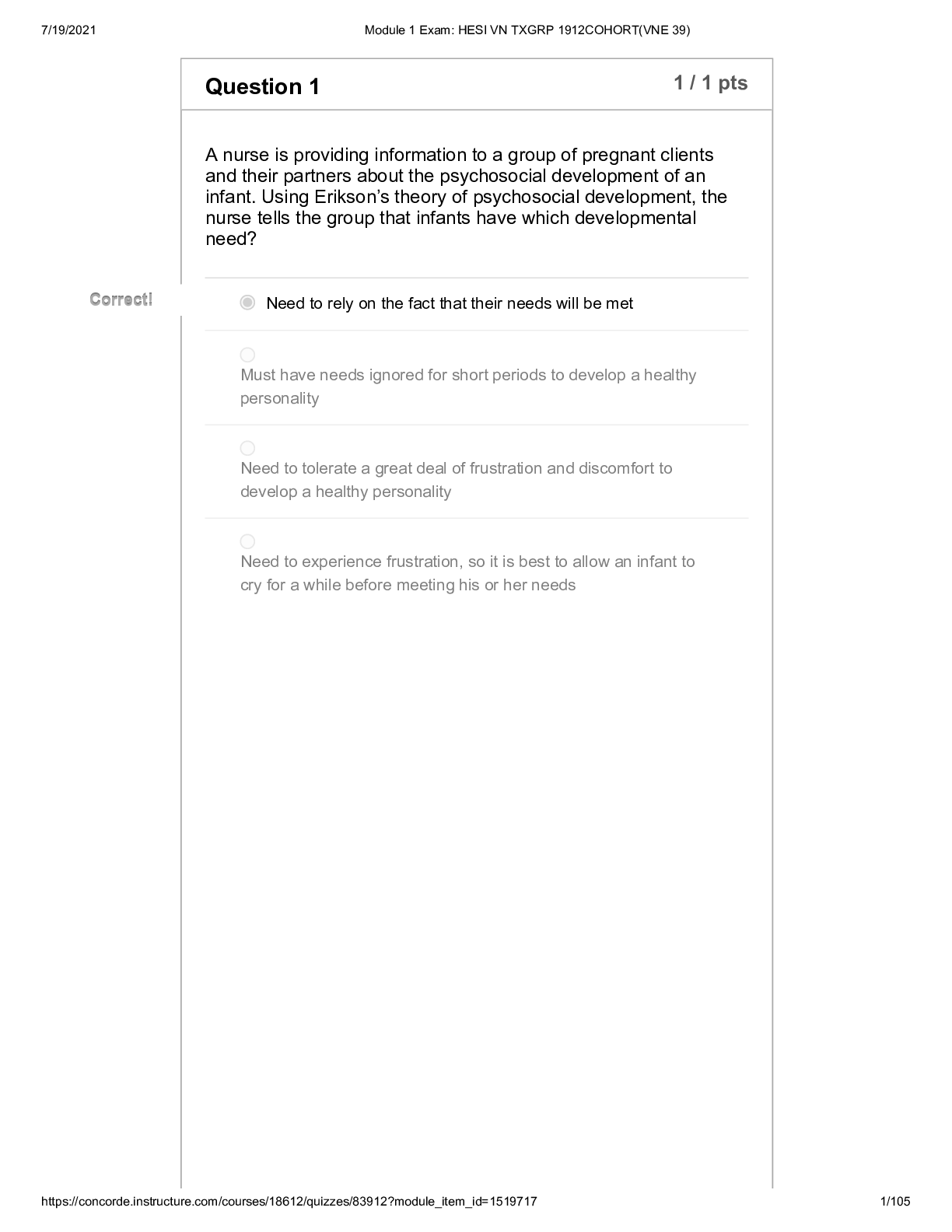
A nurse is providing information to a group of pregnant clients
and their partners about the psychosocial development of an
infant. Using Erikson’s theory of psychosocial development, the
nurse tells the group that infants have which developmental
need?
Correct! Correct! Need to rely on the fact that their needs will be met
Must have needs ignored for short periods to develop a healthy
personality
Need to tolerate a great deal of frustration and discomfort to
develop a healthy personality
Need to experience frustration, so it is best to allow an infant to
cry for a while before meeting his or her needs7/19/2021 Module 1 Exam: HESI VN TXGRP 1912COHORT(VNE 39)
https://concorde.instructure.com/courses/18612/quizzes/83912?module_item_id=1519717 2/105
Rationale: According to Erikson’s theory of psychosocial
development, infants struggle to establish a sense of basic
trust rather than a sense of basic mistrust in their world,
their caregivers, and themselves. If provided with
consistent satisfying experiences that are delivered in a
timely manner, infants come to rely on the fact that their
needs are met and that, in turn, they will be able to
tolerate some degree of frustration and discomfort until
those needs are met. This sense of confidence is an early
form of trust and provides the foundation for a healthy
personality. Therefore the other options are incorrect.
Test-Taking Strategy: Use the process of elimination.
Eliminate the option that contains the closed-ended word
“must.” Eliminate the comparable or alike options and
indicate that experiencing frustration is necessary. Review
Erikson’s theory of psychosocial development as it relates
to the infant if you had difficulty with this question.
Level of Cognitive Ability: Applying
Client Needs: Health Promotion and Maintenance
Integrated Process: Teaching and Learning
Content Area: Developmental Stages
Question 2 1 / 1 pts
A nurse is weighing a breastfed 6-month-old infant who has been
brought to the pediatrician’s office for a scheduled visit. The
infant’s weight at birth was 6 lb 8 oz. The nurse notes that the
infant now weighs 13 lb. The nurse should take which action?
Tell the mother that the infant’s weight is increasing as expected.
Correct! Correct!
Tell the mother to decrease the daily number of feedings because
the weight gain is excessive.
Tell the mother that semisolid foods should not be introduced
until the infant’s weight stabilizes.7/19/2021 Module 1 Exam: HESI VN TXGRP 1912COHORT(VNE 39)
https://concorde.instructure.com/courses/18612/quizzes/83912?module_item_id=1519717 3/105
Tell the mother that the infant should be switched from breast
milk to formula because the weight gain is inadequate.
Rationale: Infants usually double their birth weight by 6
months and triple it by 1 year of age. If the infant is 6 lb 8
oz, at birth, a weight of 13 lb at 6 months of age is to be
expected. Semisolid foods are usually introduced between
4 and 6 months of age.
Test-Taking Strategy: Use the process of elimination and
focus on the data in the question. Recalling that infants
double their weight by 6 months of age will direct you to
the correct option. Review the growth rate of an infant if
you had difficulty with this question.
Level of Cognitive Ability: Applying
Client Needs: Physiological Integrity
Integrated Process: Nursing Process/Implementation
Content Area: Developmental Stages
Question 3 1 / 1 pts
The nurse is assisting with data collection on a well-baby
examination. The nurse measures the head circumference, and it
is the same as the chest circumference. On the basis of this
measurement, the nurse should take which action?
Report the presence of hydrocephalus to the health care
provider.
Suggest to the health care provider that a skull x-ray be
performed.
Tell the mother that the infant is growing faster than expected.7/19/2021 Module 1 Exam: HESI VN TXGRP 1912COHORT(VNE 39)
https://concorde.instructure.com/courses/18612/quizzes/83912?module_item_id=1519717 4/105
Document these measurements in the infant’s health care record.
Correct! Correct!
Rationale: The head circumference growth rate during the
first year is approximately 0.4 inch (1 cm) per month. By
10 to 12 months of age, the infant’s head and chest
circumferences are equal. Therefore, suspecting the
presence of hydrocephalus, telling the mother that the
infant is growing faster than expected, and suggesting that
a skull x-ray be performed are incorrect.
Test-Taking Strategy: Use the process of elimination.
Eliminate the comparable or alike options that indicate that
the infant has a physiological problem. Review the
expected growth rate of an infant if you had difficulty with
this question.
Level of Cognitive Ability: Applying
Client Needs: Health Promotion and Maintenance
Integrated Process: Nursing Process/Data Collection
Content Area: Developmental Stages
Question 4 1 / 1 pts
A new mother asks the nurse, “I was told that my infant received
my antibodies during pregnancy. Does that mean that my infant is
protected against infections?” Which statement should the nurse
make in response to the mother?
“Yes, your infant is protected from all infections.”
"If you breastfeed, your infant is protected from infection."
"The transfer of your antibodies protects your infant until the
infant is 12 months old."7/19/2021 Module 1 Exam: HESI VN TXGRP 1912COHORT(VNE 39)
https://concorde.instructure.com/courses/18612/quizzes/83912?module_item_id=1519717 5/105
"The immune system of an infant is immature, and the infant is at
risk for infection."
Correct! Correct!
Rationale: Transplacental transfer of maternal antibodies
supplements the infant’s weak response to infection until
approximately 3 to 4 months of age. Although the infant
begins to produce immunoglobulin (Ig) soon after birth, by
1 year of age, the infant has only approximately 60% of
the adult IgG level, 75% of the adult IgM level, and 20% of
the adult IgA level. Breast milk transmits additional IgA
protection. The activity of T lymphocytes also increases
after birth. Even though the immune system matures
during infancy, maximal protection against infection is not
achieved until early childhood. This immaturity places the
infant at risk for infection.
Test-Taking Strategy: Use the process of elimination.
Eliminate the option containing the closed-ended word
"all." Recalling that breastfeeding alone does not protect
the infant from infection will assist you in eliminating the
option that suggests breastfeeding protects the infant.
From the remaining options, use the strategy of selecting
the umbrella option to answer correctly. Review the
physiological concepts related to the maturity of body
systems in an infant if you had difficulty with this question.
Level of Cognitive Ability: Applying
Client Needs: Safe and Effective Care Environment
Integrated Process: Nursing Process/Implementation
Content Area: Developmental Stages
Question 5 1 / 1 pts
A nurse is assisting with data collection on the language
development of a 9-month-old infant. Which developmental
milestone does the nurse expect to note in an infant of this age?
The infant babbles.7/19/2021 Module 1 Exam: HESI VN TXGRP 1912COHORT(VNE 39)
https://concorde.instructure.com/courses/18612/quizzes/83912?module_item_id=1519717 6/105
Correct! Correct! The infant says "Mama."
The infant smiles and coos.
The infant babbles single consonants.
Rationale: An 8- to 9-month-old infant can string vowels
and consonants together. The first words, such as
"Mama," "Daddy," "bye-bye," and "baby," begin to have
meaning. A 1- to 3-month-old infant produces cooing
sounds. Babbling is common in a 3- to 4-month-old.
Single-consonant babbling occurs between 6 and 8
months of age.
Test-Taking Strategy: Use the process of elimination and
focus on the subject, the developmental milestone of a 9-
month-old. Recalling the language development that
occurs during infancy will direct you to the correct option.
Remember that an 8- to 9-month-old infant can string
vowels and consonants together. Review the
developmental milestones related to language
development in an infant if you had difficulty with this
question.
Level of Cognitive Ability: Understanding
Client Needs: Health Promotion and Maintenance
Integrated Process: Nursing Process/Data Collection
Content Area: Developmental Stages
Question 6 1 / 1 pts
The mother of a 9-month-old infant calls the nurse at the
pediatrician’s office, tells the nurse that her infant is teething, and
asks what can be done to relieve the infant’s discomfort. The
nurse should provide which instruction?
Schedule an appointment with a dentist for a dental evaluation.7/19/2021 Module 1 Exam: HESI VN TXGRP 1912COHORT(VNE 39)
https://concorde.instructure.com/courses/18612/quizzes/83912?module_item_id=1519717 7/105
Rub the infant's gums with baby aspirin that has been dissolved
in water.
Obtain an over-the-counter (OTC) topical medication for gumpain relief.
Give the infant cool liquids or a Popsicle and hard foods such as
dry toast.
Correct! Correct!
Rationale: Although sometimes asymptomatic, teething is
often signaled by behavior such as nighttime awakening,
daytime restlessness, an increase in nonnutritive sucking,
excess drooling, and temporary loss of appetite. Some
degree of discomfort is normal. It is unnecessary to obtain
a dental evaluation, but a health care professional should
further investigate any incidence of increased
temperature, irritability, ear-tugging, or diarrhea. The nurse
may suggest that the mother provide cool liquids and hard
foods such as dry toast, Popsicles, or a frozen bagel for
chewing to relieve discomfort. Hard, cold teethers and ice
wrapped in cloth may also provide comfort for inflamed
gums. OTC medications for gum relief should only be
used as directed by the health care provider. Home
remedies such as rubbing the gums with aspirin should be
discouraged, but acetaminophen (Tylenol), administered
as directed for the child’s age, can relieve discomfort.
Test-Taking Strategy: Focus on the subject, teething and
relieving the infant’s discomfort. First recall that it is
unnecessary to consult with a dentist. Next, eliminate the
comparable or alike options that involve administering
medication to the infant. Review the measures that will
relieve the discomfort of teething if you had difficulty with
this question.
Level of Cognitive Ability: Applying
Client Needs: Physiological Integrity
Integrated Process: Nursing Process/Implementation
Content Area: Developmental Stages7/19/2021 Module 1 Exam: HESI VN TXGRP 1912COHORT(VNE 39)
https://concorde.instructure.com/courses/18612/quizzes/83912?module_item_id=1519717 8/105
Question 7 1 / 1 pts
A nurse is teaching the mother of an 11-month-old infant how to
clean the infant’s teeth. The nurse tells the mother to take which
action?
Correct! Correct! Use water and a cotton swab and rub the teeth.
Use diluted fluoride and rub the teeth with a soft washcloth.
Use a small amount of toothpaste and a soft-bristle toothbrush.
Dip the infant's pacifier in maple syrup so that the infant will suck.7/19/2021 Module 1 Exam: HESI VN TXGRP 1912COHORT(VNE 39)
https://concorde.instructure.com/courses/18612/quizzes/83912?module_item_id=1519717 9/105
Rationale: Because the primary teeth are used for
chewing until the permanent teeth erupt and because
decay of the primary teeth often results in decay of the
permanent teeth, dental care must be started in infancy.
The mother can use cotton swabs or a soft washcloth to
clean the teeth. Appropriate amounts of fluoride are
necessary for the development of healthy teeth, but infants
usually receive fluoride when formula and cereal are
mixed with fluoridated water or through fluoride
supplementation. Toothpaste is not recommended
because infants tend to swallow it, possibly ingesting
excessive amounts of fluoride. Dipping the infant's pacifier
in maple syrup is unacceptable because of the risk of
tooth decay.
Test-Taking Strategy: Use the process of elimination and
focus on the subject, cleaning the teeth. Recalling the risk
associated with tooth decay will help eliminate the option
that identifies the use of maple syrup. To select from the
remaining options, noting that the client in the question is
an infant will direct you to the correct option. Review the
procedure for cleaning teeth in an infant if you had
difficulty with this question.
Level of Cognitive Ability: Applying
Client Needs: Health Promotion and Maintenance
Integrated Process: Teaching and Learning
Content Area: Developmental Stages
Question 8 1 / 1 pts
A nurse provides information about feeding to the mother of a 6-
month-old infant. Which statement by the mother indicates an
understanding of the information?
"I can mix the food in the my infant's bottle if he won't eat it."
"Fluoride supplementation is not necessary until permanent teeth
come in."7/19/2021 Module 1 Exam: HESI VN TXGRP 1912COHORT(VNE 39)
https://concorde.instructure.com/courses/18612/quizzes/83912?module_item_id=1519717 10/105
"Egg white should not be given to my infant because of the risk
for an allergy."
Correct! Correct!
"Meats are really important for iron, and I should start feeding
meats to my infant right away."
Rationale: Egg white, even in small quantities, is not given
to the infant until the end of the first year of life because it
is a common food allergen. Fluoride supplementation may
be needed beginning at of 6 months, depending on the
infant’s intake of fluoridated tap water. Foods are never
mixed with formula in the bottle. It may be difficult for the
infant to consume the formula, and it will also be difficult to
determine the infant’s intake of the formula. Solid foods
may be introduced into the diet when the infant is 5 to 6
months old. Rice cereal may be introduced first because
of its low allergenic potential; or, depending on the health
care provider’s recommendation, fruits and vegetables
may be introduced first.
Test-Taking Strategy: Read each option carefully and think
about the subject, the principles associated with feeding
and nutrition. Recalling that allergy is a concern will direct
you to the correct option. Review the principles related to
nutrition an infant if you had difficulty with this question.
Level of Cognitive Ability: Evaluating
Client Needs: Physiological Integrity
Integrated Process: Nursing Process/Evaluation
Content Area: Nutrition
Question 9 1 / 1 pts
A nurse provides instructions to a mother of a newborn infant who
weighs 7 lb 2 oz about car safety. The nurse provides the mother
with which instructions?7/19/2021 Module 1 Exam: HESI VN TXGRP 1912COHORT(VNE 39)
https://concorde.instructure.com/courses/18612/quizzes/83912?module_item_id=1519717 11/105
To secure the infant in the middle of the back seat in a rear-facing
infant safety seat
Correct! Correct!
To place the infant in a booster seat in the front seat of the car
with the shoulder and lap belts secured around the infant
That it is acceptable to place the infant in the front seat in a rearfacing infant safety seat as long as the car has passenger-side
air bags
That because of the infant's weight it is acceptable to hold the
infant as long as the mother and infant are sitting in the middle of
the back seat of the car
Rationale: Infants should not be restrained in the front
seats of cars. If a passenger-side airbag is deployed, the
airbag may severely jolt an infant safety seat, harming the
infant. Infants weighing less than 20 lb and those younger
than 1 year should always be in the middle of the back
seat in a rear-facing car safety seat. An infant must be
placed in an infant safety seat and is never to be held by
another person when riding in a car.
Test-Taking Strategy: Use the process of elimination.
Eliminate the comparable or alike options that recommend
placing the infant in the front seat. To select from the
remaining options, keep safety in mind and remember that
the infant should never be held and should be placed in an
infant safety seat. Review car safety principles for an
infant if you had difficulty with this question.
Level of Cognitive Ability: Applying
Client Needs: Safe and Effective Care Environment
Integrated Process: Teaching and Learning
Content Area: Safety
Question 10 1 / 1 pts7/19/2021 Module 1 Exam: HESI VN TXGRP 1912COHORT(VNE 39)
https://concorde.instructure.com/courses/18612/quizzes/83912?module_item_id=1519717 12/105
A nurse provides instructions to a mother about crib safety for her
infant. Which statement by the mother indicates a need for further
instructions?
"I need to keep large toys out of the crib."
"The drop side needs to be impossible for my infant to release."
"Wood surfaces on the crib need to be free of splinters and
cracks."
"The distance between the slats needs to be no more than 4
inches wide to prevent entrapment of my infant's head or body."
Correct! Correct!
Rationale: The distance between slats must be no more
than 2⅜ inches to prevent entrapment of the infant’s head
and body. The mesh in a mesh-sided crib should have
openings smaller than ¼ inch. The drop side must be
impossible for the infant to release, and wood surfaces
should be free of splinters, cracks, and lead-based paint.
The mother should avoid placing large toys in the crib
because an older infant may use them as steps to climb
over the side, possibly resulting in serious injury.
Test-Taking Strategy: Use the process of elimination and
note the strategic words “need for further instructions” in
the question. These words indicate a negative event query
and the need to select the incorrect statement by the
mother. Visualizing each of these options and keeping
safety in mind will direct you to the correct option. Review
crib safety instructions if you had difficulty with this
question.
Level of Cognitive Ability: Evaluating
Client Needs: Safe and Effective Care Environment
Integrated Process: Teaching and Learning
Content Area: Safety7/19/2021 Module 1 Exam: HESI VN TXGRP 1912COHORT(VNE 39)
https://concorde.instructure.com/courses/18612/quizzes/83912?module_item_id=1519717 13/105
Question 11 1 / 1 pts
The mother of a 2-year-old tells the nurse that she is very
concerned about her child because he has developed "a will of
his own" and "acts as if he can control others." The nurse
provides information to the mother to alleviate her concern,
recalling that, according to Erikson, a toddler is confronting which
developmental task?
Initiative versus guilt
Trust versus mistrust
Industry versus inferiority
Correct! Correct! Autonomy versus doubt and shame7/19/2021 Module 1 Exam: HESI VN TXGRP 1912COHORT(VNE 39)
https://concorde.instructure.com/courses/18612/quizzes/83912?module_item_id=1519717 14/105
Rationale: According to Erikson, the toddler is struggling
with the developmental task of acquiring a sense of
autonomy while overcoming a sense of shame and doubt.
Toddlers discover that they have wills of their own and that
they can control others. Asserting their will and insisting on
their own way, however, often lead to conflict with those
they love, whereas submissive behavior is rewarded with
affection and approval. Toddlers experience conflict
because they want to assert their will but do not want to
risk losing the approval of loved ones. Trust versus
mistrust is the developmental task of the infant. Initiative
versus guilt is the developmental task of the preschoolage child. Industry versus inferiority is the developmental
task of the school-age child.
Test-Taking Strategy: Focus on the data in the question.
Note the relationship between the words "a will of his own"
and the word "autonomy" in the correct option. Review
Erikson's developmental stages if you had difficulty with
this question.
Level of Cognitive Ability: Applying
Client Needs: Health Promotion and Maintenance
Integrated Process: Teaching and Learning
Content Area: Developmental Stages
Question 12 1 / 1 pts
A nurse is planning care for a hospitalized toddler. To best
maintain the toddler’s sense of control and security and ease
feelings of helplessness and fear, the nurse should perform which
action?
Spend as much time as possible with the toddler.
Keep hospital routines as similar as possible to those at home.
Correct! Correct!
Allow the toddler to play with other children in the nursing unit
playroom.7/19/2021 Module 1 Exam: HESI VN TXGRP 1912COHORT(VNE 39)
https://concorde.instructure.com/courses/18612/quizzes/83912?module_item_id=1519717 15/105
Allow the toddler to select toys from the nursing unit playroom
that can be brought into the toddler's hospital room.
Rationale: The nurse can decrease the stress of
hospitalization for the toddler by incorporating the toddler's
usual rituals and routines from home into nursing care
activities. Keeping hospital routines as similar to those of
home as possible and recognizing ritualistic needs gives
the toddler some sense of control and security and eases
feelings of helplessness and fear. Spending as much time
as possible with the toddler and allowing the toddler to
play with other children and select the toys he would like
to play with may be appropriate interventions, but keeping
the hospital routine as similar as possible to the routine at
home will best maintain the toddler's sense of control and
security and ease feelings of helplessness and fear.
Test-Taking Strategy: Note the strategic word "best" in the
question. Use the process of elimination and focus on the
subject, how to best maintain the toddler's sense of control
and security and ease feelings of helplessness and fear.
This will assist you in selecting the correct option. Review
the psychosocial needs of the toddler with regard to
hospitalization if you had difficulty with this question.
Level of Cognitive Ability: Applying
Client Needs: Health Promotion and Maintenance
Integrated Process: Nursing Process/Planning
Content Area: Developmental Stages
Question 13 1 / 1 pts
A nurse in a day-care setting is planning play activities for 2- and
3-year-old children. Which toys are most appropriate for these
activities?
Correct! Correct! Blocks and push-pull toys
Finger paints and card games7/19/2021 Module 1 Exam: HESI VN TXGRP 1912COHORT(VNE 39)
https://concorde.instructure.com/courses/18612/quizzes/83912?module_item_id=1519717 16/105
Simple board games and puzzles
Videos and cutting-and-pasting toys
Rationale: Toys for the toddler should meet the child’s
needs for activity and inquisitiveness. The toddler enjoys
objects of different textures such as clay, sand, finger
paints, and bubbles; push–pull toys; large balls; sand and
water play; blocks; painting; coloring with large crayons;
large puzzles; and trucks or dolls. Card games, simple
board games, videos, and cutting-and-pasting toys are
more appropriate play activities for the preschooler.
Test-Taking Strategy: Focus on the subject, toys
appropriate for 2- to 3-year-old children. Remember that
all parts of an option need to be correct for the option to be
correct. Focusing on the age of the child will direct you to
the correct option. Review age-appropriate toys for the
toddler if you had difficulty with this question.
Level of Cognitive Ability: Applying
Client Needs: Health Promotion and Maintenance
Integrated Process: Nursing Process/Planning
Content Area: Developmental Stages
Question 14 1 / 1 pts
A mother of twin toddlers tells the nurse that she is concerned
because she found her children involved in sex play and didn’t
know what to do. The nurse should provide the mother with which
advice?
To separate her children during playtime
That if the behavior continues, she will need to bring her children
to a child psychologist7/19/2021 Module 1 Exam: HESI VN TXGRP 1912COHORT(VNE 39)
https://concorde.instructure.com/courses/18612/quizzes/83912?module_item_id=1519717 17/105
That if she notes the behavior again, she should casually tell her
children to dress and to direct them to another activity
Correct! Correct!
To tell her children that what they are doing is bad and that they
will be punished if they are caught doing it again
Rationale: Sex play and masturbation are common among
toddlers. Parents should respect the toddler's curiosity as
normal without judging the toddler as bad. Parents who
discover children involved in sex play may casually tell
them to dress and direct them to another play activity,
thereby limiting sex play without producing feelings of
shame or anxiety. Bringing the children to a child
psychologist, separating them at play, and punishing them
are all inappropriate.
Test-Taking Strategy: Use the process of elimination and
focus on the strategic word “toddlers.” Recalling that sex
play and masturbation are common among toddlers will
direct you to the correct option. Review psychosexual
development in the toddler if you had difficulty with this
question.
Level of Cognitive Ability: Applying
Client Needs: Health Promotion and Maintenance
Integrated Process: Nursing Process/Implementation
Content Area: Developmental Stages
Question 15 0.5 / 1 pts
A nurse is assisting with data collection regarding the motor
development of a 24-month-old child. Which activities would the
nurse expect the mother to report that the child can
perform? Select all that apply.
Put on and tie his shoes7/19/2021 Module 1 Exam: HESI VN TXGRP 1912COHORT(VNE 39)
https://concorde.instructure.com/courses/18612/quizzes/83912?module_item_id=1519717 18/105
Correct! Correct! Align two or more blocks
Y You Answered ou Answered Dress himself appropriately
Go to the bathroom without help
Correct! Correct! Turn the pages of a book one at a time
Question 16 1 / 1 pts
A nurse is assisting with data collection regarding language
development in a toddler from a bilingual family. The nurse
expects which characteristic in the child’s language
development?
Correct! Correct! Is slower than expected
Is developing as expected
Is more advanced than expected
Will require assistance from a speech therapist7/19/2021 Module 1 Exam: HESI VN TXGRP 1912COHORT(VNE 39)
https://concorde.instructure.com/courses/18612/quizzes/83912?module_item_id=1519717 19/105
Rationale: Although the age at which children begin to talk
varies widely, most can communicate verbally by the
second birthday. The rate of language development
depends on physical maturity and the amount of
reinforcement the child has received. Children of bilingual
families, twins, and children other than firstborns may
have slower language development. A child from a
bilingual family does not require assistance from a speech
therapist to ensure language development.
Test-Taking Strategy: Use the process of elimination. Note
that there are no data in the question to indicate that the
child needs assistance from a speech therapist. When
selecting from the remaining options, noting the word
"bilingual" in the question and recalling the factors that
affect language development will direct you to the correct
option. Review the factors that affect language
development if you had difficulty with this question.
Level of Cognitive Ability: Understanding
Client Needs: Health Promotion and Maintenance
Integrated Process: Nursing Process/Assessment
Content Area: Cultural Diversity
Question 17 1 / 1 pts
A mother asks the nurse when her child should have his first
dentist visit. The nurse provide which response?
At age 3
Just before beginning kindergarten
Twelve months after the first primary tooth erupts
Soon after the first primary tooth erupts, usually around 1 year of
age
Correct! Correct!7/19/2021 Module 1 Exam: HESI VN TXGRP 1912COHORT(VNE 39)
https://concorde.instructure.com/courses/18612/quizzes/83912?module_item_id=1519717 20/105
Rationale: The child should see the dentist soon after the
first primary tooth erupts at around 1 year of age.
Therefore the remaining options are incorrect. Parents
should be aware of the dental guidelines for children and
should not delay necessary dental care.
Test-Taking Strategy: Use the process of elimination and
recall the subject, the importance of dental care. Answer
correctly by selecting the option that provides dental care
at the earliest age. Review dental care guidelines if you
had difficulty with this question.
Level of Cognitive Ability: Applying
Client Needs: Health Promotion and Maintenance
Integrated Process: Teaching and Learning
Content Area: Developmental Stages
Question 18 1 / 1 pts
The mother of a toddler asks the nurse when she will know that
her child is ready to start toilet training. The nurse tells the mother
that which observation is a sign of physical readiness?
The child has been walking for 2 years.
The child can eat using a fork and knife.
The child no longer has temper tantrums.
Correct! Correct! The child can remove his or her own clothing.7/19/2021 Module 1 Exam: HESI VN TXGRP 1912COHORT(VNE 39)
https://concorde.instructure.com/courses/18612/quizzes/83912?module_item_id=1519717 21/105
Rationale: Signs of physical readiness for toilet training
include the following: The child can remove her own
clothing; is willing to let go of a toy when asked; is able to
sit, squat, and walk well; and has been walking for 1 year.
Using a fork and knife, walking for 2 years, and an
absence of temper tantrums are not signs of physical
readiness.
Test-Taking Strategy: Use the process of elimination.
Noting the strategic words "physical readiness" in the
question will assist you in eliminating the option that
addresses temper tantrums. To select from the remaining
options, visualize each to help direct you to the correct
option. Review the signs of physical readiness for toilet
training if you had difficulty with this question.
Level of Cognitive Ability: Applying
Client Needs: Health Promotion and Maintenance
Integrated Process: Teaching and Learning
Content Area: Developmental Stages
Question 19 1 / 1 pts
The mother of a child who weighs 45 lb asks a nurse about car
safety seats. The nurse tells the mother to place the child in
which car safety seat?
Booster seat in a rear-facing position in the front seat
Booster seat with one of the car's seat belts placed over the child
Correct! Correct!
Car safety seat in the back seat in a face-forward position
Car safety seat in a face-forward position in the front seat7/19/2021 Module 1 Exam: HESI VN TXGRP 1912COHORT(VNE 39)
https://concorde.instructure.com/courses/18612/quizzes/83912?module_item_id=1519717 22/105
Rationale: A child needs to remain in a car safety seat
until he or she weighs 40 lb. Once the child has outgrown
the car safety seat, a booster seat is used. Booster seats
are designed to raise the child high enough so that the
restraining straps are correctly positioned over the child's
chest and pelvis. The child should not be placed in the
front seat. A car safety seat is used for the child who
weighs less than 40 lb. These seats are placed in the
middle of the back seat in a rear-facing position.
Test-Taking Strategy: Use the process of elimination and
note that the child weighs 45 lb. Keeping the subject of
safety in mind and visualizing each of the options will
direct you to the correct option. Review car safety
measures if you had difficulty with this question.
Level of Cognitive Ability: Applying
Client Needs: Safe and Effective Care Environment
Integrated Process: Nursing Process/Implementation
Content Area: Safety
Question 20 1 / 1 pts
The mother of a 5-year-old asks the nurse how often her child
should undergo a dental examination. The nurse tells the mother
that the child should have a dental examination how frequently?
Once a year
Every 3 months
Correct! Correct! Every 6 months
Whenever a new primary tooth erupts7/19/2021 Module 1 Exam: HESI VN TXGRP 1912COHORT(VNE 39)
https://concorde.instructure.com/courses/18612/quizzes/83912?module_item_id=1519717 23/105
Rationale: Dental examinations for a 4- to 5-year-old child
should be conducted every 6 months. Every 3 months,
once a year, and whenever a new primary tooth erupts are
all incorrect.
Test-Taking Strategy: Knowledge of the subject, the
schedule for dental examinations for a 5-year-old child is
needed to answer this question. Recalling the general
principles related to dental care and thinking about dental
health care of an adult will help direct you to the correct
option. Review dental-care principles for a child if you had
difficulty with this question.
Level of Cognitive Ability: Applying
Client Needs: Health Promotion and Maintenance
Integrated Process: Teaching and Learning
Content Area: Developmental Stages
Question 21 1 / 1 pts
A nurse, planning play activities for a hospitalized school-age
child, uses Erikson’s theory of psychosocial development to
select an appropriate activity. The nurse selects an activity that
will assist the child in developing which developmental goal?
Initiative
Autonomy
A sense of trust
Correct! Correct! A sense of industry7/19/2021 Module 1 Exam: HESI VN TXGRP 1912COHORT(VNE 39)
https://concorde.instructure.com/courses/18612/quizzes/83912?module_item_id=1519717 24/105
Rationale: According to Erikson, the central task of the
school-age years is the development of a sense of
industry. The school-age child replaces fantasy play with
"work" at school, crafts, chores, hobbies, and athletics.
Development of trust is the task of infancy. Development
of autonomy is the task of toddlerhood. Development of
initiative is the task of the preschooler.
Test-Taking Strategy: Use knowledge regarding the
subject, Erikson’s stages of psychosocial development, to
answer the question. Focusing on the words “school-age
child” will help direct you to the correct option. Review
Erikson’s stages of psychosocial development if you had
difficulty with this question.
Level of Cognitive Ability: Applying
Client Needs: Health Promotion and Maintenance
Integrated Process: Nursing Process/Planning
Content Area: Developmental Stages
Question 22 0 / 1 pts
A nurse, assigned to care for a hospitalized child who is 8 years
old, assists with planning care, taking into account Erik Erikson’s
theory of psychosocial development. According to Erikson’s
theory, which task represents the primary developmental task of
this child?
Correct Answer Correct Answer Mastering useful skills and tools
Gaining independence from parents
Y You Answered ou Answered Developing a sense of trust in the world
Developing a sense of control over self and body functions7/19/2021 Module 1 Exam: HESI VN TXGRP 1912COHORT(VNE 39)
https://concorde.instructure.com/courses/18612/quizzes/83912?module_item_id=1519717 25/105
Rationale: According to Erikson's theory of psychosocial
development, the school-age child's task is to master
useful skills and tools of the culture (industry versus
inferiority). Gaining independence from parents is the
psychosocial task of the adolescent. Developing a sense
of trust in the world is the psychosocial task of an infant.
Developing a sense of control over self and body functions
is the psychosocial task of the toddler.
Test-Taking Strategy: Focus on the strategic words “8
years old” in the question and think about the
developmental level of the child. Use knowledge of
Erikson’s theory of psychosocial developmental to answer
this question. Review Erikson’s theory of psychosocial
development if you had difficulty with this question.
Level of Cognitive Ability: Understanding
Client Needs: Health Promotion and Maintenance
Integrated Process: Nursing Process/Planning
Content Area: Developmental Stages
Question 23 0 / 1 pts
A school nurse provides information to the parents of school-age
children regarding appropriate dental care. The nurse tells the
parents that their children should perform which action?
Y You Answered ou Answered Brush their teeth every morning and at bedtime
Correct Answer Correct Answer Brush and floss their teeth after meals and at bedtime
Brush and floss their teeth every morning and at bedtime
Brush their teeth every morning and at bedtime and floss the
teeth once a day, preferably at bedtime7/19/2021 Module 1 Exam: HESI VN TXGRP 1912COHORT(VNE 39)
https://concorde.instructure.com/courses/18612/quizzes/83912?module_item_id=1519717 26/105
Rationale: School-age children are able to assume
responsibility for their own dental hygiene. Good oral
health habits tend to be carried into the adult years,
helping prevent cavity formation for a lifetime. Thorough
brushing with fluoride toothpaste followed by flossing
between the teeth should be done after meals and before
bedtime. It is important that parents set up a routine
schedule for the child that promotes good daily oral
hygiene and gives them responsibility for their own dental
care.
Test-Taking Strategy: Use the process of elimination. Use
the process of elimination. Use the subject, general
principles and guidelines related to dental care and select
the option that provides the most frequent and thorough
dental care. Review principles and guidelines of dental
care if you had difficulty with this question.
Level of Cognitive Ability: Applying
Client Needs: Health Promotion and Maintenance
Integrated Process: Teaching and Learning
Content Area: Developmental Stages
Question 24 1 / 1 pts
The parents of an adolescent tell the school nurse that they are
frustrated because their daughter has become self-centered, lazy,
and irresponsible. The nurse should provide which response to
the parents?
Correct! Correct! That this is normal behavior for an adolescent
To restrict any social privileges until the behavior stops
That this type of behavior is usually the result of parents' spoiling
a child
That their daughter will need to see a child psychologist if the
behavior continues7/19/2021 Module 1 Exam: HESI VN TXGRP 1912COHORT(VNE 39)
https://concorde.instructure.com/courses/18612/quizzes/83912?module_item_id=1519717 27/105
Rationale: Identity formation is the major developmental
task of adolescence. Energy is focused within the self, and
the adolescent is sometimes described as egocentric or
self-absorbed. Frustrated parents often describe
teenagers during this phase as self-centered, lazy, or
irresponsible. In fact, the adolescent just needs time to
think, concentrate on himself or herself, and determine
who he or she is going to be. Erikson describes the
conflict of this phase of psychosocial development as
identity formation versus role confusion. The assertions
that a psychologist is needed and that the behavior is the
result of spoiling are incorrect. Restriction of social
privileges will cause resentment and rebellion in the
adolescent.
Test-Taking Strategy: Focus on the adolescent’s behaviors
described in the question. Recalling the subject, stages of
psychosocial development according to Erikson will direct
you to the correct option. Remember that identity
formation is a major developmental task of adolescence.
Review the psychosocial development of the adolescent if
you had difficulty with this question.
Level of Cognitive Ability: Applying
Client Needs: Health Promotion and Maintenance
Integrated Process: Nursing Process/Implementation
Content Area: Developmental Stages
Question 25 1 / 1 pts
A nurse is preparing to care for a hospitalized teenage girl who is
in skeletal traction. The nurse assists with planning care knowing
that which is the most likely primary concern of the teenager?
Correct! Correct! Body image
Obtaining adequate nutrition
Keeping up with schoolwork7/19/2021 Module 1 Exam: HESI VN TXGRP 1912COHORT(VNE 39)
https://concorde.instructure.com/courses/18612/quizzes/83912?module_item_id=1519717 28/105
Obtaining adequate rest and sleep
Rationale: Body image is of particular importance to an
adolescent. Teenagers tend to be concerned about their
weight, complexion, sexual development, and acceptance
by their peers. They are not as concerned about obtaining
adequate nutrition and tend to eat fast foods and junk
foods and may experiment with weight-management
techniques such as fasting, diet pills and laxatives, selfinduced vomiting, and fad diets. Keeping up with
schoolwork may be important to some teenagers, but it is
not usually the primary concern. Along with engaging in
increasingly independent activities, teenagers tend to stay
up late and have difficulty waking in the morning.
Obtaining adequate rest and sleep is not teenagers’
primary concern.
Test-Taking Strategy: Note the strategic word "primary."
Thinking about the psychosocial development of the
teenager (adolescent) will direct you to the correct option.
Review psychosocial development of the adolescent if you
had difficulty with this question.
Level of Cognitive Ability: Applying
Client Needs: Health Promotion and Maintenance
Integrated Process: Nursing Process/Planning
Content Area: Developmental Stages
Question 26 1 / 1 pts
The mother of an adolescent calls the clinic nurse and reports
that her daughter wants to have her navel pierced. The mother
asks the nurse about the dangers associated with body piercing.
The nurse provides which information to the mother?
Hepatitis B is a concern with body piercing
Infection always occurs when body piercing is done7/19/2021 Module 1 Exam: HESI VN TXGRP 1912COHORT(VNE 39)
https://concorde.instructure.com/courses/18612/quizzes/83912?module_item_id=1519717 29/105
Body piercing is generally harmless as long as it is performed
under sterile conditions
Correct! Correct!
It is important to discourage body piercing because of the risk of
contracting human immunodeficiency virus (HIV)
Rationale: Generally body piercing is harmless if the
procedure is performed under sterile conditions by a
qualified person. Some of the complications that may
occur are bleeding, infection, keloid formation, and the
development of allergies to metal. The area needs to be
cleaned at least twice a day (more often for a tongue
piercing) to prevent infection. HIV and hepatitis B
infections are not associated with body piercing; however,
they are a possibility with tattooing.
Test-Taking Strategy: Use the process of elimination.
Eliminate the option containing the closed-ended word
"always." The fact that HIV and hepatitis B are not
associated with body piercing will help you eliminate these
options. Review the complications associated with body
piercing if you had difficulty with this question.
Level of Cognitive Ability: Applying
Client Needs: Safe and Effective Care Environment
Integrated Process: Teaching and Learning
Content Area: Safety
Question 27 1 / 1 pts
A sexually active adolescent asks the school nurse about the use
of latex condoms and the reduction of the risk of sexually
transmitted infections (STIs). The nurse provides which
information to the adolescent?
Use of a latex condom can reduce the risk of transmission of
STIs.
Correct! Correct!7/19/2021 Module 1 Exam: HESI VN TXGRP 1912COHORT(VNE 39)
https://concorde.instructure.com/courses/18612/quizzes/83912?module_item_id=1519717 30/105
The only way to reduce the risk of transmission of STIs is
abstinence.
Use of a latex condom is a good method for preventing
pregnancy.
A spermicide needs to be used along with a condom to prevent
transmission of STIs.
Rationale: Use of a condom during intercourse can reduce
the risk of STI transmission. Abstinence is not the only
way to reduce the risk of STI transmission. A spermicide
used along with a condom will help prevent pregnancy, not
an STI. One disadvantage of condoms is that they may fail
to prevent pregnancy. Also, using a latex condom to
prevent pregnancy is unrelated to preventing the
transmission of STIs.
Test-Taking Strategy: Use the process of elimination and
focus on the subject, reduction of the risk of transmission
of an STI. Eliminate the option using the closed-ended
word “only.” Focusing on the subject will help you select
the correct option from the remaining options. Review the
methods of reducing the risk of transmission of STIs if you
had difficulty with this question.
Level of Cognitive Ability: Applying
Client Needs: Safe and Effective Care Environment
Integrated Process: Teaching and Learning
Content Area: Infection Control
Question 28 1 / 1 pts
A nurse helps a young adult conduct a personal lifestyle
assessment. The nurse carefully reviews the assessment with the
young adult for which reason?7/19/2021 Module 1 Exam: HESI VN TXGRP 1912COHORT(VNE 39)
https://concorde.instructure.com/courses/18612/quizzes/83912?module_item_id=1519717 31/105
Yong adults are at risk for a serious illness.
Young adults are unable to afford health insurance.
Young adults are exposed to hazardous substances.
Young adults may ignore physical symptoms and postpone
seeking health care.
Correct! Correct!
Rationale: Young adults are usually quite active,
experience severe illnesses less commonly than members
of older age groups, tend to ignore physical symptoms,
and often postpone seeking health care. Clients in this
developmental stage may benefit from a personal lifestyle
assessment. A personal lifestyle assessment can help the
nurse and client identify habits that increase the risk for
cardiac, pulmonary, renal, malignant, and other chronic
diseases. Young adults are not at risk for serious illness.
The young adult may or may not be exposed to hazardous
substances and may or may not be able to afford health
insurance.
Test-Taking Strategy: Use the process of elimination.
Focusing on the subject, a characteristic of young adults,
will direct you to the correct option. Review the
characteristics associated with the young adult if you had
difficulty with this question.
Level of Cognitive Ability: Applying
Client Needs: Health Promotion and Maintenance
Integrated Process: Nursing Process/Assessment
Content Area: Health Assessment/Physical Exam
Question 29 1 / 1 pts
A nurse is conducting a psychosocial assessment of a young
adult. Which observations would lead the nurse to determine that
the client is demonstrating a sign of emotional health? Select all
that apply.7/19/2021 Module 1 Exam: HESI VN TXGRP 1912COHORT(VNE 39)
https://concorde.instructure.com/courses/18612/quizzes/83912?module_item_id=1519717 32/105
The young adult is sensitive to criticism.
The young adult verbalizes unrealistic fears.
The young adult verbalizes disappointment with life.
Correct! Correct! The young adult verbalizes satisfaction with friendships.
Correct! Correct! The young adult has a sense of meaning and direction in life.
Rationale: Most young adults have the physical and
emotional resources and support systems to meet the
many challenges, tasks, and responsibilities they face.
Signs of emotional health in the young adult include a
sense of meaning and direction in life, successful
negotiation of transitions, absence of feelings of being
cheated or disappointed by life, attainment of several longterm goals, satisfaction with personal growth and
development, reciprocated feelings of love for a partner,
satisfaction with social interactions and friendships, a
generally cheerful attitude, no sensitivity to criticism, and
no unrealistic fears.
Test-Taking Strategy: Focus on the subject, a sign of
emotional health. Select the options that use positive
words such as “satisfaction” and “meaning and direction.”
Review the signs of emotional health in the young adult if
you had difficulty with this question.
Level of Cognitive Ability: Analyzing
Client Needs: Health Promotion and Maintenance
Integrated Process: Nursing Process/Assessment
Content Area: Health Assessment/Physical Exam
Question 30 0 / 1 pts
According to Erik Erikson’s developmental theory, which choice is
a developmental task of the middle adult?7/19/2021 Module 1 Exam: HESI VN TXGRP 1912COHORT(VNE 39)
https://concorde.instructure.com/courses/18612/quizzes/83912?module_item_id=1519717 33/105
Redefining self-perception and capacity for intimacy
Correct Answer Correct Answer Providing guidance during interactions with his children
Verbalizing readiness to assume parental responsibilities
Making decisions concerning career, marriage, and parenthood
Y You Answered ou Answered
Rationale: According to Erikson’s developmental theory,
the primary developmental task of the middle adult is to
achieve generativity. Generativity is the willingness to care
for and guide others. Middle adults can achieve
generativity with their own children or the children of close
friends or through guidance in social interactions with the
next generation. Making decisions concerning career,
marriage, and parenthood; redefining self-perception and
capacity for intimacy; and verbalizing readiness to assume
parental responsibilities are all developmental tasks of the
young adult.
Test-Taking Strategy: Use the process of elimination.
Eliminate comparable or alike options that relate to
marriage and parenting. Also, focusing on the subject, a
middle adult, will direct you to the correct option. Review
the developmental tasks of the middle adult if you had
difficulty with this question.
Level of Cognitive Ability: Understanding
Client Needs: Health Promotion and Maintenance
Integrated Process: Nursing Process/Assessment
Content Area: Developmental Stages
Question 31 1 / 1 pts
A nurse is participating in a planning conference to improve
dietary measures for an older client who is experiencing7/19/2021 Module 1 Exam: HESI VN TXGRP 1912COHORT(VNE 39)
https://concorde.instructure.com/courses/18612/quizzes/83912?module_item_id=1519717 34/105
dysphagia. Which action should the nurse suggest including in
the plan of care?
Encouraging the client to feed herself
Ensuring that most of the diet consists of liquids
Monitoring the client during meals to ensure that food is
swallowed
Correct! Correct!
Consulting with the physician regarding feeding through an
enteral tube
Rationale: Clients with dysphagia must be assisted during
meals, and the nurse should carefully observe the client to
ensure that foods are successfully swallowed instead of
being trapped in the mouth. The diet should be
nutritionally balanced and consist of both solids and
liquids. Aspiration of liquids or solids is possible and may
lead to aspiration pneumonia. Thickeners can be added to
liquids because thin liquids are most difficult to swallow for
clients with dysphagia. Clients with severe dysphagia may
require enteral tube feedings, but there is no information in
the question to indicate that the dysphagia is severe.
Test-Taking Strategy: Use the ABCs—airway, breathing,
and circulation. This will direct you to the correct option.
Remember that one risk that exists with dysphagia is
aspiration. Review nutritional measures for the older client
with dysphagia and dysphagia precautions if you had
difficulty with this question.
Level of Cognitive Ability: Applying
Client Needs: Safe and Effective Care Environment
Integrated Process: Nursing Process/Planning
Content Area: Safety
Question 32 1 / 1 pts7/19/2021 Module 1 Exam: HESI VN TXGRP 1912COHORT(VNE 39)
https://concorde.instructure.com/courses/18612/quizzes/83912?module_item_id=1519717 35/105
An older client reports that she has been awakening during the
night, awakens early in the morning and is unable to fall back to
sleep, and feels sleepy during the daytime. On the basis of these
reported data, the nurse should take which action?
Report the findings to the registered nurse.
Correct! Correct! Document the findings in the medical record.
Ask the registered nurse to obtain a prescription for a nighttime
sedative.
Encourage the client to consume stimulants such as caffeinated
coffee or tea during the daytime hours.
Rationale: Age-related changes in sleep include reduced
sleep efficiency, increased incidence of nocturnal
awakening, increased incidence of early-morning
awakening, and increased daytime sleepiness. Because
the reported data are normal age-related changes, the
nurse would document the findings. There is no reason to
report the findings to the registered nurse. Sedatives
should be avoided. The consumption of caffeinated
beverages is likely to increase disruption of sleep patterns.
Test-Taking Strategy: Use the process of elimination and
focus on the data in the question. Recalling the agerelated changes related to sleep patterns and
remembering that those described in the question are
normal will direct you to the correct option. Review agerelated sleep pattern changes if you had difficulty with this
question.
Level of Cognitive Ability: Applying
Client Needs: Health Promotion and Maintenance
Integrated Process: Nursing Process/Implementation
Content Area: Developmental Stages
Question 33 1 / 1 pts7/19/2021 Module 1 Exam: HESI VN TXGRP 1912COHORT(VNE 39)
https://concorde.instructure.com/courses/18612/quizzes/83912?module_item_id=1519717 36/105
A nurse is assisting with developing a plan of care for an older
client that will help maintain an adequate sleep pattern. Which
action should the nurse suggest be included in the plan?
Encouraging at least one daytime nap
Discouraging the use of a nightlight at bedtime
Correct! Correct! Encouraging bedtime reading or listening to music
Discouraging social interaction, particularly at bedtime
Rationale: Measures that will help maintain an adequate
sleep pattern include balancing daytime activities with rest,
discouraging daytime naps, promoting social interactions,
and encouraging bedtime reading or listening to music.
The use of a nightlight will foster an environment that is
both helpful and safe.
Test-Taking Strategy: Use the process of elimination.
Thinking about the safety needs of the older client will
assist you in eliminating the option of discouraging the use
of a nightlight. To select from the remaining options,
focusing on the subject, maintaining an adequate sleep
pattern, will direct you to the correct option. Review
measures that will maintain an adequate sleep pattern if
you had difficulty with this question.
Level of Cognitive Ability: Applying
Client Needs: Health Promotion and Maintenance
Integrated Process: Nursing Process/Planning
Content Area: Developmental Stages
Question 34 1 / 1 pts
A nurse is assisting with data collection on an older client who will
be seen by a physician in a health care clinic. When the nurse
asks the client about sexual and reproductive function, the client7/19/2021 Module 1 Exam: HESI VN TXGRP 1912COHORT(VNE 39)
https://concorde.instructure.com/courses/18612/quizzes/83912?module_item_id=1519717 37/105
reports concern about sexual dysfunction. Which should be the
nurse’s next action?
Report the client’s concern to the health care provider.
Correct! Correct! Ask the client about medications he is taking.
Document the client’s concern in the medical record.
Tell the client that sexual dysfunction is a normal age-related
change.
Rationale: Sexual dysfunction is not a normal process of
aging. The prevalence of chronic illness and medication
use is higher among older adults than in the younger
population. Illnesses and medications can interfere with
the normal sexual function of older men and women.
Although the nurse may report the client’s concern and
document the concern in his medical record, the next
action is to ask the client about the medications he is
taking.
Test-Taking Strategy: Use the steps of the nursing process
to answer the question. This will direct you to the correct
option, which is the only option related to data collection.
Review the causes of sexual dysfunction in the older client
if you had difficulty with this question.
Level of Cognitive Ability: Applying
Client Needs: Health Promotion and Maintenance
Integrated Process: Nursing Process/Data Collection
Content Area: Developmental Stages
Question 35 1 / 1 pts
A community health nurse is providing information to a group of
older clients about measures to decrease the risk of contracting
influenza during peak flu season. The nurse should provide which
information?7/19/2021 Module 1 Exam: HESI VN TXGRP 1912COHORT(VNE 39)
https://concorde.instructure.com/courses/18612/quizzes/83912?module_item_id=1519717 38/105
It is best to do grocery shopping and other errands late in the
day.
Clients must stay in the house and ask a neighbor or family
member to run their errands.
Drinking eight 8-oz glasses of fluid each day will reduce the risk
of contracting influenza.
Clients should wash their hands frequently and keep hands away
from the face, especially during peak flu season.
Correct! Correct!
Rationale: During peak influenza season, older clients
should avoid crowds to decrease the risk of contracting
influenza. The nurse should encourage clients to do their
shopping and other errands early in the morning, when
crowds are smaller, or to have someone else shop for
them. Frequent hand hygiene is the best means of
avoiding transmission of the flu virus. Drinking eight 8-oz
glasses of fluid a day will not reduce the risk of contracting
influenza; however, it will prevent dehydration if illness
occurs.
Test-Taking Strategy: Use the process of elimination.
Eliminate the option containing the closed-ended word
“must.” Also eliminate the option that uses the words “late
in the day.” To select from the remaining options, focusing
on the subject of the question, how to decrease the risk of
contracting influenza, will direct you to the correct option.
Review interventions used to decrease the risk of
contracting influenza if you had difficulty with this
question.
Level of Cognitive Ability: Applying
Client Needs: Safe and Effective Care Environment
Integrated Process: Teaching and Learning
Content Area: Infection Control7/19/2021 Module 1 Exam: HESI VN TXGRP 1912COHORT(VNE 39)
https://concorde.instructure.com/courses/18612/quizzes/83912?module_item_id=1519717 39/105
Question 36 1 / 1 pts
A nurse is caring for an older client who has a bronchopulmonary
infection. The nurse monitors the client’s ability to maintain a
patent airway because of which factor involved in the normal
aging process?
Increased production of surfactant
Increased respiratory system compliance
Correct! Correct! Decreased older client’s ability to clear secretions
Decreased number of alveoli and increased function of those
remaining7/19/2021 Module 1 Exam: HESI VN TXGRP 1912COHORT(VNE 39)
https://concorde.instructure.com/courses/18612/quizzes/83912?module_item_id=1519717 40/105
Rationale: Respiratory changes related to the normal
aging process decrease an older adult’s ability to clear
secretions and protect the airway. In healthy older adults,
the number of alveoli does not change or reduce
significantly; their structure, however, is altered.
Respiratory system compliance decreases with advancing
age because of a progressive loss of elastic recoil of the
lung parenchyma and conducting airways and reduced
elastic recoil of the lung and opposing forces of the chest
wall. Production of surfactant in the lung does not usually
decrease with aging, nor does it increase. However, the
production of alveolar cells responsible for surfactant
production is diminished.
Test-Taking Strategy: Use knowledge of the subject,
normal age-related changes in the older client. Note the
relationship between the words “maintain a patent airway”
in the question and “ability to clear secretions” in the
correct option. Review the normal age-related changes of
the respiratory system if you had difficulty with this
question.
Level of Cognitive Ability: Applying
Client Needs: Health Promotion and Maintenance
Integrated Process: Nursing Process/Data Collection
Content Area: Adult Health/Respiratory
Question 37 1 / 1 pts
An older female client asks a nurse why her hair has turned gray.
Which response is most appropriate for the nurse to make to the
client?
"It is caused by hereditary factors."
Correct! Correct! "A loss of melanin occurs in the normal aging process."
"The skin on the scalp becomes thin, causing moisture to
escape."7/19/2021 Module 1 Exam: HESI VN TXGRP 1912COHORT(VNE 39)
https://concorde.instructure.com/courses/18612/quizzes/83912?module_item_id=1519717 41/105
"The number of sweat glands and blood vessels decreases in the
normal aging process."
Rationale: The number of melanocytes, which provide
pigment and hair color, decreases with age, giving older
adults less protection from ultraviolet rays, paler skin color,
and graying hair. Although the skin becomes thinner with
the aging process and the number of sweat glands and
blood vessels decreases, these changes are unrelated to
graying hair. Heredity factors influence when the process
of graying begins but do not cause the graying of hair.
Test-Taking Strategy: Use knowledge of the subject, and
recall the normal process of aging. Note the relationship
between the words “turned gray” in the question and “loss
of melanin” in the correct option. Review the age-related
changes related to the hair if you had difficulty with this
question.
Level of Cognitive Ability: Applying
Client Needs: Health Promotion and Maintenance
Integrated Process: Nursing Process/Implementation
Content Area: Developmental Stages
Question 38 1 / 1 pts
A nurse provides instructions to an older adult about measures to
prevent heatstroke. Which statement by the client indicates a
need for further instruction?
"I should drink extra fluids during the summer."
"I should wear cool, light clothing in warm weather."
"I need to wear a hat with a wide brim when I go outdoors."7/19/2021 Module 1 Exam: HESI VN TXGRP 1912COHORT(VNE 39)
https://concorde.instructure.com/courses/18612/quizzes/83912?module_item_id=1519717 42/105
"I need to wear additional antiperspirant and deodorant in warm
weather."
Correct! Correct!
Rationale: As an individual ages, the number of sweat
glands decreases, resulting in reduced body odor and
reduced evaporative heat loss because of decreased
sweating. The need for antiperspirants and deodorants is
decreased. However, older adults are at a greater risk of
heatstroke as a result of a compromised cooling
mechanism; they should therefore avoid heat exposure
over long periods and in areas of high humidity. The older
adult should wear a hat with a wide brim and cool,
lightweight, light-colored clothing when outdoors. It is also
important that the older adult maintain adequate hydration,
particularly during the summer and in hot climates.
Test-Taking Strategy: Focus on the subject, heatstroke,
and note the strategic words “need for further instruction.”
These words indicate a negative event query and the need
to select the incorrect option. Recall that with aging, bodily
changes occur, including a decrease in the number of
sweat glands. This will help direct you to the correct
option. Review these age-related changes to the skin if
you had difficulty with this question.
Level of Cognitive Ability: Evaluating
Client Needs: Health Promotion and Maintenance
Integrated Process: Teaching and Learning
Content Area: Developmental Stages
Question 39 1 / 1 pts
A nurse is interviewing an older adult while assisting with data
collection. Which client comment regarding vision requires
immediate discussion with the health care provider?
“It looks like I have a blank spot in the middle of what I’m trying to
see.”
Correct! Correct!7/19/2021 Module 1 Exam: HESI VN TXGRP 1912COHORT(VNE 39)
https://concorde.instructure.com/courses/18612/quizzes/83912?module_item_id=1519717 43/105
“I have to hold my newspaper farther and farther away from me
when I read.”
“If I go from a very bright room to a very dark room, I have some
trouble adjusting.”
“I have a little trouble telling if my same-colored shirts and
blouses actually match; the colors seem the same to me.”
Rationale: Seeing blank spots in the middle of an object is
loss of central vision, a symptom of macular degeneration,
which would require an immediate discussion with the
health care provider. Having to hold close objects farther
away is presbyopia, a normal finding with aging. With
normal aging, the lens of the eye loses the ability to
quickly adjust to changes in lighting. Slight changes in
color perception are common with aging.
Test-Taking Strategy: Use knowledge of the subject, visual
changes with aging, to assist with answering this question.
Losing central vision (or any actual loss of vision) is not
normal and would warrant an immediate discussion with
the health care provider. Review expected changes in
vision with aging if you had difficulty with this question.
Level of Cognitive Ability: Applying
Client Needs: Physiological Integrity
Integrated Process: Nursing Process/Data Collection
Content Area: Developmental Stages
Question 40 1 / 1 pts
A nurse is reviewing the medical record of an older client with
presbycusis. Which finding would the nurse expect to note in the
client’s record?
Unilateral conductive hearing loss7/19/2021 Module 1 Exam: HESI VN TXGRP 1912COHORT(VNE 39)
https://concorde.instructure.com/courses/18612/quizzes/83912?module_item_id=1519717 44/105
Difficulty hearing low-pitched tones
Correct! Correct! Difficulty hearing whispered words in the voice test
Improved hearing ability during conversational speech
Rationale: Presbycusis, a sensorineural hearing loss, is
the most common form of hearing loss in older adults.
Typically the loss is bilateral, resulting in difficulty hearing
high-pitched tones. The condition is revealed when the
client has difficulty hearing whispered words in the voice
test and difficulty hearing consonants during
conversational speech.
Test-Taking Strategy: Use knowledge of the subject,
hearing changes in older adults. Eliminate the option
containing the words “increased hearing.” Recalling that
the hearing loss in presbycusis is bilateral will assist you in
eliminating the option containing the word “unilateral.” For
you to select from the remaining options, it is necessary to
know that the client has difficulty hearing high-pitched
tones (not low-pitched tones). Review age-related
changes in hearing if you had difficulty with this question.
Level of Cognitive Ability: Understanding
Client Needs: Health Promotion and Maintenance
Integrated Process: Nursing Process/Data Collection
Content Area: Developmental Stages
Question 41 0 / 1 pts
A nurse is assisting with data collection regarding skin and
peripheral vascular findings on a client in later adulthood. Which
observation would the nurse expect to note as an age-related
finding?
Y You Answered ou Answered Thin, ridged toenails7/19/2021 Module 1 Exam: HESI VN TXGRP 1912COHORT(VNE 39)
https://concorde.instructure.com/courses/18612/quizzes/83912?module_item_id=1519717 45/105
Thick skin on the lower legs
Bounding dorsalis pedis pulse
Correct Answer Correct Answer Loss of hair on the lower legs
Rationale: In later adulthood, the dorsalis pedis and
posterior tibial pulses may become more difficult to find.
They would not be bounding. Trophic changes associated
with arterial insufficiency (thin, shiny skin; thick, ridged
nails; loss of hair on the lower legs) also occur normally
with aging.
Test-Taking Strategy: Use knowledge of the subject,
changes related to aging in the skin and peripheral
vascular systems. Recalling the age-related changes in
the skin and cardiovascular system and noting the words
“loss of hair” will direct you to the correct option. Review
age-related changes in the skin and peripheral vascular
systems if you had difficulty with this question.
Level of Cognitive Ability: Analyzing
Client Needs: Health Promotion and Maintenance
Integrated Process: Nursing Process/Data Collection
Content Area: Health Assessment/Physical Exam
Question 42 1 / 1 pts
The nurse notes that a client in later adulthood has tremors of the
hands. On the basis of this finding, the nurse should take which
action?
Correct! Correct! Document the findings.
Notify the registered nurse immediately.
Obtain a prescription for a muscle relaxant.7/19/2021 Module 1 Exam: HESI VN TXGRP 1912COHORT(VNE 39)
https://concorde.instructure.com/courses/18612/quizzes/83912?module_item_id=1519717 46/105
Ask the registered nurse about referring the client to a
neurological specialist.
Rationale: Senile tremors are occasionally noted in clients
in later adulthood. These benign tremors include
intentional tremor of the hands, head-nodding (as if saying
“yes”), and tongue protrusion. Because this finding is an
age-related occurrence, obtaining a prescription for a
muscle relaxant, notifying the registered nurse
immediately, and asking about referring the client to a
neurological specialist are unnecessary and incorrect.
Test-Taking Strategy: Use the process of elimination.
Eliminate the comparable or alike options that indicate
contact with the registered nurse. Review age-related
changes of the neurological system if you had difficulty
with this question.
Level of Cognitive Ability: Applying
Client Needs: Health Promotion and Maintenance
Integrated Process: Nursing Process/Implementation
Content Area: Health Assessment/Physical Exam
Question 43 1 / 1 pts
A nurse observes a nursing assistant communicating with a
hearing-impaired client in later adulthood. The nurse should
intervene if the nursing assistant performs which action?
Uses short sentences
Correct! Correct! Overarticulates words
Uses facial expressions or gestures
Speaks at a normal rate and volume7/19/2021 Module 1 Exam: HESI VN TXGRP 1912COHORT(VNE 39)
https://concorde.instructure.com/courses/18612/quizzes/83912?module_item_id=1519717 47/105
Rationale: Hearing-impaired clients must supplement
hearing with lip-reading. The client needs to be able to see
the speaker's face and lips. The nurse would watch to see
that the nursing assistant avoided situations in which there
is a glare or shadows on the client's field of vision. The
nurse would also remind the assistant to reduce or
eliminate background noise, speak at a normal rate and
volume, and refrain from overarticulating or shouting. The
assistant should use short sentences and pause at the
end of each sentence and should use facial expressions
or gestures to give useful clues.
Test-Taking Strategy: Note the strategic word “intervene”
in the question. This word indicates that you need to select
the option that indicates an incorrect action by the nursing
assistant. Visualize each of the options to help direct you
to the correct one. Review strategies to improve
communication when a client has hearing loss if you had
difficulty with this question.
Level of Cognitive Ability: Applying
Client Needs: Health Promotion and Maintenance
Integrated Process: Nursing Process/Implementation
Content Area: Leadership and Management
Question 44 1 / 1 pts
A nurse is assisting with gathering subjective data from a client
during a health assessment and plans to ask the client about the
medical history of the client’s extended family. About which family
members would the nurse ask the client?
Wife and wife's parents
Foster children and their parents
Wife's children from a previous marriage
Correct! Correct! Aunts, uncles, grandparents, and cousins7/19/2021 Module 1 Exam: HESI VN TXGRP 1912COHORT(VNE 39)
https://concorde.instructure.com/courses/18612/quizzes/83912?module_item_id=1519717 48/105
Rationale: The extended family includes relatives (aunts,
uncles, grandparents, and cousins) in addition to the
nuclear family. The nuclear family consists of a husband
and a wife and perhaps one or more children. A blended
family is formed when parents bring unrelated children
from prior or foster-parenting relationships into a new joint
living situation.
Test-Taking Strategy: Use the process of elimination.
Focusing on the strategic words "extended family" in the
question will direct you to the correct option. Review family
structures if you had difficulty with this question.
Level of Cognitive Ability: Applying
Client Needs: Health Promotion and Maintenance
Integrated Process: Nursing Process/Data Collection
Content Area: Data Collection/Physical Exam
Question 45 1 / 1 pts
A home health care nurse is visiting a male African American
client who was recently discharged from the hospital. Which
family member does the nurse ensure is present when teaching
the client about his prescribed medications?
The client's son
The client's father
Correct! Correct! The client's mother
The client's grandson7/19/2021 Module 1 Exam: HESI VN TXGRP 1912COHORT(VNE 39)
https://concorde.instructure.com/courses/18612/quizzes/83912?module_item_id=1519717 49/105
Rationale: African American families are oriented around
women. Within the African American family structure, the
wife/mother is often charged with the responsibility of
protecting the health of family members. The African
American woman is expected to assist each family
member in maintaining good health and in determining the
course of treatment if a family member becomes ill. The
nurse must recognize the importance of the African
American woman in disseminating information and in
assisting the client in making decisions. Although the
African American man may be included in the decisionmaking process, the African American family is often
matrifocal, so the nurse ensures that the woman is
present. Therefore the other options are incorrect.
Test-Taking Strategy: Use the process of elimination.
Eliminate the comparable or alike options that identify
male members of the family. Review the characteristics of
the African American family system if you had difficulty
with this question.
Level of Cognitive Ability: Applying
Client Needs: Health Promotion and Maintenance
Integrated Process: Teaching and Learning
Content Area: Cultural Diversity
Question 46 1 / 1 pts
A female client asks a nurse about the advantages of using a
female condom. The nurse discusses which advantage with the
client?
That it can be used along with a male condom
That it is 100% safe in preventing pregnancy
That it offers protection against sexually transmitted infections
(STIs)
Correct! Correct!7/19/2021 Module 1 Exam: HESI VN TXGRP 1912COHORT(VNE 39)
https://concorde.instructure.com/courses/18612/quizzes/83912?module_item_id=1519717 50/105
That it does not have to be discarded after use and can be used
several times before a new one must be obtained
Rationale: A female condom is a loose-fitting tubular
polyurethane pouch that is anchored over the labia and
cervix. The condom, which is prelubricated, is available
without a prescription. It cannot be combined with a male
condom and should be used just once, then discarded.
Like the male condom, the female condom provides
protection against STIs. The pregnancy failure rate with
typical use is approximately 21%..
Test-Taking Strategy: Use the process of elimination.
Noting the strategic word “condom” in the question and
recalling that one advantage of using a male condom is
the prevention of STIs will direct you to the correct option.
Review the advantages and disadvantages of the female
barrier device if you had difficulty with this question.
Level of Cognitive Ability: Applying
Client Needs: Health Promotion and Maintenance
Integrated Process: Teaching and Learning
Content Area: Reproductive
Question 47 1 / 1 pts
A nurse provides information to a client about the use of a
diaphragm. Which statement indicates to the nurse that the client
needs further information on how to use the diaphragm?
"I need to reapply spermicidal cream with repeated intercourse."
"The diaphragm needs to be filled with spermicidal cream before
insertion."7/19/2021 Module 1 Exam: HESI VN TXGRP 1912COHORT(VNE 39)
https://concorde.instructure.com/courses/18612/quizzes/83912?module_item_id=1519717 51/105
"The diaphragm can be inserted as long as 6 hours before
intercourse."
"I can leave the diaphragm in place as long as I want after
intercourse."
Correct! Correct!
Rationale: The diaphragm may be inserted as long as 6
hours before intercourse and must remain in place for at
least 6 hours after. Because of the risk of toxic shock
syndrome, the diaphragm must not remain in place for
more than 24 hours. The diaphragm must be filled with
spermicidal cream or jelly before insertion, and the
spermicide must be reapplied before intercourse is
repeated.
Test-Taking Strategy: Use the process of elimination and
note the strategic words “needs further information.”
These words indicate a negative event query and the need
to select the incorrect client statement. Recalling that the
risk of toxic shock syndrome exists with the use of a
diaphragm and noting the words “as long as I want” will
direct you to the correct option. Review client instructions
for use of a diaphragm if you had difficulty with this
question.
Level of Cognitive Ability: Evaluating
Client Needs: Safe and Effective Care Environment
Integrated Process: Teaching and Learning
Content Area: Reproductive
Question 48 0 / 1 pts
A nurse is discussing birth control methods with a client who is
trying to decide which method to use. On which major factor that
will provide the motivation needed for consistent implementation
of a birth control method should the nurse focus?
Correct Answer Correct Answer Personal preference7/19/2021 Module 1 Exam: HESI VN TXGRP 1912COHORT(VNE 39)
https://concorde.instructure.com/courses/18612/quizzes/83912?module_item_id=1519717 52/105
Family planning goals
Work and home schedules
Y You Answered ou Answered Desire to have children in the future
Rationale: Personal preference is a major factor in
providing the motivation needed for consistent
implementation of a birth control method. The nurse
should educate the client about the various contraceptive
methods available so that expressions of preference may
be based on understanding. The desire to have children in
the future, work and home schedules, and family planning
goals may affect the choice of birth control method but are
not motivating factors.
Test-Taking Strategy: Focus on the subject, the major
factor that will provide motivation. This will direct you to
the correct option. Review factors to consider when
helping a client choose a birth control method if you had
difficulty with this question.
Level of Cognitive Ability: Applying
Client Needs: Health Promotion and Maintenance
Integrated Process: Nursing Process/Planning
Content Area: Reproductive
Question 49 1 / 1 pts
A sexually active married couple, discussing birth control
methods with the nurse, expresses the need for a method that is
convenient. Because the couple has told the nurse that familyplanning goals have been met, which method of birth control
does the nurse suggest?
Diaphragm
Spermicide7/19/2021 Module 1 Exam: HESI VN TXGRP 1912COHORT(VNE 39)
https://concorde.instructure.com/courses/18612/quizzes/83912?module_item_id=1519717 53/105
Correct! Correct! Sterilization
Male condom
Rationale: If family planning goals have already been met,
sterilization of the male or female partner may be
desirable. When sexual activity is limited, use of a
spermicide, condom, or diaphragm may be most
appropriate.
Test-Taking Strategy: Focus on the data in the question,
and note that the couple is sexually active and is seeking
a method of birth control that is convenient. Eliminate the
comparable or alike options that involve the application of
a contraceptive method. Review family planning and
methods of birth control if you had difficulty with this
question.
Level of Cognitive Ability: Applying
Client Needs: Health Promotion and Maintenance
Integrated Process: Teaching and Learning
Content Area: Reproductive
Question 50 1 / 1 pts
A nurse is assisting with gathering subjective data from a client
who is seeking a prescription for an oral contraceptive. To identify
risk factors associated with the use of an oral contraceptive,
which question does the nurse ask?
"Are you dieting?"
Correct! Correct! "Do you smoke cigarettes?"
"Do you engage in strenuous exercise such as jogging?"
"Do you normally have menstrual cramps with your periods?"7/19/2021 Module 1 Exam: HESI VN TXGRP 1912COHORT(VNE 39)
https://concorde.instructure.com/courses/18612/quizzes/83912?module_item_id=1519717 54/105
Rationale: Oral contraceptives have been associated with
venous and arterial thromboembolism, pulmonary
embolism, myocardial infarction, and thrombotic stroke.
The risk of thromboembolic phenomena is increased in the
presence of other risk factors, especially heavy smoking
and a history of thrombosis. Additional risk factors include
hypertension, cerebrovascular disease, coronary artery
disease, and surgery in which postoperative thrombosis
might be expected. Dieting, menstrual cramping, and
strenuous exercise are not risk factors associated with the
use of oral contraceptives.
Test-Taking Strategy: Use the process of elimination and
note that the question addresses the use of an oral
contraceptive. Focusing on the subject, identification of
risk factors, will direct you to the correct option. Review
the risks associated with oral contraceptives if you had
difficulty with this question.
Level of Cognitive Ability: Analyzing
Client Needs: Health Promotion and Maintenance
Integrated Process: Nursing Process/Data Collection
Content Area: Pharmacology
Question 51 0 / 1 pts
A nurse reviews the health history of a client who will be seeing
the health care provider to obtain a prescription for a combination
oral contraceptive (estrogen and progestin). Which finding in the
health history would cause the nurse to determine that use of a
combination oral contraceptive is contraindicated?
The client has hyperlipidemia.
The client has type 2 diabetes mellitus.
Y You Answered ou Answered The client is being treated for hypertension.
Correct Answer Correct Answer The client has been treated for breast cancer.7/19/2021 Module 1 Exam: HESI VN TXGRP 1912COHORT(VNE 39)
https://concorde.instructure.com/courses/18612/quizzes/83912?module_item_id=1519717 55/105
Rationale: Combination oral contraceptives contain both
estrogen and progestin and are contraindicated during
pregnancy and for women who have (or have a history of)
the following disorders: thrombophlebitis, thromboembolic
disorders, cerebrovascular disease, coronary artery
disease, myocardial infarction, known or suspected breast
cancer, known or suspected estrogen-dependent
neoplasm, benign or malignant liver tumors, and
undiagnosed abnormal genital bleeding. They are used
with caution in women with diabetes mellitus, women who
smoke heavily, women with risk factors for cardiovascular
disease (hypertension, obesity, hyperlipidemia), and
women anticipating elective surgery in which thrombosis
might be expected.
Test-Taking Strategy: Focus on the subject, a
contraindication of a combination oral contraceptive.
Recalling that a combination oral contraceptive contains
estrogen will direct you to the correct option, breast
cancer. Review the contraindications combination oral
contraceptive if you had difficulty with this question.
Level of Cognitive Ability: Analyzing
Client Needs: Physiological Integrity
Integrated Process: Nursing Process/Data Collection
Content Area: Pharmacology
Question 52 1 / 1 pts
Clomiphene is prescribed for a female client to treat infertility. The
nurse is providing information to the client and her spouse about
the medication and provides the couple with which information?
The couple should engage in coitus once a week during
treatment.
The physician should be notified immediately if breast
engorgement occurs.7/19/2021 Module 1 Exam: HESI VN TXGRP 1912COHORT(VNE 39)
https://concorde.instructure.com/courses/18612/quizzes/83912?module_item_id=1519717 56/105
If the oral tablets are not successful, the medication will be
administered intravenously.
Multiple births occur in a small percentage of clomiphenefacilitated pregnancies.
Correct! Correct!
Rationale: Multiple births (usually twins) occur in a small
percentage (8%–10%) of clomiphene-facilitated
pregnancies, and the couple should be informed of this.
The medication is available in 50-mg tablets for oral use.
There is no available intravenous form. Breast
engorgement is a common side effect of the medication
that reverses after medication withdrawal. When ovulation
does occur as a result of use of clomiphene, it is usually
within 5 to 10 days after the last dose. The couple is
instructed to engage in coitus at least every other day
during this time.
Test-Taking Strategy: Use knowledge of the subject, use
of clomiphene. Note the relationship between the words
“treat infertility” in the question and “multiple births” in the
correct option. Review use of clomiphene if you had
difficulty with this question.
Level of Cognitive Ability: Applying
Client Needs: Health Promotion and Maintenance
Integrated Process: Teaching and Learning
Content Area: Reproductive
Question 53 1 / 1 pts
A nurse is reviewing the medical notes of a client seen by the
physician to determine whether the client is pregnant. The nurse
determines that pregnancy was confirmed if which finding is
documented?
Amenorrhea7/19/2021 Module 1 Exam: HESI VN TXGRP 1912COHORT(VNE 39)
https://concorde.instructure.com/courses/18612/quizzes/83912?module_item_id=1519717 57/105
Correct! Correct! Palpable fetal movement
Thinning of the cervix
Positive result on home urine test for pregnancy
Rationale: The positive indicators of pregnancy include
auscultation of fetal heart sounds, fetal movement felt by
the examiner, and visualization of the fetus with
sonography. Amenorrhea is a presumptive sign of
pregnancy because it is experienced and reported by the
woman. Presumptive signs are not reliable indicators of
pregnancy, because they may be caused by conditions
other than pregnancy. Thinning of the cervix (the Hegar
sign) and a positive pregnancy test result are probable
indicators of pregnancy. A false-positive pregnancy test
result may occur as a result of an error in reading, the
presence of protein or blood in the urine, a recent
pregnancy, a recent first-trimester abortion, or medications
the client is taking.
Test-Taking Strategy: Use the process of elimination.
Noting the strategic word "confirmed" will assist you in
selecting the correct option. Recalling the presumptive,
probable, and positive signs of pregnancy will also assist
you in answering correctly. Review the positive signs of
pregnancy if you had difficulty with this question.
Level of Cognitive Ability: Understanding
Client Needs: Health Promotion and Maintenance
Integrated Process: Nursing Process/Data Collection
Content Area: Maternity/Antepartum
Question 54 1 / 1 pts
A nurse is preparing to assess the fetal heart rate (FHR) of a
client who is 14 weeks pregnant. Which piece of equipment does
the nurse use to assess the FHR?7/19/2021 Module 1 Exam: HESI VN TXGRP 1912COHORT(VNE 39)
https://concorde.instructure.com/courses/18612/quizzes/83912?module_item_id=1519717 58/105
Fetoscope
Stethoscope
Correct! Correct! Doppler transducer
Pulse oximetry on the client and a fetoscope
Rationale: Fetal heart sounds can be heard with a
fetoscope by 20 weeks of gestation. The Doppler
transducer amplifies fetal heart sounds so that they are
audible by 10 to 12 weeks of gestation. Fetal heart sounds
cannot be heard with a stethoscope. Pulse oximetry is not
used to auscultate fetal heart sounds.
Test-Taking Strategy: Use the process of elimination.
Eliminate the comparable or alike options that involve a
fetoscope. To select from the remaining options, note the
week of gestation of the client, which will direct you to the
correct option. Review the equipment used for
auscultating fetal heart sounds if you had difficulty with this
question.
Level of Cognitive Ability: Applying
Client Needs: Health Promotion and Maintenance
Integrated Process: Nursing Process/Data Collection
Content Area: Maternity/Antepartum
Question 55 1 / 1 pts
A nurse auscultating the fetal heart rate (FHR) of a pregnant
client in the first trimester of pregnancy notes that the FHR is 160
beats/min. With this information, what should be the nurse’s next
action?
Correct! Correct! Document the findings.
Notify the registered nurse of the finding.7/19/2021 Module 1 Exam: HESI VN TXGRP 1912COHORT(VNE 39)
https://concorde.instructure.com/courses/18612/quizzes/83912?module_item_id=1519717 59/105
Wait 15 minutes and then recheck the FHR.
Tell the client that the FHR is faster than normal but that it is
nothing to be concerned about at this time.
Rationale: The normal fetal heart depends on gestational
age (usually higher in the first trimester) and is generally in
the range of 120 to 160 beats/min. An FHR of 160
beats/min is within the normal range, so documentation is
the only action indicated.
Test-Taking Strategy: Recalling that the normal FHR is in
the range of 120 to 160 beats/min will direct you to the
correct option, documenting the findings. Also note that
the incorrect options are comparable or alike options, in
that they indicate concern over the FHR finding. Review
the normal FHR if you had difficulty with this question.
Level of Cognitive Ability: Applying
Client Needs: Physiological Integrity
Integrated Process: Nursing Process/Implementation
Content Area: Maternity/Antepartum
Question 56 1 / 1 pts
A nurse is preparing to auscultate a fetal heart rate (FHR). The
nurse performs the Leopold maneuvers to determine the position
of the fetus and then places the fetoscope over which part of the
fetus?
Chest of the fetus
Correct! Correct! Back of the fetus
Carotid artery in the neck of the fetus
Brachial area of one extremity of the fetus7/19/2021 Module 1 Exam: HESI VN TXGRP 1912COHORT(VNE 39)
https://concorde.instructure.com/courses/18612/quizzes/83912?module_item_id=1519717 60/105
Rationale: The nurse would use the Leopold maneuvers to
identify the position of the fetus and to determine the
location of the fetal back. The FHR is most easily heard
through the fetal back because it usually lies closest to the
surface of the maternal abdomen. Because of the position
of the fetus in the maternal abdomen (fetal position),
auscultation of the FHR over the chest, carotid artery, or
brachial area is not possible.
Test-Taking Strategy: Use knowledge of the subject,
location of the FHR, and visualize each of the options.
Recalling the position of the fetus in the maternal
abdomen will direct you to the correct option. Review the
procedure for auscultating the FHR and the Leopold
maneuvers if you had difficulty with this question.
Level of Cognitive Ability: Applying
Client Needs: Physiological Integrity
Integrated Process: Nursing Process/Data Collection
Content Area: Maternity/Antepartum
Question 57 1 / 1 pts
A nurse is determining the fetal heart rate (FHR) and places the
fetoscope on the mother’s abdomen to count the FHR. The nurse
simultaneously palpates the mother’s radial pulse and notes that
it is synchronized with the sounds heard through the fetoscope.
Which action should the nurse take?
Ask the mother to lie still while both the FHR and the radial pulse
rate are counted.
Move the fetoscope to another area on the mother's abdomen to
locate the fetal heart.
Correct! Correct!
Count the FHR for 30 seconds and then count the radial pulse
rate of the mother for 30 seconds.7/19/2021 Module 1 Exam: HESI VN TXGRP 1912COHORT(VNE 39)
https://concorde.instructure.com/courses/18612/quizzes/83912?module_item_id=1519717 61/105
Count the FHR for 60 seconds, ensuring that it is synchronized
consistently with the mother's radial pulse.
Rationale: When auscultating the fetal heart rate, the
nurse would place the fetoscope on the maternal
abdomen, over the fetal back. The nurse would then
palpate the mother’s radial pulse. If her pulse is
synchronized with the sounds from the fetoscope, the
nurse would move the fetoscope to another area on the
mother’s abdomen to locate the FHR. The nurse needs to
be sure that the FHR is what is actually being heard. Other
sounds that may be heard are the funic souffle (blood
flowing through the umbilical cord) and the uterine souffle
(blood flowing through the uterine vessels). The funic
souffle is synchronized with the FHR; the uterine souffle is
synchronized with the mother’s pulse.
Test-Taking Strategy: Focus on the data in the question.
Noting that the sounds heard through the fetoscope are
synchronized with the mother’s radial pulse will help direct
you to the correct option. Also note that the incorrect
options are comparable or alike options in that they
indicate continuing with the counting of the heart rate.
Review the procedure for auscultating the FHR if you had
difficulty with this question.
Level of Cognitive Ability: Applying
Client Needs: Health Promotion and Maintenance
Integrated Process: Nursing Process/Data Collection
Content Area: Maternity/Antepartum
Question 58 1 / 1 pts
A nurse is determining a fetal heart rate (FHR) and notes
accelerations from the baseline rate when the fetus is moving.
The nurse interprets this finding as:
Correct! Correct! A reassuring sign7/19/2021 Module 1 Exam: HESI VN TXGRP 1912COHORT(VNE 39)
https://concorde.instructure.com/courses/18612/quizzes/83912?module_item_id=1519717 62/105
A nonreassuring sign
An indication of fetal distress
An indication of the need to contact the physician
Rationale: When determining the FHR, the nurse
determines that the findings are reassuring or whether
further steps should be taken to clarify data or correct
problems. Reassuring signs include an average rate
between 120 and 160 beats/min at term; a regular rhythm
or a rhythm with slight fluctuations; accelerations from the
baseline rate, often occurring with fetal movement; and the
absence of decreases from the baseline rate. A
nonreassuring sign suggests fetal distress, warranting
immediate intervention and indicating the need to contact
the physician.
Test-Taking Strategy: Use the process of elimination. Note
that the incorrect options are comparable or alike options,
indicating a problem and the need for immediate
intervention. Review reassuring signs during monitoring of
the FHR if you had difficulty with this question.
Level of Cognitive Ability: Analyzing
Client Needs: Physiological Integrity
Integrated Process: Nursing Process/Analysis
Content Area: Maternity/Intrapartum
Question 59 1 / 1 pts
A nurse-midwife, performing a vaginal examination of a client
who suspects that she is pregnant, documents the presence of
the Chadwick sign. The nurse reads the client’s record and
interprets this sign as indicating which situation?
A thinning of the cervix
A positive sign of pregnancy7/19/2021 Module 1 Exam: HESI VN TXGRP 1912COHORT(VNE 39)
https://concorde.instructure.com/courses/18612/quizzes/83912?module_item_id=1519717 63/105
That cervical softening is present
Correct! Correct! That the cervix was seen to be violet
Rationale: One probable sign of pregnancy is the
Chadwick sign—violet coloration of the cervix, which is
normally pink. The color change, which also extends into
the vagina and labia, occurs because of increased
vascularity of the pelvic organs. Thinning of the cervix is
termed the Hegar sign, and softening of the cervix is
called the Goodell sign. These are both probable signs of
pregnancy.
Test-Taking Strategy: Focus on the subject, the Chadwick
sign. Recalling that the Chadwick sign is the name given
to violet coloration of the cervix, which is normally pink,
and that this is a probable sign of pregnancy will direct you
to the correct option. Review the presumptive, probable,
and positive signs of pregnancy if you had difficulty with
this question.
Level of Cognitive Ability: Understanding
Client Needs: Health Promotion and Maintenance
Integrated Process: Nursing Process/Data Collection
Content Area: Maternity/Antepartum
Question 60 1 / 1 pts
A client is pregnant for the sixth time. She tells the nurse that she
has had three elective first-trimester abortions and that she has a
son who was born at 40 weeks' gestation and a daughter who
was born at 36 weeks' gestation. In calculating the gravidity and
para (parity), the nurse determines that the client is:
Correct! Correct! Gravida 6, para 2
Gravida 2, para 6
Gravida 2, para 27/19/2021 Module 1 Exam: HESI VN TXGRP 1912COHORT(VNE 39)
https://concorde.instructure.com/courses/18612/quizzes/83912?module_item_id=1519717 64/105
Gravida 3, para 6
Rationale: The term gravida refers to the number of
pregnancies, of any duration, that a woman has
had. Parity (para) refers to the number of pregnancies that
have progressed past 20 weeks at delivery. Therefore this
client is gravida 6 (pregnant for the sixth time), para 2 (has
a son and a daughter). Pregnancy outcomes may also be
described with the GTPAL acronym: gravida (G), term
births (T), preterm births (P), abortions (A), and live births
(L). The GTPAL for this client would be G = 6, T = 1, P = 1,
A = 3, L = 2.
Test-Taking Strategy: Knowledge regarding the subject,
calculation of gravida and para, is needed to answer this
question. Recalling that gravida refers to the number of
pregnancies and para refers to the number of pregnancies
that have progressed past 20 weeks at delivery will direct
you to the correct option. Review gravida and para as a
component of the obstetric history if you had difficulty with
this question.
Level of Cognitive Ability: Understanding
Client Needs: Health Promotion and Maintenance
Integrated Process: Nursing Process/Data Collection
Content Area: Maternity/Antepartum
Question 61 1 / 1 pts
A nurse is determining the estimated date of delivery for a
pregnant client using Nagele’s rule and notes documentation that
the date of the client’s last menstrual period was August 30,
2013. The nurse determines the estimated date of delivery to be
which date?
July 6, 2014
May 6, 20147/19/2021 Module 1 Exam: HESI VN TXGRP 1912COHORT(VNE 39)
https://concorde.instructure.com/courses/18612/quizzes/83912?module_item_id=1519717 65/105
Correct! Correct! June 6, 2014
May 30, 2014
Rationale: Nagele’s rule is often used to establish the
estimated date of delivery. This method involves
subtracting 3 months and adding 7 days to the date of the
first day of the last normal menstrual period, then
correcting the year. Subtracting 3 months from August 30,
2013, brings the date to May 30, 2013; adding 7 days
brings it to June 6, 2013. Finally, the year is corrected,
bringing the estimated date of delivery to June 6, 2014.
Test-Taking Strategy: Recalling the subject, Nagele’s rule,
will assist you in answering this question. (Remember
when you calculate the date for this client that there are 31
days in May.) Review Nagele’s rule if you had difficulty
with this question.
Level of Cognitive Ability: Understanding
Client Needs: Health Promotion and Maintenance
Integrated Process: Nursing Process/Data Collection
Content Area: Maternity/Antepartum
Question 62 1 / 1 pts
A rubella titer is performed on a pregnant client, and the results
indicate a titer of less than 1:8. The nurse provides the client with
which information?
The test results are normal.
She has developed immunity to the rubella virus.
Correct! Correct! The test will need to be repeated during the pregnancy.7/19/2021 Module 1 Exam: HESI VN TXGRP 1912COHORT(VNE 39)
https://concorde.instructure.com/courses/18612/quizzes/83912?module_item_id=1519717 66/105
She must have been exposed to the rubella virus at some point
in her life.
Rationale: A client is not immune to rubella if the titer is
1:8 or less. If the client is not immune, retesting will be
performed during the pregnancy. Additionally, rubella
immunization is required after delivery if the client is not
immune. Therefore telling the client that she has
developed immunity to the rubella virus, telling her that
she may have been exposed to rubella, and telling her that
the test results are normal are all incorrect.
Test-Taking Strategy: Use the process of elimination.
Eliminate the comparable or alike options that indicate that
the results are normal or that the woman has developed
immunity. Review rubella titer testing and the result that
indicates immunity to rubella if you had difficulty with this
question.
Level of Cognitive Ability: Applying
Client Needs: Safe and Effective Care Environment
Integrated Process: Nursing Process/Implementation
Content Area: Laboratory Values
Question 63 1 / 1 pts
A hepatitis B screen is performed on a pregnant client, and the
results indicate the presence of antigens in the client’s blood. On
the basis of this finding, the nurse makes which determination?
The results are negative.
The client needs to receive the hepatitis B series of vaccines.
The results indicate that the mother does not have hepatitis B.7/19/2021 Module 1 Exam: HESI VN TXGRP 1912COHORT(VNE 39)
https://concorde.instructure.com/courses/18612/quizzes/83912?module_item_id=1519717 67/105
Hepatitis immune globulin and vaccine will be administered to the
newborn infant soon after birth.
Correct! Correct!
Rationale: A hepatitis B screen is performed to determine
the presence of antigens in maternal blood. If they are
present, the newborn will need to receive hepatitis
immunoglobulin and vaccine soon after birth. Therefore
noting that the results are negative, noting that the client
needs to receive the hepatitis B series of vaccines, and
noting that the results indicate that the mother does not
have hepatitis B are all incorrect interpretations.
Test-Taking Strategy: Use the process of elimination.
Eliminate the comparable or alike options that indicate that
the results are negative and that the mother does not have
hepatitis B. To select from the remaining options, recall the
significance of antigens in maternal blood, which will direct
you to the correct option. Review the significance of the
hepatitis B screen during pregnancy if you had difficulty
with this question.
Level of Cognitive Ability: Analyzing
Client Needs: Physiological Integrity
Integrated Process: Nursing Process/Analysis
Content Area: Laboratory Values
Question 64 1 / 1 pts
A multigravida pregnant woman asks the nurse when she will
start to feel fetal movements. Around which week of gestation
does the nurse tell the mother that fetal movements are first
noticed?
6 weeks
8 weeks
12 weeks7/19/2021 Module 1 Exam: HESI VN TXGRP 1912COHORT(VNE 39)
https://concorde.instructure.com/courses/18612/quizzes/83912?module_item_id=1519717 68/105
Correct! Correct! 16 weeks
Rationale: Fetal movements (quickening) are first noticed
by the multigravida pregnant woman at 16 to 20 weeks of
gestation and gradually increase in frequency and
strength. The other options are incorrect.
Test-Taking Strategy: Knowledge of the subject regarding
quickening is required to answer this question. In this
situation, it is best to select the option that identifies the
longest duration of gestation. Review the process of
quickening if you had difficulty with this question.
Level of Cognitive Ability: Applying
Client Needs: Health Promotion and Maintenance
Integrated Process: Nursing Process/Implementation
Content Area: Maternity/Antepartum
Question 65 1 / 1 pts
The nurse provides information to a pregnant client who is
experiencing nausea and vomiting about measures to relieve the
discomfort. Which statement by the mother indicates the need for
further information?
"I need to avoid eating fried or greasy foods."
Correct! Correct! "I need to be sure to drink adequate fluids with my meals."
"I should eat five or six small meals a day rather than three full
meals."
"I should keep dry crackers at my bedside and eat them before I
get out of bed in the morning."7/19/2021 Module 1 Exam: HESI VN TXGRP 1912COHORT(VNE 39)
https://concorde.instructure.com/courses/18612/quizzes/83912?module_item_id=1519717 69/105
Rationale: To alleviate nausea and vomiting, the client
should avoid drinking fluids with meals. The client should
keep dry crackers at her bedside, avoid fried foods, and
eat smaller meals. Additionally, the client should eat dry
crackers every 2 hours to prevent an empty stomach and
avoid spicy foods and foods with strong odors, such as
onion and cabbage.
Test-Taking Strategy: Use the process of elimination,
noting the strategic words “need for further information.”
These words indicate a negative event query and the need
to select the incorrect statement. Use knowledge of
general principles related to nutrition and the measures to
alleviate nausea and vomiting to direct you to the correct
option. Review the measures that will alleviate nausea and
vomiting if you had difficulty with this question.
Level of Cognitive Ability: Evaluating
Client Needs: Health Promotion and Maintenance
Integrated Process: Teaching and Learning
Content Area: Maternity/Antepartum
Question 66 1 / 1 pts
A pregnant client asks a nurse about the use of noninvasive
acupressure as a complementary alternative therapy to relieve
nausea. The nurse provides which instruction?
Complementary alternative therapies should not be used during
pregnancy.
Devices that apply pressure alone are available over the counter.
Correct! Correct!
The physician or nurse-midwife needs to provide a prescription
for acupressure.7/19/2021 Module 1 Exam: HESI VN TXGRP 1912COHORT(VNE 39)
https://concorde.instructure.com/courses/18612/quizzes/83912?module_item_id=1519717 70/105
It is all right to try any type of complementary alternative therapy
to relieve the nausea.
Rationale: As a complementary alternative therapy,
acupressure over the Neiguan acupuncture point
(approximately three fingers’ width above the wrist crease
on the inner arm) is performed with the use of electrical
impulses or with a device that applies pressure alone.
Devices that apply an electrical impulse over this point
require a prescription from a physician or nurse-midwife.
Devices that apply pressure alone are available over the
counter. Certain types (those that are noninvasive and are
not harmful) may be acceptable for use during pregnancy.
Not all types of complementary alternative therapies can
be used during pregnancy, because some may be harmful
to the mother, fetus, or both.
Test-Taking Strategy: Use the process of elimination.
Noting the strategic word “noninvasive acupressure” will
help direct you to the correct option. Review
complementary alternative therapies to relieve nausea and
those that are safe during pregnancy if you had difficulty
with this question.
Level of Cognitive Ability: Applying
Client Needs: Physiological Integrity
Integrated Process: Teaching and Learning
Content Area: Maternity/Antepartum
Question 67 1 / 1 pts
A nurse is telling a pregnant client about the signs that must be
reported to the health care provider. The nurse tells the client that
the health care provider should be contacted if which occurs?
Morning sickness
Breast tenderness7/19/2021 Module 1 Exam: HESI VN TXGRP 1912COHORT(VNE 39)
https://concorde.instructure.com/courses/18612/quizzes/83912?module_item_id=1519717 71/105
Urinary frequency
Correct! Correct! Puffiness of the face
Rationale: Danger signs in pregnancy include swelling of
the fingers (rings become tight); puffiness of the face or
around the eyes; vaginal bleeding, with or without
discomfort; rupture of the membranes; a continuous
pounding headache; visual disturbances; persistent or
severe abdominal pain; chills or fever; painful urination;
persistent vomiting; and a change in the frequency or
strength of fetal movements. Morning sickness, breast
tenderness, and frequent urination are common
occurrences during pregnancy and do not warrant
contacting the physician or nurse-midwife.
Test-Taking Strategy: Use the process of elimination and
focus on the subject, a sign that should be reported.
Eliminate the comparable or alike options that indicate
common occurrences during pregnancy. Review the
danger signs in pregnancy if you had difficulty with this
question.
Level of Cognitive Ability: Applying
Client Needs: Physiological Integrity
Integrated Process: Teaching and Learning
Content Area: Maternity/Antepartum
Question 68 1 / 1 pts
A pregnant client tells the nurse that she has a 2-year-old child at
home and expresses concern about how the toddler will adapt to
a newborn infant’s being brought into the home. Which statement
is the most appropriate response for the nurse to make to the
client?
"Don’t be concerned; any 2-year-old would welcome a newborn.”7/19/2021 Module 1 Exam: HESI VN TXGRP 1912COHORT(VNE 39)
https://concorde.instructure.com/courses/18612/quizzes/83912?module_item_id=1519717 72/105
"If your 2-year-old becomes angry or jealous, you should have
the child seen by a child psychologist."
"A 2-year-old toddler will be more concerned about exploring the
environment, so there’s no reason to be concerned.”
"Even though a 2-year-old may have little perception of time, if
any changes in sleeping arrangements need to be made for the
newborn they should be carried out several weeks before birth."
Correct! Correct!
Rationale: Sibling adaptation to the birth of an infant
depends largely on age and developmental level. Very
young children (2 years or younger) are unaware of the
maternal changes occurring during pregnancy and are
unable to understand that a new brother or sister is going
to be born. Even though toddlers have little perception of
time, if any changes in sleeping arrangements need to be
made they should be carried out several weeks before the
birth of the new baby. Until a child feels secure in the
affection of his or her parents, expecting a 2-year-old to
welcome a new “stranger” is unrealistic. The parents can
be taught to accept strong feelings such as anger,
jealousy, and frustration without judgment and to continue
to reinforce the child’s feelings of being loved.
Test-Taking Strategy: Use the process of elimination.
Eliminate the comparable or alike options that are
nontherapeutic and avoid addressing the client’s concern.
To select from the remaining options, recall that anger and
jealousy are expected feelings in a toddler, which will
assist you in eliminating this option. Review the concepts
related to sibling adaptation if you had difficulty with this
question.
Level of Cognitive Ability: Applying
Client Needs: Health Promotion and Maintenance
Integrated Process: Communication and Documentation
Content Area: Maternity/Antepartum7/19/2021 Module 1 Exam: HESI VN TXGRP 1912COHORT(VNE 39)
https://concorde.instructure.com/courses/18612/quizzes/83912?module_item_id=1519717 73/105
Question 69 1 / 1 pts
A Muslim woman and her husband are seen in the health care
clinic because the woman suspects that she is pregnant. When
planning for the physical assessment of the woman, the nurse
ensures that which occurs?
Correct! Correct! A female health care provider examines the woman.
The woman's husband remains in the examining room at all
times.
The woman is examined without any other people in the
examining room.
Written permission is obtained from the woman to obtain
subjective health data.7/19/2021 Module 1 Exam: HESI VN TXGRP 1912COHORT(VNE 39)
https://concorde.instructure.com/courses/18612/quizzes/83912?module_item_id=1519717 74/105
Rationale: Fear, modesty, and a desire to avoid
examination by men may keep some women from seeking
health care during pregnancy. In many cultures (e.g.,
Muslim, Hindu, Latino), exposure of a woman’s genitals to
men is considered demeaning. Nurses must remember
that the reputations of women from these cultures depend
on their demonstrated modesty. It is best for a female
health care practitioner to perform the examination. If this
is not possible, the woman should be carefully draped,
with her legs completely covered. A female nurse should
remain with the woman at all times. Obtaining permission
from the husband may be necessary before an
examination or treatment can be performed.
Test-Taking Strategy: Focus on the subject, a Muslim
client. Recalling that modesty is a cultural characteristic of
a Muslim woman will direct you to the correct option.
Review these cultural characteristics of a Muslim client if
you had difficulty with this question.
Level of Cognitive Ability: Applying
Client Needs: Health Promotion and Maintenance
Integrated Process: Nursing Process/Implementation
Content Area: Cultural Diversity
Question 70 1 / 1 pts
A nurse is teaching a pregnant client about nutrition and food
sources that are high in folic acid. Which food item does the
nurse tell the client contains the highest amount of folic acid?
Lettuce
Oranges
Broccoli
Correct! Correct! Pinto beans7/19/2021 Module 1 Exam: HESI VN TXGRP 1912COHORT(VNE 39)
https://concorde.instructure.com/courses/18612/quizzes/83912?module_item_id=1519717 75/105
Rationale: Foods high in folic acid include beans (black,
kidney, pinto, refried), peanuts, orange juice and oranges,
asparagus, peas, broccoli, lettuce, and spinach. Pinto
beans contain 294 mcg per 1-cup serving. An orange
contains 44 mcg per 1-cup serving, lettuce contains 60
mcg per 1-cup serving, and broccoli contains 78 mcg per
1-cup serving.
Test-Taking Strategy: Note the strategic words “highest
amount” in the question. These words indicate that all of
the items in the options contain folic acid but also that you
need to select the item that contains the greatest amount.
You need to recall that beans are high in folic acid to
answer correctly. Review foods high in folic acid if you had
difficulty with this question.
Level of Cognitive Ability: Applying
Client Needs: Health Promotion and Maintenance
Integrated Process: Teaching and Learning
Content Area: Nutrition
Question 71 1 / 1 pts
A pregnant client is scheduled to undergo a transabdominal
ultrasound, and the nurse provides information to the client about
the procedure. The nurse provides which information?
The procedure takes about 2 hours.
She will be positioned on her back for the procedure.
A probe coated with gel will be inserted into the vagina.
She may need to drink fluids before the test and may not void
until the test has been completed.
Correct! Correct!7/19/2021 Module 1 Exam: HESI VN TXGRP 1912COHORT(VNE 39)
https://concorde.instructure.com/courses/18612/quizzes/83912?module_item_id=1519717 76/105
Rationale: For a transabdominal ultrasound, the woman is
positioned on her back, with her head elevated, but is
turned slightly to one side to prevent supine hypotension.
A wedge or rolled blanket is placed under one hip to help
her maintain this position comfortably. If a full bladder is
necessary, the woman is instructed to drink several
glasses of clear fluid 1 hour before the test and told that
she should not void until the test has been completed.
Warm mineral oil or transmission gel is spread over her
abdomen, and the sonographer slowly moves a
transducer over the abdomen to obtain a picture. The
procedure takes 10 to 30 minutes. For transvaginal
ultrasonography, a transvaginal probe is inserted into the
vagina.
Test-Taking Strategy: Use the process of elimination. Note
the strategic word “transabdominal” in the question, and
eliminate the option that contains the words “inserted into
the vagina.” Recalling that the pregnant client is at risk for
supine hypotension will help you eliminate the option that
involves positioning the client on her back. To select from
the remaining options, visualize this procedure and
eliminate the option stating that the test will take 2 hours,
because this is a lengthy period. Review the procedure for
transabdominal ultrasound if you had difficulty with this
question.
Level of Cognitive Ability: Applying
Client Needs: Physiological Integrity
Integrated Process: Nursing Process/Implementation
Content Area: Maternity/Antepartum
Question 72 0 / 1 pts
An amniocentesis is scheduled for a pregnant client who is in the
third trimester of pregnancy. The nurse tells the client that the
most common indication for amniocentesis during the third
trimester is which reason?
Correct Answer Correct Answer Determination of fetal lung maturity7/19/2021 Module 1 Exam: HESI VN TXGRP 1912COHORT(VNE 39)
https://concorde.instructure.com/courses/18612/quizzes/83912?module_item_id=1519717 77/105
Checking the amniotic fluid for intrauterine infection
Checking the fetal cells for chromosomal abnormalities
Determination of whether alpha-fetoprotein (AFP) is present in
the amniotic fluid
Y You Answered ou Answered
Rationale: The most common indications for
amniocentesis in the third trimester are determination of
fetal lung maturity and evaluation of the fetus’ condition
when the woman has Rh isoimmunization. The most
common purpose for midtrimester amniocentesis is to
examine fetal cells in the amniotic fluid to identify
chromosomal abnormalities. Midtrimester amniocentesis is
also performed to evaluate the fetus’ condition when the
woman is sensitized to Rh-positive blood, to diagnose
intrauterine infection, and to investigate amniotic-fluid AFP
and acetylcholinesterase when the maternal serum AFP
concentration is increased.
Test-Taking Strategy: Use the process of elimination.
Noting the words “third trimester” in the question will help
direct you to the option that addresses fetal lung maturity.
Use of the ABCs—airway, breathing, and circulation—will
also direct you to the correct option. Review the
indications for performing an amniocentesis in the third
trimester if you had difficulty with this question.
Level of Cognitive Ability: Applying
Client Needs: Physiological Integrity
Integrated Process: Nursing Process/Implementation
Content Area: Maternity/Antepartum
Question 73 0 / 1 pts
A nurse is explaining a nonstress test to a pregnant client. The
nurse explains that the results are nonreactive if which finding is
noted on the electronic monitoring recording strip?7/19/2021 Module 1 Exam: HESI VN TXGRP 1912COHORT(VNE 39)
https://concorde.instructure.com/courses/18612/quizzes/83912?module_item_id=1519717 78/105
Correct Answer Correct Answer Absence of accelerations after fetal movement
Accelerations without fetal movement with fetal heart rate (FHR)
increases of 15 beats/min for 15 seconds
Acceleration of the FHR by 25 to 30 beats/min for at least 15
seconds in response to fetal movement
Y You Answered ou Answered
Two fetal heart accelerations within a 20-minute period, peaking
at 15 beats/min above baseline and lasting 15 seconds from
baseline to baseline
Rationale: In a nonreactive (nonreassuring) stress test, the
monitor recording would not demonstrate the required
characteristics of a reactive (reassuring) recording within a
40-minute period. In a reactive (reassuring) recording, at
least two fetal heart accelerations, with or without fetal
movement detected by the woman, occur within a 20-
minute period, peak at least 15 beats/min above the
baseline, and last 15 seconds from baseline to baseline.
Test-Taking Strategy: Use knowledge of the subject,
nonstress testing. Note the relationship between the word
“nonreactive” in the question and “absence” in the correct
option. Review interpretation of the results of a nonstress
test if you had difficulty with this question.
Level of Cognitive Ability: Analyzing
Client Needs: Physiological Integrity
Integrated Process: Teaching and Learning
Content Area: Maternity/Antepartum
Question 74 1 / 1 pts
A nurse is taking the vital signs of a pregnant client who has been
admitted to the labor unit. The nurse notes that the client’s
temperature is 100.6°F, the pulse rate is 100 beats/min, and7/19/2021 Module 1 Exam: HESI VN TXGRP 1912COHORT(VNE 39)
https://concorde.instructure.com/courses/18612/quizzes/83912?module_item_id=1519717 79/105
respirations are 24 breaths/min. On the basis of these findings,
what is the most appropriate nursing action?
Recheck the vital signs in 1 hour.
Correct! Correct! Notify the registered nurse of the findings.
Continue collecting subjective and objective data.
Document the findings in the client’s medical record.
Rationale: The woman’s temperature should range from
98°F to 99.6°F. The pulse rate should be 60 to 90
beats/min, and respirations should be 12 to 20
breaths/min. A temperature of 100.4°F or higher,
especially in the presence of an increased pulse rate and
faster respirations, suggests infection, and the registered
nurse should be notified. Although the findings would be
documented, the nurse would most appropriately contact
the registered nurse. Once the nurse has contacted the
registered nurse, the nurse would continue assisting with
data collection. Vital signs would be rechecked as
prescribed or in accordance with agency protocol.
Test-Taking Strategy: Use the process of elimination and
focus on the data in the question. Noting that the vital
signs are elevated above normal range will help direct you
to the correct option. Review normal maternal vital signs in
the intrapartum period if you had difficulty with this
question.
Level of Cognitive Ability: Applying
Client Needs: Health Promotion and Maintenance
Integrated Process: Nursing Process/Implementation
Content Area: Maternity/Intrapartum
Question 75 1 / 1 pts
A nurse is caring for a pregnant client in the labor unit who
suddenly experiences spontaneous rupture of the membranes.7/19/2021 Module 1 Exam: HESI VN TXGRP 1912COHORT(VNE 39)
https://concorde.instructure.com/courses/18612/quizzes/83912?module_item_id=1519717 80/105
On inspecting the amniotic fluid, the nurse notes that it is clear,
with creamy white flecks. What is the most appropriate action for
the nurse to take on the basis of this finding?
Correct! Correct! Document the findings.
Check the client's temperature.
Report the findings to the nurse-midwife.
Obtain a sample of the amniotic fluid for laboratory analysis.
Rationale: Amniotic fluid should be clear and may include
bits of vernix, the creamy white fetal skin lubricant.
Therefore the nurse would most appropriately document
the findings. Checking the client’s temperature, reporting
the findings to the nurse-midwife, and obtaining a sample
of the amniotic fluid for laboratory analysis are not
necessary. Cloudy, yellow, or foul-smelling amniotic fluid
suggests infection. Green fluid indicates that the fetus
passed meconium before birth. If abnormalities are noted,
the nurse should notify the nurse-midwife.
Test-Taking Strategy: Use knowledge of the subject,
appearance of normal amniotic fluid. Noting the word
“clear” in the question will help direct you to the correct
option. Review the expected findings of amniotic fluid if
you had difficulty with this question.
Level of Cognitive Ability: Applying
Client Needs: Health Promotion and Maintenance
Integrated Process: Nursing Process/Implementation
Content Area: Maternity/Intrapartum
Question 76 1 / 1 pts
A client in labor complains of back discomfort. Which position that
will best aid in relieving the discomfort does the nurse encourage
the mother to assume?7/19/2021 Module 1 Exam: HESI VN TXGRP 1912COHORT(VNE 39)
https://concorde.instructure.com/courses/18612/quizzes/83912?module_item_id=1519717 81/105
Prone
Supine
Standing
Correct! Correct! Hands and knees
Rationale: "Back labor," in which the back of the fetal head
puts pressure on the woman’s sacral promontory (occiput
posterior position), is common. The discomfort of back
labor is difficult to relieve with medication alone. Positions
that encourage the fetus to move away from the sacral
promontory are the hands-and-knees position and leaning
forward over a birthing ball (a sturdy ball similar to a beach
ball). These positions reduce back pain and enhance the
internal-rotation mechanism of labor. It would be difficult
for the woman to assume a prone position. The supine
position places the client at risk for supine hypotension. A
standing position might increase pressure, worsening the
woman’s backache.
Test-Taking Strategy: Focus on the subject of the
question, relieving back discomfort, and note the strategic
word “best” in the question. Visualizing each of the
positions in the options will direct you to the correct option.
Review the measures for relieving back discomfort if you
had difficulty with this question.
Level of Cognitive Ability: Applying
Client Needs: Health Promotion and Maintenance
Integrated Process: Nursing Process/Implementation
Content Area: Maternity/Intrapartum
Question 77 1 / 1 pts
A nurse monitoring a client in labor notes this fetal heart rate
pattern (see figure) on the electronic fetal monitoring strip. Which
is the most appropriate nursing action?7/19/2021 Module 1 Exam: HESI VN TXGRP 1912COHORT(VNE 39)
https://concorde.instructure.com/courses/18612/quizzes/83912?module_item_id=1519717 82/105
Stop the oxytocin (Pitocin) infusion.
Notify the registered nurse of the findings.
Administer oxygen with a face mask at 8 to 10 L/min.
Correct! Correct! Continue to monitor the client and fetal heart rate patterns.7/19/2021 Module 1 Exam: HESI VN TXGRP 1912COHORT(VNE 39)
https://concorde.instructure.com/courses/18612/quizzes/83912?module_item_id=1519717 83/105
Rationale: Early decelerations are not associated with fetal
compromise and require no intervention. They occur
during contractions as the fetal head presses against the
woman’s pelvis or soft tissues, such as the cervix. Early
decelerations have a gradual rather than an abrupt
decrease from baseline. They have a consistent
appearance in that one early deceleration looks similar to
others. Early decelerations mirror the contraction,
beginning near its onset and returning to the baseline by
the end of the contraction, with the low point of the
deceleration occurring near the contraction’s peak. The
rate at the lowest point of the deceleration usually remains
greater than 100 beats/min.
Test-Taking Strategy: Knowledge regarding of the subject,
the appearance and significance of early decelerations, is
needed to answer this question. Recalling that early
decelerations are not associated with fetal compromise
will help you answer correctly. Review the appearance and
significance of early decelerations if you had difficulty with
this question.
Level of Cognitive Ability: Applying
Client Needs: Health Promotion and Maintenance
Integrated Process: Nursing Process/Implementation
Content Area: Maternity/Intrapartum
Question 78 1 / 1 pts
A nurse notes the presence of variable decelerations on the fetal
heart rate monitor strip and suspects cord compression. The
nurse should immediately perform which action?
Notify the registered nurse.
Perform a vaginal examination on the mother.
Correct! Correct! Position the mother so that her hips are elevated.7/19/2021 Module 1 Exam: HESI VN TXGRP 1912COHORT(VNE 39)
https://concorde.instructure.com/courses/18612/quizzes/83912?module_item_id=1519717 84/105
Insert a gloved finger into the mother's vagina to feel for cord
compression.
Rationale: Conditions that restrict blood flow through the
umbilical cord may result in variable decelerations. If cord
compression is suspected, the mother is immediately
repositioned. She may be turned to her side, or her hips
may be elevated to shift the fetal presenting part toward
her diaphragm. A hands-and-knees position may also
reduce compression of a cord that is trapped behind the
fetus. Several position changes may be required before
the pattern improves or resolves. The nurse may need to
contact the registered nurse, but this would not be the
immediate action. Although the nurse may check the
woman’s vaginal area for the presence of the umbilical
cord, a vaginal examination is not performed because of
the possibility of further compromise of blood flow through
the umbilical cord. Because of this risk, the nurse would
not insert a gloved finger into the vagina to feel for the
cord.
Test-Taking Strategy: Note the strategic word
“immediately” in the query of the question and use the
ABCs—airway, breathing, and circulation—to answer the
question. The only action that would provide circulation is
positioning the mother so that her hips are elevated, which
would relieve cord compression. Review the immediate
nursing measures when cord compression is suspected if
you had difficulty with this question.
Level of Cognitive Ability: Applying
Client Needs: Health Promotion and Maintenance
Integrated Process: Nursing Process/Implementation
Content Area: Critical Care
Question 79 1 / 1 pts
A woman in labor whose cervix is not completely dilated is
pushing strenuously during contractions. Which method of
breathing should the nurse encourage the woman to perform to
help her overcome the urge to push?7/19/2021 Module 1 Exam: HESI VN TXGRP 1912COHORT(VNE 39)
https://concorde.instructure.com/courses/18612/quizzes/83912?module_item_id=1519717 85/105
Cleansing breaths
Correct! Correct! Blowing repeatedly in short puffs
Holding her breath and using the Valsalva maneuver
Deep inspiration and expiration at the beginning and end,
respectively, of each contraction
Rationale: If a woman pushes strenuously before the
cervix is completely dilated, she risks injury to the cervix
and the fetal head. Blowing prevents closure of the glottis
and breath-holding, helping overcome the urge to push
strenuously. The woman would be encouraged to blow
repeatedly, using short puffs, when the urge to push is
strong. Cleansing breaths (deep inspiration and expiration
at the beginning and end of each contraction) are
encouraged during the first stage of labor to provide
oxygenation and reduce myometrial hypoxia and to
promote relaxation. The woman would not be encouraged
to hold her breath or perform the Valsalva maneuver,
which is a bearing-down maneuver.
Test-Taking Strategy: Use the process of elimination.
Eliminate comparable or alike options; cleansing breaths
include deep inspiration and expiration at the beginning
and end of each contraction. Recalling that the Valsalva
maneuver is a bearing-down maneuver will help you
eliminate this option. Review breathing techniques during
labor if you had difficulty with this question.
Level of Cognitive Ability: Applying
Client Needs: Health Promotion and Maintenance
Integrated Process: Nursing Process/Implementation
Content Area: Maternity/Intrapartum
Question 80 1 / 1 pts7/19/2021 Module 1 Exam: HESI VN TXGRP 1912COHORT(VNE 39)
https://concorde.instructure.com/courses/18612/quizzes/83912?module_item_id=1519717 86/105
A woman receives a subarachnoid (spinal) block for a cesarean
delivery. For which adverse effect of the block does the
postpartum nurse monitor the woman?
Pruritus
Vomiting
Correct! Correct! Headache
Hypertension
Rationale: The adverse effects associated with a
subarachnoid block include maternal hypotension, bladder
distention, and postdural headache. Postdural headache
occurs as a result of cerebrospinal fluid leakage at the site
of dural puncture. A spinal headache is postural,
worsening when the woman is upright and possibly
disappearing when she is lying flat. Bed rest with oral or
intravenous hydration helps relieve the headache.
Nausea, vomiting, and pruritus are adverse effects
associated with the use of intrathecal opioids.
Test-Taking Strategy: Use the process of elimination.
Noting the word “spinal” in the question and focusing on
the subject, an adverse effect, will help direct you to the
correct option. Review the adverse effects of a
subarachnoid block if you had difficulty with this question.
Level of Cognitive Ability: Analyzing
Client Needs: Physiological Integrity
Integrated Process: Nursing Process/Data Collection
Content Area: Maternity/Postpartum
Question 81 1 / 1 pts
A nurse is monitoring a woman who is receiving oxytocin to
induce labor. Which action should the nurse, on suddenly noting7/19/2021 Module 1 Exam: HESI VN TXGRP 1912COHORT(VNE 39)
https://concorde.instructure.com/courses/18612/quizzes/83912?module_item_id=1519717 87/105
the presence of late decelerations on the fetal heart rate (FHR)
monitor, take first?
Correct! Correct! Stopping the oxytocin infusion
Notifying the registered nurse
Checking the woman's blood pressure and pulse
Increasing the intravenous (IV) rate of the nonadditive solution
Rationale: Oxytocin stimulates uterine smooth muscle,
resulting in increased strength, duration, and frequency of
uterine contractions. The nurse monitors the client who is
receiving oxytocin closely and, if uterine hypertonicity or a
nonreassuring FHR pattern such as late decelerations
occurs, intervenes to reduce uterine activity and increase
fetal oxygenation. The nurse would first stop the oxytocin
infusion. The nurse would next increase the IV rate of the
nonadditive solution, place the woman in a side-lying
position, and administer oxygen through a snug face mask
at a rate of 8 to 10 L/min. The nurse would then notify the
nurse-midwife or physician of the adverse reaction, the
nursing interventions taken, and the response to
interventions. The nurse would monitor the woman’s vital
signs while she is receiving oxytocin, but this would not be
the first action in this situation.
Test-Taking Strategy: Use the process of elimination and
note the strategic word “first.” Noting that the question
indicates that the client is receiving oxytocin and recalling
the adverse effects of oxytocin will direct you to the correct
option. Review the adverse effects of oxytocin and the
associated nursing interventions if you had difficulty with
this question.
Level of Cognitive Ability: Applying
Client Needs: Physiological Integrity
Integrated Process: Nursing Process/Implementation
Content Area: Delegating/Prioritizing7/19/2021 Module 1 Exam: HESI VN TXGRP 1912COHORT(VNE 39)
https://concorde.instructure.com/courses/18612/quizzes/83912?module_item_id=1519717 88/105
Question 82 1 / 1 pts
Immediately after delivery, the nurse assesses the woman's
uterine fundus. At what location does the nurse expect to be able
to palpate the fundus?
In the pelvic cavity
Two centimeters above the umbilicus
At the level of the umbilicus
Correct! Correct! Midway between the symphysis pubis and umbilicus
Rationale: Immediately after delivery, the uterus is about
the size of a large grapefruit or softball. The fundus may
be palpated midway between the symphysis pubis and the
umbilicus but then rises to a level just above the umbilicus
and then sinks to the level of the umbilicus, where it
remains for about 24 hours. After 24 hours, the fundus
begins to descend by approximately 1 cm, or one finger’s
breadth, per day. By the 10th to 14th day, the fundus is in
the pelvic cavity and cannot be palpated abdominally.
Test-Taking Strategy: Knowledge regarding the descent of
the uterine fundus is required to answer this question.
Noting the strategic words “immediately after delivery” will
help direct you to the correct option. Review the expected
findings in the immediate postpartum period related to
involution if you had difficulty with this question.
Level of Cognitive Ability: Understanding
Client Needs: Health Promotion and Maintenance
Integrated Process: Nursing Process/Data Collection
Content Area: Maternity/Postpartum
Question 83 1 / 1 pts7/19/2021 Module 1 Exam: HESI VN TXGRP 1912COHORT(VNE 39)
https://concorde.instructure.com/courses/18612/quizzes/83912?module_item_id=1519717 89/105
A nurse is taking the vital signs of a woman who delivered a
healthy newborn 1 hour ago. The nurse notes that the woman’s
radial pulse rate is 55 beats/min. On the basis of this finding,
which action by the nurse is most appropriate?
Correct! Correct! Documenting the finding
Helping the woman get out of bed and walk
Performing active and passive range-of-motion exercises
Reporting the finding to the registered nurse immediately
Rationale: After delivery, bradycardia (pulse rate 50–70
beats/min) may occur. The lower pulse rate reflects the
large amount of blood returning to the central circulation
after delivery of the placenta. The increase in central
circulation results in increased stroke volume and permits
a slower heart rate to provide adequate maternal
circulation. It is not necessary to notify the registered
nurse immediately because a pulse rate of 55 beats/min is
a normal finding. The client should remain on bed rest in
the immediate postpartum period. Although range-ofmotion exercises are important for the client on bed rest,
this action is unrelated to the data in the question.
Therefore the most appropriate nursing action is to
document the finding.
Test-Taking Strategy: Use knowledge of the subject,
expected vital signs in the immediate postpartum period.
Recalling the physiological alterations that occur in the
woman after delivery will direct you to the correct option.
Remember that after delivery bradycardia may occur and
that it is a normal finding. Review the expected vital sign
measurements in the immediate postpartum period if you
had difficulty with this question.
Level of Cognitive Ability: Applying
Client Needs: Health Promotion and Maintenance
Integrated Process: Nursing Process/Implementation
Content Area: Maternity/Postpartum7/19/2021 Module 1 Exam: HESI VN TXGRP 1912COHORT(VNE 39)
https://concorde.instructure.com/courses/18612/quizzes/83912?module_item_id=1519717 90/105
Question 84 1 / 1 pts
A nurse is monitoring the amount of lochia drainage on a perineal
pad in a woman who is 1 hour postpartum and notes a 5-inch
bloodstain (see figure). How does the nurse report the amount of
lochial flow?
Scant
Light
Correct! Correct! Moderate
Heavy7/19/2021 Module 1 Exam: HESI VN TXGRP 1912COHORT(VNE 39)
https://concorde.instructure.com/courses/18612/quizzes/83912?module_item_id=1519717 91/105
Rationale: Lochia is the discharge from the uterus,
consisting of blood from the vessels of the placental site
and debris from the decidua, that occurs during the
postpartum period. Use the following guide to determine
the amount of flow: scant = less than 2.5 cm (1 inch) on
menstrual pad in 1 hour; light = less than 10 cm (4 inches)
on menstrual pad in 1 hour; moderate = less than 15 cm
(6 inches) on menstrual pad in 1 hour; heavy = saturated
menstrual pad in 1 hour; and excessive = menstrual pad
saturated in 15 minutes.
Test-Taking Strategy: Focus on the data in the question
and the figure. Noting the words “5-inch bloodstain” and
the use of guidelines to determine the amount of lochial
flow will direct you to the correct option. If you had
difficulty with this question, review postpartum assessment
of the amount of lochial flow.
Level of Cognitive Ability: Understanding
Client Needs: Health Promotion and Maintenance
Integrated Process: Nursing Process/Data Collection
Content Area: Maternity/Postpartum
Question 85 0 / 1 pts
A woman who delivered a healthy newborn 6 hours earlier
complains of discomfort at the episiotomy site. Which action by
the nurse is the most appropriate?
Correct Answer Correct Answer Applying an ice pack to the perineum
Contacting the registered nurse
Y You Answered ou Answered Administering an intravenous (IV) opioid analgesic
Assisting the woman in taking a warm sitz bath7/19/2021 Module 1 Exam: HESI VN TXGRP 1912COHORT(VNE 39)
https://concorde.instructure.com/courses/18612/quizzes/83912?module_item_id=1519717 92/105
Rationale: Ice causes vasoconstriction and is most
effective if applied to the perineal area soon after birth to
prevent edema and numb the area. Ice is used for the first
12 to 24 hours after a vaginal birth. Sitz baths, which
provide continuous circulation of water, cleanse and
comfort the traumatized perineum. Warm water is most
effective after 24 hours have elapsed since delivery. An IV
opioid analgesic is not necessary. Rather, an anesthetic
spray that will decrease surface discomfort may be used.
It is not necessary to notify the registered nurse.
Test-Taking Strategy: Use the process of elimination and
focus on the subject, the woman’s complaint. Recalling
that episiotomy pain is to be expected will assist in
eliminating the option that involves contacting the
registered nurse. An IV medication is not required to
relieve the discomfort, so eliminate this option. To select
from the remaining options, recall the effects of heat and
cold and note that the client gave birth 6 hours ago.
Review measures to relieve perineal discomfort in the
postpartum period if you had difficulty with this question.
Level of Cognitive Ability: Applying
Client Needs: Health Promotion and Maintenance
Integrated Process: Nursing Process/Implementation
Content Area: Maternity/Postpartum
Question 86 0 / 1 pts
A nurse provides information to a new mother who is being
discharged from the maternity unit about signs and symptoms
that should be reported to her health care provider. Which
statement by the mother indicates a need for further information?
"My temperature needs to remain within a normal range."
Correct Answer Correct Answer "Frequent urination and burning when I urinate are expected."
"Feelings of pelvic fullness or pelvic pressure are a sign of a
problem."
Y You Answered ou Answered7/19/2021 Module 1 Exam: HESI VN TXGRP 1912COHORT(VNE 39)
https://concorde.instructure.com/courses/18612/quizzes/83912?module_item_id=1519717 93/105
"I will call my nurse-midwife if I get any redness, swelling, or
tenderness in my legs."
Rationale: The new mother is instructed to notify the
nurse-midwife or physician if any of the following occurs:
fever; localized areas of redness, swelling, or pain in either
breast that is not relieved by support or analgesics;
persistent abdominal tenderness; feelings of pelvic
fullness or pressure; persistent perineal pain; frequency,
urgency, or burning on urination; a change in the character
of lochia (increased amount, resumption of bright-red
color, passage of clots, foul odor); localized tenderness,
redness, swelling, or warmth of the legs; and swelling,
redness, drainage from, or separation of an abdominal
incision.
Test-Taking Strategy: Use the process of elimination and
note the strategic words “need for further information.”
These words indicate a negative event query and the need
to select the incorrect statement. Recalling the signs of a
urinary tract infection will direct you to the correct option.
Review the postpartum signs and symptoms that should
be reported if you had difficulty with this question.
Level of Cognitive Ability: Evaluating
Client Needs: Physiological Integrity
Integrated Process: Teaching and Learning
Content Area: Maternity/Postpartum
Question 87 1 / 1 pts
A nurse, monitoring a client in the fourth stage of labor, checks
the client’s vital signs every 15 minutes. The nurse notes that the
client’s pulse rate has increased from 70 to 100 beats/min. On
the basis of this finding, which priority action should the nurse
take?
Correct! Correct! Checking the client's uterine fundus7/19/2021 Module 1 Exam: HESI VN TXGRP 1912COHORT(VNE 39)
https://concorde.instructure.com/courses/18612/quizzes/83912?module_item_id=1519717 94/105
Notifying the registered nurse immediately
Documenting the vital signs in the client's medical record
Continuing to check the client's vital signs every 15 minutes
Rationale: During the fourth stage of labor, the woman’s
vital signs should be assessed every 15 minutes during
the first hour. An increasing pulse rate is an early sign of
excessive blood loss, because the heart pumps faster to
compensate for reduced blood volume. The blood
pressure decreases as the blood volume diminishes, but
this is a later sign of hypovolemia. The most common
reason for excessive postpartum bleeding is that the
uterus is not firmly contracting and compressing open
vessels at the placental site. Therefore the nurse should
check the client’s uterine fundus for firmness, height, and
positioning. Notifying the registered nurse immediately is
not necessary unless the nurse is unable to determine the
cause of bleeding and is unable to correct it. Continuing to
check the client’s vital signs every 15 minutes will delay
necessary intervention. Although the findings will need to
be documented, the priority action is to determine if the
client is bleeding.
Test-Taking Strategy: Note the strategic words “priority
action.” Noting that the pulse rate has increased and
recalling the signs of bleeding and shock will help direct
you to the correct option. Also note that the correct option
addresses assessment of the cause for bleeding. Review
the signs of bleeding and the causes in the postpartum
client if you had difficulty with this question.
Level of Cognitive Ability: Applying
Client Needs: Health Promotion and Maintenance
Integrated Process: Nursing Process/Implementation
Content Area: Delegating/Prioritizing
Question 88 1 / 1 pts7/19/2021 Module 1 Exam: HESI VN TXGRP 1912COHORT(VNE 39)
https://concorde.instructure.com/courses/18612/quizzes/83912?module_item_id=1519717 95/105
A nurse calculates a newborn infant’s Apgar score 1 minute after
birth and determines that the score is 6. The nurse should take
which most appropriate action?
Recheck the score in 5 minutes.
Initiate cardiopulmonary resuscitation.
Provide no action except to support the infant's spontaneous
efforts.
Gently stimulate the infant by rubbing his back while
administering oxygen.
Correct! Correct!
Rationale: The Apgar score is a method of rapid
evaluation of an infant’s cardiorespiratory adaptation after
birth. The nurse scores the infant at 1 minute and 5
minutes in five areas: heart rate, respiratory effort, muscle
tone, reflex response, and color. The infant is assigned a
score of 0 to 2 in each of the five areas, and the scores
are totaled. If the score ranges from 8 to 10, no action is
needed other than support of the infant’s spontaneous
efforts and continued observation. If the score falls
between 4 and 7, the nurse gently stimulates the infant by
rubbing his back while administering oxygen. The nurse
also determines whether the mother received opioids,
which may have depressed the infant’s respirations. If the
score is between 1 and 3, the infant needs resuscitation..
Test-Taking Strategy: Focus on the data in the question,
the Apgar score. Recalling that the score ranges from 0 to
10 will help direct you to the correct option. Review the
significance of the Apgar score if you had difficulty with
this question.
Level of Cognitive Ability: Applying
Client Needs: Physiological Integrity
Integrated Process: Nursing Process/Implementation
Content Area: Maternity/Postpartum7/19/2021 Module 1 Exam: HESI VN TXGRP 1912COHORT(VNE 39)
https://concorde.instructure.com/courses/18612/quizzes/83912?module_item_id=1519717 96/105
Question 89 1 / 1 pts
A nurse monitoring a newborn infant notes that the infant’s
respirations are 40 breaths/min. On the basis of this finding, what
is the most appropriate action for the nurse to take?
Correct! Correct! Documenting the findings
Contacting the registered nurse
Placing the infant in an oxygen tent
Wrapping an extra blanket around the infant
Rationale: The normal respiratory rate of a newborn infant
is 30 to 60 breaths/min (average 40). The nurse would
document the findings. Contacting the registered nurse,
placing the infant in an oxygen tent, and wrapping an extra
blanket around the infant are all unnecessary actions.
Test-Taking Strategy: Knowledge regarding the normal
respiratory rate in a newborn infant is needed to answer
this question. Eliminate the comparable or alike options
that indicate action must be taken for an abnormal finding.
Focus on the data in the question, and recall that 40
breaths/min is normal. Review normal newborn vital signs
if you had difficulty with this question.
Level of Cognitive Ability: Applying
Client Needs: Health Promotion and Maintenance
Integrated Process: Nursing Process/Implementation
Content Area: Newborn
Question 90 1 / 1 pts
A nurse in the newborn nursery, assisting with data collection for
a newborn, prepares to measure the chest circumference. The7/19/2021 Module 1 Exam: HESI VN TXGRP 1912COHORT(VNE 39)
https://concorde.instructure.com/courses/18612/quizzes/83912?module_item_id=1519717 97/105
nurse places the tape measure around the infant at which
location?
In the axillary area
Correct! Correct! At the level of the nipples
Two inches below the nipples
At the level of the umbilicus
Rationale: The chest circumference of the infant is
measured at the level of the nipples. It is usually 2 to 3 cm
smaller than the head’s circumference. The average
circumference of the chest is 30.5 to 33 cm (12–13
inches). (If molding of the head is present, the head and
chest measurements may be equal at birth.) The other
options are incorrect anatomical areas for measuring
chest circumference.
Test-Taking Strategy: Focus on the subject, measuring
chest circumference. Visualizing each of the options will
help direct you to the correct one. Review the procedure
for measuring chest circumference in a newborn infant if
you had difficulty with this question.
Level of Cognitive Ability: Applying
Client Needs: Health Promotion and Maintenance
Integrated Process: Nursing Process/Data Collection
Content Area: Newborn
Question 91 0 / 1 pts
A nurse in the health care provider’s office is checking the
Babinski reflex in a 3-month-old infant. The nurse determines that
the infant’s response is normal if which finding is noted?
The infant turns to the side that is touched.7/19/2021 Module 1 Exam: HESI VN TXGRP 1912COHORT(VNE 39)
https://concorde.instructure.com/courses/18612/quizzes/83912?module_item_id=1519717 98/105
The fingers curl tightly and the toes curl forward.
Correct Answer Correct Answer The toes flare, and the big toe is dorsiflexed.
There is extension of the extremities on the side to which the
head is turned, with flexion on the opposite side.
Y You Answered ou Answered
Rationale: To elicit the Babinski reflex, the nurse strokes
the lateral sole of the foot from the heel to across the base
of the toes. In the expected response, the toes flare, and
the big toe dorsiflexes. The Babinski reflex disappears at
12 months of age. Turning to the side that is touched is
the expected response when the rooting reflex is elicited.
Tight curling of the fingers and forward curling of the toes
is the expected response when the grasp reflex (palmar
and plantar) is elicited. Extension of the extremities on the
side to which the head is turned with flexion on the
opposite side is the expected response when the tonic
neck reflex is elicited.
Test-Taking Strategy: Knowledge regarding the subject,
the method of testing and the expected response of the
Babinski reflex, is needed to answer this question.
Recalling that to elicit Babinski reflex the nurse would
stroke the lateral sole of the foot will direct you to the
correct option. Review the procedure for testing the
Babinski reflex in an infant and the expected response if
you had difficulty with this question.
Level of Cognitive Ability: Analyzing
Client Needs: Health Promotion and Maintenance
Integrated Process: Nursing Process/Data Collection
Content Area: Newborn
Question 92 1 / 1 pts
Intramuscular (IM) phytonadione (vitamin K) 0.5 mg is prescribed
for a newborn. After the medication is prepared, in which
anatomic site does the nurse administer it?7/19/2021 Module 1 Exam: HESI VN TXGRP 1912COHORT(VNE 39)
https://concorde.instructure.com/courses/18612/quizzes/83912?module_item_id=1519717 99/105
Gluteal muscle
Deltoid muscle
Rectus femoris muscle
Correct! Correct! Vastus lateralis muscle
Rationale: Vitamin K is administered to the newborn infant
in the hour after birth to help prevent hemorrhagic disease.
The best site for intramuscular injection is the infant’s
vastus lateralis muscle, although, if necessary, the rectus
femoris muscle may be used. The large vastus lateralis
muscle is located away from the sciatic nerve, as well as
the femoral artery and vein. The rectus femoris muscle is
nearer these structures, and an injection there is more
hazardous. The deltoid muscle is not used to administer
intramuscular injections in the newborn infant. The gluteal
muscles are never used until a child has been walking for
at least a year. These muscles are poorly developed and
dangerously near the sciatic nerve.
Test-Taking Strategy: Use knowledge of the subject, the
anatomic site for an IM injection. Visualizing the anatomic
location of each of the muscles identified in the options will
direct you to the correct option. Review the procedure for
administering vitamin K to a newborn if you had difficulty
with this question.
Level of Cognitive Ability: Applying
Client Needs: Physiological Integrity
Integrated Process: Nursing Process/Implementation
Content Area: Newborn
Question 93 1 / 1 pts
A newborn infant's blood glucose level is analyzed by the
laboratory. The laboratory staff calls the nurse and reports that
the blood glucose level is 40 mg/dL. On the basis of this result,
which action should the nurse take first?7/19/2021 Module 1 Exam: HESI VN TXGRP 1912COHORT(VNE 39)
https://concorde.instructure.com/courses/18612/quizzes/83912?module_item_id=1519717 100/105
Hold the next scheduled feeding.
Correct! Correct! Contact the registered nurse.
Document the results in the newborn's medical record.
Ask the laboratory to draw another blood sample in 2 hours and
repeat the test.
Rationale: The blood glucose level for a newborn infant
should remain greater than 40 mg/dL. If glucose is not
constantly available to the brain, permanent damage may
occur. The nurse would most appropriately contact the
registered nurse to obtain prescriptions regarding feeding
the infant with a low blood glucose. The nurse would also
follow agency policy regarding feeding infants with a low
blood glucose level if such a policy exists. A common
practice is to feed the infant if the glucose level is 40
mg/dL or less. Holding the next scheduled feeding is
harmful. Although the nurse would document the
laboratory result, this is not the most appropriate initial
action. Another blood sample may need to be drawn if it is
prescribed, but asking the laboratory to repeat the test in 2
hours is not the appropriate action.
Test-Taking Strategy: Note the strategic word “first” in the
query of the question. Recalling the normal blood glucose
level for a newborn and recalling the danger associated
with a low blood glucose level will direct you to the correct
option. Review nursing interventions for maintaining a safe
blood glucose level in the newborn if you had difficulty with
this question.
Level of Cognitive Ability: Applying
Client Needs: Health Promotion and Maintenance
Integrated Process: Nursing Process/Implementation
Content Area: Newborn
Question 94 1 / 1 pts7/19/2021 Module 1 Exam: HESI VN TXGRP 1912COHORT(VNE 39)
https://concorde.instructure.com/courses/18612/quizzes/83912?module_item_id=1519717 101/105
A nurse demonstrates the procedure for bathing a newborn to a
new mother. The next day, the nurse watches as the mother
bathes the infant. The nurse determines that the mother is
performing the procedure correctly if the mother performs which
action?
Washes the diaper area first
Washes the infant's chest first
Correct! Correct! Uncovers only the body part being washed
Uses a cotton-tipped swab to carefully clean inside the infant's
nose
Rationale: Bathing should start with the eyes and face,
usually the cleanest areas. Next, the external ear and the
areas behind the ears are cleansed. The infant’s neck
should be washed because formula, lint, or breast milk
often accumulates in the folds of the neck. The hands and
arms are then washed. Next, the infant’s legs are washed,
and the diaper area is washed last. The person
administering the bath should keep the infant warm by
uncovering only the area being washed. Cotton-tipped
swabs are not used to clean the infant’s ears or nose
because injury could occur if the infant were to move
suddenly.
Test-Taking Strategy: Use the process of elimination.
Remembering the subject, the basic techniques of bathing
a client, will assist you in answering this question. Always
start with the cleanest area of the body first and proceed
to the dirtiest area. Also, recalling that cotton-tipped swabs
can cause injury will assist you in eliminating this option.
Review the procedure for bathing an infant if you had
difficulty with this question.
Level of Cognitive Ability: Evaluating
Client Needs: Health Promotion and Maintenance
Integrated Process: Nursing Process/Evaluation
Content Area: Newborn7/19/2021 Module 1 Exam: HESI VN TXGRP 1912COHORT(VNE 39)
https://concorde.instructure.com/courses/18612/quizzes/83912?module_item_id=1519717 102/105
Question 95 1 / 1 pts
The mother of a newborn who was circumcised before discharge
from the hospital calls the nurse at the pediatrician’s office and
tells the nurse that she is concerned because she has noticed a
yellow crust over the circumcision site. The nurse provides which
information to the mother?
To bring the infant to the pediatrician's office to be checked
Correct! Correct! That the crust is to be expected as a normal part of healing
To remove the crust, using a warm, wet face cloth and a mild
soap
That it could indicate a sign of an infection and the infant’s
temperature should be checked every 2 hours
Rationale: After circumcision, a yellow crust may form over
the circumcision site. This crust is a normal part of healing
and should not be removed. The mother should be told to
expect this occurrence. Yellow crusting or discharge is not
a sign of infection, and the pediatrician does not need to
be notified, because the finding is to be expected.
Test-Taking Strategy: Use the process of elimination.
Eliminate the comparable or alike options that indicate that
a complication exists. To select from the remaining
options, recall the normal process of healing. This will help
you answer correctly. Review the expected findings after
circumcision if you had difficulty with this question.
Level of Cognitive Ability: Applying
Client Needs: Physiological Integrity
Integrated Process: Nursing Process/Implementation
Content Area: Newborn7/19/2021 Module 1 Exam: HESI VN TXGRP 1912COHORT(VNE 39)
https://concorde.instructure.com/courses/18612/quizzes/83912?module_item_id=1519717 103/105
Question 96 1 / 1 pts
A new mother who is breastfeeding her newborn calls the nurse
at the pediatrician’s office and reports that her infant is passing
seedy, mustard-yellow stools. The nurse provides the mother with
which information?
Correct! Correct! That this is normal for breastfed infants
To decrease the number of feedings by two per day
That the stools should be solid and pale yellow to light brown
To monitor the infant for infection and, if a fever develops, to
contact the pediatrician
Rationale: Breastfed infants pass very soft, seedy,
mustard-yellow stools. Formula-fed infants excrete stools
that are more solid and pale yellow to light brown.
Decreasing the number of feedings might be harmful to
the newborn. Because this finding is an expected
occurrence in a breastfed infant, infection is not a concern.
Test-Taking Strategy: Use the process of elimination.
Eliminate the comparable or alike options that indicate that
the infant’s stools are abnormal. Remember, breastfed
infants pass very soft, seedy, mustard-yellow stools.
Review the expected elimination patterns in a breastfed
infant if you had difficulty with this question.
Level of Cognitive Ability: Applying
Client Needs: Health Promotion and Maintenance
Integrated Process: Nursing Process/Implementation
Content Area: Newborn
Question 97 1 / 1 pts7/19/2021 Module 1 Exam: HESI VN TXGRP 1912COHORT(VNE 39)
https://concorde.instructure.com/courses/18612/quizzes/83912?module_item_id=1519717 104/105
A nurse is monitoring a newborn infant for jaundice. Which step
should the nurse take to determine the presence of jaundice in
the infant?
Squeeze the infant's nail beds.
Squeeze the infant's brachial area.
Apply pressure with a finger over the umbilical area.
Correct! Correct! Apply pressure with a finger on the infant's forehead.
Rationale: To assess an infant for jaundice, pressure is
applied with a finger over a bony area such as the nose,
forehead, or sternum for several seconds to empty all
capillaries in that spot. If jaundice is present, the blanched
area will appear yellow before the capillaries refill.
Jaundice is first noticeable in the head and then
progresses gradually toward the abdomen and extremities
because of the newborn infant’s circulatory pattern.
Squeezing the infant’s nail beds and brachial area and
applying pressure with a finger over the umbilical area are
all incorrect methods of assessing for jaundice. Assessing
for jaundice in natural light is recommended because
artificial lighting and reflection from nursery walls may
distort the actual skin color. Visual assessment of jaundice
does not, however, provide an accurate assessment of the
level of serum bilirubin.
Test-Taking Strategy: Use the process of elimination.
Eliminate the comparable or alike options that contain the
word “squeeze.” To select from the remaining options,
recall that jaundice is first noticeable in the head; this will
direct you to the correct option. Review the procedure for
determining the presence of jaundice in a newborn if you
had difficulty with this question.
Level of Cognitive Ability: Applying
Client Needs: Health Promotion and Maintenance
Integrated Process: Nursing Process/Data Collection
Content Area: Newborn7/19/2021 Module 1 Exam: HESI VN TXGRP 1912COHORT(VNE 39)
https://concorde.instructure.com/courses/18612/quizzes/83912?module_item_id=1519717 105/105
Question 98 1 / 1 pts
A prescription is written to administer hepatitis B vaccine to a
newborn infant. Before administering the vaccine, the nurse
should perform which action?
Check the infant for jaundice.
Check the infant's temperature.
Correct! Correct! Obtain parental consent to administer the vaccine.
Request that a hepatitis blood screen be performed on the infant.
Rationale: Hepatitis B vaccine is for immunization against
infection caused by all known subtypes of hepatitis B
virus. The usual recommended schedule is to administer
the vaccine at birth, at 1 month of age, and again at 6
months of age. Parental consent must be obtained before
the vaccine is administered. Checking the infant’s
temperature, checking for jaundice, and requesting that a
hepatitis blood screen be performed on the infant are all
unnecessary.
Test-Taking Strategy: Knowledge regarding the subject,
the administration of the hepatitis B vaccine to a newborn,
is required to answer this question. Remember, parental
consent is required before the vaccine is administered.
Review the procedure for administering this vaccine to a
newborn if you had difficulty with this question.
[Show More]