1. Within the first five minutes of his speech, Stevenson uses a consistent pattern of
anaphora to frame his opening examples. What is the effect of this usage on his
speech? (2)
→ Using anaphora to emphasize words su
...
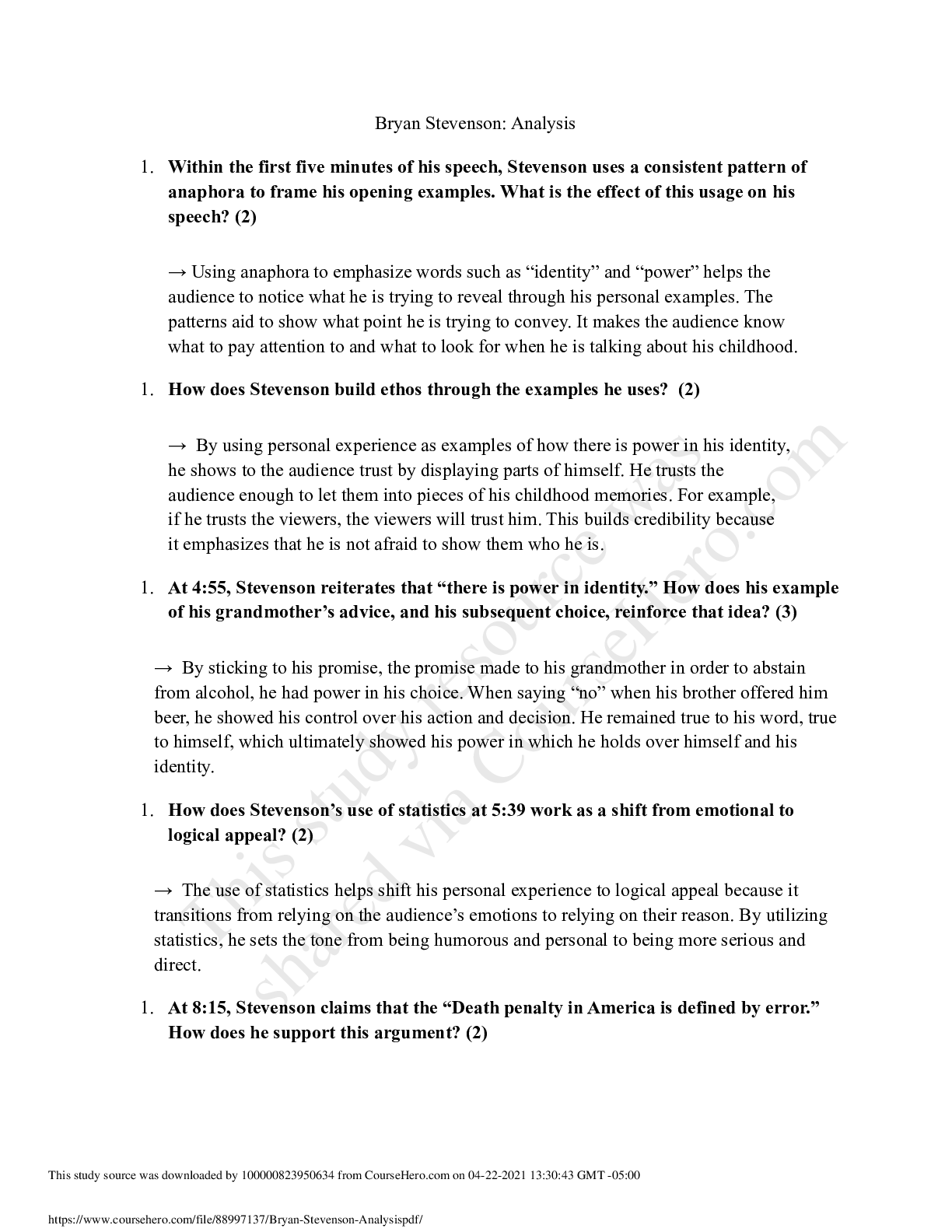
1. Within the first five minutes of his speech, Stevenson uses a consistent pattern of
anaphora to frame his opening examples. What is the effect of this usage on his
speech? (2)
→ Using anaphora to emphasize words such as “identity” and “power” helps the
audience to notice what he is trying to reveal through his personal examples. The
patterns aid to show what point he is trying to convey. It makes the audience know
what to pay attention to and what to look for when he is talking about his childhood.
1. How does Stevenson build ethos through the examples he uses? (2)
→ By using personal experience as examples of how there is power in his identity,
he shows to the audience trust by displaying parts of himself. He trusts the
audience enough to let them into pieces of his childhood memories. For example,
if he trusts the viewers, the viewers will trust him. This builds credibility because
it emphasizes that he is not afraid to show them who he is.
1. At 4:55, Stevenson reiterates that “there is power in identity.” How does his example
of his grandmother’s advice, and his subsequent choice, reinforce that idea? (3)
→ By sticking to his promise, the promise made to his grandmother in order to abstain
from alcohol, he had power in his choice. When saying “no” when his brother offered him
beer, he showed his control over his action and decision. He remained true to his word, true
to himself, which ultimately showed his power in which he holds over himself and his
identity.
1. How does Stevenson’s use of statistics at 5:39 work as a shift from emotional to
logical appeal? (2)
→ The use of statistics helps shift his personal experience to logical appeal because it
transitions from relying on the audience’s emotions to relying on their reason. By utilizing
statistics, he sets the tone from being humorous and personal to being more serious and
direct.
1. At 8:15, Stevenson claims that the “Death penalty in America is defined by error.”
How does he support this argument? (2)
[Show More]