What is a Dental Assistant? Correct Answer: One who is employeed in a dental office to perform certain duties that assist the dentist.
What is Direct Supervision? Correct Answer: Dentist is in office, personally tel
...
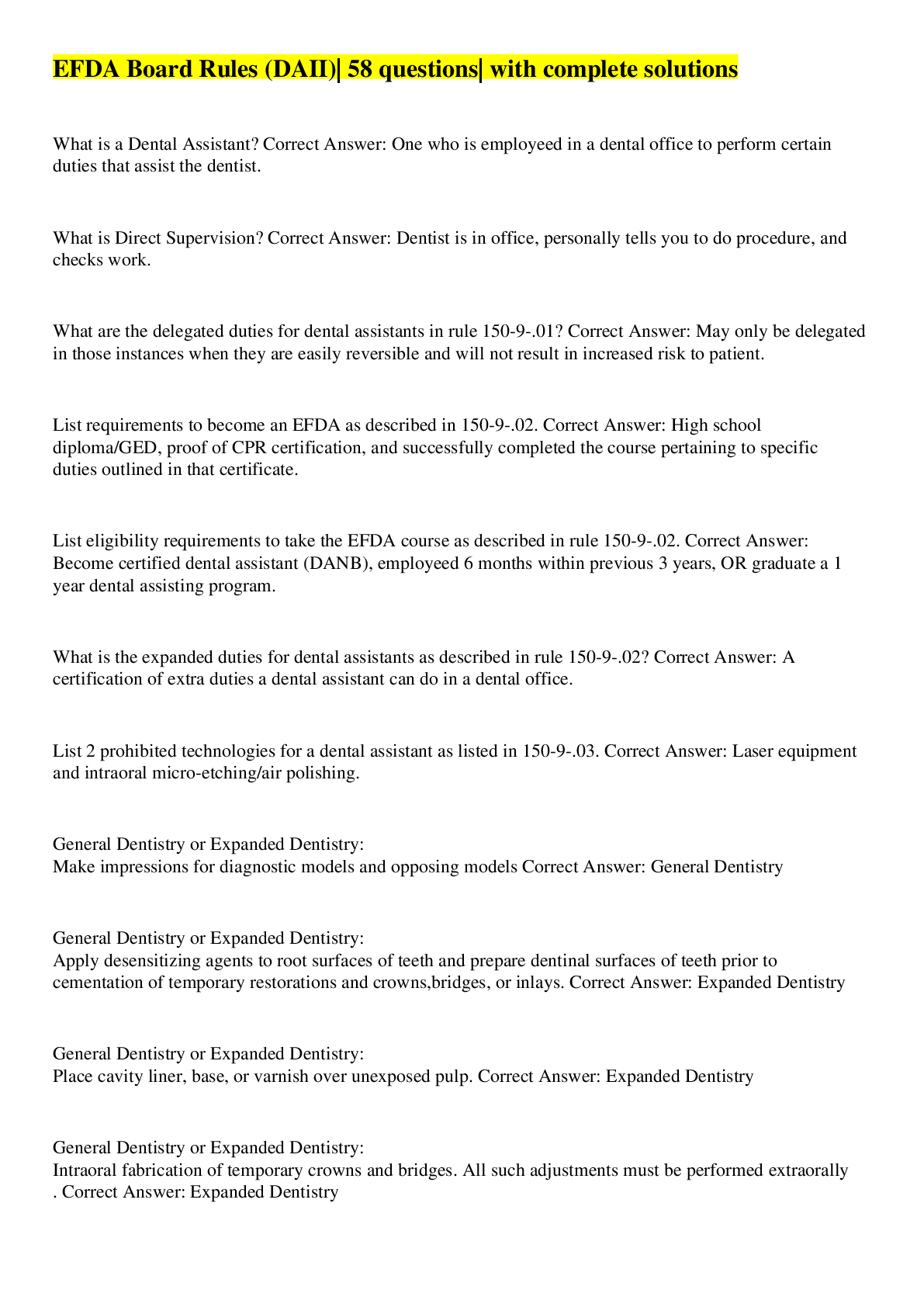
What is a Dental Assistant? Correct Answer: One who is employeed in a dental office to perform certain duties that assist the dentist.
What is Direct Supervision? Correct Answer: Dentist is in office, personally tells you to do procedure, and checks work.
What are the delegated duties for dental assistants in rule 150-9-.01? Correct Answer: May only be delegated in those instances when they are easily reversible and will not result in increased risk to patient.
List requirements to become an EFDA as described in 150-9-.02. Correct Answer: High school diploma/GED, proof of CPR certification, and successfully completed the course pertaining to specific duties outlined in that certificate.
List eligibility requirements to take the EFDA course as described in rule 150-9-.02. Correct Answer: Become certified dental assistant (DANB), employeed 6 months within previous 3 years, OR graduate a 1 year dental assisting program.
What is the expanded duties for dental assistants as described in rule 150-9-.02? Correct Answer: A certification of extra duties a dental assistant can do in a dental office.
List 2 prohibited technologies for a dental assistant as listed in 150-9-.03. Correct Answer: Laser equipment and intraoral micro-etching/air polishing.
General Dentistry or Expanded Dentistry:
Make impressions for diagnostic models and opposing models Correct Answer: General Dentistry
General Dentistry or Expanded Dentistry:
Apply desensitizing agents to root surfaces of teeth and prepare dentinal surfaces of teeth prior to cementation of temporary restorations and crowns,bridges, or inlays. Correct Answer: Expanded Dentistry
General Dentistry or Expanded Dentistry:
Place cavity liner, base, or varnish over unexposed pulp. Correct Answer: Expanded Dentistry
General Dentistry or Expanded Dentistry:
Intraoral fabrication of temporary crowns and bridges. All such adjustments must be performed extraorally. Correct Answer: Expanded Dentistry
General Dentistry or Expanded Dentistry:
Place and expose radiographs after completing the training required by GA. Comp.R.& Regs, 290-5-22-.04 entitled X-rays in the health arts. Correct Answer: General Dentistry
General Dentistry or Expanded Dentistry:
Remove sutures other than wire sutures Correct Answer: General Dentistry
General Dentistry or Expanded Dentistry:
Remove periodontal dressing Correct Answer: General Dentistry
General Dentistry or Expanded Dentistry:
Place and remove rubber dams Correct Answer: General Dentistry
General Dentistry or Expanded Dentistry:
Apply topical anesthetic Correct Answer: General Dentistry
General Dentistry or Expanded Dentistry:
Perform face bow transfer Correct Answer: Expanded Dentistry
General Dentistry or Expanded Dentistry:
Make impressions to be used to repair damaged prosthetics Correct Answer: Expanded Dentistry
General Dentistry or Expanded Dentistry:
Place periodontal dressing Correct Answer: Expanded Dentistry
General Dentistry or Expanded Dentistry:
Remove visible excess cement from Supramarginal areas of dental restorations and appliances with nonmechanical hand instruments Correct Answer: General Dentistry
General Dentistry or Expanded Dentistry:
Fabricate extraorally temporary crowns and bridges Correct Answer: General Dentistry
General Dentistry or Expanded Dentistry:
Cement temporary crowns and bridges with intermediate cement. Correct Answer: General Dentistry
General Dentistry or Expanded
[Show More]