PMT 252 Mod 1
1. Your team is developing a list of new ideas to improve processes, so they brainstorm those ideas
to develop a list of potential causes, collect data, and conduct analysis to determine priorities.
Whic
...
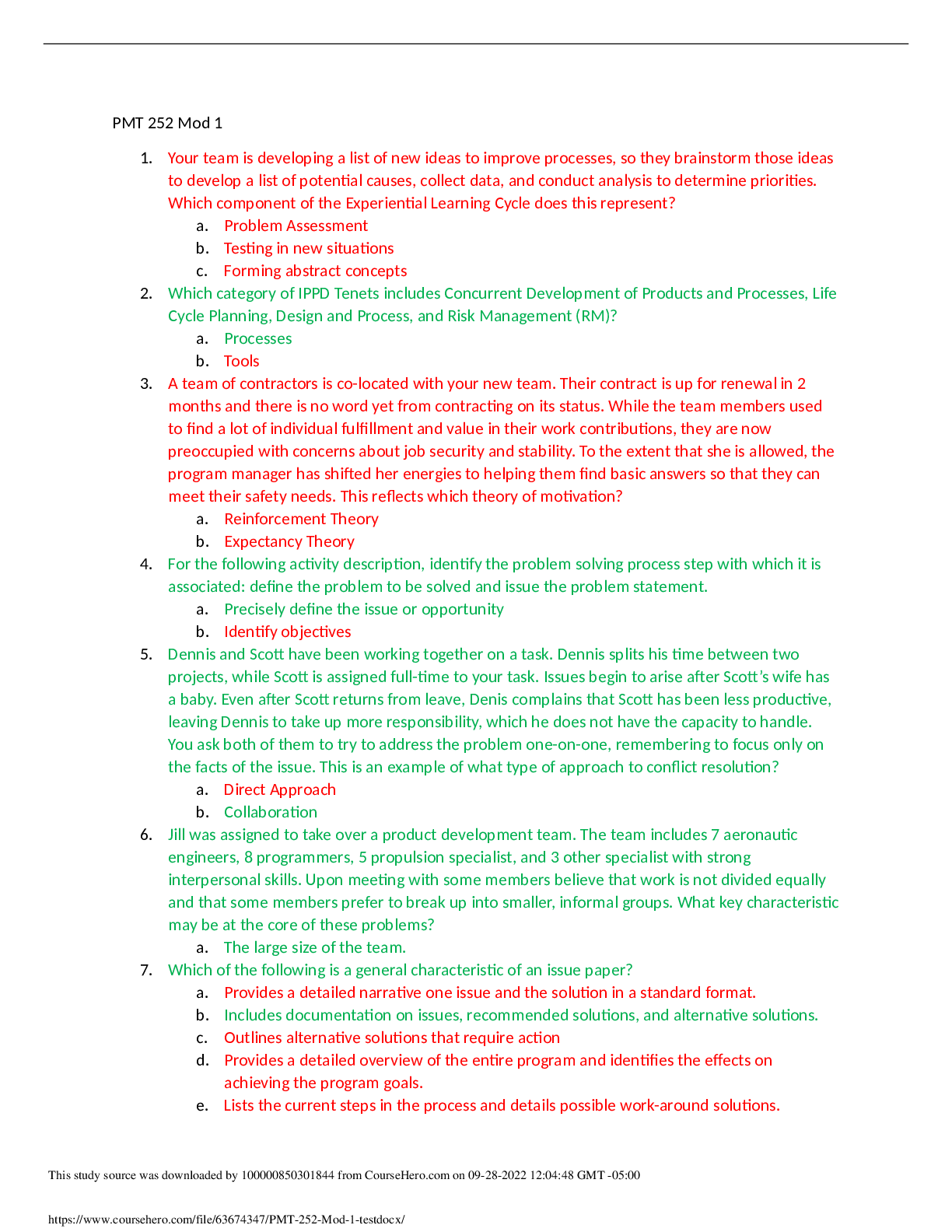
PMT 252 Mod 1
1. Your team is developing a list of new ideas to improve processes, so they brainstorm those ideas
to develop a list of potential causes, collect data, and conduct analysis to determine priorities.
Which component of the Experiential Learning Cycle does this represent?
a. Problem Assessment
b. Testing in new situations
c. Forming abstract concepts
2. Which category of IPPD Tenets includes Concurrent Development of Products and Processes, Life
Cycle Planning, Design and Process, and Risk Management (RM)?
a. Processes
b. Tools
3. A team of contractors is co-located with your new team. Their contract is up for renewal in 2
months and there is no word yet from contracting on its status. While the team members used
to find a lot of individual fulfillment and value in their work contributions, they are now
preoccupied with concerns about job security and stability. To the extent that she is allowed, the
program manager has shifted her energies to helping them find basic answers so that they can
meet their safety needs. This reflects which theory of motivation?
a. Reinforcement Theory
b. Expectancy Theory
4. For the following activity description, identify the problem solving process step with which it is
associated: define the problem to be solved and issue the problem statement.
a. Precisely define the issue or opportunity
b. Identify objectives
5. Dennis and Scott have been working together on a task. Dennis splits his time between two
projects, while Scott is assigned full-time to your task. Issues begin to arise after Scott’s wife has
a baby. Even after Scott returns from leave, Denis complains that Scott has been less productive,
leaving Dennis to take up more responsibility, which he does not have the capacity to handle.
You ask both of them to try to address the problem one-on-one, remembering to focus only on
the facts of the issue. This is an example of what type of approach to conflict resolution?
a. Direct Approach
b. Collaboration
6. Jill was assigned to take over a product development team. The team includes 7 aeronautic
engineers, 8 programmers, 5 propulsion specialist, and 3 other specialist with strong
interpersonal skills. Upon meeting with some members believe that work is not divided equally
and that some members prefer to break up into smaller, informal groups. What key characteristic
may be at the core of these problems?
a. The large size of the team.
7. Which of the following is a general characteristic of an issue paper?
a. Provides a detailed narrative one issue and the solution in a standard format.
b. Includes documentation on issues, recommended solutions, and alternative solutions.
c. Outlines alternative solutions that require action
d. Provides a detailed overview of the entire program and identifies the effects on
achieving the program goals.
e. Lists the current steps in the process and details possible work-around solutions.
Informs the reader only of the issues.
8. A team charter is important to the team because it documents which of the following?
a. A detailed schedule
b. Minutes for all of the team’s critical meetings
c. Reporting structure and interfaces with other teams
9. Your team is planning to propose an innovative and unconventional solution to a major technical
issue in your project. Your team is meeting to create a compelling implementation strategy that
will persuade key stakeholders. Which tool should you use in the meeting to examine all the
forces for and against the desired outcome?
a. Force Field analysis
10. An Integrated Product Team (IPT) has been established to develop a critical network system that
will be accessed 24/7. System integrity issues are plaguing quality assurance (QA) testers. The
IPT contracted other sub-teams to determine whether similar integrity data is already being
collected in other parts of the program. This best describes which step of the metrics
development process?
a. Generate new metrics if needed.
b. Identify and examine existing metrics
11. In which stage of the team life cycle process do the following activities take place: establish team
leadership, clarify purpose, establish rapport, identify and agree upon goals and objectives, and
establish team processes and Standard Operating Procedures (SOPs)?
a. Forming
b. Norming
c. Storming
12. Projects that are executed in CONUS are usually awarded as design/build projects. However, the
government team has been presented with a host nation-funded project that is required to be
awarded as design/bid/build. This requires the different government teams to change the way
they do business from planning to engineering and contracting because the change will require
longer timelines and higher costs. Your team is aware of this new requirement and initially open
to adjusting their processes, but they do not understand the details of how this will affect their
work. Given the circumstances, what should your next step be?
a. Refine the vision statement to evaluate the pros and cons of the new process.
b. Bring the guiding team together to develop a shared assessment of problems and
opportunities.
13. Your team is developing maintenance software for a new network infrastructure and requires
adherence to a tight budget. You decide to track the cost of requirements changes to the
software. What makes this an effective relevance metric?
a. It can drive process decisions and discipline in the design phases.
b. It can indicate additional issues in the project processes that need to be addressed
immediately.
c. It will indicate how well the organizational goals are being met through processes and
tasks.
14. One of the first items on the agenda of the first meeting for any team should be which of the
following?
a. Ground rules
candidate that will work well with everyone. Which decision-making method would be the best
fit?
a. Consultative Unilateral
b. Consensus
[Show More]