show how various parts and pieces that compose an assembly or subassembly are put together. - ANSWER Exploded Assembly Drawings
Freehand Sketching is - ANSWER fundamental engineering competency
Also good hand eye c
...
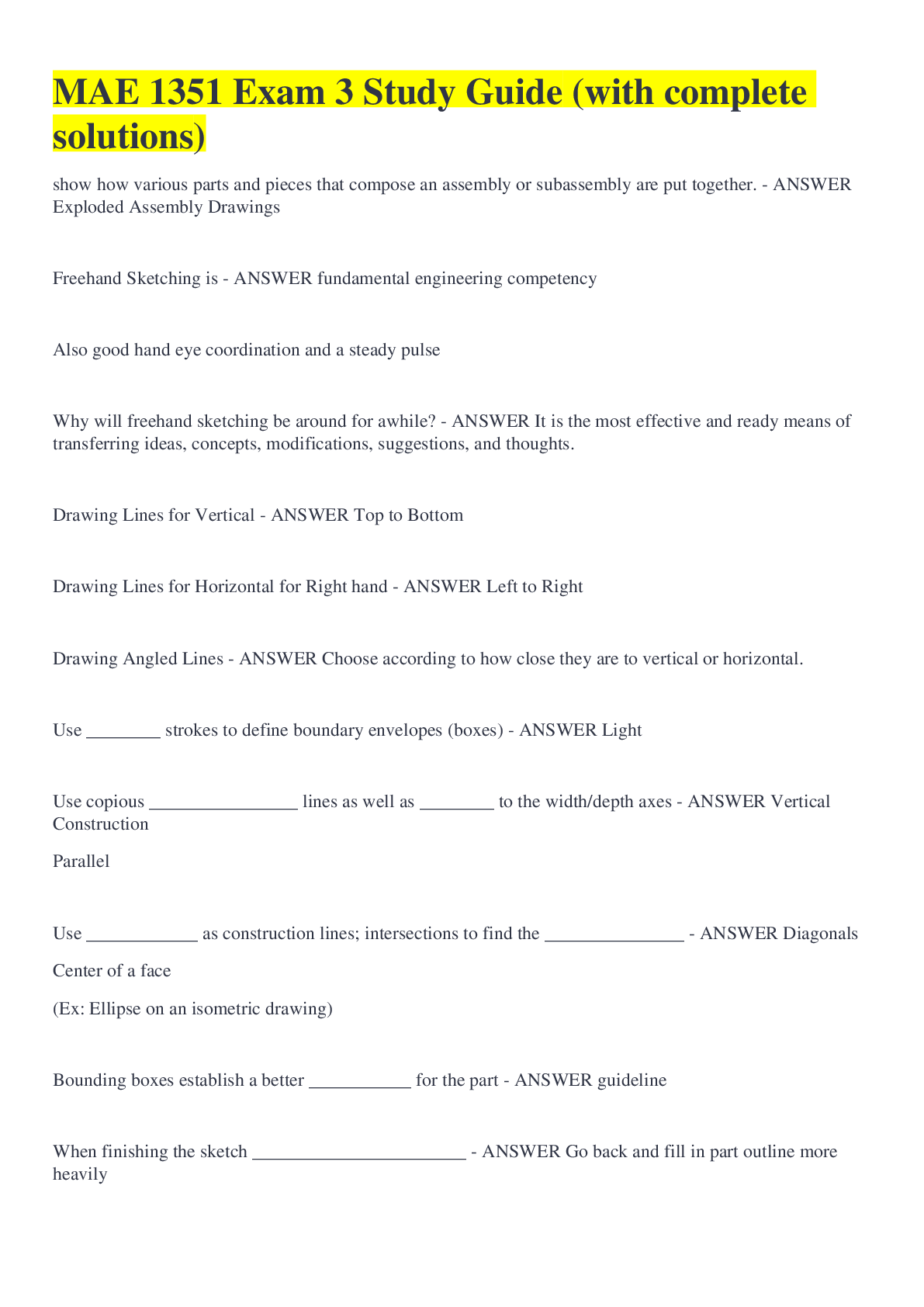
show how various parts and pieces that compose an assembly or subassembly are put together. - ANSWER Exploded Assembly Drawings
Freehand Sketching is - ANSWER fundamental engineering competency
Also good hand eye coordination and a steady pulse
Why will freehand sketching be around for awhile? - ANSWER It is the most effective and ready means of transferring ideas, concepts, modifications, suggestions, and thoughts.
Drawing Lines for Vertical - ANSWER Top to Bottom
Drawing Lines for Horizontal for Right hand - ANSWER Left to Right
Drawing Angled Lines - ANSWER Choose according to how close they are to vertical or horizontal.
Use ________ strokes to define boundary envelopes (boxes) - ANSWER Light
Use copious ________________ lines as well as ________ to the width/depth axes - ANSWER Vertical Construction
Parallel
Use ____________ as construction lines; intersections to find the _______________ - ANSWER Diagonals
Center of a face
(Ex: Ellipse on an isometric drawing)
Bounding boxes establish a better ___________ for the part - ANSWER guideline
When finishing the sketch _______________________ - ANSWER Go back and fill in part outline more heavily
When finishing the sketch it is also important to _____________ - ANSWER Erase occluded lines
Pictorials - ANSWER In engineering graphics, a 2D rendering of a 3D object that shows all three dimensions (width, height, and depth) in a single view
3D projection onto a 2D plane
Pictorials as visualization aids - ANSWER Graphics Communications
Assembly Instructions
Not a substitute for formal engineering drawings, but used to improve understanding
Axonometric Projection - ANSWER -Isometric (120 DEGREES APART)
-Dimetric (TWO EQUAL ANGLES)
-Trimetric (THREE DIFFERENT ANGLES)
Oblique Projection - ANSWER -Cavalier
-Cabinet
Perspective Projection - ANSWER Conical Projection that is classified as the most realistic of projections
A __________________ is chosen to be displayed in a front view (width/height) - ANSWER Principal Plane
Depth is added along a receding axis that departs at an angle of what - ANSWER 30-60 Degrees from horizontal but typically 45 Degrees
Perspective Projections are similar to axonometric but - ANSWER parallel lines converge at a vanishing point
-no optical aberration
How do you access Perspective View - ANSWER View, Display, Perspective View
Try drawing freehand a vertical line 5 inches long. Which direction did you follow? - ANSWER Top to Bottom
A pictorial may be used as a formal engineering drawing of record. True? - ANSWER No, Pictorials are for informal communication only
A fundamental problem with pictorials is that - ANSWER Angles and distances cannot be read directly
SW can display an object in the following views - ANSWER isometric, perspective
My drawing axes for a 3D view are set such that the angles between them are as follows: 240,30,90 with one of the lines horizontal. The view is: - ANSWER Cavalier
Pictorials are not enough. They are realistic and useful - ANSWER but not sufficiently precise
Angles and distances not shown in true view
Orthographic - ANSWER Every point on the object is projected at right angles to the viewing plane (parallel to each other)
Multiview - ANSWER Select views such that every feature is drawn at least once in its TRUE VIEW
True View - ANSWER Shape and Dimensions of an object are shown exactly as they are in real life
In practice, viewing plans are chosen to be parallel to object's front/side/top
Planes and edges perpendicular to the will collapse into - ANSWER single lines and points
Most US engineering drawings are served by - ANSWER Orthographic Projections
(front, top, right)
Third Angle - ANSWER Corresponds to the glass box projection system. Used exclusively in the US
First Angle - ANSWER Projects what the user would see on a panel *behind* the part. Used in Europe and Asia.
Highest Directive - ANSWER Provide all Information without Redundancy (too much) or ambiguity (too little)
Fundamental Rule - ANSWER The minimum number of views is given by the requirement that every feature of the object be seen in its true length in at least one view (and preferably, unconcluded-without resorting to hidden lines)
Least amount of views would be a - ANSWER single front view
______ views would be needed for most simple parts, but most of the time ______ is the typical number (front, top, side) - ANSWER Two, Three
Under some circumstances, complex parts would require up to - ANSWER six standard views, plus any number of additional auxiliary views
Hidden lines generally... - ANSWER add clarity and uncover detail that would not otherwise be visible
Use of hidden lines may - ANSWER obviate need for an additional view
Centerlines are used to emphasize the fact that - ANSWER a circular feature is present
The same orthographic projection may be obtained from two different parts. True? - ANSWER Yes; two orthographic projections of completely different objects may look identical
A part may be properly represented on an engineering drawing with as few views as... - ANSWER one
The US standard for multiview orthographic projection is: - ANSWER Third angle
First angle - ANSWER Germany
Specific Sheet Size in the US - ANSWER (8 1/2 x 11" / letter size), B, C, D, E (Largest)
Standard Boilerplate Drawing - ANSWER -Border/Grid Markers
-Title Blocks
Usually customized by each industry
-Main title Block
-Revision title block
C size - ANSWER Plotter
If one chooses a larger sheet size, the text must also be printed larger. True? - ANSWER No; lettering size should be the same no matter how small or large the sheet of paper
The revision block in an engineering drawing contains... - ANSWER A historical record of changes made to a drawing
Engineering drawings should always have a front, top and right view. True? - ANSWER No
Section Views - ANSWER "Cut" through the part of examine inner detail
Superior alternative to hidden lines
Verities: Full, Removed, Offset, Revolved, Half, Broken Out
Removed View - ANSWER Similar to full section, but restricted to a feature of interest. Typically used for cross section of select structural members.
Revolved View - ANSWER Same as removed, but located inside the source view
Broken Out View - ANSWER Used to uncover a small arbitrary portion of the part.
Auxiliary Views - ANSWER Orient the viewing plane so as to obtain a true view of a foreshortened face (parallel to it)
Should be aligned with source face/feature
Section views must retain the same scale as the part from which they are created, and must be aligned with the source view. True? - ANSWER no, they may be scaled, but must retain orientation
Instead of using multiple sections for different features, I can cluster them under a single section using... - ANSWER An offset section
If a standard view has any hidden lines, then creating a sectional view is always recommended. True? - ANSWER No, it's up to the draftsperson
In assembly drawings it is a must that you use - ANSWER balloon annotations and BOM to identify components and reference individual, detailed drawings
Generally avoid use of dimensions
An outline assembly drawing is used to show the fit and function of parts in an assembly. True? - ANSWER Yes
The table that lists all the components in an assembly is called the... - ANSWER BOM (Bill of Materials)
Isometric Grid Paper - ANSWER Is used to create 3*3*3 blocks
Oblique Pictorial - ANSWER Preferred in freehand sketching. Two true angles with a estimated depth.
Vanishing Point (VP) - ANSWER The point where receding parallel lines appear to converge
Multiview - ANSWER A drawing witch shows multiple drawings of the same object but in multiple perspectives.
Viewing Plane - ANSWER visualize a piece of glass in front of your eyes that you can see an object through. That is _________.
6 Standard Views - ANSWER sides of a box around the object
Working Drawings - ANSWER Shows all necessary views to fully define the part(s) as well as size, tolerance, and how to construct the part(s).
US sheet sizes - ANSWER designated by A, B, C, D, and E. A being the smallest
International Sheet Sizes - ANSWER designated by A1, A2, A3, and A4. A1 being the largest
Manufacturing drawings - ANSWER They include
Header
Border
Location Grid
Main Title Block
Secondary Title Block
Notes
Main Title Block - ANSWER Part Number
Part Name
Engineering Change level (EC level)
Quantity per Machine (Q/M)
Approval Signatures
Default tolerances
Half Section - ANSWER cuts less of a section because of symmetry
Exploded Configuration - ANSWER The assembly shows all the parts and how they are put together.
Bill of Materials - ANSWER All the materials that are in an assembly
When sketching arcs and circles, use lightly sketched square ______ to define the limits of the curved entities and then construct the curved entities as tangent to the edges of the bounding box - ANSWER bounding boxes
is that space can be represented by three mutually perpendicular coordinate axes, typically the x-, y-, and z-axes - ANSWER 3D Coordinate System
Oblique Pictorials - ANSWER are usually preferred for freehand sketching because a specialized grid is not required
___________ representation depicts in one plane, such as a sheet of paper, many images of the same object, each viewed from a different direction - ANSWER multiview
Objects such as engineered parts can usually be fully defined when they are viewed through a set of six viewing planes that together form a - ANSWER Glass Box
The glass box representation of multiviews of an object is formally referred to as - ANSWER Third Angle Projection\
If you have decided that you would like someone else to make your parts or device for you, you must produce a set of formal documents known as ... to send to the fabricator - ANSWER Working Drawings
can be considered modifications of full sections. An offset section allows multiple features, which normally require multiple section views, to be captured on a single view - ANSWER Offset Sections
are used to save space and labor on an engineering drawing, especially for symmetrical parts - ANSWER Half Sections
offers the convenience of showing only the new surfaces created by a cutting plane, without the complexity of showing the remaining surfaces on an object - ANSWER Removed Section
A frontal surface is seen as an edge in the top and side views and is seen in its - ANSWER True Shape
What about an inclined or oblique surface? You learned previously that these types of surfaces are not parallel to any of the primary views. Because they are not parallel to any of the primary views, they are seen - ANSWER Foreshortened
When you constructed the top view, you projected it onto the top pane of the glass box using - ANSWER Projection Rays
In the front view, these projection rays extended perpendicularly from the horizontal ______ of the normal surface toward the top viewing plane - ANSWER edge view
The glass box hinges are referred to as - ANSWER Reference Lines
- ANSWER
Once you assemble your system, you can create an ________- n that will essentially be an assembly drawing for the system - ANSWER Exploded Configuration
The amount that two instances overlap is referred to as the - ANSWER Interference
Depending on individual company practices, the number inside the balloon can be the part number or an - ANSWER Item Number
Finally, each custom-made part requires a - ANSWER Detailed Drawing
The path of insertion for each part is then shown using a dashed path called a - ANSWER Trail
Outline assembly drawings, sometimes called - ANSWER Layout Drawings
If any Assembly Drawings are required - ANSWER they must be shown with their tolerances on the layout drawing
________ if used at all, should be used sparingly and must be clearly identified and placed inside parentheses - ANSWER Reference Dimensions
sectioned assembly drawing - ANSWER Is a pictorial or orthogonal view(s) that shows all of the various pieces of an assembly or a subassembly in their final resting position
[Show More]


.png)