NATURE/NURTURE - Explain the major issue addressed in the model of development. - ANSWER Nature/Nurture:
The longstanding controversy over the relative contributions that genes and experience make to the development o
...
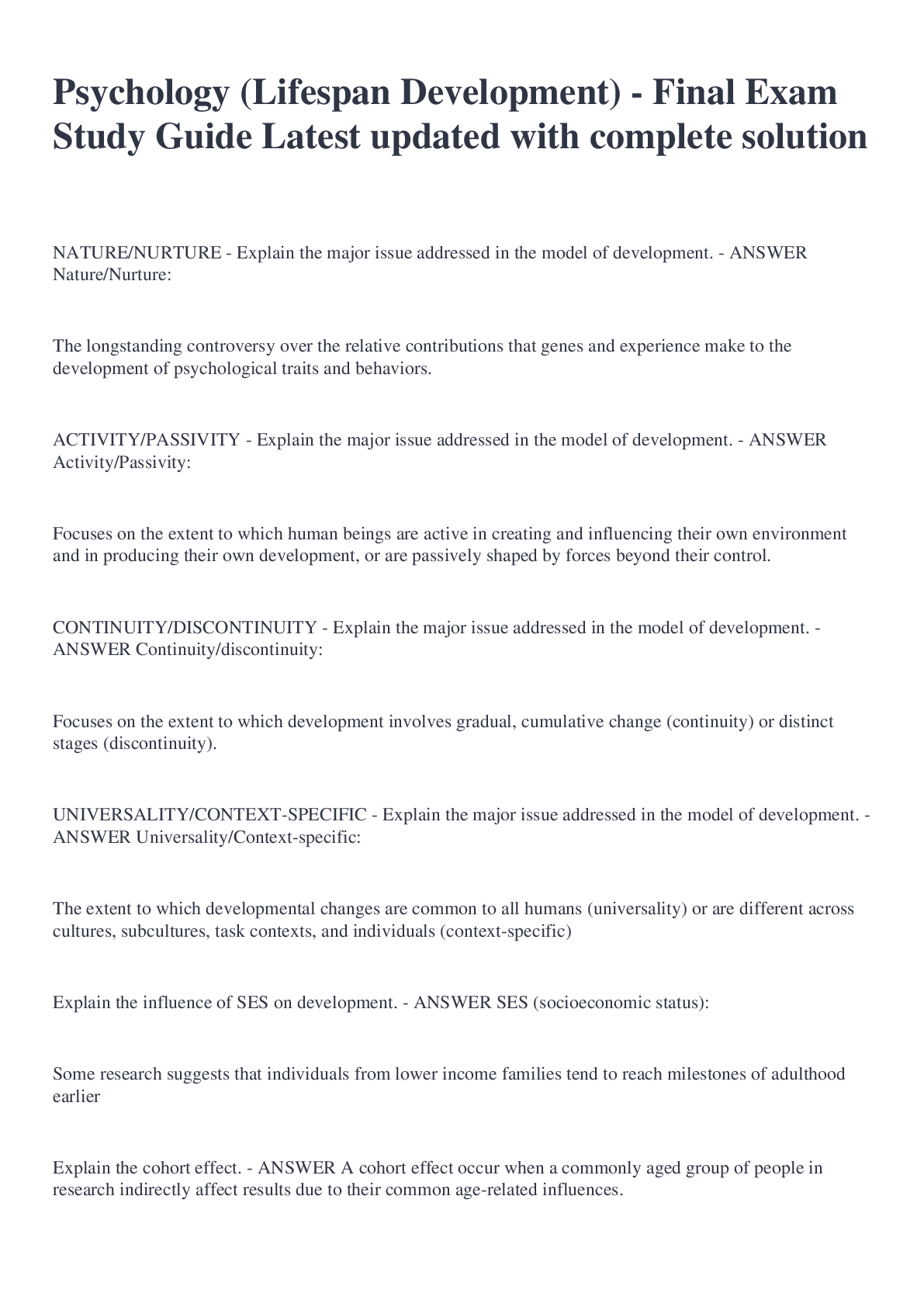
NATURE/NURTURE - Explain the major issue addressed in the model of development. - ANSWER Nature/Nurture:
The longstanding controversy over the relative contributions that genes and experience make to the development of psychological traits and behaviors.
ACTIVITY/PASSIVITY - Explain the major issue addressed in the model of development. - ANSWER Activity/Passivity:
Focuses on the extent to which human beings are active in creating and influencing their own environment and in producing their own development, or are passively shaped by forces beyond their control.
CONTINUITY/DISCONTINUITY - Explain the major issue addressed in the model of development. - ANSWER Continuity/discontinuity:
Focuses on the extent to which development involves gradual, cumulative change (continuity) or distinct stages (discontinuity).
UNIVERSALITY/CONTEXT-SPECIFIC - Explain the major issue addressed in the model of development. - ANSWER Universality/Context-specific:
The extent to which developmental changes are common to all humans (universality) or are different across cultures, subcultures, task contexts, and individuals (context-specific)
Explain the influence of SES on development. - ANSWER SES (socioeconomic status):
Some research suggests that individuals from lower income families tend to reach milestones of adulthood earlier
Explain the cohort effect. - ANSWER A cohort effect occur when a commonly aged group of people in research indirectly affect results due to their common age-related influences.
*A cohort is a group of people who share a common identity in some way.
Explain cross-sectional research design. - ANSWER People of different ages are tested at the same time and compared.
*Different age groups are cohorts
Explain longitudinal research design. - ANSWER Follows the development of the same group of people over time.
*2 days, 2 weeks or 2 years
Explain sequential research design. - ANSWER -Combined groups from at least two cohorts followed in a longitudinal study
-Comparison of cohorts while incorporating some degree of individual differences
*has both longitudinal and cross-section aspects
What are some challenges for conducting cross-cultural research? - ANSWER -Possibly being biased (ethnocentrism)
-language barrier
-Validity (testing what you think your tasting), reliability (consistency)
-Cultural applicability/interpretation
INFORMED CONSENT - Explain ethical guidelines for research. - ANSWER -Informed Consent
~awareness of
[Show More]