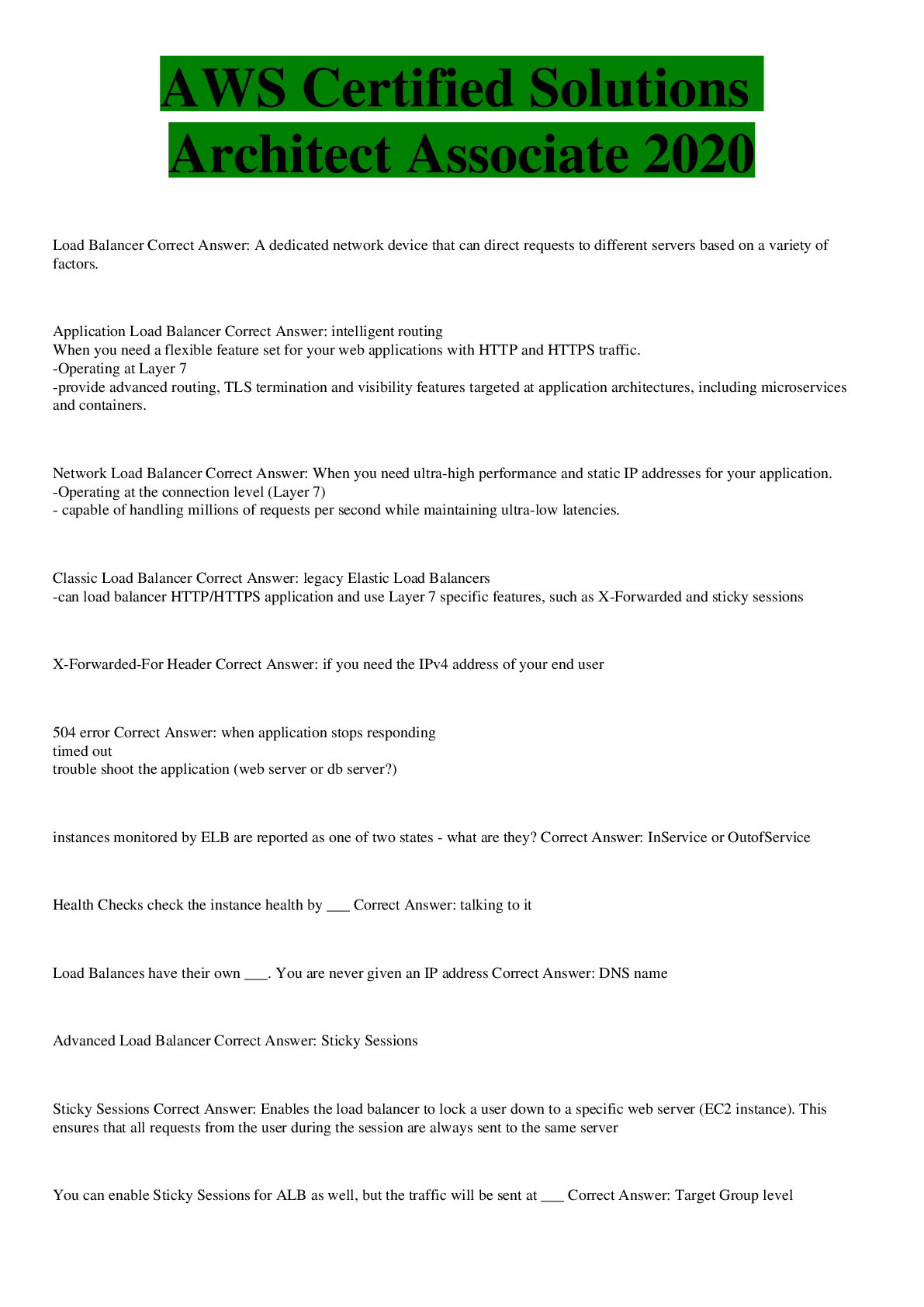
AWS Certified Solutions Architect Associate 2020
Load Balancer Correct Answer: A dedicated network device that can direct requests to different servers based on a variety of factors.
Application Load Balancer Corr
...
AWS Certified Solutions Architect Associate 2020
Load Balancer Correct Answer: A dedicated network device that can direct requests to different servers based on a variety of factors.
Application Load Balancer Correct Answer: intelligent routing
When you need a flexible feature set for your web applications with HTTP and HTTPS traffic.
-Operating at Layer 7
-provide advanced routing, TLS termination and visibility features targeted at application architectures, including microservices and containers.
Network Load Balancer Correct Answer: When you need ultra-high performance and static IP addresses for your application.
-Operating at the connection level (Layer 7)
- capable of handling millions of requests per second while maintaining ultra-low latencies.
Classic Load Balancer Correct Answer: legacy Elastic Load Balancers
-can load balancer HTTP/HTTPS application and use Layer 7 specific features, such as X-Forwarded and sticky sessions
X-Forwarded-For Header Correct Answer: if you need the IPv4 address of your end user
504 error Correct Answer: when application stops responding
timed out
trouble shoot the application (web server or db server?)
instances monitored by ELB are reported as one of two states - what are they? Correct Answer: InService or OutofService
Health Checks check the instance health by ___ Correct Answer: talking to it
Load Balances have their own ___. You are never given an IP address Correct Answer: DNS name
Advanced Load Balancer Correct Answer: Sticky Sessions
Sticky Sessions Correct Answer: Enables the load balancer to lock a user down to a specific web server (EC2 instance). This ensures that all requests from the user during the session are always sent to the same server
You can enable Sticky Sessions for ALB as well, but the traffic will be sent at ___ Correct Answer: Target Group level
Cross-Zone Load Balancing Correct Answer: enables you to load balance across multiple availability zone
Even if some Availability Zones have more healthy instances running than others. The ELB will ignore this and distribute the requests evenly.
-reduces the need to maintain equivalent numbers of instances in each enabled Availability Zone, and improves your application's ability to handle the loss of one or more instances.
Also some client cache DNS information which would favor one AZ over another. Cross-Zone load balancing would solve this by evenly distributing requests.
Path Patterns Correct Answer: allow you to direct traffic to different EC2 instances based on the URL contained in the request.
-path-based routing
-if you are running microservices, you can route traffic to multiple back-end services using path-based routing (for ex: you can route general requests to one target group and requests to render images to another target group)
Auto Scaling Correct Answer: scale up/down on conditions you define
best for apps that experience hourly, daily, or weekly variations in use
Auto Scaling components Correct Answer: Groups
Configuration Templates
Scaling Options
Groups (Auto Scaling) Correct Answer: logical component. Webserver group or Application group or Database group
Configuration Templates (Auto Scaling) Correct Answer: Groups uses a launch template or a launch configuration as a configuration template for its EC2 instances. You can specify information such as the AMI ID, instance type, key pair, security groups, and block device mapping for your instances.
Scaling Options (Auto Scaling) Correct Answer: provide several ways for you to scale your Auto Scaling groups. For example, you can configure a group to scale based on the occurrence of specified conditions (dynamic scaling) or on a schedule.
What are my scaling options? Correct Answer: -maintain current instance levels at all times
-scale manually
-scale based on a schedule
-scale based on demand
-use predictive scaling
Maintain current instance levels at all times Correct Answer: configure your Auto Scaling group to maintain a specified number of running instances at all times
Scale manually Correct Answer: most basic way
you specify only the change in the maximum, minimum or desired capacity
Scale based on a schedule Correct Answer: performed automatically as a function of time and date
Scale based on demand Correct Answer: more advanced way to scale your resources
-using scaling policies - lets you define parameters that control the scaling process
Use predictive scaling Correct Answer: can help you maintain optimal availability and performance by combining predictive and dynamic scaling (proactive and reactive)
Scenario: You have a website that requires a minimum of 6 instances and it must be highly available. You must also be able to tolerate the failure of 1 AZ. What the ideal architecture for this environment while also being the most cost effective? Correct Answer: 3 AZs with with 3 instances in each AZ
HA Architecture tips Correct Answer: -Always design for failure
-Use multiple AZ's and Multiple Regions where ever you can
-Difference between Multi-AZ(for disaster recovery) and Read Replicas (for performance)
-Difference between scaling out (additional instances) and scaling up (increase resources within instances)
-Cost element
CloudFormation Correct Answer: is a way of completely scripting your cloud environment
QuickStart Correct Answer: is a bunch of CloudFormation templates already built by AWS Solutions Architects allowing you to create complex environments very quickly
Elastic Beanstalk Correct Answer: you can quickly deploy and manage applications without worrying about the infrastructure that runs those applications.
Advanced Load Balancer Theory Correct Answer: Sticky Sessions
Cross Zone Load Balancing
Path Patterns
Which service works in conjunction with EC2 Autoscaling in order to provide predictive scaling? Correct Answer: AWS Autoscaling
Which of the below are not components of EC2 Autoscaling? Correct Answer: cfn-init
In discussions about Cloud services the words 'Availability', 'Durability', 'Reliability' and 'Resiliency' are often used. Which term is used to refer to the likelihood that a resource ability to recover from damage or disruption? Correct Answer: Resiliency
Following an unplanned outage, you have been called into a planning meeting. You are asked what can be done to reduce the risk of a single bad deployment taking the whole site down. (The selected options do not necessarily need to work together) (Choose 4) Correct Answer: Use Route 53 with health checks to distribute load across multiple ELBs.
Use multiple autoscaling groups and boundaries for a staged or 'canary' deployment process.
Use a Classic Load Balancer to spread the load over several availability zones.
Use several Target groups or auto scaling groups under each Load Balancers.
In discussions about Cloud services the words 'Availability', 'Durability', 'Reliability' and 'Resiliency' are often used. Which term is used to refer to the likelihood that a resource will continue to exist until you decide to remove it? Correct Answer: Durability
When you have deployed an RDS database into multiple availability zones, can you use the secondary database as an independent read node? Correct Answer: No.
If you are told that an EC2 instance is being changed to have more RAM, Is this considered Scaling Up or Scaling Out Correct Answer: Scaling Up
Can I "force" a failover for any RDS instance that has Multi-AZ configured? Correct Answer: Yes.
In discussions about Cloud services the words 'Availability', 'Durability', 'Reliability' and 'Resiliency' are often used. Which term is used to refer to the likelihood that you can access a resource or service when you need it? Correct Answer: Availability
A product manager walks into your office and advises that the simple single node MySQL RDS instance that has been used for a pilot needs to be upgraded for production. She also advises that they may need to alter the size of the instance once they see how many people use the system during peak periods. The key concern is that there can not be any outages of more than a few seconds during the go-live period. Which of the following might you recommend, (Choose 2) Correct Answer: Consider replacing it with Aurora before go live.
Convert the RDS instance to a multi-AZ implementation.
You work for a major news network in Europe. They have just released a new mobile app that allows users to post their photos of newsworthy events in real-time. Your organization expects this app to grow very quickly, essentially doubling its user base each month. The app uses S3 to store the images, and you are expecting sudden and sizable increases in traffic to S3 when a major news event takes place (as users will be uploading large amounts of content.) You need to keep your storage costs to a minimum, and you are happy to temporarily lose access to up to 0.1% of uploads per year. With these factors in mind, which storage media should you use to keep costs as low as possible? Correct Answer: S3 Standard-IA
The key drivers here are availability and cost, so an awareness of cost is necessary to answer this. Full S3 is quite expensive at around $0.023 per GB for the lowest band. S3 standard IA is $0.0125 per GB, S3 OneZone-IA is $0.01 per GB, and Legacy S3-RRS is around $0.024 per GB for the lowest band. Of the offered solutions S3 One Zone-IA is the cheapest suitable option. Glacier cannot be considered as it is not intended for direct access, however it comes in at around $0.004 per GB. S3 has an availability of 99.99%, S3-IA has an availability of 99.9% while S3-1Zone-IA only has 99.5%
[Show More]





 Correct Study Guide, Download to Score A.png)

.png)