NCLE Prep Exam 3 of 4
The tolerance for the overall lens diamter according to the ANSI standards is:
A. +/-0.005mm
B. +/-0.05mm
C. +/-0.01mm
D. +/-0.1mm - ✔✔B.
According to the ANSI standards (Z80.2-1989), the tole
...
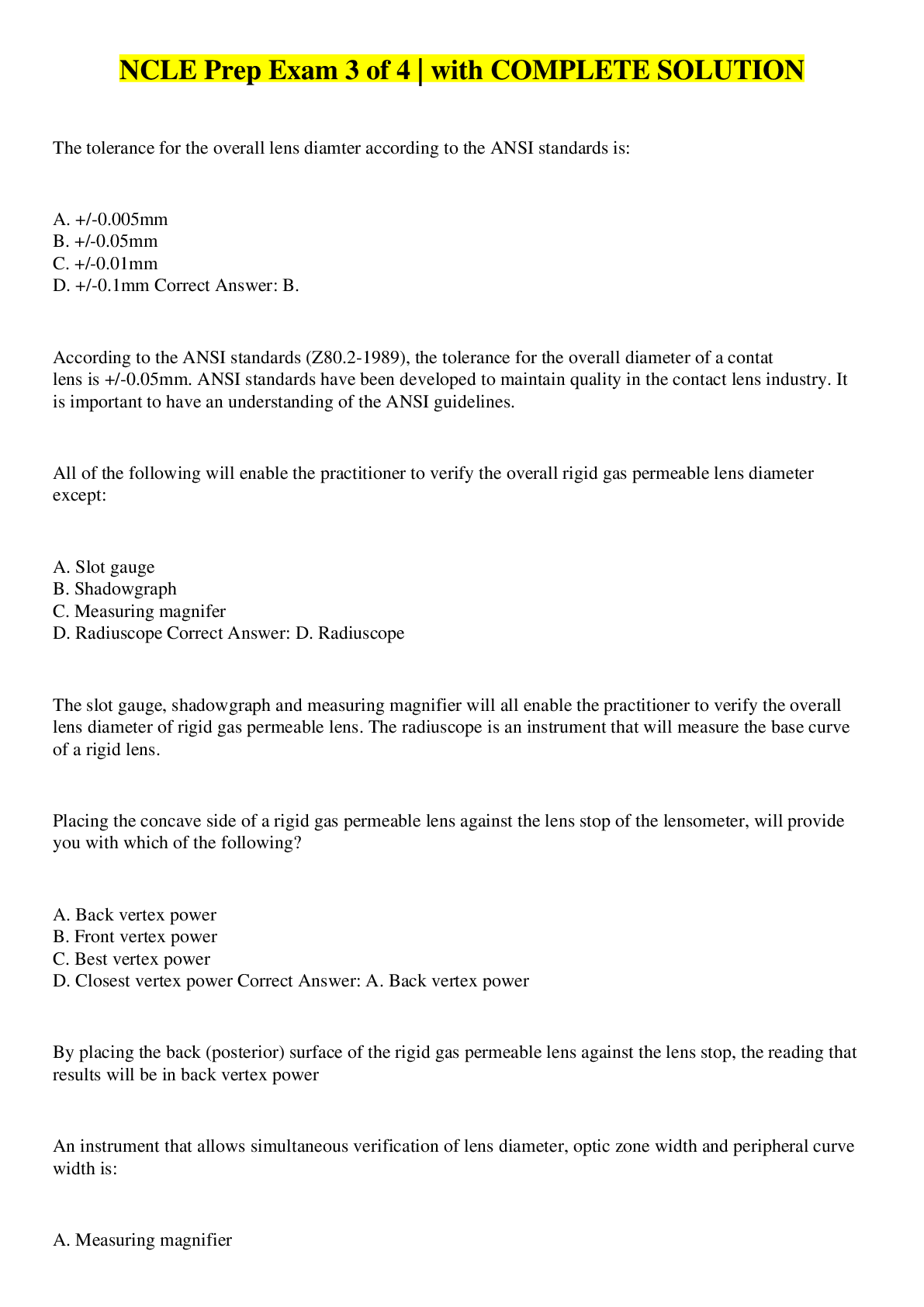
NCLE Prep Exam 3 of 4
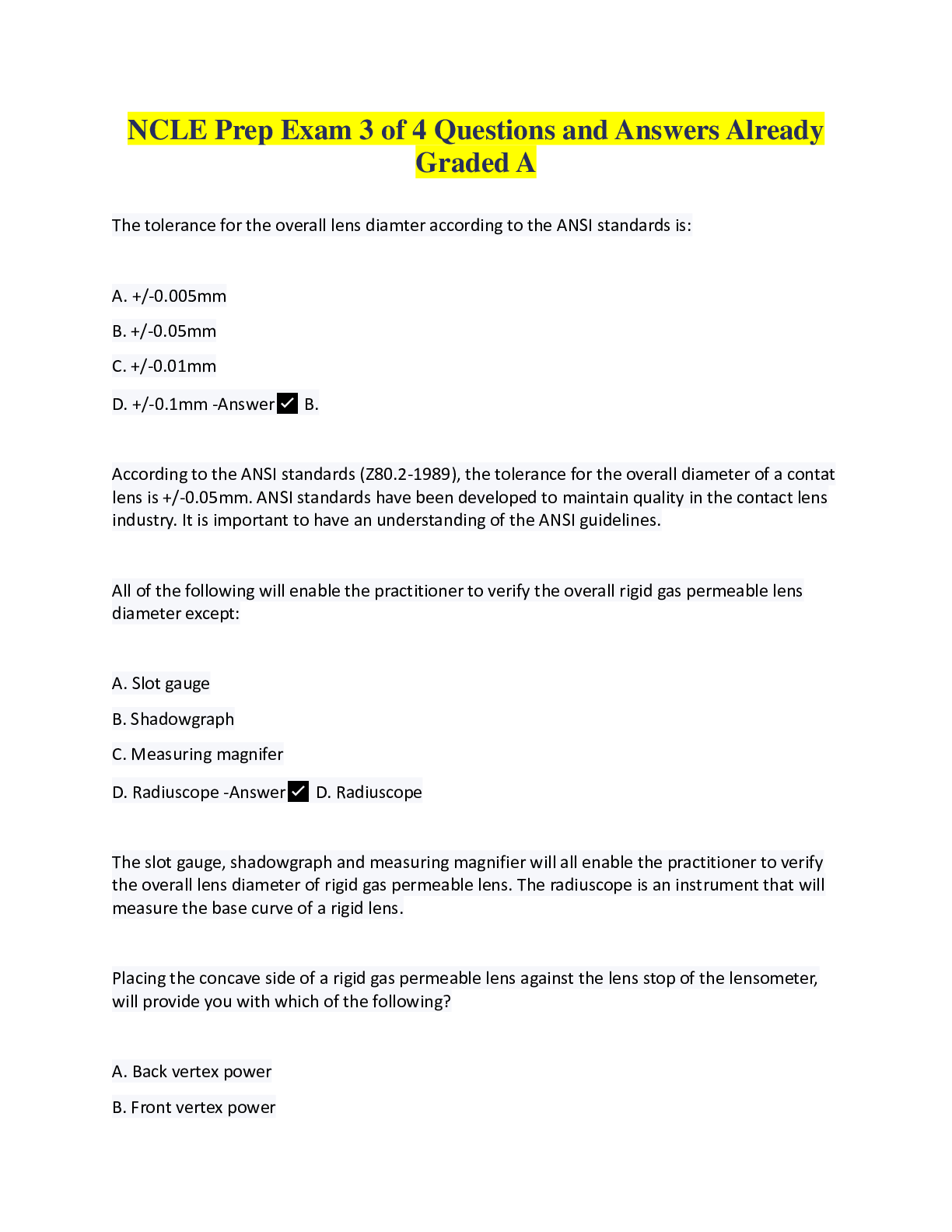
The tolerance for the overall lens diamter according to the ANSI standards is:
A. +/-0.005mm
B. +/-0.05mm
C. +/-0.01mm
D. +/-0.1mm - ✔✔B.
According to the ANSI standards (Z80.2-1989), the tolerance for the overall diameter of a contat
lens is +/-0.05mm. ANSI standards have been developed to maintain quality in the contact lens
industry. It is important to have an understanding of the ANSI guidelines.
All of the following will enable the practitioner to verify the overall rigid gas permeable lens
diameter except:
A. Slot gauge
B. Shadowgraph
C. Measuring magnifer
D. Radiuscope - ✔✔D. Radiuscope
The slot gauge, shadowgraph and measuring magnifier will all enable the practitioner to verify
the overall lens diameter of rigid gas permeable lens. The radiuscope is an instrument that will
measure the base curve of a rigid lens.
Placing the concave side of a rigid gas permeable lens against the lens stop of the lensometer,
will provide you with which of the following?
A. Back vertex power
B. Front vertex power
C. Best vertex power
D. Closest vertex power - ✔✔A. Back vertex power
By placing the back (posterior) surface of the rigid gas permeable lens against the lens stop, the
reading that results will be in back vertex power
An instrument that allows simultaneous verification of lens diameter, optic zone width and
peripheral curve width is:
A. Measuring magnifier
B. Ophthalmometer
C. Profile analyzer
D. Radiuscope - ✔✔A. Measuring magnifier
An ophthalmometer, another name for the keratometer, cannot measure the listed parameters.
The profile analyzer evaluates the peripheral curve blends and the radiuscope measures the base
curve of the rigid contact lens. The measuring magnifier is the only instrument that will measure
the parameters listed.
Assessment of the quality of the peripheral curves (blends) of a rigid contact lens is achievable
by the use of the:
A. Profile analyzer
B. Shadowgraph
C. Profile analyzer
D. Burton lamp - ✔✔A. Profile analyzer
All of the listed instruments show that a rigid contact lens has blends. However, the only
instrument that can adequately assess the quality of the blends between the peripheral posterior
curve (PPC), intermediate posterior curve (IPC) and the central posterior curve (CPC), is the
profile analyzer.
The instrumental used for magnification of the edge of a rigid contact lens is a:
A. Keratometer
B. Shadowgraph
C. Profile analyzer
D. V-groove gauge - ✔✔B. Shadowgraph
A keratometer measures the corneal curvature. A profile analyzer measures the peripheral curves
(blends) and a v-groove gauge measures the diameter of a rigid contact lens.
The tolerance for lens power under +/-10.00D is:
A. 0.12D
B. 0.25D
C. 0.37D
D. 0.50D - ✔✔A. 0.12D
According to the ANSI standards (Z80.2 - 1989), the tolerance for the power of a contact lens
under +/-10.00D is +/-0.12D
Which of the following will NOT measure contact lens parameters?
A. Keratometer
B. Radiuscope
C. Burton lamp
D. Thickness gauge - ✔✔A keratometer will measure the base curve of a lens with an attachment
known as a con-ta-check; however, a radiuscope is most frequently used. A thickness gauge will
measure the center thickness of a contact lens. A burton lamp evaluates the fluorescein pattern
similar to a slit lamp.
A warped lens will show ________ base curve(s) on the radiuscope and a ________ power on
the lensometer.
A. One / sphero-cylindrical
B. Two / sphero-cylindrical
C. One / sphero-cylindrical
D. Two / spherical - ✔✔D. Two / spherical
Verification should show the following:
Lens type - Radiuscope - Lensometer
Spherical - One base curve - Spherical Rx
Warped - two base curves - spherical rx
Front toric - one base curves - sphero-cylindrical rx
Back toric - two base curves - sphero-cylindrical rx
Bi-toric - two base curves - sphero-cylindrical rx
Prolonged periods of reading in contact lenses may lead to lens discomfort due to:
A. Decreased blinking
B. Corneal temperature changes
C. Accommodative response
D. Neovasularization - ✔✔A. Decreased Blinking
When a patient spends a great deal of time reading or any other activity in which they are
intently staring at an object (watching tv, driving, etc.) they may experience some discomfort as
their blink rate drops and new tears are not exchanged for old tears underneath the lens
Which of the following statements is most accurate:
A. Routine cosmetic daily wear patients should be seen at 3 month intervals for a contact lens
evaluation
B. Patients with a history of GPC should be refit with disposable soft lenses and followed on a
bi-weekly basis for 6 months
C. New soft lens fits should be seen one week, one month, three months and 6 months from the
time their initial fit, then every 6 to 12 months
D. Patients who are wearing RGP lenses after penetrating keratoplasty need fewer follow-up
visits than keratoconus patients because their corneas are now spherical - ✔✔C.
Choice A would be correct only for patients who have already gone through the sequence of
follow-up care recommended for new contact lens wearers as outlined in Choice C. Choice B
involves an excessive number of follow-up visits which can be inconvenient for the patient and
impractical for the practitioner. If the GPC is so severe that the patient must return every two
weeks, they are not yet ready to be refit with contact lenses. Choice D is incorrect because it is
rare that a penetrating keratoplasty results in a spherical cornea and post-graft patients tend to be
more difficult to fit with contact lenses. One must also watch the graft/host junction closely for
problems
Which of the following materials would least likely require a weekly enzymatic cleaner?
A. Polymethylmethacrylate
B. Hydrophilic
C. Hydroxyethyl Methacrylate
D. Silicone acrylate - ✔✔A. Polymethylmethacrylate
All of the other lens materials are recommended to be cleaned weekly with an enzymatic cleaner.
Which type of lens would best satisfy this patient's visual needs given the following information:
K's 43.00 @ 160 / 44.00 @ 75 3+ distortion
[Show More]

.png)
.png)
.png)
.png)
.png)
.png)
.png)
.png)


.png)
.png)




![Preview of [SOLVED] EDCO 740 / EDCO740 Quiz 1 (LATES 2021/2022 Graded A)](https://scholarfriends.com/storage/EDCO_740_Quiz_1.png)

