A 17-year-old African American female from the inner city complains of severe chest
and abdominal pain. Upon examination, the attending physician performs an EKG,
chest x-ray, and an abdominal and chest clinical examin
...
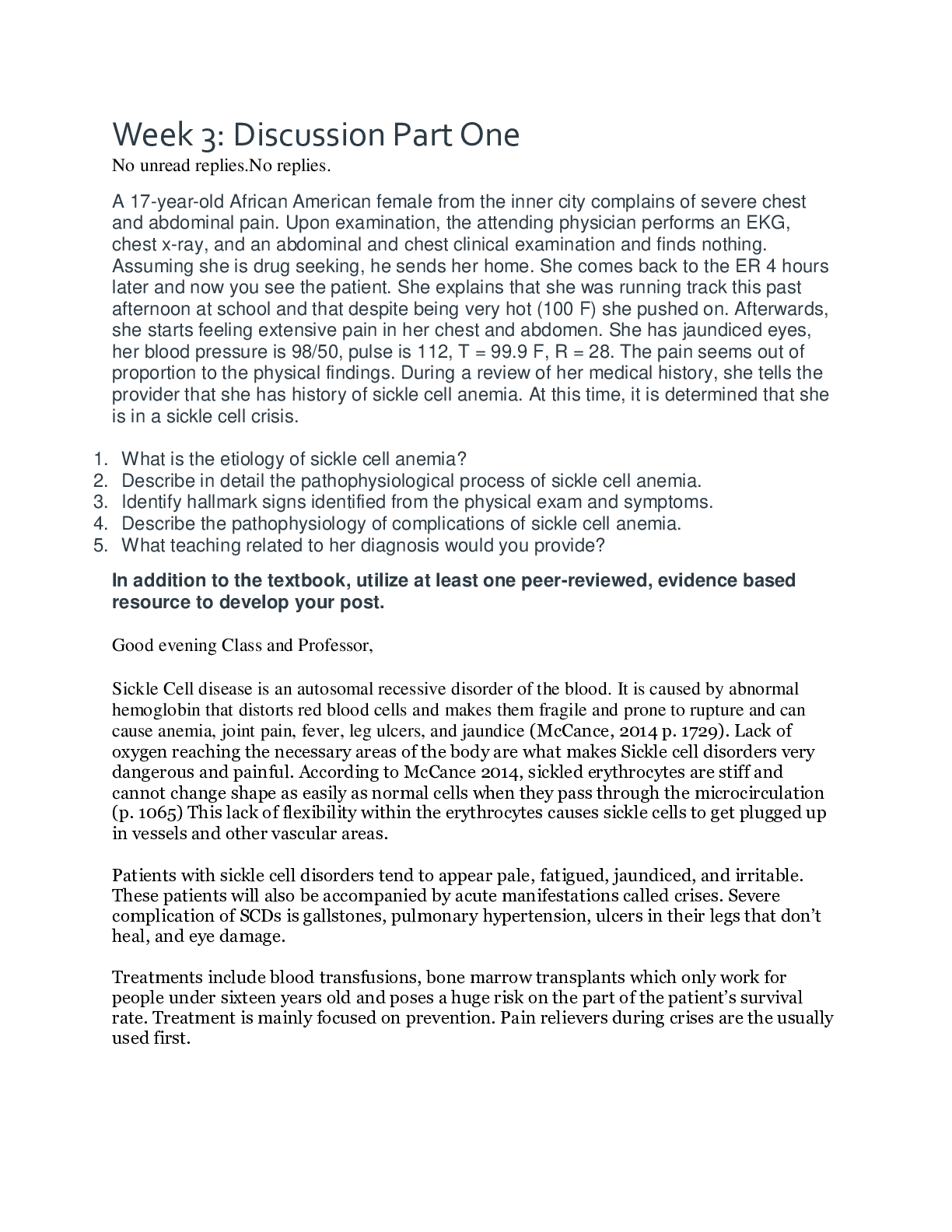
A 17-year-old African American female from the inner city complains of severe chest
and abdominal pain. Upon examination, the attending physician performs an EKG,
chest x-ray, and an abdominal and chest clinical examination and finds nothing.
Assuming she is drug seeking, he sends her home. She comes back to the ER 4 hours
later and now you see the patient. She explains that she was running track this past
afternoon at school and that despite being very hot (100 F) she pushed on. Afterwards,
she starts feeling extensive pain in her chest and abdomen. She has jaundiced eyes,
her blood pressure is 98/50, pulse is 112, T = 99.9 F, R = 28. The pain seems out of
proportion to the physical findings. During a review of her medical history, she tells the
provider that she has history of sickle cell anemia. At this time, it is determined that she
is in a sickle cell crisis.
1. What is the etiology of sickle cell anemia?
2. Describe in detail the pathophysiological process of sickle cell anemia.
3. Identify hallmark signs identified from the physical exam and symptoms.
4. Describe the pathophysiology of complications of sickle cell anemia.
5. What teaching related to her diagnosis would you provide?
Week 3: Discussion Part Two
11 unread reply.11 reply.
Jesse is a 57-year-old male who presents with gradual onset of dyspnea on exertion
and fatigue. He also complains of frequent dyspepsia with nausea and occasional
epigastric pain. He states that at night he has trouble breathing especially while lying on
his back. This is relieved by him sitting up. His vitals are 180/110, P = 88, T = 98.0 F, R
= 20. After a thorough work-up, he is diagnosed with congestive heart failure.
1. What is the etiology of congestive heart failure?
2. Describe in detail the pathophysiological process of congestive heart failure.
3. Identify hallmark signs identified from the physical exam, diagnostic lab work and
symptoms.
4. Describe the pathophysiology of complications of congestive heart failure
5. What teaching would you provide this patient to avoid heart failure symptoms?
[Show More]






.png)

.png)