Read all of chapters 1 and 2 in HESI book!!! Study this information for ALL HESI exams!
Basic Nursing Skills – Vital Signs – Chapter 30
BP cuff size (review what happens with wrong cuff size)
o False-high diastolic
...
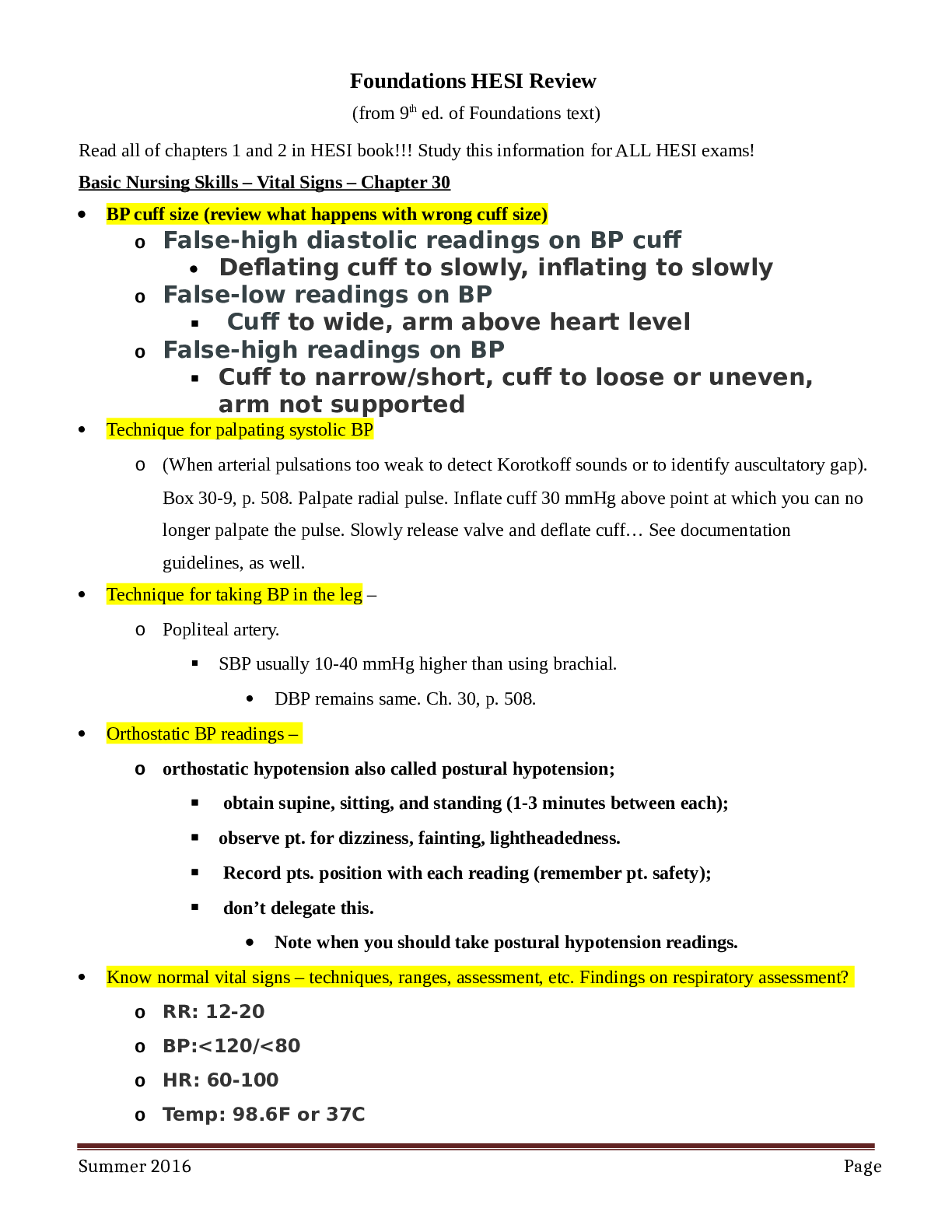
Read all of chapters 1 and 2 in HESI book!!! Study this information for ALL HESI exams!
Basic Nursing Skills – Vital Signs – Chapter 30
BP cuff size (review what happens with wrong cuff size)
o False-high diastolic readings on BP cuf
Deflating cuf to slowly, inflating to slowly
o False-low readings on BP
Cuf to wide, arm above heart level
o False-high readings on BP
Cuf to narrow/short, cuf to loose or uneven,
arm not supported
Technique for palpating systolic BP
o (When arterial pulsations too weak to detect Korotkoff sounds or to identify auscultatory gap).
Box 30-9, p. 508. Palpate radial pulse. Inflate cuff 30 mmHg above point at which you can no
longer palpate the pulse. Slowly release valve and deflate cuff… See documentation
guidelines, as well.
Technique for taking BP in the leg –
o Popliteal artery.
SBP usually 10-40 mmHg higher than using brachial.
DBP remains same. Ch. 30, p. 508.
Orthostatic BP readings –
o orthostatic hypotension also called postural hypotension;
obtain supine, sitting, and standing (1-3 minutes between each);
observe pt. for dizziness, fainting, lightheadedness.
Record pts. position with each reading (remember pt. safety);
don’t delegate this.
Note when you should take postural hypotension readings.
Know normal vital signs – techniques, ranges, assessment, etc. Findings on respiratory assessment?
o RR: 12-20
o BP:<120/<80
o HR: 60-100
o Temp: 98.6F or 37C
Summer 2016 Page
o Pain 5th vital sign
Vital Signs – Guidelines
Nurse ultimately responsible for vitals but can be delegated in
stable patients,
RN to interpret their significance and make decision about
interventions;
Determine equipment
[Show More]