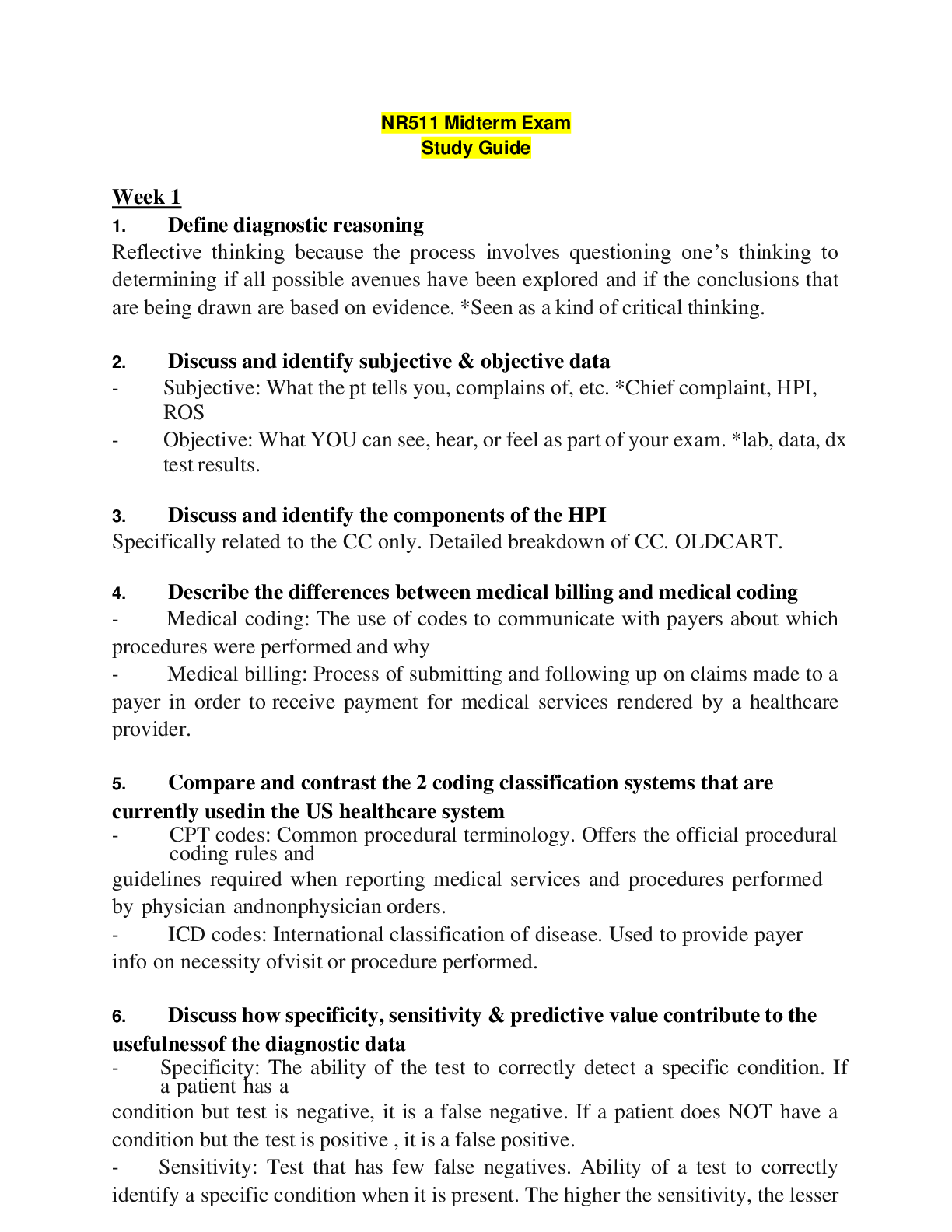
NR511 Midterm Exam Study Guide
Week 1
1. Define diagnostic reasoning
2. Discuss and identify subjective & objective data
3. Discuss and identify the components of the HPI
4. Describe the differences between
...
NR511 Midterm Exam Study Guide
Week 1
1. Define diagnostic reasoning
2. Discuss and identify subjective & objective data
3. Discuss and identify the components of the HPI
4. Describe the differences between medical billing and medical coding
- M
5. Compare and contrast the 2 coding classification systems that are currently used in the US healthcare system
6. Discuss how specificity, sensitivity & predictive value contribute to the usefulness of the diagnostic data
7. Discuss the elements that need to be considered when developing a plan
8. Describe the components of Medical Decision Making in E&M coding
9. Correctly order the E&M office visit codes based on complexity from least to most complex
New patient:
10. Discuss a minimum of three purposes of the written history and physical in relation to the importance of documentation
11. Accurately document why every procedure code must have a corresponding diagnosis code
12. Correctly identify a patient as new or established given the historical information
13. Identify the 3 components required in determining an outpatient, office visit E&M code
14. Describe the components of Medical Decision Making in E&M coding
15. Correctly order the E&M office visit codes based on complexity from least to most complex
16. Explain what a “well rounded” clinical experience means
17. State the maximum number of hours that time can be spent “rounding” in a facility
18. State 9 things that must be documented when inputting data into clinical encounter
19. Identify and explain each part of the acronym SNAPPS
Week 2
1. Identify the most common type of pathogen responsible for acute gastroenteritis
2. Recognize that assessing for prior antibiotic use is a critical part of the history in patients presenting with diarrhea
3. Describe the difference between Irritable Bowel Disease (IBS) and Inflammatory Bowel Disorder (IBD)
Inflammatory Bowel Disorder (IBD)
4. Discuss two common Inflammatory Bowel Diseases Ulcerative colitis (UC):
Crohn’s disease (CD):
●
5. Discuss the diagnosis of diverticulitis, risk factors, and treatments
6. Identify the significance of Barrett’s esophagus
7. Discuss the diagnosis of GERD, risk factors, and treatments
..........................................................................................continued.................................................................................
[Show More]