1. A company's "macro-environment" refers to:
A. the industry and the competitive arena in which the company operates.
B. general economic conditions plus the factors driving change in the markets where a company opera
...
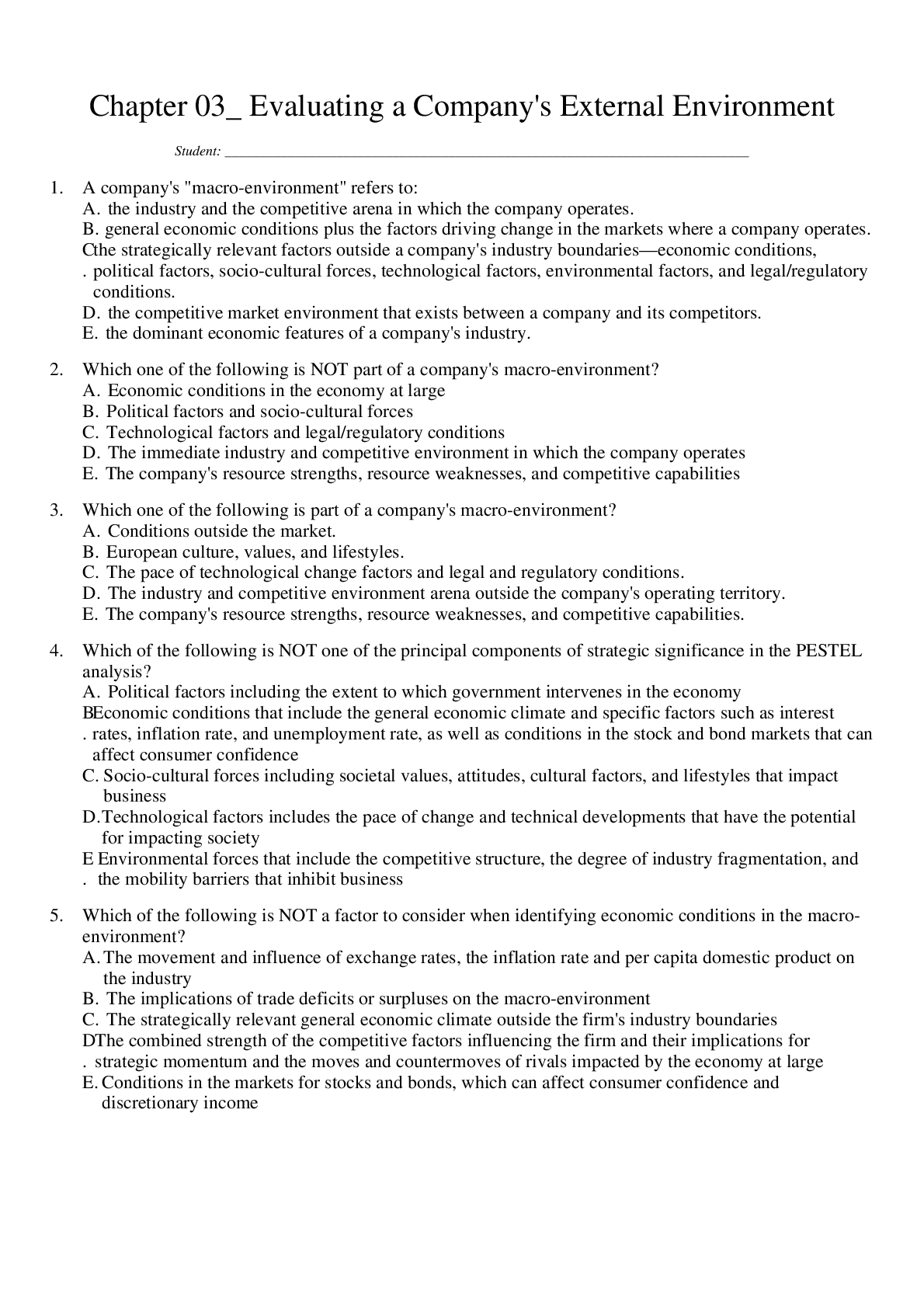
1. A company's "macro-environment" refers to:
A. the industry and the competitive arena in which the company operates.
B. general economic conditions plus the factors driving change in the markets where a company operates.
C
.
the strategically relevant factors outside a company's industry boundaries—economic conditions,
political factors, socio-cultural forces, technological factors, environmental factors, and legal/regulatory
conditions.
D. the competitive market environment that exists between a company and its competitors.
E. the dominant economic features of a company's industry.
2. Which one of the following is NOT part of a company's macro-environment?
A. Economic conditions in the economy at large
B. Political factors and socio-cultural forces
C. Technological factors and legal/regulatory conditions
D. The immediate industry and competitive environment in which the company operates
E. The company's resource strengths, resource weaknesses, and competitive capabilities
3. Which one of the following is part of a company's macro-environment?
A. Conditions outside the market.
B. European culture, values, and lifestyles.
C. The pace of technological change factors and legal and regulatory conditions.
D. The industry and competitive environment arena outside the company's operating territory.
E. The company's resource strengths, resource weaknesses, and competitive capabilities.
4. Which of the following is NOT one of the principal components of strategic significance in the PESTEL
analysis?
A. Political factors including the extent to which government intervenes in the economy
B
.
Economic conditions that include the general economic climate and specific factors such as interest
rates, inflation rate, and unemployment rate, as well as conditions in the stock and bond markets that can
affect consumer confidence
C. Socio-cultural forces including societal values, attitudes, cultural factors, and lifestyles that impact
business
D.Technological factors includes the pace of change and technical developments that have the potential
for impacting society
E
.
Environmental forces that include the competitive structure, the degree of industry fragmentation, and
the mobility barriers that inhibit business
5. Which of the following is NOT a factor to consider when identifying economic conditions in the macroenvironment?
A.The movement and influence of exchange rates, the inflation rate and per capita domestic product on
the industry
B. The implications of trade deficits or surpluses on the macro-environment
C. The strategically relevant general economic climate outside the firm's industry boundaries
D
.
The combined strength of the competitive factors influencing the firm and their implications for
strategic momentum and the moves and countermoves of rivals impacted by the economy at large
E.Conditions in the markets for stocks and bonds, which can affect consumer confidence and
discretionary income
6. Which of the following factors represents the strategically relevant political factors in the macroenvironment that will influence the performance of all firms across the board?
A. The strength of the federal banking system
B. The exogenous forces related to the general environmental demand
C. Social factors that could fuel a political agenda and create greater transparency
D. Bailouts and energy policies that are industry-specific
E. Tax policy, fiscal policy, and tariffs providing impetus for anti-trust matters
7. Which of the following is NOT a major question to ask in thinking strategically about industry and
competitive conditions in a given industry?
A. How many companies in the industry have good track records for revenue growth and profitability?
B. What strategic moves are rivals likely to make next?
C. What are the industry's key factors for future competitive success?
D. Is the outlook for the industry conducive to providing attractive profitability?
E
.
What are the driving forces in the industry, and what impact will these changes have on competitive
intensity and industry profitability?
8. Thinking strategically about the industry and competitive environment involves in-depth analysis and
evaluation of such consideration as:
A. the strength of the equilibrium forces driving change in the environment.
B. the identification of the dominant financial risk components of the industry in which the company
operates.
C
.
the market positions of industry rivals and their relative strength, and the competitive forces rivals are
facing and what impact they will have on competitive intensity and industry profitability.
D. the critical factors influencing past competitive success in the industry.
E. All of these.
[Show More]



.png)


.png)

.png)