MULTIPLE CHOICE
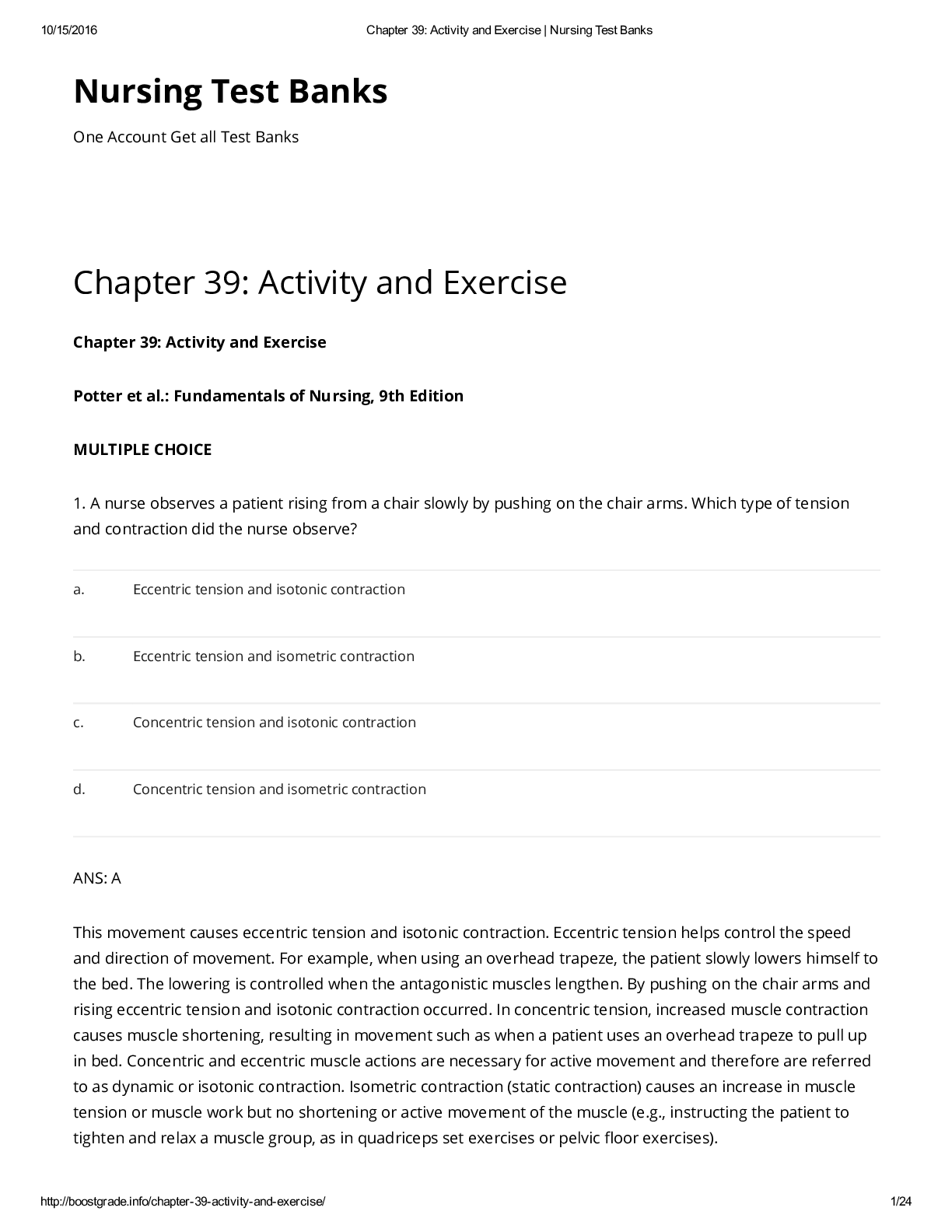
1. A nurse observes a patient rising from a chair slowly by pushing on the chair arms. Which type of tension
and contraction did the nurse observe?
a. Eccentric tension and isotonic contraction
b. Ecc
...
MULTIPLE CHOICE
1. A nurse observes a patient rising from a chair slowly by pushing on the chair arms. Which type of tension
and contraction did the nurse observe?
a. Eccentric tension and isotonic contraction
b. Eccentric tension and isometric contraction
c. Concentric tension and isotonic contraction
d. Concentric tension and isometric contraction
ANS: A
This movement causes eccentric tension and isotonic contraction. Eccentric tension helps control the speed
and direction of movement. For example, when using an overhead trapeze, the patient slowly lowers himself to
the bed. The lowering is controlled when the antagonistic muscles lengthen. By pushing on the chair arms and
rising eccentric tension and isotonic contraction occurred. In concentric tension, increased muscle contraction
causes muscle shortening, resulting in movement such as when a patient uses an overhead trapeze to pull up
in bed. Concentric and eccentric muscle actions are necessary for active movement and therefore are referred
to as dynamic or isotonic contraction. Isometric contraction (static contraction) causes an increase in muscle
tension or muscle work but no shortening or active movement of the muscle (e.g., instructing the patient to
tighten and relax a muscle group, as in quadriceps set exercises or pelvic ߔoor exercises).
10/15/2016 Chapter 39: Activity and Exercise | Nursing Test Banks
http://boostgrade.info/chapter39activityandexercise/ 2/24
DIF:Apply (application)REF:790
OBJ: Describe the role of the musculoskeletal and nervous systems in the regulation of activity and exercise.
TOP: Assessment MSC: Health Promotion and Maintenance
2. A nurse notices that a patient has a structural curvature of the spine associated with vertebral rotation.
Which condition will the nurse most likely ߔnd documented in the patient’s medical record?
a. Scoliosis
b. Arthritis
c. Osteomalacia
d. Osteogenesis
ANS: A
Scoliosis is a structural curvature of the spine associated with vertebral rotation. Osteogenesis imperfecta is an
inherited disorder that makes bones porous, short, bowed, and deformed. Osteomalacia is an uncommon
metabolic disease characterized by inadequate and delayed mineralization, resulting in compact and spongy
bone. Arthritis is an inߔammatory joint disease characterized by inߔammation or destruction of the synovial
membrane and articular cartilage and by systemic signs of inߔammation.
DIF:Understand (comprehension)REF:791
OBJ: Describe the role of the musculoskeletal and nervous systems in the regulation of activity and exercise.
TOP: Assessment MSC: Health Promotion and Maintenance
3. A nurse is caring for a patient who has some immobility from noninߔammatory joint degeneration. The
nurse is teaching the patient about this process. Which information will the nurse include in the teaching
session?
a. This will aߔect synovial ߔuid.
b. This will aߔect the body systemically.
c. This involves mostly non–weight-bearing joints.
10/15/2016 Chapter 39: Activity and Exercise | Nursing Test Banks
http://boostgrade.info/chapter39activityandexercise/ 3/24
d. This involves overgrowth of bone at the articular ends.
ANS: D
Joint degeneration, which can occur with inߔammatory and noninߔammatory disease, is marked by changes in
articular cartilage combined with overgrowth of bone at the articular ends. Degenerative changes commonly
aߔect weight-bearing joints. Synovial ߔuid is normal in noninߔammatory diseases. Inߔammatory joint disease
(e.g., arthritis) is characterized by inߔammation or destruction of the synovial membrane and articular cartilage
and by systemic signs of inߔammation.
DIF:Apply (application)REF:791
OBJ: Discuss the inߔuence of immobility on body alignment, joint movement, and activity.
TOP: Teaching/Learning MSC: Physiological Adaptation
4. The nurse is providing care to a patient who is bedridden. The nurse raises the height of the bed. What is the
rationale for the nurse’s action?
a. Narrows the nurse’s base of support.
b. Allows the nurse to bring feet closer together.
c. Prevents a shift in the nurse’s base of support.
d. Shifts the nurse’s center of gravity farther away from the base of support.
ANS: C
Raising the height of the bed when performing a procedure prevents bending too far at the waist and shifting
the base of support. Balance is maintained by proper body alignment and posture through two simple
techniques. First, widen the base of support by separating the feet to a comfortable distance. Second, increase
balance by bringing the center of gravity closer to the base of support.
DIF:Apply (application)REF:788
OBJ escribe how to maintain and use proper body mechanics.
10/15/2016 Chapter 39: Activity and Exercise | Nursing Test Banks
http://boostgrade.info/chapter39activityandexercise/ 4/24
TOP: Planning MSC: Safety and Infection Control
5. A nurse is following the no-lift policy when working to prevent personal injury. Which type of personal back
injury is the nurse most likely trying to prevent?
a. Thoracic
b. Cervical
c. Lumbar
d. Sacral
ANS: C
The most common back injury for nurses is strain on the lumbar muscle group, which includes the muscles
around the lumbar vertebrae. While cervical, thoracic, and sacral can occur, lumbar is the most common.
DIF:Apply (application)REF:803
OBJ escribe how to maintain and use proper body mechanics.
TOP lanningMSC:Health Promotion and Maintenance
6. The nurse is caring for a patient in the emergency department with an injured shoulder. Which type of joint
will the nurse assess?
a. Fibrous
b. Synovial
c. Synergistic
d. Cartilaginous
ANS: B
10/15/2016 Chapter 39: Activity and Exercise | Nursing Test Banks
http://boostgrade.info/chapter39activityandexercise/ 5/24
Synovial joints, or true joints, such as the hinge type at the elbow, are freely movable and the most mobile,
numerous, and anatomically complex body joints. Fibrous joints ߔt closely together and are ߔxed, permitting
little, if any, movement such as the syndesmosis between the tibia and the ߔbula. Synergistic is a type of
muscle, not joint. Cartilaginous joints have little movement but are elastic and use cartilage to unite separate
bony surfaces such as the synchondrosis that attaches the ribs to the costal cartilage.
DIF:Understand (comprehension)REF:789
OBJ: Describe the role of the musculoskeletal and nervous systems in the regulation of activity and exercise.
TOP: Assessment MSC: Physiological Adaptation
7. The nurse is caring for a patient with inner ear problems. Which goal is the priority?
a. Maintain balance.
b. Maintain proprioception.
c. Maintain muscle strength.
d. Maintain body alignment.
ANS: A
Within the inner ear are the semicircular canals, three ߔuid-ߔlled structures that help maintain balance.
Proprioception is the awareness of the position of the body and its parts, and proprioceptors are located on
nerve endings, not the inner ear. Muscle strength is maintained with activity and exercise. Although body
alignment is important, it is not maintained by the inner ear.
DIF:Apply (application)REF:791
OBJ: Describe the role of the musculoskeletal and nervous systems in the regulation of activity and exercise.
TOP: Planning MSC: Safety and Infection Control
8. A nurse is teaching a health promotion class about isotonic exercises. Which types of exercises will the nurse
give as examples?
a. Swimming, jogging, and bicycling
b. Tightening or tensing of muscles without moving body parts
10/15/2016 Chapter 39: Activity and Exercise | Nursing Test Banks
http://boostgrade.info/chapter39activityandexercise/ 6/24
c. Quadriceps set exercises and contraction of the gluteal muscles
d. Push-ups, hip lifting, pushing feet against a footboard on the bed
ANS: A
Examples of isotonic exercises are walking, swimming, dance aerobics, jogging, bicycling, and moving arms and
legs with light resistance. Isometric exercises involve tightening or tensing of muscles without moving body
parts. Examples include quadriceps set exercises and contraction of the gluteal muscles. Examples of resistive
isometric exercises are push-ups and hip lifting, as well as placing a footboard on the foot of the bed for
patients to push against with their feet.
DIF:Apply (application)REF:788
OBJ: Describe the evidence that supports regular activity and exercise in patient care.
TOP: Teaching/Learning MSC: Health Promotion and Maintenance
9. An adolescent tells the nurse that a health professional said the ߔbrous tissue that connects bone and
cartilage was strained in a sporting accident. On which structure will the nurse focus an assessment?
a. Tendon
b. Ligament
c. Synergistic muscle
d. Antagonistic muscle
ANS: B
Ligaments are white, shiny, and ߔexible bands of ߔbrous tissue that bind joints and connect bones and
cartilage. Tendons are strong, ߔexible, and inelastic as they serve to connect muscle to bone. Muscles attach
bone to bone. Synergistic muscles contract to accomplish the same movement. Antagonistic muscles cause
movement at the joint
[Show More]








![Preview of PN comprehensive predictor A [2022] with rationales_Rated 100%](https://scholarfriends.com/storage/PN comprehensive predictor A.png)


.png)
.png)
.png)
.png)
.png)
.png)