Chapter 01: Perspectives on Maternal, Newborn, and Womens Health
Care
1. The United States ranks 50th in the world for maternal mortality and 41st
among industrialized nations for infant mortality rate. When developin
...
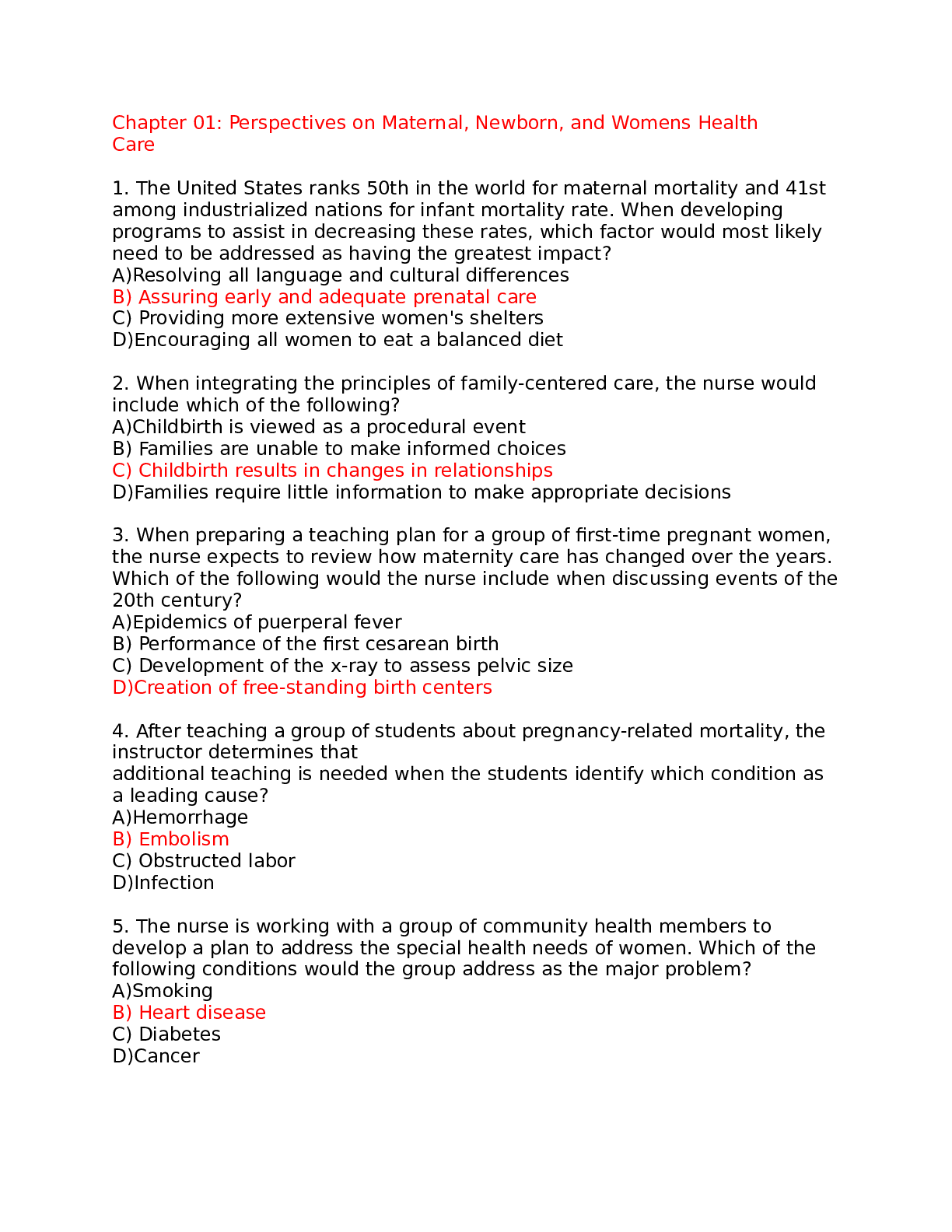
Chapter 01: Perspectives on Maternal, Newborn, and Womens Health
Care
1. The United States ranks 50th in the world for maternal mortality and 41st
among industrialized nations for infant mortality rate. When developing
programs to assist in decreasing these rates, which factor would most likely
need to be addressed as having the greatest impact?
A)Resolving all language and cultural differences
B) Assuring early and adequate prenatal care
C) Providing more extensive women's shelters
D)Encouraging all women to eat a balanced diet
2. When integrating the principles of family-centered care, the nurse would
include which of the following?
A)Childbirth is viewed as a procedural event
B) Families are unable to make informed choices
C) Childbirth results in changes in relationships
D)Families require little information to make appropriate decisions
3. When preparing a teaching plan for a group of first-time pregnant women,
the nurse expects to review how maternity care has changed over the years.
Which of the following would the nurse include when discussing events of the
20th century?
A)Epidemics of puerperal fever
B) Performance of the first cesarean birth
C) Development of the x-ray to assess pelvic size
D)Creation of free-standing birth centers
4. After teaching a group of students about pregnancy-related mortality, the
instructor determines that
additional teaching is needed when the students identify which condition as
a leading cause?
A)Hemorrhage
B) Embolism
C) Obstructed labor
D)Infection
5. The nurse is working with a group of community health members to
develop a plan to address the special health needs of women. Which of the
following conditions would the group address as the major problem?
A)Smoking
B) Heart disease
C) Diabetes
D)Cancer
6. When assessing a family for possible barriers to health care, the nurse
would consider which factor to be most important?
A)Language
B) Health care workers attitudes
C) Transportation
D)Finances
7. After teaching a group of nursing students about the issue of informed
consent. Which of the following, if identified by the student, would indicate
an understanding of a violation of informed consent?
A)Performing a procedure on a 15-year-old without consent
B) Serving as a witness to the signature process
C) Asking whether the client understands what she is signing
D)Getting verbal consent over the phone for emergency procedures
8. The nurse is trying to get consent to care for an 11-year-old boy with
diabetic ketoacidosis. His parents are out of town on vacation, and the child
is staying with a neighbor. Which action would be the priority?
A)Getting telephone consent with two people listening to the verbal consent
B) Providing emergency care without parental consent
C) Contacting the childs aunt or uncle to obtain their consent
D)Advocating for termination of parental rights for this situation
9. After teaching nursing students about the basic concepts of familycentered care, the instructor determines that the teaching was successful
when the students state which of the following?
A)Childbirth affects the entire family, and relationships will change.
B) Families are not capable of making health care decisions for themselves.
C) Mothers are the family members affected by childbirth.
D)Childbirth is a medical procedure.
10.A nursing instructor is preparing a class discussion on the trends in health
care and health care delivery
over the past several centuries. When discussing the changes during the
past century, which of the
following would the instructor be least likely to include?
A) Disease prevention
B) Health promotion
C) Wellness
D) Analysis of morbidity and mortality
11.A nurse is assigned to care for an Asian American client. The nurse
develops a plan of care with the
understanding that based on this clients cultural background, the client most
likely views illness as which
of the following?
A) Caused by supernatural forces.
B) A punishment for sins.
C) Due to spirits or demons.
D) From an imbalance of yin and yang
12.A nurse is developing a plan of care for a woman to ensure continuity of
care during pregnancy, labor, and childbirth. Which of the following would be
most important for the nurse to incorporate into that plan?
A) Adhering to strict, specific routines
B) Involving a pediatric physician
C) Educating the client about the importance of a support person
D) Assigning several nurses as a support team
13.A nursing instructor is preparing a class discussion on case management
in maternal and newborn health care. Which of the following would the
instructor include as a key component? Select all that apply.
A) Advocacy
B) Coordination
C) Communication
D) Resource management
E) Event managed care
14.After teaching a group of students about the concept of maternal
mortality, the instructor determines that additional teaching is needed when
the students state which of the following?
A) The rate includes accidental causes for deaths.
B) It addresses pregnancy-related causes.
C) The duration of the pregnancy is not a concern.
D) The time frame is typically for a specified year.
15.A group of students are reviewing the historical aspects about childbirth.
The students demonstrate
understanding of the information when they identify the use of twilight sleep
as a key event during which
time frame?
A) 1700s
B) 1800s
C) 1900s
D) 2000s
16.A nurse is providing care to a woman who has just delivered a healthy
newborn. Which action would least likely demonstrate application of the
concept of family-centered care?
A) Focusing on the birth as a normal healthy event for the family
B) Creating opportunities for the family to make informed decisions
C) Encouraging the woman to keep her other children at home
D) Fostering a sense of respect for the mother and the family
17.When discussing fetal mortality with a group of students, a nurse
addresses maternal factors. Which of the following would the nurse most
likely include? Select all that apply.
A) Chromosomal abnormalities
B) Malnutrition
C) Preterm cervical dilation
D) Underlying disease condition
E) Poor placental attachment
18.A nurse is preparing a presentation for a local community group about
health status and children health. Which of the following would the nurse
include as one of the most significant measures?
A) Fetal mortality rate
B) Neonatal mortality rate
C) Infant mortality rate
D) Maternal mortality rate
19.A group of students are reviewing an article describing information
related to indicators for women's health and the results of a national study.
Which of the following would the students identify as being satisfactory for
women? Select all that apply.
A) Smoking cessation
B) Colorectal cancer screening
C) Violence against women
D) Health insurance coverage
E) Mammograms
20.A nurse is preparing a presentation for a local women's group about heart
disease and women. Which of the following would the nurse expect to
address when discussing measures to promote health.
A) Women have similar symptoms as men for a heart attack.
B) Heart disease is no longer viewed as a man's disease.
C) Women experiencing a heart attack are at greater risk for dying.
D) Heart attacks in women are more easily diagnosed.
21.A nurse is working to develop a health education program for a local
community to address breast cancer awareness. Which of the following
would the nurse expect to include when describing this problem to the
group? Select all that apply.
A) White women have higher rates of breast cancer than African American
women.
B) African American women are more likely to die from breast cancer at any
age.
C) Survival at any stage is worse among white women.
D) Women living in South America have the highest rates of breast cancer.
E) Breast cancer is the leading cause of cancer mortality in women.
22.A group of nursing students are reviewing information about factors
affecting maternal, newborn, and
women's health. The students demonstrate understanding of the information
when they identify which of
the following deficiencies as being associated with poverty? Select all that
apply.
A) Literacy
B) Employment opportunities
C) Mobility
D) Political representation
E) Skills
Answer Key
1. B
2. C
3. D
4. B
5. B
6. D
7. A
8. A
9. A
10. D
11. D
12. C
13. A, B, C, D
14. A
15. C
16. C
17. B, C, D
18. C
19. B, E
20. C
21. A, B
22. A, B, C, D, E
Chapter 02: Family-Centered Community-Based Care
1. The nurse is caring for a 2-week-old newborn girl with a metabolic
disorder. Which of the following
activities would deviate from the characteristics of family-centered care?
A)Softening unpleasant information or prognoses
B) Evaluating and changing the nursing plan of care
C) Collaborating with the child and family as equals
D)Showing respect for the familys beliefs and wishes
2. The nurse is providing home care for a 6-year-old girl with multiple
medical challenges. Which of the
following activities would be considered the tertiary level of prevention?
A)Arranging for a physical therapy session
B) Teaching parents to administer albuterol
C) Reminding parent to give a full course of antibiotics
D)Giving a DTaP vaccination at the proper interval
3. A nursing student is reviewing information about documenting client care
and education in the medical
record and the purposes that it serves. The student demonstrates a need for
additional study when the nurse identifies which of the following as a reason?
A)Serves as a communication tool for the interdisciplinary team.
B) Demonstrates education the family has received if legal matters arise.
C) Permits others access to allow refusal of medical insurance coverage.
D)Verifies meeting client education standards set by the Joint Commission.
4. A pregnant client tells her nurse that she is interested in arranging a home
birth. After educating the client on the advantages and disadvantages, which
statement would indicate that the client understood the
information?
A)I like having the privacy, but it might be too expensive for me to set up in
my home.
B) I want to have more control, but I am concerned if an emergency would
arise.
C) It is safer because I will have a midwife.
D)The midwife is trained to resolve any emergency, and she can bring any
pain meds.
5. The nurse is making a home visit to a client who had a cesarean birth 3
days ago. Assessment reveals that the client is complaining of intermittent
pain, rating it as 8 on a scale of 1 to 10. She states, I'm pretty tired. And with
this pain, I havent been drinking and eating like I should. The medication
helps a bit but not much. My mom has been helping with the baby. Her
incision is clean, dry, and intact. Which nursing
diagnosis would the nurse identify as the priority for this client?
A)Impaired skin integrity related to cesarean birth incision
B) Fatigue related to effects of surgery and caretaking activities
C) Imbalanced nutrition, less than body requirements related to poor fluid
and food intake
D)Acute pain related to incision and cesarean birth
6. When caring for childbearing families from cultures different from ones
own, which of the following must be accomplished first?
A)Adapt to the practices of the familys culture
B) Determine similarities between both cultures
C) Assess personal feelings about that culture
D)Learn as much as possible about that culture
7. After teaching a group of students about the changes in health care
delivery and funding, which of the
following, if identified by the group as a current trend seen in the maternal
and child health care settings,
would indicate that the teaching was successful?
A)Increase in community settings for care
B) Decrease in family poverty level
C) Increase in hospitalization of children
D)Decrease in managed care
8. The nurse would recommend the use of which supplement as a primary
prevention strategy to prevent
neural tube defects with pregnant women?
A)Calcium
B) Folic acid
C) Vitamin C
D)Iron
9. Which action would the nurse include in a primary prevention program in
the community to help reduce the incidence of HIV infection?
A)Provide treatment for clients who test positive for HIV
B) Monitor viral load counts periodically
C) Educate clients in how to practice safe sex
D)Offer testing for clients who practice unsafe sex
10.When assuming the role of discharge planner for a woman requiring
ventilator support at home, the nurse would do which of the following?
A) Confer with the clients mother
B) Teach new self-care skills to the client
C) Determine if there is a need for back-up power
D) Discuss coverage with the insurance company
11.When comparing community-based nursing with nursing in the acute care
setting to a group of nursing
students, the nurse describes the challenges associated with communitybased nursing. Which of the
following would the nurse include?
A) Increased time available for education
B) Improved access to resources
C) Decision making in isolation
D) Greater environmental structure
12.After teaching a group of students about the different levels of
prevention, the instructor determines a need for additional teaching when
the students identify which of the following as a secondary prevention level
activity in community-based health care?
A) Teaching women to take folic acid supplements to prevent neural tube
defects
B) Working with women who are victims of domestic violence
C) Working with clients at an HIV clinic to provide nutritional and CAM
therapies
D) Teaching hypertensive clients to monitor blood pressure
13.A nursing instructor is describing trends in maternal and newborn health
care. The instructor addresses the length of stay for vaginal births during the
past decade, citing that which of the following denotes the
average stay?
A) 2448 hours or less
B) 7296 hours or less
C) 4872 hours or less
D) 96120 hours or less
14. Which of the following statements is accurate regarding women's health
care in todays system?
A) Women spend 95 cents of every dollar spent on health care.
B) Women make almost 90% of all health care decisions.
C) Women are still the minority in the United States.
D) Men use more health services than women.
15.A nurse is educating a client about a care plan. Which of the following
statements would be appropriate to assess the clients learning ability?
A) Did you graduate from high school; how many years of schooling did you
have?
B) Do you have someone in your family who would understand this
information?
C) Many people have trouble remembering information; is this a problem for
you?
D) Would you prefer that the doctor give you more detailed medical
information?
16.A nurse is developing cultural competence. Which of the following
indicates that the nurse is in the process of developing cultural knowledge?
Select all that apply.
A) Examining personal sociocultural heritage
B) Reviewing personal biases and prejudices
C) Seeking resources to further understanding of other cultures
D) Becoming familiar with other culturally diverse lifestyles
E) Performing a competent cultural assessment
F) Advocating for social justice to eliminate disparities.
17.A nurse is engaged in providing family-centered care for a woman and her
family. The nurse is providing instrumental support with which activity?
A) Explaining to the woman and family what to expect during the birth
process.
B) Assisting the woman in breathing techniques to cope with labor
contractions.
C) Reinforcing the woman's role as a mother after birth
D) Helping the family obtain extra financial help for prescribed phototherapy
18.A nurse is considering a change in employment from the acute care
setting to community-based nursing. The nurse is focusing her job search on
ambulatory care settings. Which of the following would the nurse most likely
find as a possible setting? Select all that apply.
A) Urgent care center
B) Hospice care
C) Immunization clinic
D) Physicians office
E) Day surgery center
F) Nursing home
19.A nursing instructor is presenting a class for a group of students about
community-based nursing
interventions. The instructor determines that additional teaching is needed
when the students identify which of the following?
A) Conducting childbirth education classes
B) Counseling a pregnant teen with anemia
C) Consulting with a parent of a child who is vomiting
D) Performing epidemiologic investigations
20.During class, a nursing student asks, I read an article that was talking
about integrative medicine. What is that? Which response by the instructor
would be most appropriate?
A) It refers to the use of complementary and alternative medicine in place of
traditional therapies for a
condition.
B) It means that complementary and alternative medicine is used together
with conventional therapies to
reduce pain or discomfort.
C) It means that mainstream medical therapies and complementary and
alternative therapies are combined
based on scientific evidence for being effective.
D) It refers to situations when a client and his or her family prefer to use an
unproven method of treatment
over a proven one.
21.While a nurse is obtaining a health history, the client tells the nurse that
she practices aromatherapy. The nurse interprets this as which of the
following?
A) Use of essential oils to stimulate the sense of smell to balance the mind
and body
B) Application of pressure to specific points to allow self-healing
C) Use of deep massage of areas on the foot or hand to rebalance body parts
D) Participation in chanting and praying to promote healing.
22.A pregnant woman asks the nurse about giving birth in a birthing center.
She says, I'm thinking about using one but I'm not sure. Which of the
following would the nurse need to integrate into the explanation about this
birth setting? (Select all that apply.)
A) An alternative for women who are uncomfortable with a home birth.
B) The longer length of stay needed when compared to hospital births
C) Focus on supporting women through labor instead of managing labor
D) View of labor and birth as a normal process requiring no intervention
E) Care provided primarily by obstetricians with midwives as backup care
23.A nurse practicing in the community is preparing a presentation for a
group of nursing students about this practice setting. Which of the following
would the nurse include as characteristic of this role?
A) Greater emphasis on direct physical care
B) Broader assessment to include the environment
C) Increased dependency on physician
D) Limited decision making and support
24.A nurse is preparing a teaching plan for a woman who is pregnant for the
first time. Which of the following would the nurse incorporate into the
teaching plan to foster the clients learning? (Select all that apply.)
A) Teach survival skills first
B) Use simple, nonmedical language
C) Refrain from using a hands-on approach
D) Avoid repeating information
E) Use visual materials such as photos and videos
25.A group of nurses are reviewing the steps for developing cultural
competence. The students demonstrate understanding when they identify
which of the following as the final step?
A) Cultural knowledge
B) Cultural skills
C) Cultural encounter
D) Cultural awareness
Answer Key
1. A
2. A
3. C
4. B
5. D
6. C
7. A
8. B
9. C
10. C
11. C
12. A
13. A
14. B
15. C
16. C, D
17. D
18. A, D, E
19. D
20. C
21. A
22. A, C, D
23. B
24. A, B, E
25. C
Chapter 03: Anatomy and Physiology of the Reproductive System
1. When describing the menstrual cycle to a group of young women, the
nurse explains that estrogen levels are highest during which phase of the
endometrial cycle?
A)Menstrual
B) Proliferative
C) Secretory
D)Ischemic
2. After teaching a group of adolescent girls about female reproductive
development, the nurse determines that teaching was successful when the
girls state that menarche is defined as a woman's first:
A)Sexual experience
B) Full hormonal cycle
C) Menstrual period
D)Sign of breast development
3. A client with a 28-day cycle reports that she ovulated on May 10. The
nurse would expect the clients next menses to begin on:
A)May 24
B) May 26
C) May 30
D)June 1
4. Which female reproductive tract structure would the nurse describe to a
group of young women as
containing rugae that enable it to dilate during labor and birth?
A)Cervix
B) Fallopian tube
C) Vagina
D)Vulva
5. After teaching a group of pregnant women about breast-feeding, the nurse
determines that the teaching was successful when the group identifies which
hormone as important for the production of breast milk after childbirth?
A)Placental estrogen
B) Progesterone
C) Gonadotropin-releasing hormone
D)Prolactin
6. The nurse is assessing a 13-year-old girl who has had her first menses.
Which of the following events would the nurse expect to have occurred first?
A)Evidence of pubic hair
B) Development of breast buds
C) Onset of menses
D)Growth spurt
7. When describing the ovarian cycle to a group of students, which phase
would the instructor include?
A) Luteal phase
B) Proliferative phase
C) Menstrual phase
D) Secretory phase
8. The nurse is explaining the events that lead up to ovulation. Which
hormone would the nurse identify as being primarily responsible for
ovulation?
A)Estrogen
B) Progesterone
C) Follicle-stimulating hormone
D)Luteinizing hormone
9. The nurse is teaching a health education class on male reproductive
anatomy and asks the students to
identify the site of sperm production. Which structure, if identified by the
group, would indicate to the nurse that the teaching was successful?
A)Testes
B) Seminal vesicles
C) Scrotum
D)Prostate gland
10.The nurse is creating a diagram that illustrates the components of the
male reproductive system. Which
structure would be inappropriate for the nurse to include as an accessory
gland?
A) Seminal vesicles
B) Prostate gland
C) Cowpers glands
D) Vas deferens
11.The nurse is preparing an outline for a class on the physiology of the male
sexual response. Which event would the nurse identify as occurring first?
A) Sperm emission
B) Penile vasodilation
C) Psychological release
D) Ejaculation
12.A woman comes to the clinic complaining that she has little sexual desire.
As part of the clients evaluation, the nurse would anticipate the need to
evaluate which hormone level?
A) Progesterone
B) Estrogen
C) Gonadotropin-releasing hormone
D) Testosterone
13.A nurse is conducting a class for a group of teenage girls about female
reproductive anatomy and
physiology. Which of the following would the nurse include as an external
female reproductive organ?
Select all that apply.
A) Mons pubis
B) Labia
C) Vagina
D) Clitoris
E) Uterus
14.When describing the hormones involved in the menstrual cycle, a nurse
identifies which hormone as
responsible for initiating the cycle?
A) Estrogen
B) Luteinizing hormone
C) Progesterone
D) Prolactin
15.A nursing instructor is describing the hormones involved in the menstrual
cycle to a group of nursing
students. The instructor determines the teaching was successful when the
students identify folliclestimulating hormone as being secreted by which of
the following?
A) Hypothalamus
B) Anterior pituitary gland
C) Ovaries
D) Corpus luteum
16.A woman comes to the clinic for an evaluation. During the visit, the
woman tells the nurse that her
menstrual cycles have become irregular. Ive also been waking up at night
feeling really hot and sweating.
The nurse interprets these findings as which of the following?
A) Menopause
B) Perimenopause
C) Climacteric
D) Menarche
17.After teaching a group of students about female reproductive anatomy,
the instructor determines that the teaching was successful when the
students identify which of the following as the site of fertilization?
A) Vagina
B) Uterus
C) Fallopian tubes
D) Vestibule
18.A woman comes to the clinic complaining of a vaginal discharge. The
nurse suspects that the client has an infection. When gathering additional
information, which of the following would the nurse be least likely to identify
as placing the client at risk for an infection?
A) Recent antibiotic therapy for an upper respiratory infection
B) Last menstrual period about 5 days ago.
C) Weekly douching
D) Frequent use of feminine hygiene sprays.
19.A group of nursing students are reviewing information about the male
reproductive structures. The students demonstrate understanding of the
information when they identify which of the following as accessory organs?
(Select all that apply.)
A) Testes
B) Vas deferens
C) Bulbourethral glands
D) Prostate gland
E) Penis
20.A nurse is examining a female client and tests the clients vaginal pH.
Which finding would the nurse
interpret as normal?
A) 4.5
B) 7
C) 8.5
D) 10
21.When describing the male sexual response to a group of students, the
instructor determines that the
teaching was successful when they identify emission as which of the
following?
A) Semen forced through the urethra to the outside
B) Movement of sperm from the testes and fluid into the urethras
C) Dilation of the penile arteries with increased blood flow to the tissues.
D) Bodys return to the physiologic nonstimulated state
22.A nurse is describing the structure and function of the reproductive
system to an adolescent health class. The nurse describes the secretion of
the seminal vesicles as which of the following?
A) Mucus-like
B) Alkaline
C) Acidic
D) Semen
Answer Key
1. B
2. C
3. A
4. C
5. D
6. B
7. A
8. D
9. A
10. D
11. B
12. D
13. A, B, D
14. B
15. B
16. B
17. C
18. B
19. B, C, D
20. A
21. B
22. B
Chapter 04: Common Reproductive Issues
1. After discussing various methods of contraception with a client and her
partner, the nurse determines that the teaching was successful when they
identify which contraceptive method as providing protection against sexually
transmitted infections (STIs)?
A)Oral contraceptives
B) Tubal ligation
C) Condoms
D)Intrauterine system
2. When discussing contraceptive options, which method would the nurse
recommend as being the most
reliable?
A)Coitus interruptus
B) Lactational amenorrheal method (LAM)
C) Natural family planning
D)Intrauterine system
3. A client comes to the clinic with abdominal pain. Based on her history the
nurse suspects endometriosis. The nurse expects to prepare the client for
which of the following to confirm this suspicion?
A)Pelvic examination
B) Transvaginal ultrasound
C) Laparoscopy
D)Hysterosalpingogram
4. A client is to receive an implantable contraceptive. The nurse describes
this contraceptive as containing:
A) Synthetic progestin
B) Combined estrogen and progestin
C) Concentrated spermicide
D) Concentrated estrogen
5. The nurse discusses various contraceptive methods with a client and her
partner. Which method would the nurse explain as being available only with
a prescription?
A)Condom
B) Spermicide
C) Diaphragm
D)Basal body temperature
6. When developing a teaching plan for a couple considering contraception
options, which of the following statements would the nurse include?
A)You should select one that is considered to be 100% effective.
B) The best one is the one that is the least expensive and most convenient.
C) A good contraceptive doesnt require a physicians prescription.
D)The best contraceptive is one that you will use correctly and consistently.
7. Which of the following measures would the nurse include in the teaching
plan for a woman to reduce the risk of osteoporosis after menopause?
A)Taking vitamin supplements
B) Eating high-fiber, high-calorie foods
C) Restricting fluid to 1,000 mL daily
D)Participating in regular daily exercise
8. When teaching a group of postmenopausal women about hot flashes and
night sweats, the nurse would
address which of the following as the primary cause?
A)Poor dietary intake
B) Estrogen deficiency
C) Active lifestyle
D)Changes in vaginal pH
9. A client states that she is to have a test to measure bone mass to help
diagnose osteoporosis. The nurse
would most likely plan to prepare the client for:
A)DEXA scan
B) Ultrasound
C) MRI
D)Pelvic x-ray
10.The nurse is reviewing the medical records of several clients. Which client
would the nurse expect to have an increased risk for developing
osteoporosis?
A) A woman of African American descent
B) A woman who plays tennis twice a week
C) A thin woman with small bones
D) A woman who drinks one cup of coffee a day
11.Which of the following would the nurse emphasize when teaching
postmenopausal women about ways to reduce the risk of osteoporosis?
A) Swimming daily
B) Taking vitamin A
C) Following a low-fat diet
D) Taking calcium supplements
12. Which finding would the nurse expect to find in a client with
endometriosis?
A) Hot flashes
B) Dysuria
C) Fluid retention
D) Fever
13.After the nurse teaches a client about ways to reduce the symptoms of
premenstrual syndrome, which client statement indicates a need for
additional teaching?
A) I will make sure to take my estrogen supplements a week before my
period.
B) Ive signed up for an aerobic exercise class three times a week.
C) I'll cut down on the amount of coffee and colas I drink.
D) I quit smoking about a month ago, so that should help.
14.A woman has opted to use the basal body temperature method for
contraception. The nurse instructs the client that a rise in basal body
temperature indicates which of the following?
A) Onset of menses
B) Ovulation
C) Pregnancy
D) Safe period for intercourse
15.A woman using the cervical mucus ovulation method of fertility
awareness reports that her cervical mucus looks like egg whites. The nurse
interprets this as which of the following?
A) Spinnbarkeit mucus
B) Purulent mucus
C) Postovulatory mucus
D) Normal preovulation mucus
16.The nurse is reviewing the laboratory test results of a client with
dysfunctional uterine bleeding (DUB). Which finding would be of concern?
A) Negative pregnancy test
B) Hemoglobin level of 10.1 g/dL
C) Prothrombin time of 60 seconds
D) Serum cholesterol of 140 mg/dL
17.A nurse is preparing a class for a group of women at a family planning
clinic about contraceptives. When describing the health benefits of oral
contraceptives, which of the following would the nurse most likely include?
(Select all that apply.)
A) Protection against pelvic inflammatory disease
B) Reduced risk for endometrial cancer
C) Decreased risk for depression
D) Reduced risk for migraine headaches
E) Improvement in acne
18.After teaching a group of students about the different methods for
contraception, the instructor determines that the teaching was successful
when the students identify which of the following as a mechanical barrier
method? (Select all that apply.)
A) Condom
B) Cervical cap
C) Cervical sponge
D) Diaphragm
E) Vaginal ring
19.After assessing a woman who has come to the clinic, the nurse suspects
that the woman is experiencing dysfunctional uterine bleeding. Which
statement by the client would support the nurses suspicions?
A) Ive been having bleeding off and on thats irregular and sometimes heavy.
B) I get sharp pain in my lower abdomen usually starting soon after my
period comes.
C) I get really irritable and moody about a week before my period.
D) My periods have been unusually long and heavy lately.
20.After teaching a group of students about premenstrual syndrome, the
instructor determines that additional teaching is needed when the students
identify which of the following as a prominent assessment finding?
A) Bloating
B) Tension
C) Dysphoria
D) Weight loss
21.A nurse is describing the criteria needed for the diagnosis of premenstrual
dysphoric disorder (PMDD). Which of the following would the nurse include as
a mandatory requirement for the diagnosis?
A) Appetite changes
B) Sleep difficulties
C) Persistent anger
D) Chronic fatigue
22.When reviewing the medical record of a client diagnosed with
endometriosis, which of the following would the nurse identify as a risk factor
for this woman?
A) Low fat in the diet
B) Age of 14 years for menarche
C) Menstrual cycles of 24 days
D) Short menstrual flow
23.A client who has come to the clinic is diagnosed with endometriosis.
Which of the following would the nurse expect the physician to prescribe as a
first-line treatment?
A) Progestins
B) Antiestrogens
C) Gonadotropin-releasing hormone analogues
D) NSAIDs
24.A woman comes to the clinic because she has been unable to conceive.
When reviewing the woman's
history, which of the following would the nurse least likely identify as a
possible risk factor?
A) Age of 25 years
B) History of smoking
C) Diabetes since age 15 years
D) Weight below standard for height and age
25.A couple comes to the clinic for a fertility evaluation. The male partner is
to undergo a semen analysis.
After teaching the partner about this test, which client statement indicates
that the client has understood the instructions?
A) I need to bring the specimen to the lab the day after collecting it.
B) I will place the specimen in a special plastic bag to transport it.
C) I have to abstain from sexual activity for about 1-2 days before the
sample.
D) I will withdraw before I ejaculate during sex to collect the specimen.
26.A nurse is preparing a class for a group of young adult women about
emergency contraceptives (ECs).
Which of the following would the nurse need to stress to the group. Select all
that apply.
A) ECs induce an abortion like reaction.
B) ECs provide some protection against STIs
C) ECs are birth control pills in higher, more frequent doses
D) ECs are not to be used in place of regular birth control
E) ECs provide little protection for future pregnancies.
Answer Key
1. C
2. D
3. C
4. A
5. C
6. D
7. D
8. B
9. A
10. C
11. D
12. B
13. A
14. B
15. A
16. B
17. A, B, E
18. A, B, C, D
19. A
20. D
21. C
22. C
23. D
24. A
25. C
26. C, D, E
Chapter 05: Sexually Transmitted Infections
1. The nurse is developing a plan of care for a client who is receiving highly
active antiretroviral therapy (HAART) for treatment of HIV. The goal of this
therapy is to:
A)Promote the progression of disease
B) Intervene in late-stage AIDS
C) Improve survival rates
D)Conduct additional drug research
2. A woman who is HIV-positive is receiving HAART and is having difficulty
with compliance. To promote adherence, which of the following areas would
be most important to assess initially?
A)The woman's beliefs and education
B) The woman's financial situation and insurance
C) The woman's activity level and nutrition
D)The woman's family and living arrangements
3. When developing a teaching plan for a community group about HIV
infection, which group would the nurse identify as an emerging risk group for
HIV infection?
A)Native Americans
B) Heterosexual women
C) New health care workers
D)Asian immigrants
4. After teaching a group of adolescents about HIV, the nurse asks them to
identify the major means by which adolescents are exposed to the virus. The
nurse determines that the teaching was successful when the group identifies
which of the following?
A)Sexual intercourse
B) Sharing needles for IV drug use
C) Perinatal transmission
D)Blood transfusion
5. The nurse reviews the CD4 cell count of a client who is HIV-positive. A
result less than which of the following would indicate to the nurse that the
client has AIDS?
A)1,000 cells/mm3
B) 700 cells/mm3
C) 450 cells/mm3
D)200 cells/mm3
6. When obtaining the health history from a client, which factor would lead
the nurse to suspect that the client has an increased risk for sexually
transmitted infections (STIs)?
A)Hive-like rash for the past 2 days
B) Five different sexual partners
C) Weight gain of 5 lbs in 1 year
D)Clear vaginal discharge
7. Assessment of a female client reveals a thick, white vaginal discharge. She
also reports intense itching and dyspareunia. Based on these findings, the
nurse would suspect that the client has:
A)Trichomoniasis
B) Bacterial vaginosis
C) Candidiasis
D)Genital herpes simplex
8. A client with trichomoniasis is to receive metronidazole (Flagyl). The nurse
instructs the client to avoid which of the following while taking this drug?
A)Alcohol
B) Nicotine
C) Chocolate
D)Caffeine
9. A woman gives birth to a healthy newborn. As part of the newborns care,
the nurse instills erythromycin ophthalmic ointment as a preventive measure
related to which STI?
A)Genital herpes
B) Hepatitis B
C) Syphilis
D)Gonorrhea
10. Which findings would the nurse expect to find in a client with bacterial
vaginosis?
A) Vaginal pH of 3
B) Fish-like odor of discharge
C) Yellowish-green discharge
D) Cervical bleeding on contact
11.A pregnant woman diagnosed with syphilis comes to the clinic for a visit.
The nurse discusses the risk of transmitting the infection to her newborn,
explaining that this infection is transmitted to the newborn through the:
A) Amniotic fluid
B) Placenta
C) Birth canal
D) Breast milk
12.The nurse encourages a female client with human papillomavirus (HPV) to
receive continued follow-up care because she is at risk for:
A) Infertility
B) Dyspareunia
C) Cervical cancer
D) Dysmenorrhea
13.A client is diagnosed with pelvic inflammatory disease (PID). When
reviewing the clients medical record, which of the following would the nurse
expect to find? (Select all that apply.)
A) Oral temperature of 100.4 degrees F
B) Dysmenorrhea
C) Dysuria
D) Lower abdominal tenderness
E) Discomfort with cervical motion
F) Multiparity
14. Which instructions would the nurse include when teaching a woman with
pediculosis pubis?
A) Take the antibiotic until you feel better.
B) Wash your bed linens in bleach and cold water.
C) Your partner doesnt need treatment at this time.
D) Remove the nits with a fine-toothed comb.
15.A client with genital herpes simplex infection asks the nurse, Will I ever be
cured of this infection? Which response by the nurse would be most
appropriate?
A) There is a new vaccine available that prevents the infection from
returning.
B) All you need is a dose of penicillin and the infection will be gone.
C) There is no cure, but drug therapy helps to reduce symptoms and
recurrences.
D) Once you have the infection, you develop an immunity to it.
16.A nurse is preparing a presentation for a group of women at the clinic who
have been diagnosed with genital herpes. Which of the following would the
nurse expect to include as a possible precipitating factor for a recurrent
outbreak? (Select all that apply.)
A) Exposure to ultraviolet light
B) Exercise
C) Use of corticosteroids
D) Emotional stress
E) Sexual intercourse.
17.After teaching a class on sexually transmitted infections, the instructor
determines that the teaching was successful when the class identifies which
statement as true?
A) STIs can affect anyone if exposed to the infectious organism.
B) STIs have been addressed more on a global scale.
C) Clients readily view the diagnosis of STI openly.
D) Most individuals with STIs are over the age of 30.
18.A group of students are reviewing information about STIs. The students
demonstrate understanding of the information when they identify which of
the following as the most common bacterial STI in the United States?
A) Gonorrhea
B) Chlamydia
C) Syphilis
D) Candidiasis
19.A nurse is assessing a client for possible risk factors for chlamydia and
gonorrhea. Which of the following would the nurse identify?
A) Asian American ethnicity
B) Age under 25 years
C) Married
D) Consistent use of barrier contraception
20.A nurse at a local community clinic is developing a program to address
STI prevention. Which of the following would the nurse least likely include in
the program?
A) Outlining safer sexual behavior
B) Recommending screening for symptomatic individuals
C) Promoting the use of barrier contraceptives
D) Offering education about STI transmission
21.After teaching a class on preventing pelvic inflammatory disease, the
instructor determines that the teaching was successful when the class
identifies which of the following as an effective method?
A) Advising sexually active females to use hormonal contraception
B) Encouraging vaginal douching on a weekly basis.
C) Emphasizing the need for infected sexual partners to receive treatment
D) Promoting routine treatment for asymptomatic females as risk
22.A group of nursing students are reviewing information about vaccines
used to prevent STIs. The students would expect to find information about
which of the following?
A) HIV
B) HSV
C) HPV
D) HAV
E) HBV
23.A mother brings her 12-year-old daughter in for well-visit checkup. During
the visit, the nurse is discussing the use of prophylactic HPV vaccine for the
daughter. The mother agrees and the daughter receives her first dose. The
nurse schedules the daughter for the next dose, which would be given at
which time?
A) In 2 month
B) In 2 months
C) In 3 months
D) In 4 months
24.A woman comes to the clinic complaining of a vaginal discharge. The
nurse suspects trichomoniasis based on which of the following? (Select all
that apply.)
A) Urinary frequency
B) Yellow/green discharge
C) Joint pain
D) Blister-like lesions
E) Muscle aches
25.A nurse is teaching a women with genital ulcers how to care for them.
Which statement by the client indicates a need for additional teaching?
A) I need to wash my hands after touching any of the ulcers.
B) I need to abstain from intercourse primarily when the lesions are present.
C) I should avoid applying ice or heat to my genital area.
D) I can try lukewarm sitz baths to help ease the discomfort.
Answer Key
1. C
2. A
3. B
4. A
5. D
6. B
7. C
8. A
9. D
10. B
11. B
12. C
13. B, C, D, E
14. D
15. C
16. A, C, D, E
17. A
18. B
19. B
20. B
21. C
22. C, D, E
23. B
24. A, B
25. B
Chapter 06: Disorders of the Breasts
1. The nurse is developing the discharge plan for a woman who has had a
left-sided modified radical mastectomy. The nurse is including instructions for
ways to minimize lymphedema. Which suggestion would most likely increase
the woman's symptoms?
A)Wear gloves when you are doing any gardening.
B) Have your blood pressure taken in your right arm.
C) Wear clothing with elasticized sleeves.
D)Avoid driving to and from work every day.
2. A laboratory technician arrives to draw blood for a complete blood count
(CBC. for a client who had a right-sided mastectomy 8 hours ago. The client
has an intravenous line with fluid infusing in her left antecubital space. To
obtain the blood specimen, the technician places a tourniquet on the clients
right arm. Which action by the nurse would be most appropriate?
A)Assist in holding the clients arm still.
B) Suggest a finger stick be done on one of the clients left fingers.
C) Tell the technician to obtain the blood sample from the clients left arm.
D)Call the surgeon to perform a femoral puncture.
3. The nurse determines that a woman has implemented prescribed therapy
for her fibrocystic breast disease when the client reports that she has
eliminated what from her diet?
A)Caffeine
B) Cigarettes
C) Dairy products
D)Sweets
4. When assessing a client with suspected breast cancer, which of the
following would the nurse expect to find?
A)Painful lump
B) Absence of dimpling
C) Regularly shaped mass
D)Nipple retraction
5. A woman who has undergone a right modified-radical mastectomy returns
from surgery. Which nursing intervention would be most appropriate at this
time?
A)Ask the client how she feels about having her breast removed.
B) Attach a sign above her bed to have BP, IV lines, and lab work in her right
arm.
C) Encourage her to turn, cough, and deep breathe at frequent intervals.
D)Position her right arm below heart level.
6. A breast biopsy indicates the presence of malignant cells, and the client is
scheduled for a mastectomy. Which nursing diagnosis would the nurse most
likely include in the clients preoperative plan of care as the priority?
A)Risk for deficient fluid volume
B) Activity intolerance
C) Disturbed body image
D)Impaired urinary elimination
7. A 42-year-old woman is scheduled for a mammogram. Which of the
following would the nurse include when teaching the woman about the
procedure?
A)The room will be darkened throughout the procedure.
B) Each breast will be firmly compressed between two plates.
C) Make sure to refrain from eating or drinking after midnight.
D)A small needle will be inserted to get a sample for evaluation.
8. During a clinical breast examination, the nurse palpates a well-defined,
firm, mobile lump in a 60-year-old woman's left breast. The nurse notifies the
physician. Which of the following would the nurse anticipate the physician to
order next?
A)Mammogram
B) Hormone receptor status
C) Fine-needle aspiration
D)Genetic testing for BRCA
9. A client with advanced breast cancer, who has had both chemotherapy
and radiation therapy, is to start hormonal therapy. Which agent would the
nurse expect the client to receive?
A)Progestins
B) Tamoxifen
C) Cortisone
D)Estrogen
10.As part of discharge planning, the nurse refers a woman to Reach to
Recovery. This groups primary purpose is to:
A) Help support women who have undergone mastectomies
B) Raise funds to support early breast cancer detection programs
C) Provide all supplies needed after breast surgery for no cost
D) Collect statistics for research for the American Cancer Society
11.A woman with breast cancer is undergoing chemotherapy. Which of the
following side effects would the nurse interpret as being most serious?
A) Vomiting
B) Hair loss
C) Fatigue
D) Myelosuppression
12.A woman comes to the clinic reporting a nipple discharge. On
examination, the area below the areola is red and slightly swollen, with
tortuous tubular swelling. The nurse interprets these findings as suggestive
of which of the following?
A) Fibrocystic breast disorder
B) Intraductal papilloma
C) Duct ectasia
D) Fibroadenoma
13. When performing a clinical breast examination, which would the nurse do
first?
A) Palpate the axillary area.
B) Compress the nipple for a discharge.
C) Palpate the breasts.
D) Inspect the breasts.
14.Evaluation of a woman with breast cancer reveals that her mass is
approximately 1.25 inches in diameter. Three adjacent lymph nodes are
positive. The nurse interprets this as indicating that the woman has which
stage of breast cancer?
A) 0
B) I
C) II
D) III
15.After teaching a woman how to perform breast self-examination, which
statement would indicate that the nurses instructions were successful?
A) I should lie down with my arms at my side when looking at my breasts.
B) I should use the fingerpads of my three middle fingers to apply pressure to
my breast.
C) I don't need to check under my arm on that side if my breast feels fine.
D) I need to work from the center of my breast outward toward my shoulder.
16.A nurse is working with a woman who has been diagnosed with severe
fibrocystic breast disease. When describing the medications that can be used
as treatment, which of the following would the nurse be least likely to
include?
A) Tamoxifen
B) Bromocriptine
C) Danazol
D) Penicillin
17.A group of students are reviewing information about benign and
malignant breast masses. The students demonstrate understanding when
they identify which of the following as indicating a benign breast mass.
(Select all the apply.)
A) Painless
B) Unilateral location
C) Firm consistency
D) Absence of dimpling
E) Fixed to chest wall
18.The nurse is developing a plan of care for a woman with breast cancer
who is scheduled to undergo breastconserving surgery. The nurse interprets
this as which of the following?
A) Removal of nipple and areolar area
B) Lump removal followed by radiation
C) Entire breast removal without lymph nodes
D) Axillary lymph node removal
19.A woman comes to the clinic and asks the nurse about when she should
have her first mammogram. Using the recommendations of the American
Cancer Society, which would the nurse suggest?
A) 30 years
B) 35 years
C) 40 years
D) 45 years
20.After teaching a group of nursing students about the different types of
chemotherapeutic agents used to treat breast cancer, the instructor
determines that the teaching was successful when the students identify
which of the following as an example of a selective estrogen receptor
modulator (SERM)? (Select all that apply.)
A) Tamoxifen
B) Letozole
C) Raloxifene
D) Exemestane
E) Anastrozole
21.A woman diagnosed with breast cancer is to receive trastuzumab. Which
of the following would the nurse incorporate into the explanation about how
this drug works?
A) It blocks the effect of the HER-2/neu protein inhibiting the growth of
cancer cells.
B) The drug blocks the conversion of androgens to estrogens
C) It interferes with hormone receptors that allow estrogen to enter a cell
D) The drug ultimately attacks areas where micrometastasis has occurred.
22.A nurse is conducting a class on breast cancer prevention. Which
statement would the nurse most likely include in the discussion?
A) Most often a lump is felt before it is seen.
B) Early breast cancer usually has some symptoms.
C) If the mass is not painful, it is usually benign.
D) If lump is palpable, it has been there for some time.
23.When describing programs for breast cancer screening, the nurse include
breast self-examination (BSE). Which of the following most accurately reflects
the current thinking about breast self-examination?
A) BSE is essential for early breast cancer detection.
B) A woman performing BSE has breast awareness.
C) BSE plays a minimal role in detecting breast cancer
D) A clinical breast exam has replaced BSE.
24.During a wellness visit to the clinic, a woman asks the nurse if there is
anything she can do to reduce her risk for developing breast cancer. Which of
the following would the nurse most likely include? (Select all that apply.)
A) Eating three servings of fruit daily
B) Keeping weight gain under 11 pounds after age 18
C) Eating at least seven portions of complex carbohydrates daily
D) Limiting the intake of refined sugar products
E) Using salt liberally when cooking
25.A woman comes to the clinic and tells the nurse that she has read an
article about certain foods that have anticancer properties and help boost
the immune system. The nurse identifies
A) Garlic
B) Soybeans
C) Milk
D) Leeks
E) Flax seeds
Answer Key
1. C
2. B
3. A
4. D
5. C
6. C
7. B
8. A
9. B
10. A
11. D
12. C
13. D
14. C
15. B
16. D
17. C, D
18. B
19. C
20. A, C
21. A
22. D
23. B
24. B, C, D
25. A, B, D, E
Chapter 07: Benign Disorders of the Female Reproductive Tract
1. A woman is admitted for repair of cystocele and rectocele. She has nine
living children. In taking her health history, which of the following would the
nurse expect to find?
A)Sporadic vaginal bleeding accompanied by chronic pelvic pain
B) Heavy leukorrhea with vulvar pruritus
C) Menstrual irregularities and hirsutism on the chin
D)Stress incontinence with feeling of low abdominal pressure
2. To assist the woman in regaining control of the urinary sphincter for
urinary incontinence, the nurse should teach the client to do which of the
following?
A)Perform Kegel exercises daily.
B) Void every hour while awake.
C) Limit her intake of fluid.
D)Take a laxative every night.
3. When developing the plan of care for a woman who has had an abdominal
hysterectomy, which of the following would be contraindicated?
A)Ambulating the client
B) Massaging the clients legs
C) Applying elasticized stockings
D)Encouraging range-of-motion exercises
4. Which of the following would the nurse include when teaching women
about preventing pelvic support disorders?
A)Performing Kegel isometric exercises
B) Consuming low-fiber diets
C) Using hormone replacement
D)Voiding every 2 hours
5. A client is diagnosed with an enterocele. The nurse interprets this
condition as:
A) Protrusion of the posterior bladder wall downward through the anterior
vaginal wall
B) Sagging of the rectum with pressure exerted against the posterior vaginal
wall
C) Bulging of the small intestine through the posterior vaginal wall
D) Descent of the uterus through the pelvic floor into the vagina
6. A woman is scheduled for an anterior and posterior colporrhaphy as
treatment for a cystocele. When the nurse is explaining this treatment to the
client, which of the following descriptions would be most appropriate to
include?
A)This procedure helps to tighten the vaginal wall in the front and back so
that your bladder and urethra are in the proper position.
B) Your uterus will be removed through your vagina, helping to relieve the
organ that is putting the pressure on your bladder.
C) This is a series of exercises that you will learn to do so that you can
strengthen your bladder muscles.
D)These are plastic devices that your physician will insert into your vagina to
provide support to the uterus and keep it in the proper position.
7. The nurse would be least likely to find which of the following in a client
with uterine fibroids?
A) Regularly shaped, shrunken uterus
B) Acute pelvic pain
C) Menorrhagia
D) Complaints of bloating
8. A client with polycystic ovarian syndrome (PCOS. is receiving oral
contraceptives as part of her treatment plan. The nurse understands that the
rationale for this therapy is to:
A)Restore menstrual regularity
B) Induce ovulation
C) Improve insulin uptake
D)Alleviate hirsutism
9. When teaching a woman how to perform Kegel exercises, the nurse
explains that these exercises are designed to strengthen which muscles?
A)Gluteus
B) Lower abdominal
C) Pelvic floor
D)Diaphragmatic
10.A postmenopausal woman with uterine prolapse is being fitted with a
pessary. The nurse would be most alert for which side effect?
A) Increased vaginal discharge
B) Urinary tract infection
C) Vaginitis
D) Vaginal ulceration
11.When preparing the discharge teaching plan for the woman who had
surgery to correct pelvic organ prolapse, which of the following would the
nurse include?
A) Care of the indwelling catheter at home
B) Emphasis on coughing to prevent complications
C) Return to usual activity level in a few days
D) Daily douching with dilute vinegar solution
12.A woman with polycystic ovary syndrome tells the nurse, I hate this
disease. Just look at me! I have no hair on the front of my head but Ive got
hair on my chin and upper lip. I don't feel like a woman anymore. Further
assessment reveals breast atrophy and increased muscle mass. Which
nursing diagnosis would most likely be a priority?
A) Situational low self-esteem related to masculinization effects of the
disease
B) Social isolation related to feelings about appearance
C) Risk for suicide related to effects of condition and fluctuating hormone
levels
D) Ineffective peripheral tissue perfusion related to effects of disease on
vasculature
13.After teaching a local woman's group about incontinence, the nurse
determines that the teaching was successful when the group identifies which
of the following as characteristic of stress incontinence?
A) Feeling a strong need to void
B) Passing a large amount of urine
C) Most common in women after childbirth
D) Sneezing may be an initiating stimulus
14.A woman is being evaluated for pelvic organ prolapse. A postvoid residual
urine specimen is obtained via a catheter. Which residual volume finding
would lead the nurse to suspect the need for further testing?
A) 50 mL
B) 75 mL
C) 100 mL
D) 120 mL
15.After teaching a woman with pelvic organ prolapse about dietary and
lifestyle measures, which of the following statements would indicate the
need for additional teaching?
A) If I wear a girdle, it will help support the muscles in the area.
B) I should take up jogging to make sure I exercise enough.
C) I will try to drink at least 64 oz of fluid each day.
D) I need to increase the amount of fiber I eat every day.
16.After teaching a group of students about genital fistulas, the instructor
determines that the teaching was successful when the students identify
which of the following as a major cause?
A) Radiation therapy
B) Congenital anomaly
C) Female genital cutting
D) Bartholins gland abscess
17.A nurse is providing care to a female client receiving treatment for a
Bartholins cyst. The client has had a small loop of plastic tubing secured in
place to allow for drainage. The nurse instructs the client that she will have a
follow-up appointment for removal of the plastic tubing at which time?
A) 1 week
B) 2 weeks
C) 3 weeks
D) 4 weeks
18.After undergoing diagnostic testing, a woman is diagnosed with a corpus
luteum cyst. The nurse anticipates that the woman will require:
A) Biopsy
B) No treatment
C) Oral contraceptives
D) Glucophage
19.A nurse is teaching a client how to perform Kegel exercises. Which of the
following would the nurse include? (Select all that apply.)
A) Squeeze your rectal muscles as if you are trying to avoid passing flatus.
B) Tighten your pubococcygeal muscles for a count of 10.
C) Contract and relax your pubococcygeal muscles rapidly 10 times.
D) Try bearing down for about 10 seconds for no more than 5 times.
E) Do these exercises at least 5 times every hour.
20.After teaching a group of students about pelvic organ prolapse, the
instructor determines that the teaching was successful when the group
identifies leiomyomas as which of the following?
A) Cysts
B) Pelvic organ prolapse
C) Fistula
D) Fibroid
21.A nurse is assessing a female client and suspects that the client may
have endometrial polyps based on which of the following?
A) Bleeding after intercourse
B) Vaginal discharge
C) Bleeding between menses
D) Metrorrhagia
22.After teaching a group of students about ovarian cysts, the instructor
determines that the teaching was successful when the students identify
which type of cyst as being associated with hydatiform mole?
A) Theca-lutein cyst
B) Corpus luteum cyst
C) Follicular cyst
D) Polycystic ovarian syndrome
23.A nurse is reading a journal article about care of the woman with pelvic
organ prolapse. The nurse would expect to find information related to which
of the following? (Select all that apply.)
A) Rectocele
B) Fecal incontinence
C) Cystocele
D) Urinary incontinence
E) Enterocele
24.A nurse is reviewing the medical record of a client. Which of the following
would lead the nurse to suspect that the client is experiencing polycystic
ovarian syndrome? (Select all that apply)
A) Decreased androgen levels
B) Elevated blood insulin levels
C) Anovulation
D) Waist circumference of 32 inches
E) Triglyceride level of 175 mg/dL
F) High-density lipoprotein level of 40 mg/dL
25.A group of students are preparing a class presentation about polyps.
Which of the following would the students most likely include in the
presentation?
A) Polyps are rarely the result of an infection.
B) Endocervical polyps commonly appear after menarche.
C) Cervical polyps are more common than endocervical polyps.
D) Endocervical polyps are most common in women in their 50s.
Answer Key
1. D
2. A
3. B
4. A
5. C
6. A
7. B
8. A
9. C
10. D
11. A
12. A
13. D
14. D
15. B
16. C
17. C
18. B
19. A, C
20. D
21. D
22. A
23. A, C, E
24. B, C, E
25. D
Chapter 08: Cancers of the Female Reproductive Tract
1. The nurse would refer a client, age 54, for follow-up for suspected
endometrial carcinoma if she reports which of the following?
A)Use of oral contraceptives between ages 18 and 25
B) Onset of painless, red postmenopausal bleeding
C) Menopause occurring at age 46
D)Use of intrauterine device for 3 years
2. Which of the following instructions would the nurse include when
preparing a woman for a Pap smear?
A) Refrain from sexual intercourse for 1 week before the test.
B) Wear cotton panties on the day of the test.
C) Avoid taking any medications for 24 hours.
D) Do not douche for 48 hours before the test.
3. A woman comes to the clinic for a routine checkup. A history of exposure
to which of the following would alert the nurse that she is at increased risk
for cervical cancer?
A)Hepatitis
B) Human papillomavirus
C) Cytomegalovirus
D)Epstein-Barr virus
4. A client is scheduled to have a Pap smear. After the nurse teaches the
client about the Pap smear, which of the following client statements indicates
successful teaching?
A)I need to douche the night before with a mild vinegar solution.
B) I will take a bath first thing that morning to make sure I'm clean.
C) I will not engage in sexual intercourse for 48 hours before the test.
D)I will get a clean urine specimen when I first wake up the morning of the
test.
5. Which finding obtained during a client history would the nurse identify as
increasing a clients risk for ovarian cancer?
A)Multiple sexual partners
B) Consumption of a high-fat diet
C) Underweight
D)Grand multiparity (more than five children)
6. A client is scheduled for cryosurgery to remove some abnormal tissue on
the cervix. The nurse teaches the client about this treatment, explaining that
the tissue will be removed by which method?
A)Freezing
B) Cutting
C) Burning
D)Irradiating
7. Which of the following statements best indicates that a client has taken
self-care measures to reduce her risk for cervical cancer?
A)Ive really cut down on the amount of caffeine I drink every day.
B) Ive thrown out all my bubble baths and just use soap and water now.
C) Every time I have sexual intercourse, I douche.
D)My partner always uses a condom when we have sexual intercourse.
8. A client is suspected of having endometrial cancer. The nurse would most
likely prepare the client for which procedure to confirm the diagnosis?
A)Transvaginal ultrasound
B) Colposcopy
C) Pap smear
D)Endometrial biopsy
9. Which of the following descriptions would the nurse include when teaching
a client about her scheduled colposcopy?
A)A gel will be applied to your abdomen and a microphone-like device will be
moved over the area to identify problem areas.
B) A solution will be wiped on your cervix to identify any abnormal cells,
which will be visualized with a magnifying instrument.
C) Scrapings of tissue will be obtained and placed on slides to be examined
under the microscope.
D)After you receive anesthesia, a small device will be inserted into your
abdomen near your belly button to obtain tissue samples.
10.The nurse is preparing a presentation for a local women's group about
ways to reduce the risk of reproductive tract cancers. Which of the following
would the nurse include?
A) Blood pressure evaluation every 6 months
B) Yearly Pap smears starting at age 40
C) Yearly cholesterol screening starting at age 45
D) Consumption of two to three glasses of red wine per day
11.The daughter of a woman who has been diagnosed with ovarian cancer
asks the nurse about screening for this cancer. Which response by the nurse
would be most appropriate?
A) Currently there is no reliable screening test for ovarian cancer.
B) A Pap smear is almost always helpful in identifying this type of cancer.
C) Theres a blood test for a marker, CA-125, that if elevated indicates cancer.
D) A genetic test for two genes, if positive, will identify the ovarian cancer.
12.Which of the following would the nurse be least likely to suggest when
teaching a group of young women how to reduce their risk for ovarian
cancer?
A) Pregnancy
B) Oral contraceptives
C) Feminine hygiene sprays
D) Breast-feeding
13.A woman is diagnosed with adenocarcinoma of the endometrium in situ.
The nurse interprets this as indicating which of the following about the
cancer?
A) Spread to the uterine muscle wall
B) Found on the endometrial surface
C) Spread to the cervix
D) Invaded the bladder
14.When preparing a woman with suspected vulvar cancer for a biopsy, the
nurse expects that the lesion would most likely be located at which area?
A) Labia majora
B) Labia minora
C) Clitoris
D) Prepuce
15.When describing the various types of reproductive tract cancers to a local
women's group, which of the following would the nurse identify as the least
common type?
A) Vulvar
B) Vaginal
C) Endometrial
D) Ovarian
16.When assessing a female client for the possibility of vulvar cancer, which
of the following would the nurse most likely expect the client to report?
(Select all that apply.)
A) Abnormal vaginal bleeding
B) Persistent vulvar itching
C) History of herpes simplex
D) Lesion on the cervix
E) Abnormal Pap smear
17.A nurse is reviewing the medical record of a woman diagnosed with vulvar
cancer. Which of the following would the nurse identify as a risk factor for
this cancer? (Select all that apply.)
A) Age under 40 years
B) HPV 16 exposure
C) Monogamous sexual partner
D) Hypertension
E) Diabetes
18.A nurse is assisting with the collection of a Pap smear. When collecting
the specimen, which of the following is done first?
A) Insertion of the speculum
B) Swabbing of the endocervix
C) Spreading of the labia
D) Insertion of the cytobrush
19.The plan of care for a woman diagnosed with a suspected reproductive
cancer includes a nursing diagnosis of disturbed body image related to
suspected reproductive tract cancer and impact on sexuality as evidenced by
the clients statement that she is worried that she won't be the same. Which
of the following would be an appropriate outcome for this client?
A) Client will verbalize positive statements about self and sexuality.
B) Client will demonstrate understanding of the condition and associated
treatment.
C) Client will exhibit positive coping strategies related to diagnosis.
D) Client will identify misconceptions related to her diagnosis.
20.During a routine health check-up, a young adult woman asks the nurse
about ways to prevent endometrial cancer. Which of the following would the
nurse most likely include? (Select all that apply.)
A) Eating a high-fat diet
B) Having regular pelvic exams
C) Engaging in daily exercise
D) Becoming pregnant
E) Using estrogen contraceptives
21.After teaching a group of students about cervical cancer, the instructor
determines that the teaching was successful when the students identify
which of the following as the area included with a cone biopsy?
A) Clitoris
B) Uterine fundus
C) Ovarian follicle
D) Transformation zone
22.A woman is scheduled for diagnostic testing to evaluate for endometrial
cancer. The nurse would expect to prepare the woman for which of the
following?
A) CA-125 testing
B) Transvaginal ultrasound
C) Pap smear
D) Mammography
23.A nurse is conducting a class for a local woman's group about
recommendations for a Pap smear. One of the participants asks, At what age
should a woman have her first Pap smear? The nurse responds by stating
that a woman should have her first Pap smear at which age?
A) 18
B) 21
C) 25
D) 28
24.An instructor is describing the development of cervical cancer to a group
of students. The instructor determines that the teaching was successful
when the students identify which area as most commonly involved?
A) Internal cervical os
B) Junction of the cervix and fundus
C) Squamous-columnar junction
D) External cervical os
25.A client has an abnormal Pap smear that is classified as ASC-US. Based on
the nurses understanding of this classification, the nurse would expect which
of the following?
A) Immediate colposcopy
B) Testing for HPV
C) Repeat Pap smear in 4 to 6 months
D) Cone biopsy
Answer Key
1. B
2. D
3. B
4. C
5. B
6. A
7. D
8. D
9. B
10. C
11. A
12. C
13. B
14. A
15. B
16. B, C
17. B, D, E
18. C
19. A
20. B, C, D
21. D
22. B
23. B
24. C
25. C
Chapter 09: Violence and Abuse
1. The nurse is presenting a class at a local community health center on
violence during pregnancy. Which of the following would the nurse include as
a possible complication?
A)Hypertension of pregnancy
B) Chorioamnionitis
C) Placenta previa
D)Postterm labor
2. Which approach would be most appropriate when counseling a woman
who is a suspected victim of violence?
A)Offer her a pamphlet about the local battered women's shelter.
B) Call her at home to ask her some questions about her marriage.
C) Wait until she comes in a few more times to make a better assessment.
D)Ask, Have you ever been physically hurt by your partner?
3. When describing an episode, the victim reports that she attempted to
calm her partner down to keep things from escalating. This behavior reflects
which phase of the cycle of violence?
A)Battering
B) Honeymoon
C) Tension-building
D)Reconciliation
4. A battered pregnant woman reports to the nurse that her husband has
stopped hitting her and promises never to hurt her again. Which of the
following is an appropriate response?
A)Thats great. I wish you both the best.
B) The cycle of violence often repeats itself.
C) He probably didn't mean to hurt you.
D)You need to consider leaving him.
5. Which of the following nursing actions would be least helpful for a client
who is a victim of violence?
A) Assist the client to project her anger.
B) Provide information about a safe home and crisis line.
C) Teach her about the cycle of violence.
D) Discuss her legal and personal rights.
6. When describing the cycle of violence to a community group, the nurse
explains that the first phase usually is:
A)Somehow triggered by the victims behavior
B) Characterized by tension-building and minor battery
C) Associated with loss of physical and emotional control
D)Like a honeymoon that lulls the victim
7. Which of the following statements would be most appropriate to empower
victims of violence to take action?
A)Give your partner more time to come around.
B) Remember, children do best in two-parent families.
C) Change your behavior so as not to trigger the violence.
D)You are a good person and you deserve better than this.
8. When a nurse suspects that a client may have been abused, the first
action should be to:
A) Ask the client about the injuries and if they are related to abuse.
B) Encourage the client to leave the batterer immediately.
C) Set up an appointment with a domestic violence counselor.
D) Ask the suspected abuser about the victims injuries.
9. Which of the following would the nurse describe as a characteristic of the
second phase of the cycle of violence?
A)The batterer is contrite and attempts to apologize for the behavior.
B) The physical battery is abrupt and unpredictable.
C) Verbal assaults begin to escalate toward the victim.
D)The victim accepts the anger as legitimately directed at her.
10.In addition to providing privacy, which of the following would be most
appropriate initially in situations involving suspected abuse?
A) Allow the client to have a good cry over the situation.
B) Tell the client, Injuries like these don't usually happen by accident.
C) Call the police immediately so they can question the victim.
D) Ask the abuser to describe his side of the story first.
11.When the nurse is alone with a client, the client says, It was all my fault.
The house was so messy when he got home and I know he hates that. Which
response would be most appropriate?
A) It is not your fault. No one deserves to be hurt.
B) What else did you do to make him so angry with you?
C) You need to start to clean the house early in the day.
D) Remember, he works hard and you need to meet his needs.
12.When developing a presentation for a local community organization on
violence, the nurse is planning to include statistics on intimate partner abuse
and its effects on children. In what percentage of the cases in which a parent
is abused are the children battered also?
A) 50% to 75%
B) 25% to 50%
C) 10% to 25%
D) Less than 5%
13. The primary goal when working with victims of intimate partner violence
is to:
A) Convince them to leave the abuser soon
B) Help them cope with their life as it is
C) Empower them to regain control of their life
D) Arrest the abuser so he or she can't abuse again
14. Teaching for victims who are recovering from abusive situations must
focus on ways to:
A) Enhance their personal appearance and hairstyle
B) Develop their creativity and work ethic
C) Improve their communication skills and assertiveness
D) Plan more nutritious meals to improve their own health
15.During a follow-up visit to the clinic, a victim of sexual assault reports that
she has changed her job and moved to another town. She tells the nurse, I
pretty much stay to myself at work and at home. The nurse interprets these
findings to indicate that the client is in which phase of rape recovery?
A) Disorganization
B) Denial
C) Reorganization
D) Integration
16.A nurse is assessing a rape survivor for post-traumatic stress disorder.
The nurse asks the woman, Do you feel as though you are reliving the
trauma? The nurse is assessing for which of the following?
A) Physical symptoms
B) Intrusive thoughts
C) Avoidance
D) Hyperarousal
17.A group of students are preparing a class discussion about rape and
sexual assault. Which of the following would the students include as being
most accurate? (Select all that apply.)
A) Most victims of rape tell someone about it.
B) Few women falsely cry rape.
C) Women have rape fantasies desiring to be raped.
D) A rape victim feels vulnerable and betrayed afterwards.
E) Medication and counseling can help a rape victim cope.
18.After teaching a class on date rape, the instructor determines that the
teaching was successful when the class identifies which of the following as
the most common date rape drug?
A) Gamma hydroxybutyrate
B) Liquid ecstasy
C) Ketamine
D) Rohypnol
19.A nurse is caring for a woman who was recently raped. The nurse would
expect this woman to experience which of the following first?
A) Denial
B) Disorganization
C) Reorganization
D) Integration
20.A group of nurses are researching information about risk factors for
intimate partner violence in men. Which of the following would the nurses
expect to find related to the individual person? (Select all that apply.)
A) Dysfunctional family system
B) Low academic achievement
C) Victim of childhood violence
D) Heavy alcohol consumption
E) Economic stress
21.A nurse is working with a victim of intimate partner violence and helping
her develop a safety plan. Which of the following would the nurse suggest
that the woman take with her? (Select all that apply.)
A) Drivers license
B) Social security number
C) Cash
D) Phone cards
E) Health insurance cards
22.A nurse is presenting a discussion on sexual violence at a local
community college. When describing the incidence of sexual violence, the
nurse would identify that a woman has which chance of experiencing a
sexual assault in her lifetime?
A) One in three
B) One in six
C) Two in 15
D) Three in 20
23.After teaching a class on sexual violence, the instructor determines that
the teaching was successful when the class identifies which of the following
as a type of sexual violence. (Select all that apply.)
A) Female genital cutting
B) Bondage
C) Infanticide
D) Human trafficking
E) Rape
24.A nurse is reading a journal article about sexual abuse. Which age range
would the nurse expect to find as the peak age for such abuse?
A) 710 years
B) 812 years
C) 1418 years
D) 1822 years
25.After teaching a group of students about sexual abuse and violence, the
instructor determines that the teaching was successful when the students
describe incest as involving which of the following?
A) Sexual exploitation by blood or surrogate relatives
B) Sexual abuse of individuals over age 18
C) Violent aggressive assault on a person
D) Consent between perpetrator and victim.
Answer Key
1. B
2. D
3. C
4. B
5. A
6. B
7. D
8. A
9. B
10. B
11. A
12. A
13. C
14. C
15. C
16. B
17. B, D, E
18. D
19. B
20. B, C, D
21. A, B, C, E
22. B
23. A, B, C, D, E
24. B
25. A
Chapter 10: Fetal Development and Genetics
1. While talking with a pregnant woman who has undergone genetic testing,
the woman informs the nurse that her baby will be born with Down
syndrome. The nurse understands that Down syndrome is an example of:
A)Multifactorial inheritance
B) X-linked recessive inheritance
C) Trisomy numeric abnormality
D)Chromosomal deletion
2. A nurse is describing advances in genetics to a group of students. Which
of the following would the nurse least likely include?
A)Genetic diagnosis is now available as early as the second trimester.
B) Genetic testing can identify presymptomatic conditions in children.
C) Gene therapy can be used to repair missing genes with normal ones.
D)Genetic agents may be used in the future to replace drugs.
3. After teaching a group of students about fetal development, the instructor
determines that the teaching was successful when the students identify
which of the following as providing the barrier to other sperm after
fertilization?
A)Zona pellucida
B) Zygote
C) Cleavage
D)Morula
4. A nurse is teaching a class on X-linked recessive disorders. Which of the
following statements would the nurse most likely include?
A)Males are typically carriers of the disorders.
B) No male-to-male transmission occurs.
C) Daughters are more commonly affected with the disorder.
D)Both sons and daughters have a 50% risk of the disorder.
5. A pregnant woman undergoes maternal serum alpha-fetoprotein (MSAFP)
testing at 16 to 18 weeks gestation. Which of the following would the nurse
suspect if the woman's level is decreased?
A)Down syndrome
B) Sickle-cell anemia
C) Cardiac defects
D)Open neural tube defect
6. The nurse is developing a presentation for a community group of young
adults discussing fetal development and pregnancy. The nurse would identify
that the sex of offspring is determined at the time of:
A)Meiosis
B) Fertilization
C) Formation of morula
D)Oogenesis
7. When describing amniotic fluid to a pregnant woman, the nurse would
include which of the following?
A) This fluid acts as transport mechanism for oxygen and nutrients.
B) The fluid is mostly protein to provide nourishment to your baby.
C) This fluid acts as a cushion to help to protect your baby from injury.
D) The amount of fluid remains fairly constant throughout the pregnancy.
8. Assessment of a pregnant woman reveals oligohydramnios. The nurse
would be alert for the development of which of the following?
A)Maternal diabetes
B) Placental insufficiency
C) Neural tube defects
D)Fetal gastrointestinal malformations
9. A couple comes to the clinic for preconception counseling and care. As
part of the visit, the nurse teaches the couple about fertilization and initial
development, stating that the zygote formed by the union of the ovum and
sperm consists of how many chromosomes?
A)22
B) 23
C) 44
D)46
10.A woman just delivered a healthy term newborn. Upon assessing the
umbilical cord, the nurse would identify which of the following as normal?
(Select all that apply.)
A) One vein
B) Two veins
C) One artery
D) Two arteries
E) One ligament
F) Two ligaments
11.After teaching a pregnant woman about the hormones produced by the
placenta, the nurse determines that the teaching was successful when the
woman identifies which hormone produced as being the basis for pregnancy
tests?
A) Human placental lactogen (hPL)
B) Estrogen (estriol)
C) Progesterone (progestin)
D) Human chorionic gonadotropin (hCG)
12.After the nurse describes fetal circulation to a pregnant woman, the
woman asks why her fetus has a different circulation pattern than hers. In
planning a response, the nurse integrates understanding of which of the
following?
A) Fetal blood is thicker than that of adults and needs different pathways.
B) Fetal circulation carries highly oxygenated blood to vital areas first.
C) Fetal blood has a higher oxygen saturation and circulates more slowly.
D) Fetal heart rates are rapid and circulation time is double that of adults.
13.When describing genetic disorders to a group of childbearing couples, the
nurse would identify which as an example of an autosomal dominant
inheritance disorder?
A) Huntingtons disease
B) Sickle cell disease
C) Phenylketonuria
D) Cystic fibrosis
14.Prenatal testing is used to assess for genetic risks and to identify genetic
disorders. In explaining to a couple about an elevated alpha-fetoprotein
screening test result, the nurse would discuss the need for:
A) Special care needed for a Down syndrome infant
B) A more specific determination of the acidbase status
C) Further, more definitive evaluations to conclude anything
D) Immediate termination of the pregnancy based on results
15.A nursing instructor is preparing a teaching plan for a group of nursing
students about the potential for misuse of genetic discoveries and advances.
Which the following would the instructor most likely include?
A) Gene replacement therapy for defective genes
B) Individual risk profiling and confidentiality
C) Greater emphasis on the causes of diseases
D) Slower diagnosis of specific diseases
16.After teaching a class on the stages of fetal development, the instructor
determines that the teaching was successful when the students identify
which of the following as a stage? (Select all that apply.)
A) Placental
B) Preembryonic
C) Umbilical
D) Embryonic
E) Fetal
17.A nurse is discussing fetal development with a pregnant woman. The
woman is 12 weeks pregnant and asks, Whats happening with my baby?
Which of the following would the nurse integrate into the response?
(Select all that apply.)
A) Continued sexual differentiation
B) Eyebrows forming
C) Startle reflex present
D) Digestive system becoming active
E) Lanugo present on the head
18.After teaching a group of students about fetal development, the instructor
determines that the teaching was successful when the students identify
which of the following as essential for fetal lung development?
A) Umbilical cord
B) Amniotic fluid
C) Placenta
D) Trophoblasts
19.During a prenatal class for a group of new mothers, the nurse is
describing the hormones produced by the placenta. Which of the following
would the nurse include? (Select all that apply.)
A) Prolactin
B) Estriol
C) Relaxin
D) Progestin
E) Human chorionic somatomammotropin
20.When describing the structures involved in fetal circulation, the nursing
instructor describes which structure as the opening between the right and
left atrium?
A) Ductus venosus
B) Foramen ovale
C) Ductus arteriosus
D) Umbilical artery
21.A group of students are reviewing information about genetic inheritance.
The students demonstrate understanding of the information when they
identify which of the following as an example of an autosomal recessive
disorder? (Select all that apply.)
A) Cystic fibrosis
B) Phenylketonuria
C) Tay-Sachs disease
D) Polycystic kidney disease
E) Achondroplasia
22.A nurse is assessing a child with Klinefelters syndrome. Which of the
following would the nurse expect to assess? (Select all that apply.)
A) Gross mental retardation
B) Long arms
C) Profuse body hair
D) Gynecomastia
E) Enlarged testicles
23.A woman is scheduled to undergo fetal nuchal translucency testing.
Which of the following would the nurse include when describing this test?
A) A needle will be inserted directly into the fetuss umbilical vessel.
B) Youll have an intravaginal ultrasound to measure fluid in the fetus.
C) The doctor will take a sample of fluid from your bag of waters.
D) A small piece of tissue from the fetal part of the placenta is taken.
Answer Key
1. C
2. A
3. A
4. B
5. A
6. B
7. C
8. B
9. D
10. A
11. D
12. B
13. A
14. C
15. B
16. B, C, E
17. A, D
18. B
19. B, C, D, E
20. B
21. A
22. B, D
23. B
Chapter 11: Maternal Adaptation During Pregnancy
1. During a vaginal exam, the nurse notes that the cervix has a bluish color.
The nurse documents this finding as:
A)Hegars sign
B) Goodells sign
C) Chadwicks sign
D)Ortolanis sign
Feedback:
Bluish coloration of the cervix is termed Chadwick's sign. Hegar's sign refers
to the softening of the lower uterine segment or isthmus. Goodell's sign
refers to the softening of the cervix. Ortolani's sign is a maneuver done to
identify developmental dysplasia of the hip in infants.
2. The nurse teaches a primigravida client that lightening occurs about 2
weeks before the onset of labor. The mother will most likely experience
which of the following at that time?
A)Dysuria
B) Dyspnea
C) Constipation
D)Urinary frequency
Feedback:
Lightening refers to the descent of the fetal head into the pelvis and
engagement. With this descent, pressure on the diaphragm decreases,
easing breathing, but pressure on the bladder increases, leading to urinary
frequency. Dysuria might indicate a urinary tract infection. Constipation may
occur throughout pregnancy due to decreased peristalsis, but it is unrelated
to lightening
3. A gravida 2 para 1 client in the 10th week of her pregnancy says to the
nurse, Ive never urinated as often as I have for the past three weeks. Which
response would be most appropriate for the nurse to make?
A)Having to urinate so often is annoying. I suggest that you watch how much
fluid you are drinking and limit it.
B) You shouldn't be urinating this frequently now; it usually stops by the time
youre eight weeks pregnant. Is there anything else bothering you?
C) By the time you are 12 weeks pregnant, this frequent urination should no
longer be a problem, but it is likely to return toward the end of your
pregnancy.
D)Women having their second child generally don't have frequent urination.
Are you experiencing any burning sensations?
Feedback:
As the uterus grows, it presses on the urinary bladder, causing the increased
frequency of urination during the first trimester. This complaint lessens
during the second trimester only to reappear in the third trimester as the
fetus begins to descend into the pelvis, causing pressure on the bladder.
4. In a clients seventh month of pregnancy, she reports feeling dizzy, like I'm
going to pass out, when I lie down flat on my back. The nurse integrates
which of the following in to the explanation?
A)Pressure of the gravid uterus on the vena cava
B) A 50% increase in blood volume
C) Physiologic anemia due to hemoglobin decrease
D)Pressure of the presenting fetal part on the diaphragm
Feedback:
The client is describing symptoms of supine hypotension syndrome, which
occurs when the heavy gravid uterus falls back against the superior vena
cava in the supine position. The vena cava is compressed, reducing venous
return, cardiac output, and blood pressure, with increased orthostasis. The
increased blood volume and physiologic anemia are unrelated to the client's
symptoms. Pressure on the diaphragm would lead to dyspnea.
5. A primiparous client is being seen in the clinic for her first prenatal visit. It
is determined that she is 11 weeks pregnant. The nurse develops a teaching
plan to educate the client about what she will most likely experience during
this period. Which of the following would the nurse include?
A)Ankle edema
B) Urinary frequency
C) Backache
D)Hemorrhoids
Feedback:
The client is in her first trimester and would most likely experience urinary
frequency as the growing uterus presses on the bladder. Ankle edema,
backache, and hemorrhoids would be more common during the later stages
of pregnancy.
6. A pregnant client in her second trimester has a hemoglobin level of 11
g/dL. The nurse interprets this as indicating which of the following?
A)Iron-deficiency anemia
B) A multiple gestation pregnancy
C) Greater-than-expected weight gain
D)Hemodilution of pregnancy
Feedback:
During pregnancy, the red blood cell count increases along with an increase
in plasma volume. However, there is a greater increase in the plasma volume
as a result of hormonal factors and sodium and water retention. Thus, the
plasma increase exceeds the increase in RBCs, resulting in hemodilution of
pregnancy, which is also called physiologic anemia of pregnancy. Changes in
maternal iron levels would be more indicative of an iron-deficiency anemia.
Although anemia may be present with a multiple gestation, an ultrasound
would be a more reliable method of identifying it. Weight gain does not
correlate with hemoglobin levels.
7. The nurse is discussing the insulin needs of a primaparous client with
diabetes who has been using insulin for the past few years. The nurse
informs the client that her insulin needs will increase during pregnancy
based on the nurses understanding that the placenta produces:
A)hCG, which increases maternal glucose levels
B) hPL, which deceases the effectiveness of insulin
C) Estriol, which interferes with insulin crossing the placenta
D)Relaxin, which decreases the amount of insulin produced
Feedback:
hPL acts as an antagonist to insulin, so the mother must produce more
insulin to overcome this resistance. If the mother has diabetes, then her
insulin need would most likely increase to meet this demand. hCG does not
affect insulin and glucose level. Estrogen, not estriol, is believed to oppose
insulin. In addition, insulin does not cross the placenta. Relaxin is not
associated with insulin resistance.
8. When teaching a pregnant client about the physiologic changes of
pregnancy, the nurse reviews the effect of pregnancy on glucose
metabolism. Which of the following would the nurse include as the
underlying reason
for the effect?
A)Pancreatic function is affected by pregnancy.
B) Glucose is utilized more rapidly during a pregnancy.
C) The pregnant woman increases her dietary intake.
D)Glucose moves through the placenta to assist the fetus.
Feedback:
The growing fetus has large needs for glucose, amino acids, and lipids,
placing demands on maternal glucose stores. During the first half of
pregnancy, much of the maternal glucose is diverted to the growing fetus.
The pancreas continues to function during pregnancy. However, the placental
hormones can affect maternal insulin levels. The demand for glucose by the
fetus during pregnancy is high, but it is not necessarily used more rapidly.
Placental hormones, not the woman's dietary intake, play a major role in
glucose metabolism during pregnancy.
9. When assessing a woman in her first trimester, which emotional response
would the nurse most likely expect to find?
A)Ambivalence
B) Introversion
C) Acceptance
D)Emotional lability
Feedback:
During the first trimester, the pregnant woman commonly experiences
ambivalence, with conflicting feelings at the same time. Introversion
heightens during the first and third trimesters when the woman's focus is on
behaviors that will ensure a safe and healthy pregnancy outcome.
Acceptance usually occurs during the second trimester. Emotional lability
(mood swings) is characteristic throughout a woman's pregnancy
10.The nurse is assessing a pregnant woman in the second trimester. Which
of the following tasks would indicate to the nurse that the client is
incorporating the maternal role into her personality?
A) The woman demonstrates concern for herself and her fetus as a unit.
B) The client identifies what she must give up to assume her new role.
C) The woman acknowledges the fetus as a separate entity within her.
D) The client demonstrates unconditional acceptance without rejection.
Feedback:
Incorporation of the maternal role into her personality indicates acceptance
by the pregnant woman. In doing so, the woman becomes able to identify
the fetus as a separate individual. Demonstrating concern for herself and her
fetus as a unit is associated with introversion and more commonly occurs
during the third trimester. Identification of what the mother must give up to
assume the new role occurs during the first trimester. Demonstrating
unconditional acceptance without rejection occurs during the third trimester.
11.A woman comes to the prenatal clinic suspecting that she is pregnant,
and assessment reveals probable signs of pregnancy. Which of the following
would be included as part of this assessment? (Select all that apply.)
A) Positive pregnancy test
B) Ultrasound visualization of the fetus
C) Auscultation of a fetal heart beat
D) Ballottement
E) Absence of menstruation
F) Softening of the cervix
Feedback:
Probable signs of pregnancy include a positive pregnancy test, ballottement,
and softening of the cervix (Goodell's sign). Ultrasound visualization of the
fetus, auscultation of a fetal heart beat, and palpation of fetal movements
are considered positive signs of pregnancy. Absence of menstruation is a
presumptive sign of pregnancy.
12.The nurse is teaching a pregnant woman about recommended weight
gain. The woman has a pre-pregnancy body mass index of 26. The nurse
determines that the teaching was successful when the woman states that
she should gain no more than which amount during pregnancy?
A) 35 to 40 pounds
B) 25 to 35 pounds
C) 28 to 40 pounds
D) 15 to 25 pounds
Feedback:
A woman with a body mass index of 26 is considered overweight and should
gain no more than 15 to 25 pounds during pregnancy. Women with a body
mass index of 18.5 to 24.9 (considered healthy weight) should gain 25 to 35
pounds. A woman with a body mass index less than 18.5 should gain 28 to
40 pounds.
13.A nurse strongly encourages a pregnant client to avoid eating swordfish
and tilefish because these fish contain which of the following?
A) Excess folic acid, which could increase the risk for neural tube defects
B) Mercury, which could harm the developing fetus if eaten in large amounts
C) Lactose, which leads to abdominal discomfort, gas, and diarrhea
D) Low-quality protein that does not meet the woman's requirements
Feedback:
Nearly all fish and shellfish contain traces of mercury and some contain
higher levels of mercury that may harm the developing fetus if ingested by
pregnant women in large amounts. Among these fish are shark, swordfish,
king mackerel, and tilefish. Folic acid is found in dark green vegetables,
baked beans, black-eyed peas, citrus fruits, peanuts, and liver. Folic acid
supplements are needed to prevent neural tube defects. Women who are
lactose intolerant experience abdominal discomfort, gas, and diarrhea if they
ingest foods containing lactose. Fish and shellfish are an important part of a
healthy diet because they contain high-quality proteins, are low in saturated
fat, and contain omega-3 fatty acids.
14.Which of the following changes in the musculoskeletal system would the
nurse mention when teaching a group of pregnant women about the
physiologic changes of pregnancy?
A) Ligament tightening
B) Decreased swayback
C) Increased lordosis
D) Joint contraction
Feedback:
With pregnancy, the woman's center of gravity shifts forward, requiring a
realignment of the spinal curvatures. There is an increase in the normal
lumbosacral curve (lordosis). Ligaments of the sacroiliac joints and pubis
symphysis soften and stretch. Increased swayback and an upper spine
extension to compensate for the enlarging abdomen occur. Joint relaxation
and increased mobility occur due to the influence of the hormones relaxin
and progesterone.
15.Assessment of a pregnant woman reveals a pigmented line down the
middle of her abdomen. The nurse documents this as which of the following?
A) Linea nigra
B) Striae gravidarum
C) Melasma
D) Vascular spiders
Feedback:
Linea nigra refers to the darkened line of pigmentation down the middle of
the abdomen in pregnant women. Striae gravidarum refers to stretch marks,
irregular reddish streaks on the abdomen, breasts, and buttocks. Melasma
refers to the increased pigmentation on the face, also known as the mask of
pregnancy. Vascular spiders are small, spiderlike blood vessels that appear
usually above the waist and on the neck, thorax, face, and arms.
16.A nurse is assessing a pregnant woman on a routine checkup. When
assessing the woman's gastrointestinal tract, which of the following would
the nurse expect to find? (Select all that apply.)
A) Hyperemic gums
B) Increased peristalsis
C) Complaints of bloating
D) Heartburn
E) Nausea
Feedback:
Gastrointestinal system changes include hyperemic gums due to estrogen
and increased proliferation of blood vessels and circulation to the mouth;
slowed peristalsis; acid indigestion and heartburn; bloating and nausea and
vomiting.
17.A woman suspecting she is pregnant asks the nurse about which signs
would confirm her pregnancy. The nurse would explain that which of the
following would confirm the pregnancy?
A) Absence of menstrual period
B) Abdominal enlargement
C) Palpable fetal movement
D) Morning sickness
Feedback:
Only positive signs of pregnancy would confirm a pregnancy. The positive
signs of pregnancy confirm that a fetus is growing in the uterus. Visualizing
the fetus by ultrasound, palpating for fetal movements, and hearing a fetal
heartbeat are all signs that make the pregnancy a certainty. Absence of
menstrual period and morning sickness are presumptive signs, which can be
due to conditions other than pregnancy. Abdominal enlargement is a
probable sign.
18.A nurse is developing a teaching plan about nutrition for a group of
pregnant women. Which of the following would the nurse include in the
discussion? (Select all that apply.)
A) Keep weight gain to 15 lb
B) Eat three meals with snacking
C) Limit the use of salt in cooking
D) Avoid using diuretics
E) Participate in physical activity
Feedback:
To promote optimal nutrition, the nurse would recommend gradual and
steady weight gain based on the client's prepregnant weight, eating three
meals with one or two snacks daily, not restricting the use of salt unless
instructed to do so by the health care provider, avoiding the use of diuretics,
and participating in reasonable physical activity daily.
19.Assessment of a pregnant woman reveals that she compulsively craves
ice. The nurse documents this finding as which of the following?
A) Quickening
B) Pica
C) Ballottement
D) Linea nigra
Feedback:
Pica refers to the compulsive ingestion of nonfood substances such as ice.
Quickening refers to the mother's sensation of fetal movement. Ballottement
refers to the feeling of rebound from a floating fetus when an examiner
pushes against the woman's cervix during a pelvic examination. Linea nigra
refers to the pigmented line that develops in the middle of the woman's
abdomen.
20.A woman in her second trimester comes for a follow-up visit and says to
the nurse, I feel like I'm on an emotional roller-coaster. Which response by
the nurse would be most appropriate?
A) How often has this been happening to you?
B) Maybe you need some medication to level things out.
C) Mood swings are completely normal during pregnancy.
D) Have you been experiencing any thoughts of harming yourself?
Feedback:
Emotional lability is characteristic throughout most pregnancies. One
moment a woman can feel great joy, and within a short time she can feel
shock and disbelief. Frequently, pregnant women will start to cry without any
apparent cause. Some women feel as though they are riding an emotional
roller-coaster. These extremes in emotion can make it difficult for partners
and family members to communicate with the pregnant woman without
placing blame on themselves for their mood changes. Clear explanations
about how common mood swings are during pregnancy are essential.
21.While talking with a woman in her third trimester, which behavior
indicates to the nurse that the woman is learning to give of oneself?
A) Showing concern for self and fetus as a unit
B) Unconditionally accepting the pregnancy without rejection
C) Longing to hold infant
D) Questioning ability to become a good mother
Feedback:
Learning to give of oneself would be demonstrated when the woman
questions her ability to become a good mother to the infant. Showing
concern for herself and fetus as a unit reflects the task of ensuring safe
passage throughout pregnancy and birth. Unconditionally accepting the
pregnancy reflects the task of seeking acceptance of the infant by others.
Longing to hold the infant reflects the task of seeking acceptance of self in
the maternal role to the infant.
22.A group of students are reviewing the signs of pregnancy. The students
demonstrate understanding of the information when they identify which as
presumptive signs? (Select all that apply.)
A) Amenorrhea
B) Nausea
C) Abdominal enlargement
D) Braxton-Hicks contractions
E) Fetal heart sounds
Feedback:
Presumptive signs include amenorrhea, nausea, breast tenderness, urinary
frequency and fatigue. Abdominal enlargement and Braxton-Hicks
contractions are probable signs of pregnancy. Fetal heart sounds are a
positive sign of pregnancy.
23.A nursing instructor is teaching a class to a group of students about
pregnancy, insulin, and glucose. Which of the following would the instructor
least likely include as opposing insulin?
A) Prolactin
B) Estrogen
C) Progesterone
D) Cortisol
Feedback:
Prolactin, estrogen, and progesterone are all thought to oppose insulin. As a
result, glucose is less likely to enter the mother's cells and is more likely to
cross over the placenta to the fetus. After the first trimester, hPL from the
placenta and steroids (cortisol) from the adrenal cortex act against insulin.
hPL acts as an antagonist against maternal insulin, and thus more insulin
must be secreted to counteract the increasing levels of hPL and cortisol
during the last half of pregnancy
24. A woman is at 20 weeks gestation. The nurse would expect to find the
fundus at which of the following?
A) Just above the symphysis pubis
B) Mid-way between the pubis and umbilicus
C) At the level of the umbilicus
D) Mid-way between the umbilicus and xiphoid process
Feedback:
The uterus, which starts as a pear-shaped organ, becomes ovoid as length
increases over width. By 20 weeks' gestation, the fundus, or top of the
uterus, is at the level of the umbilicus and measures 20 cm. A monthly
measurement of the height of the top of the uterus in centimeters, which
corresponds to the number of gestational weeks, is commonly used to date
the pregnancy.
25.A pregnant woman comes to the clinic and tells the nurse that she has
been having a whitish vaginal discharge. The nurse suspects vulvovaginal
candidiasis based on which assessment finding?
A) Fever
B) Vaginal itching
C) Urinary frequency
D) Incontinence
Feedback:
Vaginal secretions become more acidic, white, and thick during pregnancy.
Most women experience an increase in a whitish vaginal discharge, called
leukorrhea. This is normal except when it is accompanied by itching and
irritation, possibly suggesting Candida albicans, a monilial vaginitis, which is
a very common occurrence in this glycogen-rich environment. Fever would
suggest a more serious infection. Urinary frequency occurs commonly in the
first trimester, disappears during the second trimester, and reappears during
the third trimester. Incontinence would not be associated with a vulvovaginal
candidiasis. Incontinence would require additional evaluation.
Answer Key
1. C
2. D
3. C
4. A
5. B
6. D
7. B
8. D
9. A
10. C
11. A, D, F
12. D
13. B
14. C
15. A
16. A, C, D, E
17. C
18. B, D, E
19. B
20. C
21. D
22. A, B
23. D
24. C
25. B
Chapter 12: Nursing Management During Pregnancy
1. A woman in the 34th week of pregnancy says to the nurse, I still feel like
having intercourse with my husband. The woman's pregnancy has been
uneventful. The nurse responds based on the understanding that:
A)It is safe to have intercourse at this time.
B) Intercourse at this time is likely to cause rupture of membranes.
C) There are other ways that the couple can satisfy their needs.
D)Intercourse at this time is likely to result in premature labor.
Feedback:
Sexual activity is permissible during pregnancy unless there is a history of
vaginal bleeding, placenta previa, risk of preterm labor, multiple gestation,
incompetent cervix, premature rupture of membranes, or presence of
infection.
2. On the first prenatal visit, examination of the woman's internal genitalia
reveals a bluish coloration of the cervix and vaginal mucosa. The nurse
records this finding as:
A)Hegars sign
B) Goodells sign
C) Chadwicks sign
D)Homans sign
Feedback:
Chadwick's sign refers to the bluish coloration of the cervix and vaginal
mucosa. Hegar's sign refers to softening of the isthmus.
a. Hegar's sign: softening of the uterus
b. Goodell's sign: oftening of the cervix
d. Homan's sign: indicates pain on dorsiflexion of the food.
3. When describing perinatal education to a pregnant woman and her
partner, the nurse emphasizes that the primary goal of these classes is to:
A)Equip a couple with the knowledge to experience a pain-free childbirth
B) Provide knowledge and skills to actively participate in birth and parenting
C) Eliminate anxiety so that they can have an uncomplicated birth
D)Empower the couple to totally control the birth process
Feedback:
The primary focus of perinatal education is to provide information and
support to clients and their families to foster a more active role in the
upcoming birth. It also includes preparation for breastfeeding, infant care,
transition to new parenting roles, relationships skills, family health
promotion, and sexuality. Some methods of childbirth education focus on
pain-free childbirth. Information provided in childbirth education classes
helps to minimize anxiety and provide the couple with control over the
situation, but elimination of anxiety or total control is unrealistic
4. When assessing a woman at follow-up prenatal visits, the nurse would
anticipate which of the following to be performed?
A)Hemoglobin and hematocrit
B) Urine for culture
C) Fetal ultrasound
D)Fundal height measurement
Feedback:
On every follow-up visit, fundal height measurements are performed to
evaluate fetal growth and gestation. Hemoglobin and hematocrit, as part of a
complete blood count, would be done on the initial visit and then repeated if
the woman's status indicates a need for doing so. Urine is checked for
protein, glucose, ketones, and nitrites. A culture would be done if there are
signs and symptoms of an infection. Fetal ultrasound can be done at any
time during the prenatal period, but it is not done at every visit.
5. During a routine prenatal visit, a client, 36 weeks pregnant, states she has
difficulty breathing and feels like her pulse rate is really fast. The nurse finds
her pulse to be 100 beats per minute (increased from baseline readings of 70
to 74 beats per minute. and irregular, with bilateral crackles in the lower lung
bases. Which nursing diagnosis would be the priority for this client?
A)Ineffective tissue perfusion related to supine hypotensive syndrome
B) Impaired gas exchange related to pulmonary congestion
C) Activity intolerance related to increased metabolic requirements
D)Anxiety related to fear of pregnancy outcome
Feedback:
Typically, heart rate increases by approximately 10 to 15 beats per minute
during pregnancy and the lungs should be clear.
Dyspnea may occur during the third trimester as the enlarging uterus
presses on the diaphragm. However, the findings described indicate that the
woman is experiencing impaired gas exchange. There is no evidence to
support problems with tissue perfusion, activity, or anxiety.
6. When preparing a woman for an amniocentesis, the nurse would instruct
her to do which of the following?
A)Shower with an antiseptic scrub.
B) Swallow the pre-procedure sedative.
C) Empty her bladder.
D)Lie on her left side.
Feedback:
Before an amniocentesis, the woman should empty her bladder to reduce the
risk of bladder puncture during the procedure.
Showering with an antiseptic scrub and pre-procedural sedation are not
necessary. The woman usually is positioned in a way that proves an
adequate pocket of amniotic fluid on ultrasound.
7. A client who is 4 months pregnant is at the prenatal clinic for her initial
visit. Her history reveals she has 7-year-old twins who were born at 34 weeks
gestation, a 2-year old son born at 39 weeks gestation, and a spontaneous
abortion 1 year ago at 6 weeks gestation. Using the GTPAL method, the
nurse would document her obstetric history as:
A)3 2 1 0 3
B) 3 1 2 2 3
C) 4 1 1 1 3
D)4 2 1 3 1
Feedback:
Gravida: number of pregnancies: 4
T: number of term 1
P number of preterm 1
A: number of ended prior to age of 20 weeks 1
L: number of living children 3
8. A clients last menstrual period was April 11. Using Nageles rule, her
expected date of birth (EDB. Would be:
A)January 4
B) January 18
C) January 25
D)February 24
Feedback:
April 11 + 7 days - 3 months
9. During a nonstress test, when monitoring the fetal heart rate, the nurse
notes that when the expectant mother reports fetal movement, the heart
rate increases 15 beats or more above the baseline. The nurse interprets
this as:
A)Variable decelerations
B) Fetal tachycardia
C) A nonreactive pattern
D)Reactive pattern
Feedback:
A reactive non stress test indicates fetal activity, as evidenced by
acceleration of the fetal heart rate by at least 15 ppm for at least 15 seconds
within a 20 minute recording period. If this does not occur, the test is
considered nonreactive. An increase in the fetal heart rate does not indicate
variable decelerations. Fetal tachycardia would be noted as a heart rate
greater than 160 bpm
10.A clients maternal serum alpha-fetoprotein (MSAFP. level was unusually
elevated at 17 weeks. The nurse suspects which of the following?
A) Fetal hypoxia
B) Open spinal defects
C) Down syndrome
D) Maternal hypertension
Feedback:
Elevated MSAFP levels are associated with open neural tube defects. Fetal
hypoxia would be noted with fetal heart rate tracings and via nonstress and
contraction stress testing.
MSAFP in conjunction with marker screening tests would be more reliable for
detecting Down syndrome.
Maternal hypertension would be noted via serial blood pressure monitoring.
11.When assessing a pregnant woman in her last trimester, which question
would be most appropriate to use to gather information about weight gain
and fluid retention?
A) Whats your usual dietary intake for a typical day?
B) What size maternity clothes are you wearing now?
C) How puffy does your face look by the end of a day?
D) How swollen do your ankles appear before you go to bed?
Feedback:
Edema, especially in the dependent areas such as the legs and feet, occurs
throughout the day due to gravity. It improves after a night's sleep.
Therefore, questioning the PT about ankle swelling would provide the most
valuable information.
12.A pregnant woman in the 36th week of gestation complains that her feet
are quite swollen at the end of the day. After careful assessment, the nurse
determines that this is an expected finding at this stage of pregnancy. Which
intervention would be most appropriate for the nurse to suggest?
A) Limit your intake of fluids.
B) Eliminate salt from your diet.
C) Try elevating your legs when you sit.
D) Wear Spandex-type full-length pants.
Feedback:
The PT is experiencing dependent edema due to the effect of gravity and
increased capillary permeability caused by elevated hormone levels and
increased blood volume, and accompanied by sodium and water retention.
The best suggestion would be to encourage the PT to elevate her legs when
sitting to promote venous return and minimize the effects of gravity.
Neither fluids nor salt should be limited or eliminated.
13.A pregnant woman needs an update in her immunizations. Which of the
following vaccinations would the nurse ensure that the woman receives?
A) Measles
B) Mumps
C) Rubella
D) Hepatitis B
Feedback:
Hepatitis B vaccine should be considered during pregnancy. Immunizations
for measles, mumps, and rubella are contraindicated during pregnancy.
14.A pregnant woman is flying across the country to visit her family. After
teaching the woman about traveling during pregnancy, which statement
indicates that the teaching was successful?
A) I'll sit in a window seat so I can focus on the sky to help relax me.
B) I won't drink too much fluid so I don't have to urinate so often.
C) I'll get up and walk around the airplane about every 2 hours.
D) I'll do some upper arm stretches while sitting in my seat.
Feedback:
When traveling by airplane, the woman should get up and walk about the
plane every 2 hours to promote circulation. An aisle seat is recommended so
that she can have easy access to the aisle. drinking water throughout the
flight is encouraged to maintain hydration. Calf-tensing exercises are
important to improve circulation to the lower extremities.
15.Which of the following would the nurse include when teaching a pregnant
woman about chorionic villus sampling?
A) The results should be available in about a week.
B) Youll have an ultrasound first and then the test.
C) Afterwards, you can resume your exercise program.
D) This test is very helpful for identifying spinal defects.
Feedback:
With CVS, an ultrasound is done first to localize the embryo. Results are
usually available within 48 hrs. After the procedure, the woman should
refrain from any strenuous activity for the next 48 hrs. CVS can be used to
detect numerous genetic disorders but not neural tube (spinal) defects
16.A pregnant woman is scheduled to undergo percutaneous umbilical blood
sampling. When discussing this test with the woman, the nurse reviews what
can be evaluated with the specimens collected. Which of the following would
the nurse include? (Select all that apply.)
A) Rh incompatibility
B) Fetal acidbase status
C) Sex-linked disorders
D) Enzyme deficiencies
E) Coagulation studies
Feedback:
Specimens obtained via percutaneous umbilical cord sampling can be
evaluated for coagulation studies, blood group typing, complete blood count,
karyotyping, and blood gas analysis. Fetal infection, Rh incompatibility, and
fetal acidbase status can be determined.
Sex-linked disorders and enzyme deficiencies can be evaluated with
chorionic villus sampling.
17.A biophysical profile has been completed on a pregnant woman. The
nurse interprets which score as normal?
A) 9
B) 7
C) 5
D) 3
Feedback:
The biophysical profile is a scored test with five components, each worth 2
points if present. A total score of 10 is possible if the NST is used. Overall, a
score of 8 to 10 is considered normal if the amniotic fluid volume is
adequate. A score of 6 or below is suspicious, possibly indicating a
compromised fetus; further investigation of fetal well-being is needed.
18.After teaching a group of students about the discomforts of pregnancy,
the students demonstrate understanding of the information when they
identify which as common during the first trimester? (Select all that apply.)
A) Urinary frequency
B) Breast tenderness
C) Cravings
D) Backache
E) Leg cramps
Feedback:
Discomforts common in the first trimester include urinary frequency, breast
tenderness, and cravings.
Backache and leg cramps are common during the second trimester.
Legs cramps are also common during the third trimester.
1st: 0 -13 weeks
2nd: 14 - 26 weeks
3rd: 27 - 40 weeks
19.A nurse is reviewing the medical record of a pregnant woman and notes
that she is gravid II. The nurse interprets this to indicate the number of:
A) Deliveries
B) Pregnancies
C) Spontaneous abortions
D) Pre-term births
Feedback:
Gravid refers to a pregnant woman - gravid I during the first pregnancy,
gravid II during the second pregnancy, and so on.
Para refers to the number deliveries at 20 weeks or greater that a woman
has, regardless of whether the newborn is bron alive or dead.
A would be the number of abortions
P would be the number preterm births
20.A nurse measures a pregnant woman's fundal height and finds it to be 28
cm. The nurse interprets this to indicate which of the following?
A) 14 weeks gestation
B) 20 weeks gestation
C) 28 weeks gestation
D) 36 weeks gestation
Feedback:
Typically, the height of the fundus is measured when the uterus arises out of
the pelvis to evaluate fetal growth.
At 12 week's gestration the fundus can be palated at the symphysis pubis.
At 16 weeks' gestration the fundus is midway between the symhysis and the
umbilicus.
At 20 weeks the fundus can be palpated at the umbilicus and measures
approximately 20 cm from the syphysis pubis.
21.A pregnant woman has a rubella titer drawn on her first prenatal visit. The
nurse explains that this test measures which of the following?
A) Platelet level
B) Rh status
C) Immunity to German measles
D) Red blood cell count
Feedback:
A rubella titer detects antibodies for the virus that causes German measles.
If the titer is 1:8 or less, the woman is not immune and requires
immunization after birth.
Platelet level and red blood cell count would be determined by a complete
blood count.
Rh status would be determined by blood typing.
22.A nurse is working with a pregnant woman to schedule follow-up visits for
her pregnancy. Which statement by the woman indicates that she
understands the scheduling?
A) I need to make visits every 2 months until I'm 36 weeks pregnant.
B) Once I get to 28 weeks, I have to come twice a month.
C) From now until I'm 28 weeks, I'll be coming once a month.
D) I'll make sure to get a day off every 2 weeks to make my visits.
Feedback:
Continuous prenatal care is important for a successful pregnancy outcome.
The recommended follow-up visit schedule for a healthy pregnant woman is
as follows;
every 4 weeks up to 28 weeks (7 months); every 2 weeks from 29 to 36
weeks;
every week from 37 weeks to birth
23.A nursing instructor is describing the various childbirth methods. Which of
the following would the instructor include as part of the Lamaze method?
A) Focus on the pleasurable sensations of childbirth
B) Concentration on sensations while turning on to own bodies
C) Interruption of the fear-tension-pain cycle
D) Use of specific breathing and relaxation techniques
Feedback:
Lamaze method: Psychoprophylactic method; mind prevention; use of
specific breathing and relaxation techniques
24.After teaching a group of students about the different perinatal education
methods, the instructor determines that the teaching was successful when
the students identify which of the following as the
Bradley method?
A) Psychoprophylactic method
B) Partner-coached method
C) Natural childbirth method
D) Mind prevention method
Feedback:
The Bradley meth is also a partner-coached method that uses various
exercises and slow, controlled abdominal breathing to accomplish relaxation
and active participation of the partner as labor coach.
The Dick-Read method is referred to as natural childbirth. Dick-Read believed
that prenatal instruction was essential for pain relief and that emotional
factors during labor interfered with the normal labor progression. The woman
achieves relaxation and reduces pian by arming herself with the knowledge
of normal childbirth and using abdominal breathing during contractions.
25.A pregnant woman in her second trimester tells the nurse, I’ve been
passing a lot of gas and feel bloated. Which of the following suggestions
would be helpful for the woman?
A) Watch how much beans and onions you eat.
B) Limit the amount of fluid you drink with meals
C) Try exercising a little more.
D) Some say that eating mints can help.
E) Cut down on your intake of cheeses.
Feedback:
For gas and bloating, the nurse would instruct the woman to avoid gasforming foods, such as beans, cabbage, and onions, as well as foods that
have a high content of white sugar. Adding more biter to the diet, increasing
fluid intake, and increasing physical exercise are also helpful in reducing
flatus. In addition, reducing the amount of swallowed air when chewing gum
or smoking will reduce gas build-up. Reducing the intake of carbonated
beverages and cheese and eating mints can also help reduce flatulence
during pregnancy.
Answer Key
1. A
2. C
3. B
4. D
5. B
6. C
7. C
8. B
9. D
10. B
11. D
12. C
13. D
14. C
15. B
16. A, B, E
17. A
18. A, B, C
19. B
20. C
21. C
22. C
23. D
24. B
25. A, C, D
Chapter 13: Labor and Birth Process
1. A woman in her 40th week of pregnancy calls the nurse at the clinic and
says shes not sure whether she is in true or false labor. Which statement by
the client would lead the nurse to suspect that the woman is experiencing
false labor?
A)I'm feeling contractions mostly in my back.
B) My contractions are about 6 minutes apart and regular.
C) The contractions slow down when I walk around.
D)If I try to talk to my partner during a contraction, I cant.
Feedback:
False labor is characterized by contractions that are irregular and weak, often
slowing down with walking or a position change. True labor contractions
begin in the back and radiate around toward the front of the abdomen. They
are regular and become stronger over time; the woman may find it
extremely difficult if not I'm to have a conversation during a contraction.
2. Which of the following would indicate to the nurse that the placenta is
separating?
A) Uterus becomes globular
B) Fetal head is at vaginal opening
C) Umbilical cord shortens
D) Mucous plug is expelled
Feedback:
Placental separation is indicated by the uterus changing shape to globular
and upward rising of the uterus. Additional signs include a sudden trickle of
blood from the vaginal opening, and lengthening (not shortening) of the
umbilical cord. The fetal head at the vaginal opening is termed crowning and
occurs before birth of the head. Expulsion of the mucous plug is a
premonitory sign of labor.
3. When assessing cervical effacement of a client in labor, the nurse
assesses which of the following characteristics?
A)Extent of opening to its widest diameter
B) Degree of thinning
C) Passage of the mucous plug
D)Fetal presenting part
Feedback:
Effacement refers to the degree of thinning of the cervix. Cervical dilation
refers to the extent of opening at the widest diameter. Passage of the
mucous plug occurs with bloody show is a premonitory sign of labor. The
fetal presenting part is determined by vaginal examination and is commonly
the head (cephalic), pelvis (breech), or shoulder.
4. A woman calls the health care facility stating that she is in labor. The
nurse would urge the client to come to the facility if the client reports which
of the following?
A)Increased energy level with alternating strong and weak contractions
B) Moderately strong contractions every 4 minutes, lasting about 1 minute
C) Contractions noted in the front of abdomen that stop when she walks
D)Pink-tinged vaginal secretions and irregular contractions lasting about 30
seconds
Feedback:
Moderately strong regular contractions 60 seconds in duration indicate that
the client is probably in the active phase of the first stage of labor.
Alternating strong and weak contractions, contractions in the front of the
abdomen that change with activity, and pink-tinged secretions with irregular
contractions suggest false labor.
5. A woman is in the first stage of labor. The nurse would encourage her to
assume which position to facilitate the progress of labor?
A)Supine
B) Lithotomy
C) Upright
D)Kneechest
Feedback:
The use of any upright position helps to reduce the length of labor. Research
validates that nonmoving back-lying positions such as supine and lithotomy
positions during labor are not healthy. The knee-chest position would assist
in rotating the fetus in a posterior position.
6. A client has not received any medication during her labor. She is having
frequent contractions every 1 to 2 minutes and has become irritable with her
coach and no longer will allow the nurse to palpate her fundus during
contractions. Her cervix is 8 cm dilated and 90% effaced. The nurse
interprets these findings as indicating:
A)Latent phase of the first stage of labor
B) Active phase of the first stage of labor
C) Transition phase of the first stage of labor
D)Pelvic phase of the second stage of labor
Feedback:
The transition phase is characterized by cervical dilation of 8 to 10 cm,
effacement of 80% to 100%, contractions that are strong, painful, and
frequent (every 1 to 2 minutes) and last 60 to 90 seconds, and irritability,
apprehension, and feelings of loss of control. The latent phase is
characterized by mild contractions every 5 to 10 minutes, cervical dilation of
0 to 3 cm and effacement of 0% to 40%, and excitement and frequent talking
by the mother. The active phase is characterized by moderate to strong
contractions every 2 to 5 minutes, cervical dilation of 4 to 7 cm and
effacement of 40% to 80%, with the mother becoming intense and inwardly
focused. The pelvic phase of the second stage of labor is characterized by
complete cervical dilation and effacement, with strong contractions every 2
to 3 minutes; the mother focuses on pushing.
7. The fetus of a nulliparous woman is in a shoulder presentation. The nurse
would most likely prepare the client for which type of birth?
A)Cesarean
B) Vaginal
C) Forceps-assisted
D)Vacuum extraction
Feedback:
The fetus is in a transverse lie with the shoulder as the presenting part,
necessitating a cesarean birth. Vaginal birth, forceps-assisted, and vacuum
extraction births are not appropriate.
8. Assessment of a woman in labor reveals cervical dilation of 3 cm, cervical
effacement of 30%, and contractions occurring every 7 to 8 minutes, lasting
about 40 seconds. The nurse determines that this client is in:
A)Latent phase of the first stage
B) Active phase of the first stage
C) Transition phase of the first stage
D)Perineal phase of the second stage
Feedback:
The latent phase of the first stage of labor involves cervical dilation of 0 to 3
cm, cervical effacement of 0% to 40%, and contractions every 5 to 10
minutes lasting 30 to 45 seconds. The active phase is characterized by
cervical dilation of 4 to 7 cm, effacement of 40% to 80%, and contractions
occurring every 2 to 5 minutes lasting 45 to 60 seconds. The transition phase
is characterized by cervical dilation of 8 to 10 cm, effacement of 80% to
100%, and contractions occurring every 1 to 2 minutes lasting 60 to 90
seconds. The perineal phase of the second stage occurs with complete
cervical dilation and effacement, contractions occurring every 2 to 3 minutes
and lasting 60 to 90 seconds, and a tremendous urge to push by the mother
9. A client is admitted to the labor and birthing suite in early labor. On review
of her medical record, the nurse determines that the clients pelvic shape as
identified in the ante-partal progress notes is the most favorable one for a
vaginal delivery. Which pelvic shape would the nurse have noted?
A)Platypelloid
B) Gynecoid
C) Android
D)Anthropoid
Feedback:
The most favorable pelvic shape for vaginal delivery is the gynecoid shape.
The anthropoid pelvis is favorable for vaginal birth but it is not the most
favorable shape. The android pelvis is not considered favorable for a vaginal
birth because descent of the fetal head is slow and failure of the fetus to
rotate is common. Women with a platypelloid pelvis usually require cesarean
birth.
10.A woman telephones her health care provider and reports that her water
just broke. Which suggestion by the nurse would be most appropriate?
A) Call us back when you start having contractions.
B) Come to the clinic or emergency department for an evaluation.
C) Drink 3 to 4 glasses of water and lie down.
D) Come in as soon as you feel the urge to push.
Feedback:
When the amniotic sac ruptures, the barrier to infection is gone and there is
the danger of cord prolapse if engagement has not occurred. Therefore, the
nurse should suggest that the woman come in for an evaluation. Calling back
when contractions start, drinking water, and lying down are inappropriate
because of the increased risk for infection and cord prolapse. Telling the
client to wait until she feels the urge to push is inappropriate because this
occurs during the second stage of labor.
11.After teaching a group of students about the maternal bony pelvis, which
statement by the group indicates that the teaching was successful?
A) The bony pelvis plays a lesser role during labor than soft tissue.
B) The pelvic outlet is associated with the true pelvis.
C) The false pelvis lies below the imaginary linea terminalis.
D) The false pelvis is the passageway through which the fetus travels.
Feedback:
The maternal bony pelvis consists of the true and false portions. The true
pelvis is made up of three planes—the inlet, the mid pelvis, and the outlet.
The bony pelvis is the more important part of the passageway because it is
relatively unyielding. The false pelvis lies above the imaginary linea
terminalis. The true pelvis is the bony passageway through which the fetus
must travel.
12. A fetus is assessed at 2 cm above the ischial spines. The nurse would
document fetal station as:
A) +4
B) +2
C) 0
D) -2
Feedback:
When the presenting part is above the ischial spines, it is noted as a
negative station. Since the measurement is 2 cm, the station would be -2. A
0 station indicates that the fetal presenting part is at the level of the ischial
spines. Positive stations indicate that the presenting part is below the level of
the ischial spines.
13.Assessment of a fetus identifies the buttocks as the presenting part, with
the legs extended upward. The nurse identifies this as which type of breech
presentation?
A) Frank
B) Full
C) Complete
D) Footling
Feedback:
In a frank breech, the buttocks present first, with both legs extended up
toward the face. In a full or complete breech, the fetus sits cross-legged
above the cervix. In a footling breech, one or both legs are presenting.
14.A woman in her third trimester comes to the clinic for a prenatal visit.
During assessment the woman reports that her breathing has become much
easier in the last week but she has noticed increased pelvic pressure,
cramping and lower back pain. The nurse determines that which of the
following has most likely
occurred?
A) Cervical dilation
B) Lightening
C) Bloody show
D) Braxton-Hicks contractions
Feedback:
Lightening occurs when the fetal presenting part begins to descend into the
maternal pelvis. The uterus lowers and moves into the maternal pelvis. The
shape of the abdomen changes as a result of the change in the uterus. The
woman usually notes that her breathing is much easier. However, she may
complain of increased pelvic pressure, cramping, and lower back pain.
Although cervical dilation also may be occurring, it does not account for the
woman's complaints. Bloody show refers to passage of the mucous plug that
fills the cervical canal during pregnancy. It occurs with the onset of labor.
Braxton-Hicks contractions increase in strength and frequency and aid in
moving the cervix from a posterior position to an anterior position. They also
help in ripening and softening the cervix.
15.After teaching a group of students about the factors affecting the labor
process, the instructor determines that the teaching was successful when the
group identifies which of the following as a component of the
true pelvis? (Select all that apply.)
A) Pelvic inlet
B) Cervix
C) Mid pelvis
D) Pelvic outlet
E) Vagina
F) Pelvic floor muscles
Feedback:
The true pelvis is made up of three planes: the pelvic inlet, mid pelvis, and
pelvic outlet. The cervix, vagina, and pelvic floor muscles are the soft tissues
of the passageway.
16. A nurse is documenting fetal lie of a woman in labor. Which term would
the nurse most likely use?
A) Flexion
B) Extension
C) Longitudinal
D) Cephalic
Feedback:
Fetal lie refers to the relationships of the long axis (spine) of the fetus to the
long axis (spine) of the mother. There are two primary lies: longitudinal and
transverse. Flexion and extension are terms used to describe fetal attitude.
Cephalic is a term used to describe fetal presentation
17.The nurse is reviewing the medical record of a woman in labor and notes
that the fetal position is documented as LSA. The nurse interprets this
information as indicating which of the following is the presenting part?
A) Occiput
B) Face
C) Buttocks
D) Shoulder
Feedback:
The second letter denotes the presenting part which in this case is "S" or the
sacrum or buttocks. The letter "O" would denote the occiput or vertex
presentation. The letter "M" would denote the mentum (chin) or face
presentation. The letter "A" would denote the acromion or shoulder
presentation.
18.A nurse is preparing a class for pregnant women about labor and birth.
When describing the typical movements that the fetus goes through as it
travels through the passageway, which of the following would the nurse most
likely include? (Select all that apply.)
A) Internal rotation
B) Abduction
C) Descent
D) Pronation
E) Flexion
Feedback:
The positional changes that occur as the fetus moves through the
passageway are called the cardinal movements of labor and include
engagement, descent, flexion, internal rotation, extension, external rotation,
and expulsion. The fetus does not undergo abduction or pronation.
19.The nurse is reviewing the monitoring strip of a woman in labor who is
experiencing a contraction. The nurse notes the time the contraction takes
from its onset to reach its highest intensity. The nurse interprets this time as
which of the following?
A) Increment
B) Acme
C) Peak
D) Decrement
Feedback:
Each contraction has three phases: increment or the buildup of the
contraction; acme or the peak or highest intensity; and the decrement or
relaxation of the uterine muscle fibers. The time from the onset to the
highest intensity corresponds to the increment.
20.A nurse is assessing a woman in labor. Which finding would the nurse
identify as a cause for concern during a contraction?
A) Heart rate increase from 76 bpm to 90 bpm
B) Blood pressure rise from 110/60 mm Hg to 120/74
C) White blood cell count of 12,000 cells/mm3
D) Respiratory rate of 10 breaths /minute
Feedback:
During labor, the mother experiences various physiologic responses
including an increase in heart rate by 10 to 20 bpm, a rise in blood pressure
by up to 35 mm Hg during a contraction, an increase in white blood cell
count to 25,000 to 30,000 cells/mm3, perhaps as a result of tissue trauma,
and an increase in respiratory rate with greater oxygen consumption due to
the increase in metabolism. A drop in respiratory rate would be a cause for
concern.
21.When describing the stages of labor to a pregnant woman, which of the
following would the nurse identify as the major change occurring during the
first stage?
A) Regular contractions
B) Cervical dilation
C) Fetal movement through the birth canal
D) Placental separation
Feedback:
The primary change occurring during the first stage of labor is progressive
cervical dilation. Contractions occur during the first and second stages of
labor. Fetal movement through the birth canal is the major change during the
second stage of labor. Placental separation occurs during the third stage of
labor.
22.A nurse is caring for several women in labor. The nurse determines that
which woman is in the transition phase of labor?
A) Contractions every 5 minutes, cervical dilation 3 cm
B) Contractions every 3 minutes, cervical dilation 5 cm
C) Contractions every 2 minutes, cervical dilation 7 cm
D) Contractions every 1 minute, cervical dilation 9 cm
Feedback:
The transition phase is characterized by strong contractions occurring every
1 to 2 minutes and cervical dilation from 8 to 10 cm. Contractions every 5
minutes with cervical dilation of 3 cm is typical of the latent phase.
Contractions every 3 minutes with cervical dilation of 5 cm and contractions
every 21/2 minutes with cervical dilation of 7 cm suggest the active phase of
labor.
23.A nurse is preparing a presentation for a group of pregnant women about
the labor experience. Which of the following would the nurse most likely
include when discussing measures to promote coping for a positive labor
experience? (Select all that apply.)
A) Presence of a support partner
B) View of birth as a stressor
C) Low anxiety level
D) Fear of loss of control
E) Participation in a pregnancy exercise program
Feedback:
Numerous factors can affect a woman's coping ability during labor and birth.
Having the presence and support of a valued partner during labor, engaging
in exercise during pregnancy, viewing the birthing experience as a
meaningful rather than stressful event, and a low anxiety level can promote
a woman's ability to cope. Excessive anxiety may interfere with the labor
progress, and fear of labor and loss of control may enhance pain perception,
increasing the fear.
24.During a follow-up prenatal visit, a pregnant woman asks the nurse, How
long do you think I will be in labor? Which response by the nurse would be
most appropriate?
A) Its difficult to predict how your labor will progress, but well be there for
you the entire time.
B) Since this is your first pregnancy, you can estimate it will be about 10
hours.
C) It will depend on how big the baby is when you go into labor.
D) Time isn't important; your health and the babys health are key.
Feedback:
It is difficult to predict how a labor will progress and therefore equally difficult
to determine how long a woman's labor will last. There is no way to estimate
the likely strength and frequency of uterine contractions, the extent to which
the cervix will soften and dilate, and how much the fetal head will mold to fit
the birth canal. We cannot know beforehand whether the complex fetal
rotations needed for an efficient labor will take place properly. All of these
factors are unknowns when a woman starts labor. Telling the woman an
approximate time would be inappropriate because there is no way to
determine the length of labor. It is highly individualized. Although fetal size
and maternal and fetal health are important considerations, these responses
do not address the woman's concern
25.A nurse is describing how the fetus moves through the birth canal. Which
of the following would the nurse identify as being most important in allowing
the fetal head to move through the pelvis?
A) Sutures
B) Fontanelles
C) Frontal bones
D) Biparietal diameter
Feedback:
Sutures are important because they allow the cranial bones to overlap in
order for the head to adjust in shape (elongate) when pressure is exerted on
it by uterine contractions or the maternal bony pelvis. Fontanelles are the
intersections formed by the sutures. The frontal bones, along with the
parietal and occipital bones are bones of the cranium that are soft and
pliable. The biparietal diameter is an important diameter that can affect the
birth process.
26.Assessment of a pregnant woman reveals that the presenting part of the
fetus is at the level of the maternal ischial spines. The nurse documents this
as which station?
A) 2
B) 1
C) 0
D) +1
Feedback:
Station refers to the relationship of the presenting part to the level of the
maternal pelvic ischial spines. Fetal station is measured in centimeters and is
referred to as a minus or plus, depending on its location above or below the
ischial spines. Zero (0) station is designated when the presenting part is at
the level of the maternal ischial spines. When the presenting part is above
the ischial spines, the distance is recorded as minus stations. When the
presenting part is below the ischial spines, the distance is recorded as plus
stations
Answer Key
1. C
2. A
3. B
4. B
5. C
6. C
7. A
8. A
9. B
10. B
11. B
12. D
13. A
14. B
15. A, C, D
16. C
17. C
18. A, C, E
19. A
20. D
21. B
22. D
23. A, C, E
24. A
25. A
26. C
Chapter 14: Nursing Management During Labor and Birth
1. A woman in labor who received an opioid for pain relief develops
respiratory depression. The nurse would expect which agent to be
administered?
A)Butorphanol
B) Fentanyl
C) Naloxone
D)Promethazine
Feedback:
Naloxone is an opioid antagonist used to reverse the effects of opioids such
as respiratory depression. Butorphanol and fentanyl are opioids and would
cause further respiratory depression. Promethazine is an ataractic used as an
adjunct to potentiate the effectiveness of the opioid.
2. A clients membranes spontaneously ruptured, as evidenced by a gush of
clear fluid with a contraction. Which of the following would the nurse do
next?
A)Check the fetal heart rate.
B) Perform a vaginal exam.
C) Notify the physician immediately.
D)Change the linen saver pad.
Feedback:
When membranes rupture, the priority focus is on assessing fetal heart rate
first to identify a deceleration, which might indicate cord compression
secondary to cord prolapse. A vaginal exam may be done later to evaluate
for continued progression of labor. The physician should be notified, but this
is not a priority at this time. Changing the linen saver pad would be
appropriate once the fetal status is determined and the physician has been
notified.
3. A woman has just entered the second stage of labor. The nurse would
focus care on which of the following?
A)Encouraging the woman to push when she has a strong desire to do so
B) Alleviating perineal discomfort with the application of ice packs
C) Palpating the woman's fundus for position and firmness
D)Completing the identification process of the newborn with the mother
Feedback:
During the second stage of labor, nursing interventions focus on motivating
the woman, encouraging her to put all her efforts toward pushing. Alleviating
perineal discomfort with ice packs and palpating the woman's fundus would
be appropriate during the fourth stage of labor. Completing the newborn
identification process would be appropriate during the third stage of labor.
4. The nurse notes persistent early decelerations on the fetal monitoring
strip. Which of the following would the nurse do next?
A)Continue to monitor the FHR because this pattern is benign.
B) Perform a vaginal exam to assess cervical dilation and effacement.
C) Stay with the client while reporting the finding to the physician.
D)Administer oxygen after turning the client on her left side.
Feedback:
Early decelerations are not indicative of fetal distress and do not require
intervention. Therefore, the nurse would continue to monitor the fetal heart
rate pattern. They are most often seen during the active stage of any normal
labor, during pushing, crowning, or vacuum extraction. They are thought to
be a result of fetal head compression that results in a reflex vagal response
with a resultant slowing of the FHR during uterine contractions. There is no
need to perform a vaginal exam, report the finding to the physician, or
administer oxygen.
5. A woman is admitted to the labor and birthing suite. Vaginal examination
reveals that the presenting part is approximately 2 cm above the ischial
spines. The nurse documents this finding as:
A)+2 station
B) 0 station
C) -2 station
D)Crowning
Feedback:
The ischial spines serve as landmarks and are designated as zero status. If
the presenting part is palpated higher than the maternal ischial spines, a
negative number is assigned. Therefore, the nurse would document the
finding as -2 station. If the presenting part is below the ischial spines, then
the station would be +2. Crowning refers to the appearance of the fetal head
at the vaginal opening.
6. The nurse is performing Leopolds maneuvers to determine fetal
presentation, position, and lie. Which action would the nurse do first?
A)Feel for the fetal buttocks or head while palpating the abdomen.
B)Feel for the fetal back and limbs as the hands move laterally on the
abdomen.
C) Palpate for the presenting part in the area just above the symphysis pubis.
D)Determine flexion by pressing downward toward the symphysis pubis.
Feedback:
The first maneuver involves feeling for the buttocks and head. Next the
nurse palpates on which side the fetal back is located. The third maneuver
determines presentation and involves palpating the area just above the
symphysis pubis. The final maneuver determines attitude and involves
applying downward pressure in the direction of the symphysis pubis.
7. A client states, I think my waters broke! I felt this gush of fluid between
my legs. The nurse tests the fluid with Nitrazine paper and confirms
membrane rupture if the paper turns:
A)Yellow
B) Olive green
C) Pink
D)Blue
Feedback:
Amniotic fluid is alkaline and turns Nitrazine paper blue. Nitrazine paper that
remains yellow to olive green suggests that the membranes are most likely
intact.
8. A woman in labor is to receive continuous internal electronic fetal
monitoring. The nurse reviews the woman's medical record to ensure which
of the following as being required?
A)Intact membranes
B) Cervical dilation of 2 cm or more
C) Floating presenting fetal part
D)A neonatologist to insert the electrode
Feedback:
For continuous internal electronic fetal monitoring, four criteria must be met:
ruptured membranes, cervical dilation of at least 2 cm, fetal presenting part
low enough to allow placement of the electrode, and a skilled practitioner
available to insert the electrode.
9. When assessing fetal heart rate, the nurse finds a heart rate of 175 bpm,
accompanied by a decrease in variability and late decelerations. Which of
the following would the nurse do next?
A)Have the woman change her position.
B) Administer oxygen.
C) Notify the health care provider.
D)Continue to monitor the pattern every 15 minutes.
Feedback:
Fetal tachycardia as evidenced by a fetal heart rate greater than 160 bpm
accompanied by a decrease in variability and late decelerations is an
ominous sign indicating the need for prompt intervention. The health care
provider should be notified immediately and then measures should be
instituted such as having the woman lie on her side and administering
oxygen. In this instance, monitoring should be continuous to detect any
further changes and evaluate the effectiveness of interventions.
10.A woman in labor has chosen to use hydrotherapy as a method of pain
relief. Which statement by the woman would lead the nurse to suspect that
the woman needs additional teaching?
A) The warmth and buoyancy of the water has a nice relaxing effect.
B) I can stay in the bath for as long as I feel comfortable.
C) My cervix should be dilated more than 5 cm before I try using this method.
D) The temperature of the water should be at least 105 F.
Feedback:
Hydrotherapy is an effective pain relief method. The water temperature
should not exceed body temperature. Therefore, a temperature of 105° F
would be too warm. The warmth and buoyancy have a relaxing effect and
women are encouraged to stay in the bath as long as they feel comfortable.
The woman should be in active labor with cervical dilation greater than 5 cm.
11.A woman in labor received an opioid close to the time of birth. The nurse
would assess the newborn for which of the following?
A) Respiratory depression
B) Urinary retention
C) Abdominal distention
D) Hyperreflexia
Feedback:
Opioids given close to the time of birth can cause central nervous system
depression, including respiratory depression, in the newborn, necessitating
the administration of naloxone. Urinary retention may occur in the woman
who received neuraxial opioids. Abdominal distention is not associated with
opioid administration. Hyporeflexia would be more commonly associated with
central nervous system depression due to opioids.
12.When applying the ultrasound transducers for continuous external
electronic fetal monitoring, at which location would the nurse place the
transducer to record the FHR?
A) Over the uterine fundus where contractions are most intense
B) Above the umbilicus toward the right side of the diaphragm
C) Between the umbilicus and the symphysis pubis
D) Between the xiphoid process and umbilicus
Feedback:
The ultrasound transducer is positioned on the maternal abdomen in the
midline between the umbilicus and the symphysis pubis. The tocotransducer
is placed over the uterine fundus in the area of greatest contractility.
13.After describing continuous internal electronic fetal monitoring to a
laboring woman and her partner, which of the following would indicate the
need for additional teaching?
A) This type of monitoring is the most accurate method for our baby.
B) Unfortunately, I'm going to have to stay quite still in bed while it is in
place.
C) This type of monitoring can only be used after my membranes rupture.
D) Youll be inserting a special electrode into my babys scalp.
Feedback:
With continuous internal electronic monitoring, maternal position changes
and movement do not interfere with the quality of the tracing. Continuous
internal monitoring is considered the most accurate method, but it can be
used only if certain criteria are met, such as rupture of membranes. A spiral
electrode is inserted into the fetal presenting part, usually the head.
14.When planning the care of a woman in the active phase of labor, the
nurse would anticipate assessing the fetal heart rate at which interval?
A) Every 2 to 4 hours
B) Every 45 to 60 minutes
C) Every 15 to 30 minutes
D) Every 10 to 15 minutes
Feedback:
During the active phase of labor, FHR is monitored every 15 to 30 minutes.
FHR is assessed every 30 to 60 minutes during the latent phase of labor. The
woman's temperature is typically assessed every 4 hours during the first
stage of labor and every 2 hours after ruptured membranes. Blood pressure,
pulse, and respirations are assessed every hour during the latent phase and
every 30 minutes during the active and transition phases. Contractions are
assessed every 30 to 60 minutes during the latent phase and every 15 to 30
minutes during the active phase, and every 15 minutes during transition.
15. Which of the following is a priority when caring for a woman during the
fourth stage of labor?
A) Assessing the uterine fundus
B) Offering fluids as indicated
C) Encouraging the woman to void
D) Assisting with perineal care
Feedback:
During the fourth stage of labor, a priority is to assess the woman's fundus to
prevent postpartum hemorrhage. Offering fluids, encouraging voiding, and
assisting with perineal care are important but not an immediate priority
16.When palpating the fundus during a contraction, the nurse notes that it
feels like a chin. The nurse interprets this finding as indicating which type of
contraction?
A) Intense
B) Strong
C) Moderate
D) Mild
Feedback:
A contraction that feels like the chin typically represents a moderate
contraction. A contraction described as feeling like the tip of the nose
indicates a mild contraction. A strong contraction feels like the forehead.
17.A nurse palpates a woman's fundus to determine contraction intensity.
Which of the following would be most appropriate for the nurse to use for
palpation?
A) Finger pads
B) Palm of the hand
C) Finger tips
D) Back of the hand
Feedback:
To palpate the fundus for contraction intensity, the nurse would place the
pads of the fingers on the fundus and describe how it feels. Using the finger
tips, palm, or back of the hand would be inappropriate
18.A woman's amniotic fluid is noted to be cloudy. The nurse interprets this
finding as which of the following?
A) Normal
B) Possible infection
C) Meconium passage
D) Transient fetal hypoxia
Feedback:
Amniotic fluid should be clear when the membranes rupture, either
spontaneously or artificially through an amniotomy (a disposable plastic hook
[Amnihook] is used to perforate the amniotic sac). Cloudy or foul-smelling
amniotic fluid indicates infection. Green fluid may indicate that the fetus has
passed meconium secondary to transient hypoxia, prolonged pregnancy,
cord compression, intrauterine growth restriction, maternal hypertension,
diabetes, or chorioamnionitis; however, it is considered a normal occurrence
if the fetus is in a breech presentation.
19.After teaching a group of students about fetal heart rate patterns, the
instructor determines the need for additional teaching when the students
identify which of the following as indicating normal fetal acid-base status?
(Select all that apply.)
A) Sinusoidal pattern
B) Recurrent variable decelerations
C) Fetal bradycardia
D) Absence of late decelerations
E) Moderate baseline variability
Feedback:
Predictors of normal fetal acid-base status include a baseline rate between
110 and 160 bpm, moderate baseline variability, and absences of later or
variable decelerations. Sinusoidal pattern, recurrent variable decelerations,
and fetal bradycardia are predictive of abnormal fetal acid-base status.
20.A nurse is reviewing the fetal heart rate pattern and observes abrupt
decreases in FHR below the baseline, appearing as a U-shape. The nurse
interprets these changes as reflecting which of the following?
A) Early decelerations
B) Variable decelerations
C) Prolonged decelerations
D) Late decelerations
Feedback:
Variable decelerations present as visually apparent abrupt decreases in FHR
below baseline and have an unpredictable shape on the FHR baseline,
possibly demonstrating no consistent relationship to uterine contractions.
The shape of variable decelerations may be U, V, or W, or they may not
resemble other patterns. Early decelerations are visually apparent, usually
symmetrical and characterized by a gradual decrease in the FHR in which the
nadir (lowest point) occurs at the peak of the contraction. They are thought
to be a result of fetal head compression that results in a reflex vagal
response with a resultant slowing of the FHR during uterine contractions.
Late decelerations are visually apparent, usually symmetrical, transitory
decreases in FHR that occur after the peak of the contraction. The FHR does
not return to baseline levels until well after the contraction has ended.
Delayed timing of the deceleration occurs, with the nadir of the uterine
contraction. Late decelerations are associated with uteroplacental
insufficiency. Prolonged decelerations are abrupt FHR declines of at least 15
bpm that last longer than 2 minutes but less than 10 minutes.
21.A nurse is explaining the use of therapeutic touch as a pain relief measure
during labor. Which of the following would the nurse include in the
explanation?
A) This technique focuses on manipulating body tissues.
B) The technique requires focusing on a specific stimulus.
C) This technique redirects energy fields that lead to pain.
D) The technique involves light stroking of the abdomen with breathing.
Feedback:
Therapeutic touch is an energy therapy and is based on the premise that the
body contains energy fields that lead to either good or ill health and that the
hands can be used to redirect the energy fields that lead to pain. Attention
focusing and imagery involve focusing on a specific stimulus. Massage
focuses on manipulating body tissues. Effleurage involves light stroking of
the abdomen in rhythm with breathing.
22.A group of nursing students are reviewing the various medications used
for pain relief during labor. The students demonstrate understanding of the
information when they identify which agent as the most commonly used
opioid?
A) Butorphanol
B) Nalbuphine
C) Fentanyl
D) Meperidine
Feedback:
Of all of the synthetic opioids (butorphanol [Stadol], nalbuphine [Nubain],
fentanyl [Sublimaze], and meperidine [Demerol]), meperidine is the most
commonly used opioid for the management of pain during labor.
23.A nurse is describing the different types of regional analgesia and
anesthesia for labor to a group of pregnant women. Which statement by the
group indicates that the teaching was successful?
A) We can get up and walk around after receiving combined spinalepidural
analgesia.
B) Higher anesthetic doses are needed for patient-controlled epidural
analgesia.
C) A pudendal nerve block is highly effective for pain relief in the first stage
of labor.
D) Local infiltration using lidocaine is an appropriate method for controlling
contraction pain.
Feedback:
When compared with traditional epidural or spinal analgesia, which often
keeps the woman lying in bed, combined spinal-epidural analgesia allows the
woman to ambulate ("walking epidural"). Patient-controlled epidural
analgesia provides equivalent analgesia with lower anesthetic use, lower
rates of supplementation, and higher client satisfaction. Pudendal nerve
blocks are used for the second stage of labor, an episiotomy, or an operative
vaginal birth with outlet forceps or vacuum extractor. Local infiltration using
lidocaine does not alter the pain of uterine contractions, but it does numb
the immediate area of the episiotomy or laceration.
24.A nurse is completing the assessment of a woman admitted to the labor
and birth suite. Which of the following would the nurse expect to include as
part of the physical assessment? (Select all that apply.)
A) Current pregnancy history
B) Fundal height measurement
C) Support system
D) Estimated date of birth
E) Membrane status
F) Contraction pattern
Feedback:
As part of the admission physical assessment, the nurse would assess fundal
height, membrane status and contractions. Current pregnancy history,
support systems, and estimated date of birth would be obtained when
collecting the maternal health history.
25.A pregnant woman admitted to the labor and birth suite undergoes rapid
HIV testing and is found to be HIV-positive. Which of the following would the
nurse expect to include when developing a plan of care for this women?
(Select all that apply.)
A) Administration of penicillin G at the onset of labor
B) Avoidance of scalp electrodes for fetal monitoring
C) Refraining from obtaining fetal scalp blood for pH testing
D) Adminstering zidovudine at the onset of labor.
E) Electing for the use of forceps-assisted delivery
Feedback:
To reduce perinatal transmission, HIV-positive women are given zidovudine
(ZDV) (2 mg/kg IV over an hour, and then a maintenance infusion of 1 mg/kg
per hour until birth) or a single 200-mg oral dose of nevirapine at the onset
of labor; the newborn is given ZDV orally (2 mg/kg body weight every 6
hours) and should be continued for 6 weeks (Gardner, Carter, Enzman-Hines,
& Hernandez, 2011). To further reduce the risk of perinatal transmission,
ACOG and the U.S. Public Health Service recommend that HIV-infected
women with plasma viral loads of more than 1,000 copies per milliliter be
counseled regarding the benefits of elective cesarean birth (Reshi & Lone,
2010). Additional interventions to reduce the transmission risk would include
avoiding use of scalp electrode for fetal monitoring or doing a scalp blood
sampling for fetal pH, delaying amniotomy, encouraging formula feeding
after birth, and avoiding invasive procedures such as forceps or vacuumassisted devices.
26.Which position would be most appropriate for the nurse to suggest as a
comfort measure to a woman who is in the first stage of labor? (Select all
that apply.)
A) Walking with partner support
B) Straddling with forward leaning over a chair
C) Closed kneechest position
D) Rocking back and forth with foot on chair
E) Supine with legs raised at a 90-degree angle
Feedback:
Positioning during the first stage of labor includes walking with support from
the partner, side-lying with pillows between the knees, leaning forward by
straddling a chair, table, or bed or kneeling over a birthing ball, lunging by
rocking weight back and forth with a foot up on a chair or birthing ball or an
open knee-chest position.
27.Which of the following would be most appropriate for the nurse to suggest
about pushing to a woman in the second stage of labor?
A) Lying flat with your head elevated on two pillows makes pushing easier.
B) Choose whatever method you feel most comfortable with for pushing.
C) Let me help you decide when it is time to start pushing.
D) Bear down like youre having a bowel movement with every contraction.
Feedback:
The role of the nurse should be to support the woman in her choice of
pushing method and to encourage confidence in her maternal instinct of
when and how to push. In the absence of any complications, nurses should
not be controlling this stage of labor, but empowering women to achieve a
satisfying experience. Common practice in many labor units is still to coach
women to use closed glottis pushing with every contraction, starting at 10
cm of dilation, a practice that is not supported by research. Research
suggests that directed pushing during the second stage may be
accompanied by a significant decline in fetal pH and may cause maternal
muscle and nerve damage if done too early. Effective pushing can be
achieved by assisting the woman to assume a more upright or squatting
position. Supporting spontaneous pushing and encouraging women to
choose their own method of pushing should be accepted as best clinical
practice.
28.A nurse is assessing a woman after birth and notes a second-degree
laceration. The nurse interprets this as indicating that the tear extends
through which of the following?
A) Skin
B) Muscles of perineal body
C) Anal sphincter
D) Anterior rectal wall
Feedback:
The extent of the laceration is defined by depth: a first-degree laceration
extends through the skin; a second-degree laceration extends through the
muscles of the perineal body; a third-degree laceration continues through
the anal sphincter muscle; and a fourth-degree laceration also involves the
anterior rectal wall.
29.A nurse is assisting with the delivery of a newborn. The fetal head has just
emerged. Which of the following would be done next?
A) Suctioning of the mouth and nose
B) Clamping of the umbilical cord
C) Checking for the cord around the neck
D) Drying of the newborn
Feedback:
Once the fetal head has emerged, the primary care provider explores the
fetal neck to see if the umbilical cord is wrapped around it. If it is, the cord is
slipped over the head to facilitate delivery. Then the health care provider
suctions the newborn's mouth first (because the newborn is an obligate nose
breather) and then the nares with a bulb syringe to prevent aspiration of
mucus, amniotic fluid, or meconium. Finally the umbilical cord is doubleclamped and cut between the clamps. The newborn is placed under the
radiant warmer, dried, assessed, wrapped in warm blankets and placed on
the woman's abdomen for warmth and closeness.
30.A nurse is providing care to a woman during the third stage of labor.
Which of the following would alert the nurse that the placenta is separating?
(Select all that apply.)
A) Boggy, soft uterus
B) Uterus becoming discoid shaped
C) Sudden gush of dark blood from the vagina
D) Shortening of the umbilical cord
Feedback:
Signs that the placenta is separating include a firmly contracting uterus, a
change in uterine shape from discoid to globular ovoid, a sudden gush of
dark blood from the vaginal opening, and lengthening of the umbilical cord
protruding from the vagina.
Answer Key
1. C
2. A
3. A
4. A
5. C
6. A
7. D
8. B
9. C
10. D
11. A
12. C
13. B
14. C
15. A
16. C
17. A
18. B
19. A, B, C
20. B
21. C
22. D
23. A
24. B, E, F
25. B, C, D
26. A, B, D
27. B
28. B
29. C
30. C
Chapter 15: Postpartum Adaptations
1. A primipara client gave birth vaginally to a healthy newborn girl 48 hours
ago. The nurse palpates the clients fundus, expecting it to be at which
location?
A)Two finger-breadths above the umbilicus
B) At the level of the umbilicus
C) Two finger-breadths below the umbilicus
D)Four finger-breadths below the umbilicus
2. When caring for a mother who has had a cesarean birth, the nurse would
expect the clients lochia to be:
A) Greater than after a vaginal delivery
B) About the same as after a vaginal delivery
C) Less than after a vaginal delivery
D) Saturated with clots and mucus
3. The nurse is developing a teaching plan for a client who has decided to
bottle feed her newborn. Which of the following would the nurse include in
the teaching plan to facilitate suppression of lactation?
A)Encouraging the woman to manually express milk
B) Suggesting that she take frequent warm showers to soothe her breasts
C) Telling her to limit the amount of fluids that she drinks
D)Instructing her to apply ice packs to both breasts every other hour
4. The nurse is making a follow-up home visit to a woman who is 12 days
postpartum. Which of the following would the nurse expect to find when
assessing the clients fundus?
A)Cannot be palpated
B) 2 cm below the umbilicus
C) 6 cm below the umbilicus
D)10 cm below the umbilicus
5. A client who is breast-feeding her newborn tells the nurse, I notice that
when I feed him, I feel fairly strong contraction-like pain. Labor is over. Why
am I having contractions now? Which response by the nurse would be most
appropriate?
A)Your uterus is still shrinking in size; thats why youre feeling this pain.
B) Let me check your vaginal discharge just to make sure everything is fine.
C) Your body is responding to the events of labor, just like after a tough
workout.
D)The babys sucking releases a hormone that causes the uterus to contract.
6. When the nurse is assessing a postpartum client approximately 6 hours
after delivery, which finding would warrant further investigation?
A)Deep red, fleshy-smelling lochia
B) Voiding of 350 cc
C) Heart rate of 120 beats/minute
D)Profuse sweating
7. A postpartum client who is bottle feeding her newborn asks, When should
my period return? Which response by the nurse would be most appropriate?
A)Its difficult to say, but it will probably return in about 2 to 3 weeks.
B) It varies, but you can estimate it returning in about 7 to 9 weeks.
C) You won't have to worry about it returning for at least 3 months.
D)You don't have to worry about that now. It'll be quite a while.
8. The nurse interprets which of the following as evidence that a client is in
the taking-in phase?
A) Client states, He has my eyes and nose.
B) Client shows interest in caring for the newborn.
C) Client performs self-care independently.
D) Client confidently cares for the newborn.
9. Which of the following would the nurse interpret as being least indicative
of paternal engrossment?
A) Demonstrating pleasure when touching or holding the newborn
B) Identifying imperfections in the newborns appearance
C) Being able to distinguish his newborn from others in the nursery
D) Showing feelings of pride with the birth of the newborn
10.A postpartum client comes to the clinic for her 6-week postpartum
checkup. When assessing the clients cervix, the nurse would expect the
external cervical os to appear:
A) Shapeless
B) Circular
C) Triangular
D) Slit-like
11.The nurse develops a teaching plan for a postpartum client and includes
teaching about how to perform Kegel exercises. The nurse includes this
information for which reason?
A) Reduce lochia
B) Promote uterine involution
C) Improve pelvic floor tone
D) Alleviate perineal pain
12.A father of a newborn tells the nurse, I may not know everything about
being a dad, but I'm going to do the best I can for my son. The nurse
interprets this as indicating the father is in which stage of adaptation?
A) Expectations
B) Transition to mastery
C) Reality
D) Taking-in
13.A postpartum client is experiencing subinvolution. When reviewing the
woman's labor and birth history, which of the following would the nurse
identify as being least significant to this condition?
A) Early ambulation
B) Prolonged labor
C) Large fetus
D) Use of anesthetics
14.Which of the following would lead the nurse to suspect that a postpartum
woman is experiencing a problem?
A) Elevated white blood cell count
B) Acute decrease in hematocrit
C) Increased levels of clotting factors
D) Pulse rate of 60 beats/minute
15.A woman who gave birth 24 hours ago tells the nurse, Ive been urinating
so much over the past several hours. Which response by the nurse would be
most appropriate?
A) You must have an infection, so let me get a urine specimen.
B) Your body is undergoing many changes that cause your bladder to fill
quickly.
C) Your uterus is not contracting as quickly as it should.
D) The anesthesia that you received is wearing off and your bladder is
working again.
16.A group of students are reviewing the process of breast milk production.
The students demonstrate understanding when they identify which hormone
as responsible for milk let-down?
A) Prolactin
B) Estrogen
C) Progesterone
D) Oxytocin
17.A nurse is making a home visit to a postpartum woman who delivered a
healthy newborn 4 days ago. The woman's breasts are swollen, hard, and
tender to the touch. The nurse documents this finding as which of the
following?
A) Involution
B) Engorgement
C) Mastitis
D) Engrossment
18.A nurse is assessing a postpartum woman's adjustment to her maternal
role. Which of the following would the nurse expect to occur first?
A) Reestablishing relationships with others
B) Demonstrating increasing confidence in care of the newborn
C) Assuming a passive role in meeting her own needs
D) Becoming preoccupied with the present
19.The partner of a woman who has given birth to a healthy newborn says to
the nurse, I want to be involved, but I'm not sure that I'm able to care for
such a little baby. The nurse interprets this as indicating which of the
following stages?
A) Expectations
B) Reality
C) Transition to mastery
D) Taking-hold
20.A group of nursing students are reviewing information about maternal and
paternal adaptations to the birth of a newborn. The nurse observes the
parents interacting with their newborn physically and emotionally. The nurse
documents this as which of the following?
A) Puerperium
B) Lactation
C) Attachment
D) Engrossment
21.After teaching a group of nursing students about the process of
involution, the instructor determines that additional teaching is needed when
the students identify which of the following as being involved?
A) Catabolism
B) Muscle fiber contraction
C) Epithelial regeneration
D) Vasodilation
22.A nurse is visiting a postpartum woman who delivered a healthy newborn
5 days ago. Which of the following would the nurse expect to find?
A) Bright red discharge
B) Pinkish brown discharge
C) Deep red mucus-like discharge
D) Creamy white discharge
23.A nurse teaches a postpartum woman about her risk for
thromboembolism. Which of the following would the nurse be least likely to
include as a factor increasing her risk?
A) Increased clotting factors
B) Vessel damage
C) Immobility
D) Increased red blood cell production
24.A nursing student is preparing a class presentation about changes in the
various body systems during the postpartum period and their effects. Which
of the following would the student include as influencing a postpartum
woman's ability to void? (Select all that apply.)
A) Use of an opioid anesthetic during labor
B) Generalized swelling of the perineum
C) Decreased bladder tone from regional anesthesia
D) Use of oxytocin to augment labor
E) Need for an episiotomy
25.A postpartum woman who has experienced diastasis recti asks the nurse
about what to expect related to this condition. Which response by the nurse
would be most appropriate?
A) Youll notice that this will fade to silvery lines.
B) Exercise will help to improve the muscles.
C) Expect the color to lighten somewhat.
D) Youll notice that your shoe size will increase.
26.A group of nursing students are reviewing respiratory system adaptations
that occur during the postpartum period. The students demonstrate
understanding of the information when they identify which of the following as
a postpartum adaptation?
A) Continued shortness of breath
B) Relief of rib aching
C) Diaphragmatic elevation
D) Decrease in respiratory rate
27.A woman who delivered a healthy newborn several hours ago asks the
nurse, Why am I perspiring so much? The nurse integrates knowledge that a
decrease in which hormone plays a role in this occurrence?
A) Estrogen
B) hCG
C) hPL
D) Progesterone
Answer Key
1. C
2. C
3. D
4. A
5. D
6. C
7. B
8. A
9. B
10. D
11. C
12. B
13. A
14. B
15. B
16. D
17. B
18. C
19. B
20. C
21. D
22. B
23. D
24. B, C, D
25. B
26. B
27. A
Chapter 16: Nursing Management During the Postpartum Period
1. A woman who is 12 hours postpartum had a pulse rate around 80 beats
per minute during pregnancy. Now, the nurse finds a pulse of 60 beats per
minute. Which of these actions should the nurse take?
A)Document the finding, as it is a normal finding at this time.
B) Contact the physician, as it indicates early DIC.
C) Contact the physician, as it is a first sign of postpartum eclampsia.
D)Obtain an order for a CBC, as it suggests postpartum anemia.
2. To decrease the pain associated with an episiotomy immediately after
birth, which action by the nurse would be most appropriate?
A)Offer warm blankets.
B) Encourage the woman to void.
C) Apply an ice pack to the site.
D)Offer a warm sitz bath.
3. A postpartum client has a fourth-degree perineal laceration. The nurse
would expect which of the following medications to be ordered?
A)Ferrous sulfate (Feosol)
B) Methylergonovine (Methergine)
C) Docusate (Colace)
D)Bromocriptine (Parlodel)
4. Which statement would alert the nurse to the potential for impaired
bonding between mother and newborn?
A)You have your daddys eyes.
B) He looks like a frog to me.
C) Where did you get all that hair?
D)He seems to sleep a lot.
5. After a normal labor and birth, a client is discharged from the hospital 12
hours later. When the community health nurse makes a home visit 2 days
later, which finding would alert the nurse to the need for further
intervention?
A)Presence of lochia serosa
B) Frequent scant voidings
C) Fundus firm, below umbilicus
D)Milk filling in both breasts
6. A primipara client who is bottle feeding her baby begins to experience
breast engorgement on her third postpartum day. Which instruction would be
most appropriate to aid in relieving her discomfort?
A)Express some milk from your breasts every so often to relieve the
distention.
B) Remove your bra to relieve the pressure on your sensitive nipples and
breasts.
C) Apply ice packs to your breasts to reduce the amount of milk being
produced.
D)Take several warm showers daily to stimulate the milk let-down reflex.
7. The nurse administers RhoGAM to an Rh-negative client after delivery of
an Rh-positive newborn based on the understanding that this drug will
prevent her from:
A)Becoming Rh positive
B) Developing Rh sensitivity
C) Developing AB antigens in her blood
D)Becoming pregnant with an Rh-positive fetus
8. Which of the following factors in a clients history would alert the nurse to
an increased risk for postpartum hemorrhage?
A)Multiparity, age of mother, operative delivery
B) Size of placenta, small baby, operative delivery
C) Uterine atony, placenta previa, operative procedures
D)Prematurity, infection, length of labor
9. After teaching parents about their newborn, the nurse determines that the
teaching was successful when they identify the development of a close
emotional attraction to a newborn by parents during the first 30 to 60
minutes after birth as which of the following?
A)Reciprocity
B) Engrossment
C) Bonding
D)Attachment
10.A nurse is working as part of a committee to establish policies to promote
bonding and attachment. Which practice would be least effective in
achieving this goal?
A) Allowing unlimited visiting hours on maternity units
B) Offering round-the-clock nursery care for all infants
C) Promoting rooming-in
D) Encouraging infant contact immediately after birth
11.When developing the plan of care for the parents of a newborn, the nurse
identifies interventions to promote bonding and attachment based on the
rationale that bonding and attachment are most supported by which
measure?
A) Early parentinfant contact following birth
B) Expert medical care for the labor and birth
C) Good nutrition and prenatal care during pregnancy
D) Grandparent involvement in infant care after birth
12.A postpartum woman is having difficulty voiding for the first time after
giving birth. Which of the following would be least effective in helping to
stimulate voiding?
A) Pouring warm water over her perineal area
B) Having her hear the sound of water running nearby
C) Placing her hand in a basin of cool water
D) Standing her in the shower with the warm water on
13.The nurse is assisting a postpartum woman out of bed to the bathroom
for a sitz bath. Which of the following would be a priority?
A) Placing the call light within her reach
B) Teaching her how the sitz bath works
C) Telling her to use the sitz bath for 30 minutes
D) Cleaning the perineum with the peri-bottle
14.A nurse is reviewing the medical record of a postpartum client. The nurse
identifies that the woman is at risk for a postpartum infection based on which
of the following? (Select all that apply.)
A) History of diabetes
B) Labor of 12 hours
C) Rupture of membranes for 16 hours
D) Hemoglobin level 10 mg/dL
E) Placenta requiring manual extraction
15.A nurse is completing a postpartum assessment. Which finding would
alert the nurse to a potential problem?
A) Lochia rubra with a fleshy odor
B) Respiratory rate of 16 breaths per minute
C) Temperature of 101 F
D) Pain rating of 2 on a scale from 0 to 10
16.The nurse is assessing a postpartum clients lochia and finds that there is
about a 4-inch stain on the perineal pad. The nurse documents this finding as
which of the following?
A) Scant
B) Light
C) Moderate
D) Large
17.When reviewing the medical record of a postpartum client, the nurse
notes that the client has experienced a third-degree laceration. The nurse
understands that the laceration extends to which of the following?
A) Superficial structures above the muscle
B) Through the perineal muscles
C) Through the anal sphincter muscle
D) Through the anterior rectal wall
18.A nurse is observing a postpartum client interacting with her newborn and
notes that the mother is engaging with the newborn in the en face position.
Which of the following would the nurse be observing?
A) Mother placing the newborn next to bare breast.
B) Mother making eye-to-eye contact with the newborn
C) Mother gently stroking the newborns face
D) Mother holding the newborn upright at the shoulder
19.After teaching a group of students about risk factors associated with
postpartum hemorrhage, the instructor determines that the teaching was
successful when the students identify which of the following as a risk factor?
(Select all that apply.)
A) Prolonged labor
B) Placenta previa
C) Null parity
D) Hydramnios
E) Labor augmentation
20.A postpartum woman who is breast-feeding tells the nurse that she is
experiencing nipple pain. Which of the following would be least appropriate
for the nurse to suggest?
A) Use of a mild analgesic about 1 hour before breast-feeding
B) Application of expressed breast milk to the nipples
C) Application of glycerin-based gel to the nipples
D) Reinstruction about proper latching-on technique
21.A nurse is developing a teaching plan for a postpartum woman who is
breast-feeding about sexuality and contraception. Which of the following
would the nurse most likely include? (Select all that apply.)
A) Resumption of sexual intercourse about two weeks after delivery
B) Possible experience of fluctuations in sexual interest
C) Use of a water-based lubricant to ease vaginal discomfort
D) Use of combined hormonal contraceptives for the first three weeks
E) Possibility of increased breast sensitivity during sexual activity
22.After teaching a postpartum woman about breast-feeding, the nurse
determines that the teaching was successful when the woman states which
of the following?
A) I should notice a decrease in abdominal cramping during breast-feeding.
B) I should wash my hands before starting to breast-feed.
C) The baby can be awake or sleepy when I start to feed him.
D) The babys mouth will open up once I put him to my breast.
23.A postpartum woman who is bottle-feeding her newborn asks the nurse,
About how much should my newborn drink at each feeding? The nurse
responds by saying that to feel satisfied, the newborn needs which amount
at each feeding?
A) 1 to 2 ounces
B) 2 to 4 ounces
C) 4 to 6 ounces
D) 6 to 8 ounces
24.A nurse is observing a postpartum woman and her partner interact with
the their newborn. The nurse determines that the parents are developing
parental attachment with their newborn when they demonstrate which of the
following? (Select all that apply.)
A) Frequently ask for the newborn to be taken from the room
B) Identify common features between themselves and the newborn
C) Refer to the newborn as having a monkey-face
D) Make direct eye contact with the newborn
E) Refrain from checking out the newborns features
25.After reviewing information about postpartum blues, a group of students
demonstrate understanding when they state which of the following about
this condition?
A) Postpartum blues is a long-term emotional disturbance.
B) Sleep usually helps to resolve the blues.
C) The mother loses contact with reality.
D) Extended psychotherapy is needed for treatment.
Answer Key
1. A
2. C
3. C
4. B
5. B
6. C
7. B
8. C
9. C
10. B
11. A
12. C
13. A
14. A, D, E
15. C
16. B
17. C
18. B
19. B, D, E
20. A
21. B, C, E
22. B
23. B
24. B, D
25. B
Chapter 17: Newborn Transitioning
1. When explaining how a newborn adapts to extrauterine life, the nurse
would describe which body systems as undergoing the most rapid changes?
A)Gastrointestinal and hepatic
B) Urinary and hematologic
C) Respiratory and cardiovascular
D)Neurological and integumentary
2. A new mother reports that her newborn often spits up after feeding.
Assessment reveals regurgitation. The nurse responds integrating
understanding that this most likely is due to which of the following?
A)Placing the newborn prone after feeding
B) Limited ability of digestive enzymes
C) Underdeveloped pyloric sphincter
D)Relaxed cardiac sphincter
3. After teaching a class about hepatic system adaptations after birth, the
instructor determines that the teaching was successful when the class
identifies which of the following as the process of changing bilirubin from a
fat-soluble product to a water-soluble product?
A)Hemolysis
B) Conjugation
C) Jaundice
D)Hyperbilirubinemia
4. Twenty minutes after birth, a baby begins to move his head from side to
side, making eye contact with the mother, and pushes his tongue out several
times. The nurse interprets this as indicating which of the following?
A)A good time to initiate breast-feeding
B) The period of decreased responsiveness preceding sleep
C) The need to be alert for gagging and vomiting
D)Evidence that the newborn is becoming chilled
5. The nurse institutes measure to maintain thermoregulation based on the
understanding that newborns have limited ability to regulate body
temperature because they:
A)Have a smaller body surface compared to body mass
B) Lose more body heat when they sweat than adults
C) Have an abundant amount of subcutaneous fat all over
D)Are unable to shiver effectively to increase heat production
6. A new mother is changing the diaper of her 20-hour-old newborn and asks
why the stool is almost black. Which response by the nurse would be most
appropriate?
A)You probably took iron during your pregnancy.
B) This is meconium stool, normal for a newborn.
C) I'll take a sample and check it for possible bleeding.
D)This is unusual and I need to report this.
7. A client expresses concern that her 2-hour-old newborn is sleepy and
difficult to awaken. The nurse explains that this behavior indicates which of
the following?
A)Normal progression of behavior
B) Probable hypoglycemia
C) Physiological abnormality
D)Inadequate oxygenation
8. After the birth of a newborn, which of the following would the nurse do
first to assist in thermoregulation?
A)Dry the newborn thoroughly.
B) Put a hat on the newborns head.
C) Check the newborns temperature.
D)Wrap the newborn in a blanket.
9. Assessment of a newborn reveals rhythmic spontaneous movements. The
nurse interprets this as indicating:
A)Habituation
B) Motor maturity
C) Orientation
D)Social behaviors
10.After teaching new parents about the sensory capabilities of their
newborn, the nurse determines that the teaching was successful when they
identify which sense as being the least mature?
A) Hearing
B) Touch
C) Taste
D) Vision
11.The nurse places a warmed blanket on the scale when weighing a
newborn. The nurse does so to minimize heat loss via which mechanism?
A) Evaporation
B) Conduction
C) Convection
D) Radiation
12. Which of the following would alert the nurse to the possibility of
respiratory distress in a newborn?
A) Symmetrical chest movements
B) Periodic breathing
C) Respirations of 40 breaths/minute
D) Sternal retractions
13.A nurse is counseling a mother about the immunologic properties of
breast milk. The nurse integrates knowledge of immunoglobulins,
emphasizing that breast milk is a major source of which immunoglobulin?
A) IgA
B) IgG
C) IgM
D) IgE
14.The nurse is teaching a group of students about the similarities and
differences between newborn skin and adult skin. Which statement by the
group indicates that additional teaching is needed?
A) The newborns skin and that of an adult are similar in thickness.
B) The lipid composition of the skin of a newborn and adult is about the
same.
C) Skin development in the newborn is complete at birth.
D) The newborn has more fibrils connecting the dermis and epidermis.
15.A nurse is developing a teaching plan for the parents of a newborn. When
describing the neurologic development of a newborn to his parents, the
nurse would explain that the development occurs in which fashion?
A) Head-to-toe
B) Lateral-to-medial
C) Outward-to-inward
D) Distal-to-caudal
16.The nurse is assessing the respirations of several newborns. The nurse
would notify the health care provider for the newborn with which respiratory
rate at rest?
A) 38 breaths per minute
B) 46 breaths per minute
C) 54 breaths per minute
D) 68 breaths per minute
17.A new mother asks the nurse, Why has my baby lost weight since he was
born? The nurse integrates knowledge of which of the following when
responding to the new mother?
A) Insufficient calorie intake
B) Shift of water from extracellular space to intracellular space
C) Increase in stool passage
D) Overproduction of bilirubin
18.The nurse observes the stool of a newborn who has begun to breast-feed.
Which of the following would the nurse expect to find?
A) Greenish black, tarry stool
B) Yellowish-brown, seedy stool
C) Yellow-gold, stringy stool
D) Yellowish-green, pasty stool
19.A nurse is assessing a newborn who is about 4 hours old. The nurse would
expect this newborn to exhibit which of the following? (Select all that apply.)
A) Sleeping
B) Interest in environmental stimuli
C) Passage of meconium
D) Difficulty arousing the newborn
E) Spontaneous Moro reflexes
20.A nurse is assessing a newborn and observes the newborn moving his
head and eyes toward a loud sound. The nurse interprets this as which of the
following?
A) Habituation
B) Motor maturity
C) Social behavior
D) Orientation
21.A newborn is experiencing cold stress. Which of the following would the
nurse expect to assess? (Select all that apply.)
A) Respiratory distress
B) Decreased oxygen needs
C) Hypoglycemia
D) Metabolic alkalosis
E) Jaundice
22.A group of nursing students are reviewing the changes in the newborns
lungs that must occur to maintain respiratory function. The students
demonstrate understanding of this information when they identify which of
the following as the first event?
A) Expansion of the lungs
B) Increased pulmonary blood flow
C) Initiation of respiratory movement
D) Redistribution of cardiac output
23.A nurse is reviewing the laboratory test results of a newborn. Which result
would the nurse identify as a cause for concern?
A) Hemoglobin 19 g/dL
B) Platelets 75,000/uL
C) White blood cells 20,000/mm3
D) Hematocrit 52%
24.A nursing instructor is preparing a class on newborn adaptations. When
describing the change from fetal to newborn circulation, which of the
following would the instructor most likely include? (Select all that apply.)
A) Decrease in right atrial pressure leads to closure of the foramen ovale.
B) Increase in oxygen levels leads to a decrease in systemic vascular
resistance.
C) Onset of respirations leads to a decrease in pulmonary vascular
resistance.
D) Increase in pressure in the left atrium results from increases in pulmonary
blood flow.
E) Closure of the ductus venosus eventually forces closure of the ductus
arteriosus.
25.A nursing student is preparing a presentation on minimizing heat loss in
the newborn. Which of the following would the student include as a measure
to prevent heat loss through convection?
A) Placing a cap on a newborns head
B) Working inside an isolette as much as possible.
C) Placing the newborn skin-to-skin with the mother
D) Using a radiant warmer to transport a newborn
26.After teaching a group of nursing students about a neutral thermal
environment, the instructor determines that the teaching was successful
when the students identify which of the following as the newborns primary
method of heat production?
A) Convection
B) Nonshivering thermogenesis
C) Cold stress
D) Bilirubin conjugation
27.While observing the interaction between a newborn and his mother, the
nurse notes the newborn nestling into the arms of his mother. The nurse
identifies this behavior as which of the following?
A) Habituation
B) Self-quieting ability
C) Social behaviors
D) Orientation
Answer Key
1. C
2. D
3. B
4. A
5. D
6. B
7. A
8. A
9. B
10. D
11. B
12. D
13. A
14. C
15. A
16. D
17. A
18. B
19. B, C
20. D
21. A, C, E
22. C
23. B
24. A, C, D, E
25. B
26. B
27. C
Chapter 18: Nursing Management of the Newborn
1. Prior to discharging a 24-hour-old newborn, the nurse assesses her
respiratory status. Which of the following would the nurse expect to assess?
A)Respiratory rate 45, irregular
B) Costal breathing pattern
C) Nasal flaring, rate 65
D)Crackles on auscultation
2. The nurse encourages the mother of a healthy newborn to put the
newborn to the breast immediately after birth for which reason?
A)To aid in maturing the newborns sucking reflex
B) To encourage the development of maternal antibodies
C) To facilitate maternalinfant bonding
D)To enhance the clearing of the newborns respiratory passages
3. When making a home visit, the nurse observes a newborn sleeping on his
back in a bassinet. In one corner of the bassinet is a soft stuffed animal and
at the other end is a bulb syringe. The nurse determines that the mother
needs additional teaching because of which of the following?
A)The newborn should not be sleeping on his back.
B) Stuffed animals should not be in areas where infants sleep.
C) The bulb syringe should not be kept in the bassinet.
D)This newborn should be sleeping in a crib.
4. Assessment of a newborn reveals a heart rate of 180 beats/minute. To
determine whether this finding is a common variation rather than a sign of
distress, what else does the nurse need to know?
A)How many hours old is this newborn?
B) How long ago did this newborn eat?
C) What was the newborns birth weight?
D)Is acrocyanosis present?
5. Just after delivery, a newborns axillary temperature is 94 C. What action
would be most appropriate?
A) Assess the newborns gestational age.
B) Rewarm the newborn gradually.
C) Observe the newborn every hour.
D) Notify the physician if the temperature goes lower.
6. The parents of a newborn become concerned when they notice that their
baby seems to stop breathing for a few seconds. After confirming the parents
findings by observing the newborn, which of the following actions would be
most appropriate?
A)Notify the health care provider immediately.
B) Assess the newborn for signs of respiratory distress.
C) Reassure the parents that this is an expected pattern.
D)Tell the parents not to worry since his color is fine.
7. When assessing a newborn 1 hour after birth, the nurse measures an
axillary temperature of 95.8 F, an apical pulse of 114 beats/minute, and a
respiratory rate of 60 breaths/minute. Which nursing diagnosis takes highest
priority?
A)Hypothermia related to heat loss during birthing process
B) Impaired parenting related to addition of new family member
C) Risk for deficient fluid volume related to insensible fluid loss
D)Risk for infection related to transition to extrauterine environment
8. The nurse places a newborn with jaundice under the phototherapy lights in
the nursery to achieve which goal?
A)Prevent cold stress
B) Increase surfactant levels in the lungs
C) Promote respiratory stability
D)Decrease the serum bilirubin level
9. The nurse completes the initial assessment of a newborn. Which finding
would lead the nurse to suspect that the newborn is experiencing difficulty
with oxygenation?
A)Respiratory rate of 54 breaths/minute
B) Abdominal breathing
C) Nasal flaring
D)Acrocyanosis
10.During a physical assessment of a newborn, the nurse observes bluish
markings across the newborns lower back. The nurse documents this finding
as which of the following?
A) Milia
B) Mongolian spots
C) Stork bites
D) Birth trauma
11.While making rounds in the nursery, the nurse sees a 6-hour-old baby girl
gagging and turning bluish. Which of the following would the nurse do first?
A) Alert the physician stat and turn the newborn to her right side.
B) Administer oxygen via facial mask by positive pressure.
C) Lower the newborns head to stimulate crying.
D) Aspirate the oral and nasal pharynx with a bulb syringe.
12.While performing a physical assessment of a newborn boy, the nurse
notes diffuse edema of the soft tissues of his scalp that crosses suture lines.
The nurse documents this finding as:
A) Molding
B) Microcephaly
C) Caput succedaneum
D) Cephalhematoma
13.Assessment of a newborn reveals uneven gluteal (buttocks. skin creases
and a clunk when Ortolanis maneuver is performed. Which of the following
would the nurse suspect?
A) Slipping of the periosteal joint
B) Developmental hip dysplasia
C) Normal newborn variation
D) Overriding of the pelvic bone
14.The nurse strokes the lateral sole of the newborns foot from the heel to
the ball of the foot when evaluating which reflex?
A) Babinski
B) Tonic neck
C) Stepping
D) Plantar grasp
15.The nurse administers vitamin K intramuscularly to the newborn based on
which of the following
rationales?
A) Stop Rh sensitization
B) Increase erythopoiesis
C) Enhance bilirubin breakdown
D) Promote blood clotting
16.The nurse is assessing the skin of a newborn and notes a rash on the
newborns face, and chest. The rash consists of small papules and is
scattered with no pattern. The nurse interprets this finding as which of the
following?
A) Harlequin sign
B) Nevus flammeus
C) Erythema toxicum
D) Port wine stain
17.After teaching a group of nursing students about variations in newborn
head size and appearance, the instructor determines that the teaching was
successful when the students identify which of the following as a normal
variation? (Select all that apply.)
A) Cephalhematoma
B) Molding
C) Closed fontanels
D) Caput succedaneum
E) Posterior fontanel diameter 1.5 cm
18.The nurse is assessing a newborns eyes. Which of the following would the
nurse identify as normal?
(Select all that apply.)
A) Slow blink response
B) Able to track object to midline
C) Transient deviation of the eyes
D) Involuntary repetitive eye movement
E) Absent red reflex
19.Assessment of a newborns head circumference reveals that it is 34 cm.
The nurse would suspect that this newborns chest circumference would be:
A) 30 cm
B) 32 cm
C) 34 cm
D) 36 cm
20.The nurse is auscultating a newborns heart and places the stethoscope at
the point of maximal impulse at which location?
A) Just superior to the nipple, at the midsternum
B) Lateral to the midclavicular line at the fourth intercostal space
C) At the fifth intercostal space to the left of the sternum
D) Directly adjacent to the sternum at the second intercostals space
21.The nurse is inspecting the external genitalia of a male newborn. Which of
the following would alert the nurse to a possible problem?
A) Limited rugae
B) Large scrotum
C) Palpable testes in scrotal sac
D) Absence of engorgement
22.When assessing a newborns reflexes, the nurse strokes the newborns
cheek and the newborn turns toward the side that was stroked and begins
sucking. The nurse documents which reflex as being positive?
A) Palmar grasp reflex
B) Tonic neck reflex
C) Moro reflex
D) Rooting reflex
23.A nurse is teaching new parents about bathing their newborn. The nurse
determines that the teaching was successful when the parents state which of
the following?
A) We can put a tiny bit of lotion on his skin and then rub it in gently.
B) We should avoid using any kind of baby powder.
C) We need to bathe him at least four to five times a week.
D) We should clean his eyes after washing his face and hair.
24.A new mother who is breast-feeding her newborn asks the nurse, How will
I know if my baby is drinking enough? Which response by the nurse would be
most appropriate?
A) If he seems content after feeding, that should be a sign.
B) Make sure he drinks at least 5 minutes on each breast.
C) He should wet between 6 to 12 diapers each day.
D) If his lips are moist, then hes okay.
25.A nurse is teaching postpartum client and her partner about caring for
their newborns umbilical cord site. Which statement by the parents indicates
a need for additional teaching?
A) We can put him in the tub to bathe him once the cord falls off and is
healed.
B) The cord stump should change from brown to yellow.
C) Exposing the stump to the air helps it to dry.
D) We need to call the doctor if we notice a funny odor.
26.While changing a female newborns diaper, the nurse observes a mucuslike, slightly bloody vaginal discharge. Which of the following would the nurse
do next?
A) Document this as pseudomenstruation
B) Notify the practitioner immediately
C) Obtain a culture of the discharge
D) Inspect for engorgement
27.A nursing instructor is describing the advantages and disadvantages
associated with newborn circumcision to a group of nursing students. Which
statement by the students indicates effective teaching?
A) Sexually transmitted infections are more common in circumcised males.
B) The rate of penile cancer is less for circumcised males.
C) Urinary tract infections are more easily treated in circumcised males.
D) Circumcision is a risk factor for acquiring HIV infection.
28.A newborn is scheduled to undergo a screening test for phenylketonuria
(PKU). The nurse prepares to obtain the blood sample from the newborns:
A) Finger
B) Heel
C) Scalp vein
D) Umbilical vein
29.Assessment of a newborn reveals transient tachypnea. The nurse reviews
the newborns medical record. Which of the following would the nurse be
least likely to identify as a risk factor for this condition?
A) Cesarean birth
B) Shortened labor
C) Central nervous system depressant during labor
D) Maternal asthma
30.A nurse is providing teaching to a new mother about her newborns
nutritional needs. Which of the following would the nurse be most likely to
include in the teaching? (Select all that apply.)
A) Supplementing with iron if the woman is breast-feeding
B) Providing supplemental water intake with feedings
C) Feeding the newborn every 2 to 4 hours during the day
D) Burping the newborns frequently throughout each feeding
E) Using feeding time for promoting closeness
Answer Key
1. A
2. C
3. B
4. A
5. B
6. B
7. A
8. D
9. C
10. B
11. D
12. C
13. B
14. A
15. D
16. C
17. A, B, D
18. B, C, D
19. B
20. B
21. A
22. D
23. B
24. C
25. B
26. A
27. B
28. B
29. B
30. C, D, E
Chapter 19: Nursing Management of Pregnancy at Risk- Pregnancy
1. After teaching a woman who has had an evacuation for a hydatidiform
mole (molar pregnancy. about her condition, which of the following
statements indicates that the nurses teaching was successful?
A)I will be sure to avoid getting pregnant for at least 1 year.
B) My intake of iron will have to be closely monitored for 6 months.
C) My blood pressure will continue to be increased for about 6 more months.
D)I won't use my birth control pills for at least a year or two.
2. Which of the following findings on a prenatal visit at 10 weeks might lead
the nurse to suspect a
hydatidiform mole?
A)Complaint of frequent mild nausea
B) Blood pressure of 120/84 mm Hg
C) History of bright red spotting 6 weeks ago
D)Fundal height measurement of 18 cm
3. A client is diagnosed with gestational hypertension and is receiving
magnesium sulfate. Which finding
would the nurse interpret as indicating a therapeutic level of medication?
A)Urinary output of 20 mL per hour
B) Respiratory rate of 10 breaths/minute
C) Deep tendons reflexes 2+
D)Difficulty in arousing
4. Upon entering the room of a client who has had a spontaneous abortion,
the nurse observes the client
crying. Which of the following responses by the nurse would be most
appropriate?
A)Why are you crying?
B) Will a pill help your pain?
C) I'm sorry you lost your baby.
D)A baby still wasn't formed in your uterus.
Test Bank - Essentials of Maternity, Newborn, and Women's Health Nursing
(4th Edition) 145
5. Which of the following data on a clients health history would the nurse
identify as contributing to the clients risk for an ectopic pregnancy?
A)Use of oral contraceptives for 5 years
B) Ovarian cyst 2 years ago
C) Recurrent pelvic infections
D)Heavy, irregular menses
6. In a woman who is suspected of having a ruptured ectopic pregnancy, the
nurse would expect to assess for which of the following as a priority?
A)Hemorrhage
B) Jaundice
C) Edema
D)Infection
7. Which of the following findings would the nurse interpret as suggesting a
diagnosis of gestational
trophoblastic disease?
A)Elevated hCG levels, enlarged abdomen, quickening
B) Vaginal bleeding, absence of FHR, decreased hPL levels
C) Visible fetal skeleton on ultrasound, absence of quickening, enlarged
abdomen
D)Gestational hypertension, hyperemesis gravidarum, absence of FHR
8. It is determined that a clients blood Rh is negative and her partners is
positive. To help prevent Rh
isoimmunization, the nurse anticipates that the client will receive RhoGAM at
which time?
A)At 34 weeks gestation and immediately before discharge
B) 24 hours before delivery and 24 hours after delivery
C) In the first trimester and within 2 hours of delivery
D)At 28 weeks gestation and again within 72 hours after delivery
9. The nurse is developing a plan of care for a woman who is pregnant with
twins. The nurse includes
interventions focusing on which of the following because of the woman's
increased risk?
A)Oligohydramnios
B) Preeclampsia
C) Post-term labor
D)Chorioamnionitis
10.A woman hospitalized with severe preeclampsia is being treated with
hydralazine to control blood pressure. Which of the following would the lead
the nurse to suspect that the client is having an adverse effect associated
with this drug?
A) Gastrointestinal bleeding
B) Blurred vision
C) Tachycardia
D) Sweating
11.After reviewing a clients history, which factor would the nurse identify as
placing her at risk for gestational hypertension?
A) Mother had gestational hypertension during pregnancy.
B) Client has a twin sister.
C) Sister-in-law had gestational hypertension.
D) This is the clients second pregnancy.
12.A client with hyperemesis gravidarum is admitted to the facility after
being cared for at home without success. Which of the following would the
nurse expect to include in the clients plan of care?
A) Clear liquid diet
B) Total parenteral nutrition
C) Nothing by mouth
D) Administration of labetalol
13.The nurse is reviewing the laboratory test results of a pregnant client.
Which one of the following findings would alert the nurse to the development
of HELLP syndrome?
A) Hyperglycemia
B) Elevated platelet count
C) Leukocytosis
D) Elevated liver enzymes
14.Which of the following would the nurse have readily available for a client
who is receiving magnesium sulfate to treat severe preeclampsia?
A) Calcium gluconate
B) Potassium chloride
C) Ferrous sulfate
D) Calcium carbonate
15. Which assessment finding would lead the nurse to suspect infection as
the cause of a clients PROM?
A) Yellow-green fluid
B) Blue color on Nitrazine testing
C) Ferning
D) Foul odor
16.While assessing a pregnant woman, the nurse suspects that the client
may be at risk for hydramnios based on which of the following? (Select all
that apply.)
A) History of diabetes
B) Complaints of shortness of breath
C) Identifiable fetal parts on abdominal palpation
D) Difficulty obtaining fetal heart rate
E) Fundal height below that for expected gestataional age
17.After teaching a group of nursing students about the possible causes of
spontaneous abortion, the instructor determines that the teaching was
successful when the students identify which of the following as the most
common cause of first trimester abortions?
A) Maternal disease
B) Cervical insufficiency
C) Fetal genetic abnormalities
D) Uterine fibroids
18.A pregnant woman is admitted with premature rupture of the membranes.
The nurse is assessing the
woman closely for possible infection. Which of the following would lead the
nurse to suspect that the
woman is developing an infection? (Select all that apply.)
A) Fetal bradycardia
B) Abdominal tenderness
C) Elevated maternal pulse rate
D) Decreased C-reactive protein levels
E) Cloudy malodorous fluid
19.A nurse is teaching a pregnant woman with preterm premature rupture of
membranes who is about to be discharged home about caring for herself.
Which statement by the woman indicates a need for additional teaching?
A) I need to keep a close eye on how active my baby is each day.
B) I need to call my doctor if my temperature increases.
C) Its okay for my husband and me to have sexual intercourse.
D) I can shower but I shouldn't take a tub bath.
20.A nurse is assessing a pregnant woman with gestational hypertension.
Which of the following would lead the nurse to suspect that the client has
developed severe preeclampsia?
A) Urine protein 300 mg/24 hours
B) Blood pressure 150/96 mm Hg
C) Mild facial edema
D) Hyperreflexia
21.A nurse suspects that a pregnant client may be experiencing abruption
placenta based on assessment of which of the following? (Select all that
apply.)
A) Dark red vaginal bleeding
B) Insidious onset
C) Absence of pain
D) Rigid uterus
E) Absent fetal heart tones
22.The health care provider orders PGE2 for a woman to help evacuate the
uterus following a spontaneous abortion. Which of the following would be
most important for the nurse to do?
A) Use clean technique to administer the drug.
B) Keep the gel cool until ready to use.
C) Maintain the client for hour after administration.
D) Administer intramuscularly into the deltoid area.
23.A nursing student is reviewing an article about preterm premature rupture
of membranes. Which of the following would the student expect to find as
factor placing a woman at high risk for this condition? (Select all that apply.)
A) High body mass index
B) Urinary tract infection
C) Low socioeconomic status
D) Single gestations
E) Smoking
24.A woman with placenta previa is being treated with expectant
management. The woman and fetus are stable. The nurse is assessing the
woman for possible discharge home. Which statement by the woman would
suggest to the nurse that home care might be inappropriate?
A) My mother lives next door and can drive me here if necessary.
B) I have a toddler and preschooler at home who need my attention.
C) I know to call my health care provider right away if I start to bleed again.
D) I realize the importance of following the instructions for my care.
25.A woman with hyperemesis gravidarum asks the nurse about suggestions
to minimize nausea and vomiting. Which suggestion would be most
appropriate for the nurse to make?
A) Make sure that anything around your waist is quite snug.
B) Try to eat three large meals a day with less snacking.
C) Drink fluids in between meals rather than with meals.
D) Lie down for about an hour after you eat
26.A woman with gestational hypertension experiences a seizure. Which of
the following would be the
priority?
A) Fluid replacement
B) Oxygenation
C) Control of hypertension
D) Delivery of the fetus
27.A woman is receiving magnesium sulfate as part of her treatment for
severe preeclampsia. The nurse is monitoring the woman's serum
magnesium levels. Which level would the nurse identify as therapeutic?
A) 3.3 mEq/L
B) 6.1 mEq/L
C) 8.4 mEq/L
D) 10.8 mEq/L
Answer Key
1. A
2. D
3. C
4. C
5. C
6. A
7. D
8. D
9. B
10. C
11. A
12. C
13. D
14. A
15. D
16. A, B, D
17. C
18. B, C, E
19. C
20. D
21. A, D, E
22. C
23. B, C, E
24. B
25. C
26. B
27. B
Chapter 20: Nursing Management of the Pregnancy at Risk
1. The nurse is teaching a pregnant woman with type 1 diabetes about her
diet during pregnancy. Which client statement indicates that the nurses
teaching was successful?
A)I'll basically follow the same diet that I was following before I became
pregnant.
B) Because I need extra protein, I'll have to increase my intake of milk and
meat.
C) Pregnancy affects insulin production, so I'll need to make adjustments in
my diet.
D)I'll adjust my diet and insulin based on the results of my urine tests for
glucose.
2. A nurse is developing a program for pregnant women with diabetes about
reducing complications. Which factor would the nurse identify as being most
important in helping to reduce the maternal/fetal/neonatal complications
associated with pregnancy and diabetes?
A)Stability of the woman's emotional and psychological status
B) Degree of glycemic control achieved during the pregnancy
C) Evaluation of retinopathy by an ophthalmologist
D)Blood urea nitrogen level (BUN. within normal limits
3. Because a pregnant clients diabetes has been poorly controlled
throughout her pregnancy, the nurse would be alert for which of the
following in the neonate at birth?
A)Macrosomia
B) Hyperglycemia
C) Low birth weight
D)Hypobilirubinemia
4. A woman with diabetes is considering becoming pregnant. She asks the
nurse whether she will be able to take oral hypoglycemics when she is
pregnant. The nurses response is based on the understanding that oral
hypoglycemics:
A)Can be used as long as they control serum glucose levels
B) Can be taken until the degeneration of the placenta occurs
C) Are usually suggested primarily for women who develop gestational
diabetes
D)Show promising results but more studies are needed to confirm their
effectiveness
5. A 10-week pregnant woman with diabetes has a glycosylated hemoglobin
(HbA1C. level of 13%. At this time the nurse should be most concerned about
which of the following possible fetal outcomes?
A)Congenital anomalies
B) Incompetent cervix
C) Placenta previa
D)Abruptio placentae
6. After teaching a group of students about the use of antiretroviral agents in
pregnant women who are HIVpositive, the instructor determines that the
teaching was successful when the group identifies which of the following as
the underlying rationale?
A)Reduction in viral loads in the blood
B) Treatment of opportunistic infections
C) Adjunct therapy to radiation and chemotherapy
D)Can cure acute HIV/AIDS infections
7. Assessment of a pregnant woman and her fetus reveals tachycardia and
hypertension. There is also evidence suggesting vasoconstriction. The nurse
would question the woman about use of which substance?
A)Marijuana
B) Alcohol
C) Heroin
D)Cocaine
8. When teaching a class of pregnant women about the effects of substance
abuse during pregnancy, which of the following would the nurse most likely
include?
A)Low-birth-weight infants
B) Excessive weight gain
C) Higher pain tolerance
D)Longer gestational periods
9. A client who is HIV-positive is in her second trimester and remains
asymptomatic. She voices concern
about her newborns risk for the infection. Which of the following statements
by the nurse would be most appropriate?
A)Youll probably have a cesarean birth to prevent exposing your newborn.
B) Antibodies cross the placenta and provide immunity to the newborn.
C) Wait until after the infant is born and then something can be done.
D)Antiretroviral medications are available to help reduce the risk of
transmission.
10.When assessing a pregnant woman with heart disease throughout the
antepartal period, the nurse would be especially alert for signs and
symptoms of cardiac decompensation at which time?
A) 16 to 20 weeks gestation
B) 20 to 24 weeks gestation
C) 24 to 28 weeks gestation
D) 28 to 32 weeks gestation
11.When preparing a schedule of follow-up visits for a pregnant woman with
chronic hypertension, which of the following would be most appropriate?
A) Monthly visits until 32 weeks, then bi-monthly visits
B) Bi-monthly visits until 28 weeks, then weekly visits
C) Monthly visits until 20 weeks, then bi-monthly visits
D) Bi-monthly visits until 36 weeks, then weekly visits
12. Which medication would the nurse question if ordered to control a
pregnant woman's asthma?
A) Budesonide
B) Albuterol
C) Salmeterol
D) Oral prednisone
13.After teaching a pregnant woman with iron deficiency anemia about her
prescribed iron supplement, which statement indicates successful teaching?
A) I should take my iron with milk.
B) I should avoid drinking orange juice.
C) I need to eat foods high in fiber.
D) I'll call the doctor if my stool is black and tarry.
14.A nurse is providing care to several pregnant women at the clinic. The
nurse would screen for group B
streptococcus infection in a client at:
A) 16 weeks gestation
B) 28 week gestation
C) 32 weeks gestation
D) 36 weeks gestation
15.The nurse is assessing a newborn of a woman who is suspected of
abusing alcohol. Which newborn finding would provide additional evidence to
support this suspicion?
A) Wide large eyes
B) Thin upper lip
C) Protruding jaw
D) Elongated nose
16.After teaching a group of nursing students about the impact of pregnancy
on the older woman, the
instructor determines that the teaching was successful when the students
state which of the following?
A) The majority of women who become pregnant over age 35 experience
complications.
B) Women over the age of 35 who become pregnant require a specialized
type of assessment.
C) Women over age 35 and are pregnant have an increased risk for
spontaneous abortions.
D) Women over age 35 are more likely to have substance abuse problems.
17.A group of students are reviewing information about sexually transmitted
infections and their effect on pregnancy. The students demonstrate
understanding of the information when they identify which infection as being
responsible for ophthalmia neonatorum?
A) Syphilis
B) Gonorrhea
C) Chlamydia
D) HPV
18.A nurse is preparing a presentation for a group of young adult pregnant
women about common infections and their effect on pregnancy. When
describing the infections, which infection would the nurse include as the
most common congenital and perinatal viral infection in the world?
A) Rubella
B) Hepatitis B
C) Cytomegalovirus
D) Parvovirus B19
19.A pregnant woman asks the nurse, I'm a big coffee drinker. Will the
caffeine in my coffee hurt my baby? Which response by the nurse would be
most appropriate?
A) The caffeine in coffee has been linked to birth defects.
B) Caffeine has been shown to cause growth restriction in the fetus.
C) Caffeine is a stimulant and needs to be avoided completely.
D) If you keep your intake to less than 300 mg/day, you should be okay.
20.A neonate born to a mother who was abusing heroin is exhibiting signs
and symptoms of withdrawal.
Which of the following would the nurse assess? (Select all that apply.)
A) Low whimpering cry
B) Hypertonicity
C) Lethargy
D) Excessive sneezing
E) Overly vigorous sucking
F) Tremors
21.A nurse has been invited to speak at a local high school about adolescent
pregnancy. When developing the presentation, the nurse would incorporate
information related to which of the following? (Select all that apply.)
A) Peer pressure to become sexually active
B) Rise in teen birth rates over the years.
C) Latinas as having the highest teen birth rate
D) Loss of self-esteem as a major impact
E) Majority of teen pregnancies in the 1517-year-old age group
22.A nurse is counseling a pregnant woman with rheumatoid arthritis about
medications that can be used during pregnancy. Which drug would the nurse
emphasize as being contraindicated at this time?
A) Hydroxychloroquine
B) Nonsteroidal anti-inflammatory drug
C) Glucocorticoid
D) Methotrexate
23.A nurse is preparing a teaching program for a group of pregnant women
about preventing infections during pregnancy. When describing measures for
preventing cytomegalovirus infection, which of the following would the nurse
most likely include?
A) Frequent handwashing
B) Immunization
C) Prenatal screening
D) Antibody titer screening
24.A pregnant woman tests positive for HBV. Which of the following would
the nurse expect to administer?
A) HBV immune globulin
B) HBV vaccine
C) Acylcovir
D) Valacyclovir
25.After teaching a pregnant woman with iron deficiency anemia about
nutrition, the nurse determines that the teaching was successful when the
woman identifies which of the following as being good sources of iron in her
diet? (Select all that apply.)
A) Dried fruits
B) Peanut butter
C) Meats
D) Milk
E) White bread
26.A group of nursing students are preparing a presentation for their class
about measures to prevent
toxoplasmosis. Which of the following would the students be least likely to
include? Select all that apply.
A) Washing raw fruits and vegetables before eating them
B) Cooking all meat to an internal temperature of 140 F
C) Wearing gardening gloves when working in the soil
D) Avoiding contact with a cats litter box.
27.A pregnant woman with gestational diabetes comes to the clinic for a
fasting blood glucose level. When reviewing the results, the nurse
determines that which result indicates good glucose control?
A) 90 mg/dL
B) 100 mg/dL
C) 110 mg /dL
D) 120 mg/dL
Answer Key
1. C
2. B
3. A
4. D
5. A
6. A
7. D
8. A
9. D
10. D
11. B
12. D
13. C
14. D
15. B
16. C
17. B
18. C
19. D
20. B, D, F
21. A, C, D
22. D
23. A
24. A
25. A, B, C
26. B
27. A
Chapter 21: Nursing Management of Labor and Birth at Risk
1. After spontaneous rupture of membranes, the nurse notices a prolapsed
cord. The nurse immediately places the woman in which position?
A)Supine
B) Side-lying
C) Sitting
D)Kneechest
2. A primigravida whose labor was initially progressing normally is now
experiencing a decrease in the
frequency and intensity of her contractions. The nurse would assess the
woman for which condition?
A)A low-lying placenta
B) Fetopelvic disproportion
C) Contraction ring
D)Uterine bleeding
3. The nurse would be alert for possible placental abruption during labor
when assessment reveals which of the following?
A)Macrosomia
B) Gestational hypertension
C) Gestational diabetes
D)Low parity
4. Assessment of a woman in labor who is experiencing hypertonic uterine
dysfunction would reveal
contractions that are:
A)Well coordinated
B) Poor in quality
C) Rapidly occurring
D)Erratic
5. A woman in labor is experiencing hypotonic uterine dysfunction.
Assessment reveals no fetopelvic
disproportion. Which group of medications would the nurse expect to
administer?
A)Sedatives
B) Tocolytics
C) Oxytocins
D)Corticosteroids
6. The fetus of a woman in labor is determined to be in persistent occiput
posterior position. Which of the following would the nurse identify as the
priority intervention?
A)Position changes
B) Pain relief measures
C) Immediate cesarean birth
D)Oxytocin administration
7. A woman gave birth to a newborn via vaginal delivery with the use of a
vacuum extractor. The nurse would be alert for which of the following in the
newborn?
A)Asphyxia
B) Clavicular fracture
C) Caput succedaneum
D)Central nervous system injury
8. A pregnant client undergoing labor induction is receiving an oxytocin
infusion. Which of the following
findings would require immediate intervention?
A)Fetal heart rate of 150 beats/minute
B) Contractions every 2 minutes, lasting 45 seconds
C) Uterine resting tone of 14 mm Hg
D)Urine output of 20 mL/hour
9. A woman with a history of crack cocaine abuse is admitted to the labor
and birth area. While caring for the client, the nurse notes a sudden onset of
fetal bradycardia. Inspection of the abdomen reveals an irregular wall
contour. The client also complains of acute abdominal pain that is
continuous. Which of the following would the nurse suspect?
A)Amniotic fluid embolism
B) Shoulder dystocia
C) Uterine rupture
D)Umbilical cord prolapse
10.When assessing several women for possible VBAC, which woman would
the nurse identify as being the best candidate?
A) One who has undergone a previous myomectomy
B) One who had a previous cesarean birth via a low transverse incision
C) One who has a history of a contracted pelvis
D) One who has a vertical incision from a previous cesarean birth
11.A woman is to undergo an amnioinfusion. Which statement would be most
appropriate to include when teaching the woman about this procedure?
A) Youll need to stay in bed while youre having this procedure.
B) Well give you an analgesic to help reduce the pain.
C) After the infusion, youll be scheduled for a cesarean birth.
D) A suction cup is placed on your babys head to help bring it out.
12.Which finding would indicate to the nurse that a woman's cervix is ripe in
preparation for labor induction?
A) Posterior position
B) Firm
C) Closed
D) Shortened
13.A woman with preterm labor is receiving magnesium sulfate. Which
finding would require the nurse to intervene immediately?
A) Respiratory rate of 16 breaths per minute
B) Diminished deep tendon reflexes
C) Urine output of 45 mL/hour
D) Alert level of consciousness
14.A woman who is 42 weeks pregnant comes to the clinic. Which of the
following would be most important?
A) Determining an accurate gestational age
B) Asking her about the occurrence of contractions
C) Checking for spontaneous rupture of membranes
D) Measuring the height of the fundus
15.After teaching a couple about what to expect with their planned cesarean
birth, which statement indicates the need for additional teaching?
A) Holding a pillow against my incision will help me when I cough.
B) I'm going to have to wait a few days before I can start breast-feeding.
C) I guess the nurses will be getting me up and out of bed rather quickly.
D) I'll probably have a tube in my bladder for about 24 hours or so.
16.The nurse is providing care to several pregnant women who may be
scheduled for labor induction. The nurse identifies the woman with which
Bishop score as having the best chance for a successful induction and
vaginal birth?
A) 11
B) 8
C) 6
D) 3
17.After teaching a group of nursing students about risk factors associated
with dystocia, the instructor
determines that the teaching was successful when the students identify
which of the following as increasing the risk? (Select all that apply.)
A) Pudendal block anesthetic use
B) Multiparity
C) Short maternal stature
D) Maternal age over 35
E) Breech fetal presentation
18.A nurse is preparing an inservice education program for a group of nurses
about dystocia involving
problems with the passenger. Which of the following would the nurse most
likely include as the most
common problem?
A) Macrosomia
B) Breech presentation
C) Persistent occiput posterior position
D) Multifetal pregnancy
19.After teaching a group of nursing students about tocolytic therapy, the
instructor determines that the
teaching was successful when they identify which drug as being used for
tocolysis? (Select all that apply.)
A) Nifedipine
B) Terbutaline
C) Dinoprostone
D) Misoprostol
E) Indomethacin
20.A nurse is assessing a pregnant woman who has come to the clinic. The
woman reports that she feels some heaviness in her thighs since yesterday.
The nurse suspects that the woman may be experiencing preterm labor
based on which additional assessment findings?
A) Dull low backache
B) Malodorous vaginal discharge
C) Dysuria
D) Constipation
21.A nurse is teaching a pregnant woman at risk for preterm labor about
what to do if she experiences signs and symptoms. The nurse determines
that the teaching was successful when the woman states that if she
experiences any symptoms, she will do which of the following?
A) I'll sit down to rest for 30 minutes.
B) I'll try to move my bowels.
C) I'll lie down with my legs raised.
D) I'll drink several glasses of water.
22.A nurse is describing the risks associated with prolonged pregnancies as
part of an inservice presentation. Which of the following would the nurse be
least likely to incorporate in the discussion as an underlying reason for
problems in the fetus?
A) Aging of the placenta
B) Increased amniotic fluid volume
C) Meconium aspiration
D) Cord compression
23.A group of nursing students are reviewing information about methods
used for cervical ripening. The
students demonstrate understanding of the information when they identify
which of the following as a
mechanical method?
A) Herbal agents
B) Laminaria
C) Membrane stripping
D) Amniotomy
24.The nurse notifies the obstetrical team immediately because the nurse
suspects that the pregnant woman may be exhibiting signs and symptoms of
amniotic fluid embolism. Which findings would the nurse most likely assess?
(Select all that apply.)
A) Significant difficulty breathing
B) Hypertension
C) Tachycardia
D) Pulmonary edema
E) Bleeding with bruising
25.A group of nursing students are reviewing information about cesarean
birth. The students demonstrate understanding of the information when they
identify which of the following as an appropriate indication?
(Select all that apply…)
A) Active genital herpes infection
B) Placenta previa
C) Previous cesarean birth
D) Prolonged labor
E) Fetal distress
26.A pregnant woman is receiving misoprostol to ripen her cervix and induce
labor. The nurse assesses the woman closely for which of the following?
A) Uterine hyperstimulation
B) Headache
C) Blurred vision
D) Hypotension
Answer Key
1. D
2. B
3. B
4. D
5. C
6. B
7. C
8. D
9. C
10. B
11. A
12. D
13. B
14. A
15. B
16. A
17. C, D, E
18. C
19. A, B, E
20. C
21. D
22. B
23. B
24. A, C, D, E
25. A, B, C, E
26. A
Chapter 22: Nursing Management of the Postpartum Woman at Risk
1. Review of a primiparous woman's labor and birth record reveals a
prolonged second stage of labor and extended time in the stirrups. Based on
an interpretation of these findings, the nurse would be especially alert for
which of the following?
A)Retained placental fragments
B) Hypertension
C) Thrombophlebitis
D)Uterine subinvolution
2. As part of an inservice program, a nurse is describing a transient, selflimiting mood disorder that affects mothers after childbirth. The nurse
correctly identifies this as postpartum:
A)Depression
B) Psychosis
C) Bipolar disorder
D)Blues
3. A woman who is 2 weeks postpartum calls the clinic and says, My left
breast hurts. After further assessment on the phone, the nurse suspects the
woman has mastitis. In addition to pain, the nurse would assess for which of
the following?
A)An inverted nipple on the affected breast
B) No breast milk in the affected breast
C) An ecchymotic area on the affected breast
D)Hardening of an area in the affected breast
4. A group of students are reviewing the causes of postpartum hemorrhage.
The students demonstrate
understanding of the information when they identify which of the following as
the most common cause?
A)Labor augmentation
B) Uterine atony
C) Cervical or vaginal lacerations
D)Uterine inversion
5. After presenting a class on measures to prevent postpartum hemorrhage,
the presenter determines that the teaching was successful when the class
states which of the following as an important measure to prevent postpartum
hemorrhage due to retained placental fragments?
A)Administering broad-spectrum antibiotics
B) Inspecting the placenta after delivery for intactness
C) Manually removing the placenta at delivery
D)Applying pressure to the umbilical cord to remove the placenta
6. A multipara client develops thrombophlebitis after delivery. Which of the
following would alert the nurse to the need for immediate intervention?
A)Dyspnea, diaphoresis, hypotension, and chest pain
B) Dyspnea, bradycardia, hypertension, and confusion
C) Weakness, anorexia, change in level of consciousness, and coma
D)Pallor, tachycardia, seizures, and jaundice
7. A client experienced prolonged labor with prolonged premature rupture of
membranes. The nurse would be alert for which of the following in the
mother and the newborn?
A)Infection
B) Hemorrhage
C) Trauma
D)Hypovolemia
8. When assessing the postpartum woman, the nurse uses indicators other
than pulse rate and blood pressure for postpartum hemorrhage based on the
knowledge that:
A)These measurements may not change until after the blood loss is large
B) The bodys compensatory mechanisms activate and prevent any changes
C) They relate more to change in condition than to the amount of blood lost
D)Maternal anxiety adversely affects these vital signs
9. The nurse is assessing a woman with abruption placentae who has just
given birth. The nurse would be alert for which of the following?
A)Severe uterine pain
B) Board-like abdomen
C) Appearance of petechiae
D)Inversion of the uterus
10. A nurse is assessing a postpartum woman. Which finding would cause
the nurse to be most concerned?
A) Leg pain on ambulation with mild ankle edema
B) Calf pain with dorsiflexion of the foot.
C) Perineal pain with swelling along the episiotomy
D) Sharp stabbing chest pain with shortness of breath
11.A woman experiencing postpartum hemorrhage is ordered to receive a
uterotonic agent. Which of the following would the nurse least expect to
administer?
A) Oxytocin
B) Methylergonovine
C) Carboprost
D) Terbutaline
12. Which of the following would be most appropriate when massaging a
woman's fundus?
A) Place the hands on the sides of the abdomen to grasp the uterus.
B) Use an up-and-down motion to massage the uterus.
C) Wait until the uterus is firm to express clots.
D) Continue massaging the uterus for at least 5 minutes.
13.After teaching a woman with a postpartum infection about care after
discharge, which client statement indicates the need for additional teaching?
A) I need to call my doctor if my temperature goes above 100.4 F.
B) When I put on a new pad, I'll start at the back and go forward.
C) If I have chills or my discharge has a strange odor, I'll call my doctor.
D) I'll point the spray of the peribottle so the water flows front to back.
14.A nurse suspects that a postpartum client is experiencing postpartum
psychosis. Which of the following would most likely lead the nurse to suspect
this condition?
A) Delirium
B) Feelings of anxiety
C) Sadness
D) Insomnia
15.A postpartum woman is diagnosed with metritis. The nurse interprets this
as an infection involving which of the following? (Select all that apply.)
A) Endometrium
B) Decidua
C) Myometrium
D) Broad ligament
E) Ovaries
F) Fallopian tubes
16.A group of nursing students are reviewing information about mastitis and
its causes. The students
demonstrate understanding of the information when they identify which of
the following as the most
common cause?
A) E. coli
B) S. aureus
C) Proteus
D) Klebsiella
17.A home health care nurse is assessing a postpartum woman who was
discharged 2 days ago. The woman tells the nurse that she has a low-grade
fever and feels lousy. Which of the following findings would lead the nurse to
suspect metritis? (Select all that apply.)
A) Lower abdominal tenderness
B) Urgency
C) Flank pain
D) Breast tenderness
E) Anorexia
18.A postpartum client comes to the clinic for her routine 6-week visit. The
nurse assesses the client and
suspects that she is experiencing subinvolution based on which of the
following?
A) Nonpalpable fundus
B) Moderate lochia serosa
C) Bruising on arms and legs
D) Fever
19.Assessment of a postpartum client reveals a firm uterus with bright-red
bleeding and a localized bluish bulging area just under the skin at the
perineum. The woman also is complaining of significant pelvic pain and is
experiencing problems with voiding. The nurse suspects which of the
following?
A) Hematoma
B) Laceration
C) Bladder distention
D) Uterine atony
20.A postpartum woman is ordered to receive oxytocin to stimulate the
uterus to contract. Which of the
following would be most important for the nurse to do?
A) Administer the drug as an IV bolus injection.
B) Give as a vaginal or rectal suppository.
C) Piggyback the IV infusion into a primary line.
D) Withhold the drug if the woman is hypertensive.
21.Assessment of a postpartum woman experiencing postpartum
hemorrhage reveals mild shock. Which of the following would the nurse
expect to assess? (Select all that apply.)
A) Diaphoresis
B) Tachycardia
C) Oliguria
D) Cool extremities
E) Confusion
22.A group of students are reviewing risk factors associated with postpartum
hemorrhage. The students
demonstrate understanding of the information when they identify which of
the following as associated with uterine tone? (Select all that apply.)
A) Rapid labor
B) Retained blood clots
C) Hydramnios
D) Operative birth
E) Fetal malpostion
23.A nurse is massaging a postpartum clients fundus and places the
nondominant hand on the area above the symphysis pubis based on the
understanding that this action:
A) Determines that the procedure is effective
B) Helps support the lower uterine segment
C) Aids in expressing accumulated clots
D) Prevents uterine muscle fatigue
24.A nurse is developing a plan of care for a woman who is at risk for
thromboembolism. Which of the
following would the nurse include as the most cost-effective method for
prevention?
A) Prophylactic heparin administration
B) Compression stocking
C) Early ambulation
D) Warm compresses
25.A postpartum woman who developed deep vein thrombosis is being
discharged on anticoagulant therapy. After teaching the woman about this
treatment, the nurse determines that additional teaching is needed when the
woman states which of the following?
A) I will use a soft toothbrush to brush my teeth.
B) I can take ibuprofen if I have any pain.
C) I need to avoid drinking any alcohol.
D) I will call my health care provider if my stools are black and tarry.
26.The nurse is developing a discharge teaching plan for a postpartum
woman who has developed a
postpartum infection. Which of the following would the nurse most likely
include in this teaching plan?
(Select all that apply.)
A) Taking the prescribed antibiotic until it is finished
B) Checking temperature once a week
C) Washing hands before and after perineal care
D) Handling perineal pads by the edges
E) Directing peribottle to flow from back to front
27.A nurse is assessing a postpartum client who is at home. Which statement
by the client would lead the nurse to suspect that the client may be
developing postpartum depression?
A) I just feel so overwhelmed and tired.
B) I'm feeling so guilty and worthless lately.
C) It's strange, one minute I'm happy, the next I'm sad.
D) I keep hearing voices telling me to take my baby to the river.
Answer Key
1. C
2. D
3. D
4. B
5. B
6. A
7. A
8. A
9. C
10. D
11. D
12. C
13. B
14. A
15. A, B, C
16. B
17. A, E
18. B
19. A
20. C
21. A, D
22. A, C
23. B
24. C
25. B
26. A, C, D
27. B
Chapter 23: Nursing Care of the Newborn With Special Needs
1. The nurse is teaching a group of students about the differences between a
full-term newborn and a preterm newborn. The nurse determines that the
teaching is effective when the students state that the preterm newborn has:
A)Fewer visible blood vessels through the skin
B) More subcutaneous fat in the neck and abdomen
C) Well-developed flexor muscles in the extremities
D)Greater surface area in proportion to weight
2. When assessing a postterm newborn, which of the following would the
nurse correlate with this gestational age variation?
A)Moist, supple, plum skin appearance
B) Abundant lanugo and vernix
C) Thin umbilical cord
D)Absence of sole creases
3. The parents of a preterm newborn being cared for in the neonatal
intensive care unit (NICU. are coming to visit for the first time. The newborn
is receiving mechanical ventilation and intravenous fluids and medications
and is being monitored electronically by various devices. Which action by the
nurse would be most appropriate?
A)Suggest that the parents stay for just a few minutes to reduce their
anxiety.
B) Reassure them that their newborn is progressing well.
C) Encourage the parents to touch their preterm newborn.
D)Discuss the care they will be giving the newborn upon discharge.
4. When performing newborn resuscitation, which action would the nurse do
first?
A) Intubate with an appropriate-sized endotracheal tube.
B) Give chest compressions at a rate of 80 times per minute.
C) Administer epinephrine intravenously.
D) Suction the mouth and then the nose.
5. The nurse frequently assesses the respiratory status of a preterm newborn
based on the understanding that the newborn is at increased risk for
respiratory distress syndrome because of which of the following?
A)Inability to clear fluids
B) Immature respiratory control center
C) Deficiency of surfactant
D)Smaller respiratory passages
6. The nurse prepares to assess a newborn who is considered to be large for
gestational age (LGA). Which of the following would the nurse correlate with
this gestational age variation?
A)Strong, brisk motor skills
B) Difficulty in arousing to a quiet alert state
C) Birth weight of 7 lb 14 oz
D)Wasted appearance of extremities
7. An LGA newborn has a blood glucose level of 30 mg/dL and is exhibiting
symptoms of hypoglycemia.
Which of the following would the nurse do next?
A)Administer intravenous glucose immediately.
B) Feed the newborn 2 ounces of formula.
C) Initiate blow-by oxygen therapy.
D)Place the newborn under a radiant warmer.
8. A group of pregnant women are discussing high-risk newborn conditions as
part of a prenatal class. When describing the complications that can occur in
these newborns to the group, which would the nurse include as being at
lowest risk?
A)Small-for-gestational-age (SGA. newborns
B) Large-for-gestational-age (LGA. newborns
C) Appropriate-for-gestational-age (AGA. newborns
D)Low-birth-weight newborns
9. While caring for a preterm newborn receiving oxygen therapy, the nurse
monitors the oxygen therapy
duration closely based on the understanding that the newborn is at risk for
which of the following?
A)Retinopathy of prematurity
B) Metabolic acidosis
C) Infection
D)Cold stress
10. When planning the care for an SGA newborn, which action would the
nurse determine as a priority?
A) Preventing hypoglycemia with early feedings
B) Observing for respiratory distress syndrome
C) Promoting bonding between the parents and the newborn
D) Monitoring vital signs every 2 hours
11.A woman gives birth to a newborn at 36 weeks gestation. She tells the
nurse, I'm so glad that my baby isn'tpremature. Which response by the nurse
would be most appropriate?
A) You are lucky to have given birth to a term newborn.
B) We still need to monitor him closely for problems.
C) How do you feel about delivering your baby at 36 weeks?
D) Your baby is premature and needs monitoring in the NICU.
12.Which of the following would be most appropriate for the nurse to do
when assisting parents who have experienced the loss of their preterm
newborn?
A) Avoid using the terms death or dying.
B) Provide opportunities for them to hold the newborn.
C) Refrain from initiating conversations with the parents.
D) Quickly refocus the parents to a more pleasant topic.
13.Which of the following, if noted in the maternal history, would the nurse
identify as possibly contributing to the birth of an LGA newborn?
A) Drug abuse
B) Diabetes
C) Preeclampsia
D) Infection
14. Which of the following would alert the nurse to suspect that a preterm
newborn is in pain?
A) Bradycardia
B) Oxygen saturation level of 94%
C) Decreased muscle tone
D) Sudden high-pitched cry
15.When describing newborns with birth-weight variations to a group of
nursing students, the instructor
identifies which variation if the newborn weighs 5.2 lb at any gestational
age?
A) Small for gestational age
B) Low birth weight
C) Very low birth weight
D) Extremely low birth weight
16.A nurse is assessing a newborn who has been classified as small for
gestational age. Which of the following would the nurse expect to find?
(Select all that apply.)
A) Wasted extremity appearance
B) Increased amount of breast tissue
C) Sunken abdomen
D) Adequate muscle tone over buttocks
E) Narrow skull sutures
17.The nurse is reviewing the medical record of a newborn born 2 hours ago.
The nurse notes that the newborn was delivered at 35 weeks gestation. The
nurse would classify this newborn as which of the following?
A) Preterm
B) Late preterm
C) Full term
D) Postterm
18.A nursing instructor is describing common problems associated with
preterm birth. When describing the preterm newborns risk for perinatal
asphyxia, the instructor includes which of the following as contributing to the
newborns risk? (Select all that apply.)
A) Surfactant deficiency
B) Placental deprivation
C) Immaturity of the respiratory control centers
D) Decreased amounts of brown fat
E) Depleted glycogen stores
19.After determining that a newborn is in need of resuscitation, which of the
following would the nurse do first?
A) Dry the newborn thoroughly
B) Suction the airway
C) Administer ventilations
D) Give volume expanders
20.A nurse is developing a plan of care for a preterm infant experiencing
respiratory distress. Which of the following would the nurse be least likely to
include in this plan?
A) Stimulate the infant with frequent handling.
B) Keep the newborn in a warmed isolette.
C) Administer oxygen using a oxygen hood.
D) Give gavage or continous tube feedings.
21.A nurse suspects that a preterm newborn is having problems with thermal
regulation. Which of the
following would support the nurses suspicion? (Select all that apply.)
A) Shallow, slow respirations
B) Cyanotic hands and feet
C) Irritability
D) Hypertonicity
E) Feeble cry
22.The nurse is assessing a preterm newborns fluid and hydration status.
Which of the following would alert the nurse to possible overhydration?
A) Decreased urine output
B) Tachypnea
C) Bulging fontanels
D) Elevated temperature
23.The nurse is assessing a preterm newborn who is in the neonatal
intensive care unit (NICU. for signs and symptoms of overstimulation. Which
of the following would the nurse be least likely to assess?
A) Increased respirations
B) Flaying hands
C) Periods of apnea
D) Decreased heart rate
24.A group of nursing students are reviewing the literature in preparation for
a class presentation on newborn pain prevention and management. Which of
the following would the students be most likely to find about this topic?
A) Newborn pain is frequently recognized and treated
B) Newborns rarely experience pain with procedures
C) Pain is frequently mistaken for irritability or agitation
D) Newborns may be less sensitive to pain than adult.
25.A nurse is developing a plan of care for a preterm newborn to address the
nursing diagnosis of risk for delayed development. Which of the following
would the nurse include? (Select all that apply.)
A) Clustering care to promote rest
B) Positioning newborn in extension
C) Using kangaroo care
D) Loosely covering the newborn with blankets
E) Providing nonnutritive sucking
26.A nurse is assisting the anxious parents of a preterm newborn to cope
with the situation. Which statement by the nurse would be least appropriate?
A) I'll be here to help you all along the way.
B) What has helped you to deal with stressful situations in the past?
C) Let me tell you about what you will see when you visit your baby.
D) Forget about whats happened in the past and focus on the now.
Answer Key
1. D
2. C
3. C
4. D
5. C
6. B
7. A
8. C
9. A
10. A
11. B
12. B
13. B
14. D
15. B
16. A, C, E
17. B
18. A, C
19. A
20. C
21. A, B, E
22. C
23. A
24. C
25. A, C, E
26. D
Chapter 24: Nursing Management of the Newborn at Risk
1. A newborn with severe meconium aspiration syndrome (MAS. is not
responding to conventional treatment. Which of the following would the
nurse anticipate as possibly necessary for this newborn?
A)Extracorporeal membrane oxygenation (ECMO)
B) Respiratory support with a ventilator
C) Insertion of a laryngoscope for deep suctioning
D)Replacement of an endotracheal tube via x-ray
2. Which of the following would the nurse expect to assess in a newborn who
develops sepsis?
A) Increased urinary output
B) Interest in feeding
C) Hypothermia
D) Wakefulness
3. Which of the following would the nurse include in the plan of care for a
newborn receiving phototherapy?
A)Keeping the newborn in the supine position
B) Covering the newborns eyes while under the bililights
C) Ensuring that the newborn is covered or clothed
D)Reducing the amount of fluid intake to 8 ounces daily
4. A newborn has been diagnosed with a Group B streptococcal infection
shortly after birth. The nurse
understands that the newborn most likely acquired this infection from which
of the following?
A)Improper handwashing
B) Contaminated formula
C) Nonsterile catheter insertion
D)Mothers birth canal
5. Which action would be most appropriate for the nurse to take when a
newborn has an unexpected anomaly at birth?
A)Show the newborn to the parents as soon as possible while explaining the
defect.
B) Remove the newborn from the birthing area immediately.
C) Inform the parents that there is nothing wrong at the moment.
D)Tell the parents that the newborn must go to the nursery immediately.
6. The nurse prepares to administer a gavage feeding for a newborn with
transient tachypnea based on the understanding that this type of feeding is
necessary for which reason?
A)Lactase enzymatic activity is not adequate.
B) Oxygen demands need to be reduced.
C) Renal solute lead must be considered.
D)Hyperbilirubinemia is likely to develop.
7. Which of the following would the nurse include when teaching a new
mother about the difference between pathologic and physiologic jaundice?
A)Physiologic jaundice results in kernicterus.
B) Pathologic jaundice appears within 24 hours after birth.
C) Both are treated with exchange transfusions of maternal O- blood.
D)Physiologic jaundice requires transfer to the NICU.
8. When planning the care of a newborn addicted to cocaine who is
experiencing withdrawal, which of the following would be least appropriate to
include?
A)Wrapping the newborn snugly in a blanket
B) Waking the newborn every hour
C) Checking the newborns fontanels
D)Offering a pacifier
9. A newborn is suspected of having fetal alcohol syndrome. Which of the
following would the nurse expect to assess?
A)Bradypnea
B) Hydrocephaly
C) Flattened maxilla
D)Hypoactivity
10.After teaching the parents of a newborn with periventricular hemorrhage
about the disorder and treatment, which statement by the parents indicates
that the teaching was successful?
A) Well make sure to cover both of his eyes to protect them.
B) Our newborn could develop a learning disability later on.
C) Once the bleeding ceases, there won't be any more worries.
D) We need to get family members to donate blood for transfusion.
11. A newborn has an Apgar score of 6 at 5 minutes. Which of the following is
the priority?
A) Initiating IV fluid therapy
B) Beginning resuscitative measures
C) Promoting kangaroo care
D) Obtaining a blood culture
12.While reviewing a newborns medical record, the nurse notes that the
chest x-ray shows a ground glass pattern. The nurse interprets this as
indicative of:
A) Respiratory distress syndrome
B) Transient tachypnea of the newborn
C) Asphyxia
D) Persistent pulmonary hypertension
13.A newborn is suspected of developing persistent pulmonary hypertension.
The nurse would expect to
prepare the newborn for which of the following to confirm the suspicion?
A) Chest x-ray
B) Blood cultures
C) Echocardiogram
D) Stool for occult blood
14. Which of the following would alert the nurse to suspect that a newborn
has developed NEC?
A) Irritability
B) Sunken abdomen
C) Clay-colored stools
D) Bilious vomiting
15.Which of the following would not be considered a risk factor for
bronchopulmonary dysplasia (chronic lung disease)?
A) Preterm birth (less than 32 weeks)
B) Female gender
C) White race
D) Sepsis
16.A group of nursing students are reviewing the different types of
congenital heart disease in infants. The students demonstrate a need for
additional review when they identify which of the following as an example of
increased pulmonary blood flow (left-to-right shunting)?
A) Atrial septal defect
B) Tetralogy of Fallot
C) Ventricular septal defect
D) Patent ductus arteriosus
17.After teaching the parents of a newborn with retinopathy of prematurity
(ROP. about the disorder and treatment, which statement by the parents
indicates that the teaching was successful?
A) Can we schedule follow-up eye examinations with the pediatric
ophthalmologist now?
B) We can fix the problem with surgery.
C) Well make sure to administer eye drops each day for the next few weeks.
D) I'm sure the baby will grow out of it.
18.The nurse is assessing the newborn of a mother who had gestational
diabetes. Which of the following
would the nurse expect to find? (Select all that apply.)
A) Pale skin color
B) Buffalo hump
C) Distended upper abdomen
D) Excessive subcutaneous fat
E) Long slender neck
19.The nurse is assessing a newborn who is large for gestational age. The
newborn was born breech. The nurse suspects that the newborn may have
experienced trauma to the upper brachial plexus based on which assessment
findings?
A) Absent grasp reflex
B) Hand weakness
C) Absent Moro reflex
D) Facial asymmetry
20.The nurse is assessing a newborn and suspects that the newborn was
exposed to drugs in utero because the newborn is exhibiting signs of
neonatal abstinence syndrome. Which of the following would the nurse
expect to assess? (Select all that apply.)
A) Tremors
B) Diminished sucking
C) Regurgitation
D) Shrill, high-pitched cry
E) Hypothermia
F) Frequent sneezing
21.A nurse is developing a plan of care for a newborn with omphalocele.
Which of the following would the nurse include?
A) Placing the newborn into a sterile drawstring bowel bag
B) Using clean technique for dressing changes
C) Preparing the newborn for incision and drainage
D) Instituting gavage feedings
22.A nurse is explaining to the parents of a child with bladder exstrophy
about the care their infant requires. Which of the following would the nurse
include in the explanation? (Select all that apply.)
A) Covering the area with a sterile, clear, nonadherent dressing
B) Irrigating the surface with sterile saline twice a day
C) Monitoring drainage through the suprapubic catheter
D) Administering prescribed antibiotic therapy
E) Preparing for surgical intervention in about 2 weeks
23.A nursing student is preparing a presentation for the class on clubfoot.
The student determines that the presentation was successful when the class
states which of the following?
A) Clubfoot is a common genetic disorder.
B) The condition affects girls more often than boys.
C) The exact cause of clubfoot is not known.
D) The intrinsic form can be manually reduced.
24.Assessment of newborn reveals a large protruding tongue, slow reflexes,
distended abdomen, poor feeding, hoarse cry, goiter and dry skin. Which of
the following would the nurse suspect?
A) Phenylketonuria
B) Galactosemia
C) Congenital hypothyroidism
D) Maple syrup urine disease
25.A group of students are reviewing information about the effects of
substances on the newborn. The students demonstrate understanding of the
information when they identify which drug as not being associated with
teratogenic effects on the fetus?
A) Alcohol
B) Nicotine
C) Marijuana
D) Cocaine
26.A nurse is teaching the mother of a newborn diagnosed with galactosemia
about dietary restrictions. The nurse determines that the mother has
understood the teaching when she identifies which of the following as
needing to be restricted?
A) Phenylalanine
B) Protein
C) Lactose
D) Iodine
27.A newborn was diagnosed with a congenital heart defect and will undergo
surgery at a later time. The nurse is teaching the parents about signs and
symptoms that need to be reported. The nurse determines that the parents
have understood the instructions when they state that they will report which
of the following?
(Select all that apply.)
A) Weight loss
B) Pale skin
C) Fever
D) Absence of edema
E) Increased respiratory rate
28.When developing the plan of care for a newborn with an acquired
condition, which of the following would the nurse include to promote
participation by the parents?
A) Use verbal instructions primarily for explanations
B) Assist with decision making process
C) Provide personal views about their decisions
D) Encourage them to refrain from showing emotions
29.A nurse is assisting in the resuscitation of a newborn. The nurse would
expect to stop resuscitation efforts when the newborn has no heartbeat and
respiratory effort after which time frame?
A) 5 minutes
B) 10 minutes
C) 15 minutes
D) 20 minutes
30.A newborn is diagnosed with meconium aspiration syndrome. When
assessing this newborn, which of the following would the nurse expect to
find? (Select all that apply.)
A) Pigeon chest
B) Prolonged tachypnea
C) Intercostal retractions
D) High blood pH level
E) Coarse crackles on auscultation
Answer Key
1. A
2. C
3. B
4. D
5. A
6. B
7. B
8. B
9. C
10. B
11. B
12. A
13. C
14. D
15. B
16. B
17. A
18. B, C, D
19. C
20. A, C, D, F
21. A
22. A, C, D
23. C
24. C
25. C
26. C
27. A, C, E
28. B
29. B
30. B, C, E
[Show More]